
Chores Without the Character Test

Chores Without the Character Test

Your child is carrying a plate to the table, and then the plate tips. There is a clatter, a puddle, and a look that says, “I made everything worse.”

0:00 / 7:46

Episode guide

A child spills the folded laundry, carries one plate at a time, or wants to stir the pancake batter. The work takes longer, but these ordinary moments may give children a place to practice contribution, problem-solving, and being part of the family. The research supports a modest claim: chores can be useful practice. It does not support the claim that chores guarantee confidence, academic success, or a particular future.

What the evidence says

A 2019 longitudinal study followed 9,971 children in the United States from kindergarten into third grade. Children whose parents reported more frequent chores in kindergarten later reported stronger academic, social, and life-satisfaction competence, and they had slightly better math scores. The study adjusted for several family factors, but it was observational. The researchers found an association, not proof that chores caused the later outcomes. 1
A 2025 study in Acta Psychologica looked at 125 preschool children and observed parent-child interactions in a smaller group of 31 families. Children who were more involved in household chores tended to show stronger problem-solving ability. Parents often gave more help at the beginning, then stepped back as children could take over. This study was also correlational, so it cannot tell us whether chores improved problem-solving, whether children who already found problem-solving easier took on more chores, or whether both were shaped by another part of family life. 2
A 2026 study of 810 primary-school students in China found that participation in household labor was related to prosocial behavior partly through children’s sense of social responsibility. The study used questionnaires and a mediation model, rather than a randomized experiment. Its setting and design matter. The finding is a reason to take contribution seriously, not a reason to rank children by how much housework they do. 3

Myths that make chores harder

Myth one: chores are a test of character. A child who forgets, resists, or needs help is not showing you their permanent level of responsibility. Children are learning a skill inside a relationship, and families have different schedules, abilities, cultures, and available time.
Myth two: the more chores, the better the child. The studies above do not establish a magic number of tasks. More work is not automatically more developmental opportunity. A small, meaningful job that a child can understand may teach more than a long list that mostly produces reminders and conflict.
Myth three: the adult should either take over or stay completely hands-off. The 2025 preschool study points toward a middle path. Give enough help to make the first step possible. Then reduce the help when the child can carry more of the task. The goal is not a perfect result. The goal is a child who gets a real turn at the work.

Try this at home

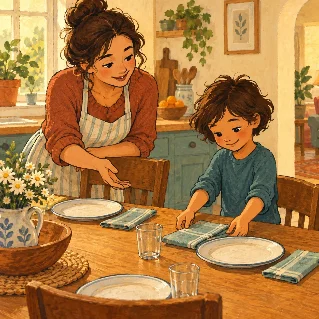
Start with one contribution that belongs to ordinary family life. The job might be putting napkins on the table, matching socks, watering a plant, or carrying unbreakable items to the counter. Choose for safety and your child’s abilities, not for an age chart that pretends every child develops on the same schedule.
Show the first step without turning the task into a performance. Say, “The napkins go beside each plate,” and do one with your child. Then wait. If the child gets stuck, offer the smallest useful prompt: “What do we need next?” or “Would you like me to hold the basket?”
Let the contribution be genuinely useful, even when it is not efficient. If a child wants to help while you cook, the safe role may be washing a vegetable or carrying a spoon. If the child cannot safely do the task, say so plainly and offer another real way to join. Participation should not require danger, exhaustion, or humiliation.
Notice the contribution without making the child responsible for your approval. “You saw that the table needed napkins and brought them over” gives information about what happened. It is different from making a sweeping judgment such as “You are the best helper.” Both warmth and correction can stay specific.
If the task falls apart, repair the moment instead of turning it into a verdict. You can say, “The water spilled. Let’s get a towel, and then we’ll decide whether you want to try again or choose a smaller job.” A child can learn responsibility without learning that mistakes threaten belonging.

Book chapter recommendation

Read Chapter 4, the Maya-parenting chapter on teaching children to help voluntarily, in Michaeleen Doucleff’s Hunt, Gather, Parent. The publisher’s reading-group guide points readers to that chapter when asking how children learn through family contribution and how a chore chart can sometimes get in the way. Treat the book as a practical cultural perspective, not as a universal experiment or a replacement for research. 4
This episode is general education, not medical advice. Families differ, and a child’s need for accommodations or support is not a failure of responsibility.

This story was produced automatically by a channel. One sentence is all it takes for Neodrop to keep producing for you.

Related content

More from this channel