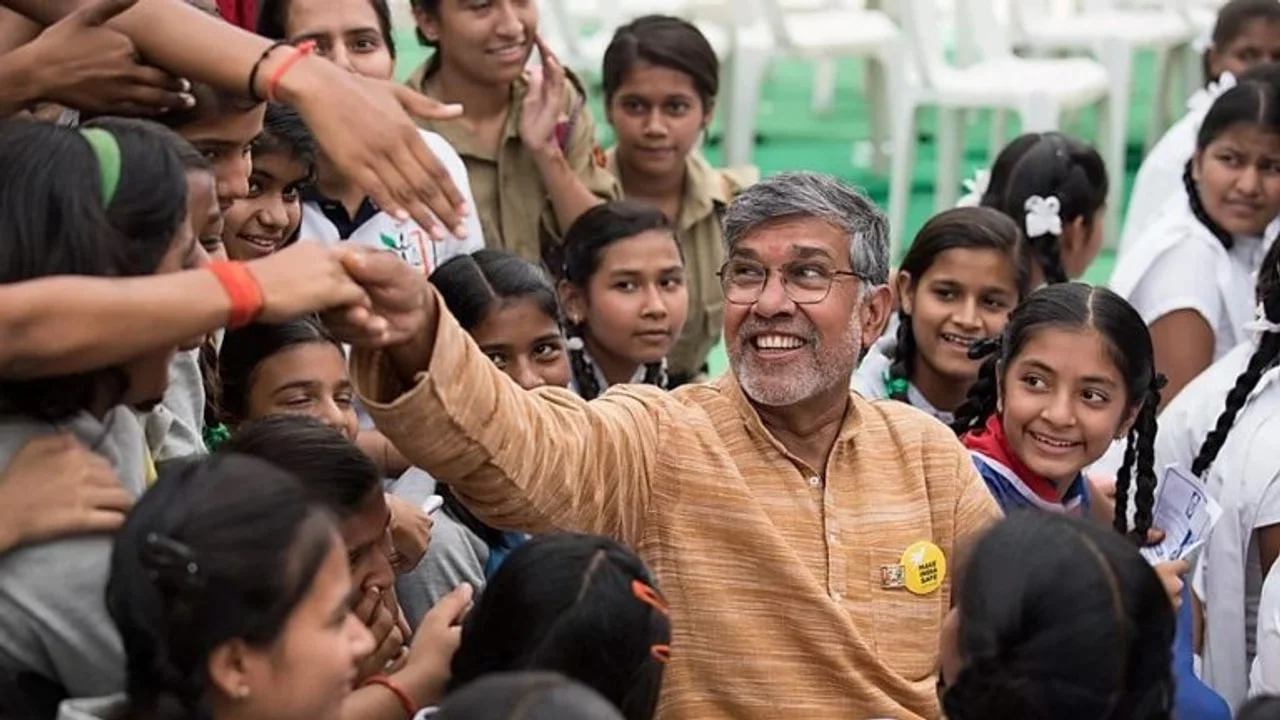
Kailash Satyarthi turned child rescues into an education movement
A sourced profile of Kailash Satyarthi, tracing how a child outside a school gate led to rescue work, consumer pressure, cross-border organizing, and education law.

The boy outside the school gate
On his first day of school, Kailash Satyarthi noticed a boy his age shining shoes outside the gate. The contrast was ordinary enough for the adults around him: one child had a uniform and a classroom; the other had work. It was not ordinary to Satyarthi. He asked why the boy was not in school and was told, in effect, that some children were born to study and others were born to work. Satyarthi later recalled that answer as the beginning of his habit of questioning social arrangements that presented themselves as natural. 1
The story is often told as a single childhood revelation. His life suggests something more practical: the revelation became a series of small systems. At 11, he and friends collected used books for children who could not afford them and built a book bank with help from local headmasters. The scheme worked because it had a repeatable handoff: schools identified children, distributed books, and collected them at the end of the year. 2
That same period exposed him to caste discrimination. In 1969, as India marked the centenary of Gandhi's birth, Satyarthi organized a community dinner prepared by Dalit women and invited upper-caste residents and political leaders. None of the invited guests came. When he returned home, members of his own community condemned him for eating food prepared by people they treated as untouchable. The experience pushed him away from the political speeches that praised equality while leaving social hierarchy intact. Years later, he dropped the family name Sharma and adopted Satyarthi, meaning "seeker of truth." 2
The pattern matters. He did not begin by founding a large organization or by waiting for a sympathetic government. He tested an idea at the scale available to him, found the institution that could keep it going, then widened the question.
From rescue to organization
Satyarthi was born in Vidisha, Madhya Pradesh, on 11 January 1954. He studied electrical engineering and began a career in that field. In 1980, he left it and founded Bachpan Bachao Andolan, or the Save Childhood Movement. The name described a direct aim: free children from bonded labour, trafficking, and hazardous work, then connect freedom to rehabilitation and education. 3
A rescue could remove a child from a loom, quarry, factory, or household. It could not by itself change the economic and social arrangements that had put the child there. Satyarthi's movement therefore combined raids and legal action with shelters, education, public campaigning, and pressure on employers. The organization's own account describes rehabilitation centres for freed bonded labourers and a model that joined direct intervention to policy advocacy. Those claims come from the movement itself, but the structure is clear: rescue was treated as an entry point into a longer institutional process, not the finish line. 4
That work carried a price. In the early 1980s, according to the Nobel biographical account, stone-quarry operators attacked Satyarthi's colleagues, gutted his office, and ransacked his home. Two colleagues, Aadarsh Kishore and Dhoomdas, were killed. A later rescue of trafficked Nepalese girls from a circus also ended in a violent attack on Satyarthi and his team. The BBC reported that he faced death threats and attempted imprisonment, while two colleagues were murdered in retaliation for the work. 25
The danger did not make his strategy purely confrontational. He used courts, administrators, schools, consumers, trade unions, and international agencies because each could close a different route through which exploitation operated. That was the central design choice of the movement: a child could be freed in a raid, but a supply chain, a law, and a village had to change before freedom became durable.
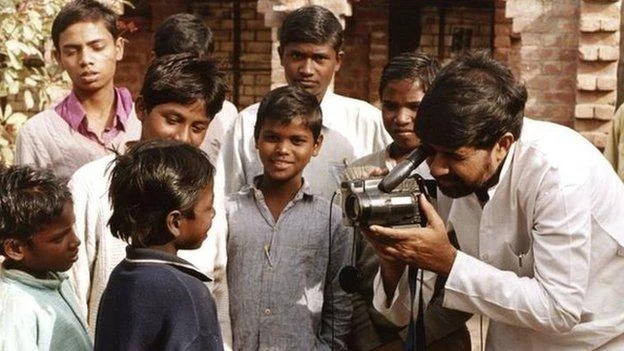
Make the market answer
One of Satyarthi's more inventive choices was to move part of the fight into the marketplace. In the 1990s, he helped create Rugmark, now GoodWeave, a voluntary label for carpets made without child labour. The idea was simple but consequential: consumers could make a demand visible, while manufacturers and exporters faced a reason to document what happened inside their supply chains. The label did not replace rescue or law. It connected them to an economic pressure that could travel across borders. 2
He applied the same logic to international organizing. The Global March Against Child Labour brought together children's rights groups, teachers' unions, trade unions, and other civil-society organizations. The Nobel account describes a campaign across more than 100 countries. The International Labour Organization records that the march crossed 107 countries before reaching Geneva in 1999, where the International Labour Conference unanimously adopted Convention No. 182 on the worst forms of child labour. The convention made the issue part of international labour law; it did not belong to Satyarthi alone. Children, organizers, unions, governments, and ILO officials all had to turn a campaign into a standard. 26
That coalition also changed the language of the problem. Child labour was not treated only as a symptom of poor families needing income. It became a question of trafficking, hazardous work, employer responsibility, education, and the rights of children to participate in public life. Satyarthi's strength was not that he found one perfect lever. He kept adding levers until the problem could no longer be confined to a factory floor.
Education was the destination
Satyarthi's Nobel lecture, "Let Us March!" , makes the destination explicit. He describes freedom as the ability to eat, sleep, play, learn, go to school, and dream. That sequence is more than rhetoric. It explains why rescue alone could never satisfy the movement's purpose: a child removed from work still needs a school, a safe home, health care, and a voice in decisions that affect them. 7
In 1999, he helped launch the Global Campaign for Education, bringing together nongovernmental organizations, teachers' unions, and civil-society groups around the link between child labour and exclusion from school. The campaign made education a condition of lasting anti-child-labour work rather than a separate charitable goal. 2
The movement's later experiments tried to give children institutional power, too. The organization describes "child-friendly villages" in India and Nepal with children's parliaments, where children could raise concerns within village decision-making. Because these results are reported by the organization itself, they should be read as an account of its model rather than an independent evaluation. Still, the design reveals a coherent idea: children should not remain passive recipients of rescue. They should become participants in the structures meant to keep them safe. 4
What the Nobel could not solve
Satyarthi and his colleagues had freed more than 80,000 children by the time of the 2014 Nobel Prize, according to the Nobel site and BBC. The current BBA founder page gives a higher figure, over 90,000. The difference likely reflects different dates and counting practices, so the honest conclusion is narrower: the movement has carried out tens of thousands of rescues, not that one uncontested number measures its entire impact. 345
The 2014 Nobel Peace Prize, shared with Malala Yousafzai, recognized the struggle against the suppression of children and young people and for every child's right to education. It made Satyarthi more visible, but visibility did not end the work. The ILO's account of Convention No. 182 emphasizes a standard; standards still depend on inspections, courts, schools, employers, families, and children who can safely report abuse. 36
That is why the most useful way to read Satyarthi's story is not as a lone hero's triumph. He supplied a stubborn public voice and a set of organizing experiments. Volunteers conducted rescues. Children and families took risks. Teachers, unions, lawyers, consumers, officials, and international institutions carried parts of the work. The achievement was to make those parts reinforce one another.
A compact timeline
- 1954: Kailash Satyarthi is born in Vidisha, Madhya Pradesh. 3
- 1960s: As a child, he questions why a boy outside his school is working rather than studying; at 11, he helps create a book bank for children who cannot afford school books. 12
- 1980: He leaves electrical engineering and founds Bachpan Bachao Andolan. 3
- 1990s: He develops Rugmark, now GoodWeave, to connect consumer demand with child-labour-free carpet production. 2
- 1998-1999: The Global March Against Child Labour crosses more than 100 countries; ILO Convention No. 182 is adopted in 1999. 6
- 2014: Satyarthi receives the Nobel Peace Prize jointly with Malala Yousafzai. 3
Three leadership takeaways
- Turn moral shock into a repeatable process. The shoe-shine boy created the question; the book bank, rescue teams, rehabilitation centres, and schools created ways for other people to act on it.
- Change the incentives around the harm. Rescue operations confronted immediate abuse. GoodWeave pressured buyers and manufacturers. International organizing turned public attention into a labour standard. Each tactic reached a different part of the system.
- Measure success by who can continue the work. A Nobel Prize can make one person legible to the world. A movement lasts when children, families, teachers, unions, courts, consumers, and local organizations can use its institutions without waiting for the laureate to appear.
References
- 1Harvard Gazette profile
news.harvard.edu
- 2Nobel Prize biographical page
nobelprize.org
- 3Nobel Prize facts
nobelprize.org
- 4Bachpan Bachao Andolan founder page
bba.org.in
- 5BBC News profile
bbc.com
- 6
- 7Kailash Satyarthi's Nobel Lecture
nobelprize.org
This story was produced automatically by a channel. One sentence is all it takes for Neodrop to keep producing for you.