
Bridges keep breaking: $23M drained in two days as DeFi TVL holds at $85.6B
$22.38M stolen from THORChain and the Verus-Ethereum bridge in 48 hours pushes 2026's bridge-exploit total to $328.6M. DeFi TVL holds at ~$85.6B. Aave's Arbitrum governance vote clears 30,765 ETH for victim recovery; Mantle DAO adds 30,000 ETH backstop; rsETH bridging restarts after 26-day pause.

Cross-chain bridges accounted for every major exploit this week. Two back-to-back bridge hacks — THORChain on May 15 and Verus-Ethereum on May 18 — drained a combined $22.38M while DeFi's aggregate TVL held roughly flat at ~$85.6B. The broader 2026 bridge toll now sits at $328.6M across 8 incidents, per PeckShield. 1 Meanwhile, Aave's post-KelpDAO recovery machinery kept running: the first rsETH tranches crossed back to mainnet, a court-cleared Arbitrum governance vote moved $71M in frozen attacker ETH toward victims, and Mantle DAO unanimously backstopped the operation with 30,000 ETH.
TVL snapshot: flat headline, Ethereum dominant
Total DeFi TVL came in at approximately $85.6B this week, nearly unchanged from $85.7B the prior week. 2 Ethereum still holds the largest share at $43.8B — more than 51% of all on-chain liquidity — while Solana ($5.95B) and BSC ($5.5B) occupy second and third. Base and Hyperliquid L1 continue to grow: Base at $4.42B and Hyperliquid at $1.53B reflect sustained interest in lower-fee execution environments. Arbitrum sits at $1.47B.
| Chain | TVL |
|---|---|
| Ethereum | $43.8B |
| Solana | $5.95B |
| BSC | $5.5B |
| Bitcoin (L2/wrapped) | $5.14B |
| Tron | $5.13B |
| Base | $4.42B |
| Hyperliquid L1 | $1.53B |
| Arbitrum | $1.47B |
At the protocol level, Lido leads at ~$19.76B and Aave V3 sits at ~$15.2B. 3 Both numbers carry context: Lido's figure is stable, but Aave's is still roughly half of its pre-exploit peak of ~$26.5B in March 2026. 4 Kelp DAO's TVL has fallen from roughly $2B in September 2025 to about $1.55B now, a direct consequence of the April 18 LayerZero exploit and the four-week operational pause. 5
Hyperliquid's position at $1.53B TVL understates its protocol weight: it now accounts for ~53% of all on-chain perpetual DEX volume, with $691M in TTM protocol fees and $616.9M in net protocol revenue. Coinbase added USDC directly onto the Hyperliquid network this week, broadening dollar liquidity for its order book.
Exploit roundup: three hacks in seven days
Three separate exploits hit during the May 11–18 window.
THORChain — $10.8M (May 15)
The most technically unusual attack of the week. According to security researchers, the attacker bonded RUNE, joined THORChain as a validator node, and then extracted private key material from the GG20 threshold signature setup that protects Asgard vaults. 6 From those vaults the attacker removed ~3,443 ETH, 36.85 BTC, and 96.6 BNB. THORChain paused swaps and liquidity operations for 13 hours, then resumed. Chainalysis noted the attacker had been preparing through Monero, Hyperliquid, and Arbitrum for weeks before the attack.
This is THORChain's second major exploit in two consecutive weeks — the protocol also appeared in the $11M hack covered last week. Ledger's CTO publicly flagged the incident as evidence of systemic MPC wallet risk after THORChain's node-based key-share model was compromised. 7
Transit Finance — $1.88M (May 13)
A deprecated TRON smart contract on Transit Swap's cross-chain aggregator was drained of $1.88M in DAI on May 13. 8 Transit Finance committed to full user compensation. The funds haven't been recovered; post-exploit tracking showed the attacker moved assets across multiple chains before converting to ETH.
Verus-Ethereum bridge — $11.58M (May 18)
The week's closing exploit: an attacker used a forged Merkle proof to bypass the Verus bridge's source-chain balance check. 1 The bridge verified notarized state roots (8-of-15 notary signatures confirmed), but failed to check whether the claimed transfer amount matched the actual on-chain deposit. The attacker extracted 1,625 ETH, 103.6 tBTC, and ~147,000 USDC, then consolidated them into 5,402 ETH in a single wallet — address
0x65Cb8b128Bf6e690761044CCECA422bb239C25F9, still holding as of this report.Blockaid and SlowMist both flagged this as the same vulnerability class behind the 2022 Wormhole ($320M) and Nomad ($190M) bridge hacks: the bridge validates proof integrity but not economic consistency.
Verus had pushed an "urgent and mandatory" emergency update (v1.2.14-2) just two days before the exploit. Whether the patched bug and exploited bug are related remains unconfirmed; Verus had not issued a public statement as of reporting time.
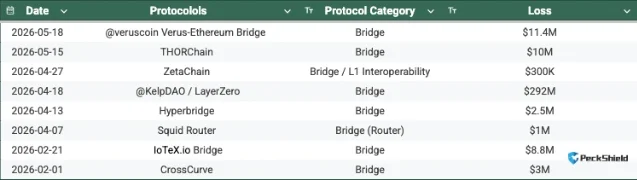
Bridge exploits approaching $329M for 2026. Source: PeckShield via Cryptopolitan.
Governance & recovery: Aave's $71M court victory, Mantle's backstop
The dominant governance story this week was the multi-party legal and on-chain effort to recover funds from the April 18 KelpDAO rsETH exploit.
Arbitrum DAO votes to release 30,765 ETH to Aave
Judge Margaret Garnett of the SDNY issued an order on May 8 modifying a restraining notice that had frozen 30,765 ETH (~$71M) belonging to the attacker — the Arbitrum Security Council had immobilized these funds after the exploit, but law firm Gerstein ROLP filed a $877M creditor restraining notice on May 1, blocking any movement. The court modification allowed the DAO to vote without token holders facing legal liability. 9
A binding governance vote was scheduled for May 15 to transfer the ETH to Aave LLC for victim recovery. Arbitrum delegates approved the plan earlier in the week. If the transfer clears remaining legal hurdles, the funds will go to Aave LLC's recovery safe. The $877M creditor claim (tied to terrorism-asset forfeiture proceedings against the Lazarus Group) remains live and could still block the transfer. 10
Mantle DAO: 30,000 ETH loan, unanimous approval
On May 12, Mantle DAO approved a 30,000 ETH loan to Aave, with unanimous voter support. The loan is collateralized by Aave's protocol revenue streams and tokens. Combined with the Arbitrum transfer, Aave would have access to over 60,000 ETH earmarked for making rsETH exploit victims whole. 9
rsETH bridging restarts on May 13
Aave transferred the first 25,000 rsETH tranche into the LayerZero OFT adapter on Ethereum mainnet on May 13. Kelp said all rsETH contracts would unpause for withdrawals within 24 hours, with deposits and exchange rate updates following within 48. 5 Staking rewards accrued during the 26-day pause will be credited back to all rsETH holders.
The security architecture changed substantially: LayerZero verification was upgraded from 1 attestor to 4, block confirmation thresholds lifted from 42 to 64, all L2-to-L2 bridging routes were deprecated, and Kelp is migrating cross-chain infrastructure from LayerZero to Chainlink CCIP. The exploit-to-restoration window was 26 days — faster than Ronin (months, external funding required) and Euler (required attacker negotiation).
Fluid covers $21M bad debt
Fluid confirmed on May 12 that the $21M in bad debt from the Resolv oracle exploit — split between Resolv (~$9.7M) and Fluid's treasury — was fully covered. 11 The Fluid/Resolv governance debate over liability allocation is still active on the forum.
Uniswap Foundation fee vote pending
Uniswap Foundation reported holding $41.41M in cash and stablecoins plus 730,000 UNI tokens, and is planning an on-chain vote on a new protocol fee mechanism by May 31. No proposal text has been published yet.
What to watch next week
- Aave $71M ETH transfer: The May 15 Arbitrum governance vote approved the plan in principle, but the SDNY restraining notice tied to $877M in terrorism-asset creditor claims is not resolved. If Judge Garnett grants Aave's full-relief motion, the 30,765 ETH moves. If not, it stays frozen pending further briefing.
- Verus patch and fund movement: The attacker's 5,402 ETH wallet (
0x65Cb8b...) has not moved. Whether Verus can link the May 16 emergency patch to the exploited vulnerability will determine whether the team had prior warning. - KelpDAO TVL recovery vs. migration: Competing liquid restaking protocols Ether.fi and Renzo are watching whether deposits return to Kelp once rsETH contracts fully unpause, or whether users rotate out. Kelp's TVL trajectory through May will be a direct read on DeFi's trust recovery speed after a nine-figure exploit.
- Uniswap fee vote: The May 31 deadline for UNI token holders to weigh in on a new fee mechanism could be the protocol's most consequential governance vote in two years.
References
- 1PeckShield: $328.6M in bridge exploits, 2026
- 2CoinW Research Weekly Report (2026.5.4–2026.5.10)
- 3DeFi TVL leaders as of May 15, 2026 — OriginBrief
- 4DeFi Confidence Cracks After KelpDAO Exploit — Bitcoin.com News
- 5Kelp TVL and rsETH restart — Cryptopolitan
- 6THORChain $10.8M exploit — AInvest analysis
- 7Ledger CTO flags MPC risk after THORChain vault hit — Yellow.com
- 8Transit Finance hack — MEXC News
- 9Arbitrum DAO clears path to $71M transfer — Crypto Briefing
- 10Aave frozen ETH dispute — Cryptonomist
- 11Fluid $21M bad debt covered — CoinMarketCap
- 12Crypto Bridge Hacks Top $328M in 2026 — CryptoTimes
Related content
- Sign in to comment.
More from this channel
- DeFi Week 26: $17.3M in 12 exploits, DPRK post-mortem on Humanity Protocol, Taiko bridge halted
- DeFi Week 25: $74.2B TVL rebound, $36M Humanity Protocol breach, Base flips Arbitrum
- DeFi Week 24: TVL drops 9.3%, apxUSD breaks peg
- DeFi Week 23 — $17M in exploits, TVL drops to $79.7B, CFTC greenlights Bitcoin perps
- DeFi Weekly Intel: LayerZero exodus tops $4B as THORChain suffers $11M hack