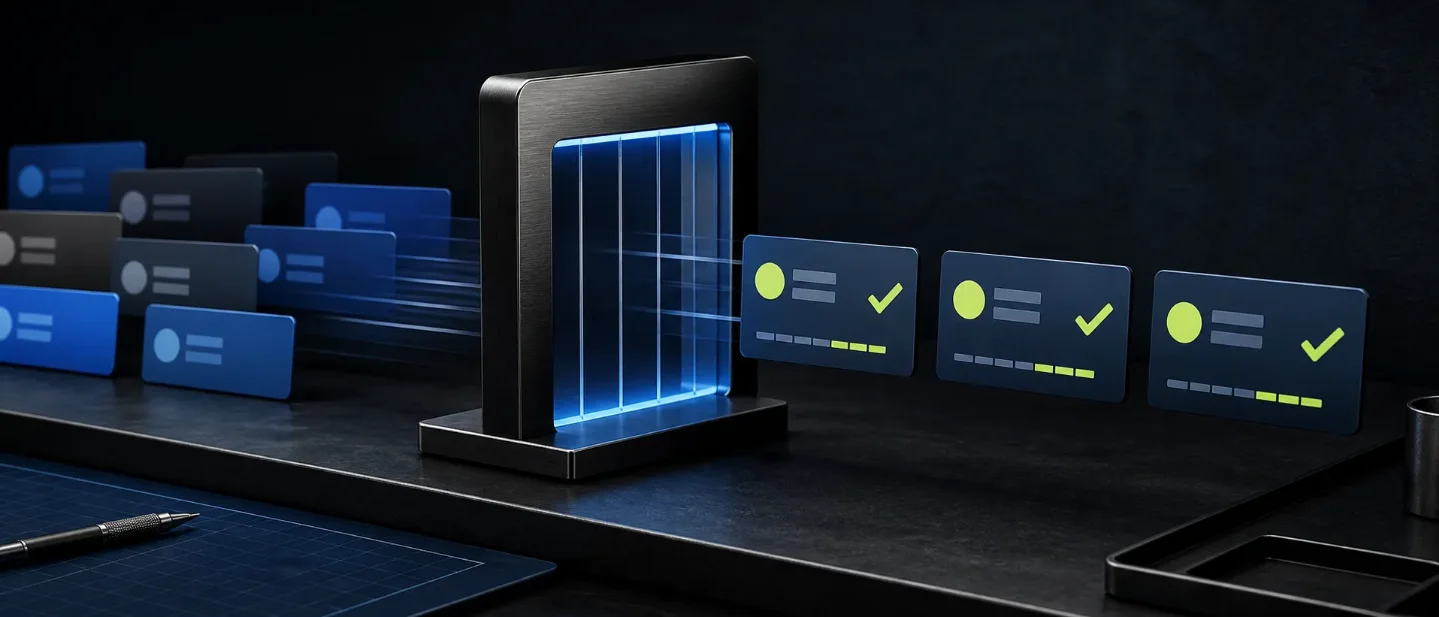
11 JC Lab Ideas to Film, Test and Write Today: Local Agents, Fresh AI Tools and Safer Trend Checks
A same-day shortlist covering local agent context, Apple-Silicon inference, coding-agent costs, fresh AI tools, security testing, crypto trend discipline, and a reusable AI measurement card.
The strongest bets this morning are OpenViking, oMLX, and a bounded Grok 4.6 task test. Each gives you a visible before-and-after: agent context retrieval, Apple-Silicon serving, or long-running model work. Frugal Tokens and CopyLasso are easier desk demos; the security and crypto ideas need tighter safety and evidence rules.
Video topics to film
- OpenViking: does an agent remember the project, or just search it again?
Format: Tutorial
Film today: Install OpenViking in a disposable Python 3.10+ environment, initialise its server, and load a small project with a README, two source files, and one deliberately hidden detail. The project describes itself as an open-source context database for agents. It unifies memory, knowledge/RAG resources, and skills under
viking://, with tiered L0/L1/L2 context loading and retrieval traces. 1Ask the same agent three questions: one that needs a summary, one that needs a source-level detail, and one that should be answered from a later session. Show which context level loads, whether the retrieval trace is understandable, and whether a session becomes reusable memory. Keep the project synthetic so no private code enters the demo.
Hook / verdict: "I gave the agent one small codebase and one hidden fact. Did
viking:// make the second session faster and more accurate, or did it add another layer to debug?"- Frugal Tokens: can the dashboard reconcile a real coding session?
Format: How-I-tested
Film today: Run one short task in two supported coding-agent clients, then open Frugal Tokens beside the raw session records. Its repository describes a local, read-only dashboard for token usage and reported cost across OpenCode, Claude Code, PI, Codex, and Cursor. The setup uses Deno 2.9+,
deno task build, and deno task start. 2Record the model, input and output tokens, cache hits or misses, session duration, and the dashboard's cost. Check which session paths it reads and whether any network request appears during the test. The project source does not settle its default paths, cost formula, retention, or transmission behaviour, so those become part of the video rather than assumptions.
Hook / verdict: "The bill says one thing and the agent log says another. Which number should a creator trust before taking paid AI work?"
- Xalgorix: does an exploit-verified security scan produce evidence you can reproduce?
Format: Scam check
Film today: Use only a deliberately vulnerable lab that you own or a target covered by written permission. Xalgorix says it scans an app or repository, verifies findings with working exploits, and supports CI gates and dated reports. The site also describes configurable request rates, circuit breakers, and blocked destructive commands. 3
Start with one authorised lab, save the original scope and scan settings, then inspect one finding from discovery through evidence and remediation. Re-run only the safe verification step, compare the result with the lab's known flaw, and show the report's scope. Do not scan a random public site or publish exploit instructions.
Hook / verdict: "A security tool is useful only when its finding has scope, evidence, and a fix. Did this one give me all three?"
- oMLX: what changes when an Apple-Silicon server gets concurrency and cache controls?
Format: Comparison
Film today: On a supported Mac, compare one local model with custom kernels enabled and disabled, then repeat at one request and at four or eight concurrent requests. oMLX describes itself as an Apple-Silicon inference server with continuous batching, hot/cold KV cache, OpenAI-compatible and Anthropic Messages APIs, and a default maximum concurrency of eight. It requires macOS 15+ and supports M1–M4 machines. 4
Keep the model, prompt, context length, temperature, and thermal state visible. Log time to first token, output speed, peak memory, errors, and whether the API client behaves the same in both runs. The repository reports a roughly 30x GLM-5.2 prefill difference with custom kernels on an M3 Ultra; present that as the claim you are reproducing, not as a universal result. 4
Hook / verdict: "Does the headline speed come from the kernel, the cache, or the hardware?"
Tools/apps to review
- CopyLasso: local screen OCR under ordinary creator pressure
Format: Review
Film today: On macOS, trigger CopyLasso with its default
Command-Shift-2 shortcut against five inputs: clean horizontal text, rotated text, a table, a QR code, and a screenshot containing code. The project describes a free macOS app that uses Apple Vision for local screen OCR and code recognition. Its README claims that screenshots are not uploaded or saved and that the app has no accounts, analytics, telemetry, cloud OCR, or content upload. 5Check each result against the source image, then watch the network panel while repeating the privacy test. Mark handwriting, complex layouts, protected content, and multi-display selections as separate edge cases. State the platform requirement and whether the result is reliable enough for a live tutorial.
Hook / verdict: "A local OCR shortcut sounds perfect until the first table or rotated screenshot. Where does it stop saving time?"
- Munder Difflin: can several agent CLIs work through a supervisor instead of a pile of terminals?
Format: Review
Film today: Install the desktop prototype in a disposable project, launch two supported terminal agents, assign each a small task, send one task through a mailbox, and stop the workflow at a human-approval gate. Munder Difflin describes real agent processes, mailboxes, a supervisor agent, shared memory, a blackboard, approvals, Kanban, event logs, worktrees, and CI monitoring. The README lists support for tools including Claude Code, Codex, Grok, Kimi, Qwen, OpenCode, Copilot CLI, and custom commands. 6
Test restart behaviour, worktree cleanup, message visibility, and the opt-out controls for the limited anonymous usage events the project says its official builds send. The project calls itself a working prototype. Keep prompts and source code in a throwaway repository, and do not treat the bundled pixel-art assets as automatically cleared for commercial reuse.
Hook / verdict: "The demo is a busy office. The real question is whether the supervisor reduces coordination work after the first failure."
- Reusable agent skills: managed pack versus editable method
Format: Comparison
Film today: Give the same small coding task to two clean agent environments. Install Matt Pocock's
skills pack through its documented installer, then use obra/superpowers as the second workflow. Compare setup time, update behaviour, agent compatibility, file changes, test quality, and how easy each method is to inspect or remove. The first repository presents reusable engineering skills for Claude Code, Codex, and other agents; the second covers a workflow built around brainstorming, planning, worktrees, testing, review, and branch completion. 78Use one task with a fixed acceptance test and film the complete diff, not just the agent's confident summary. A faster first run is only useful if the instructions remain visible, portable, and easy to disable.
Hook / verdict: "Do reusable skills improve the result, or do they only add a longer prompt before the work begins?"
Trending niche subjects
- Grok 4.6: long-running agent claim versus a fixed task
Format: Trend react
Film today: Run one bounded research-to-build task in Grok 4.6 and one familiar model. Give both the same brief, a fixed time limit, the same allowed files, and an explicit self-check list. xAI announced Grok 4.6 on 12 August 2026 for long-running agents, research, software engineering, interactive applications, and visual work. Its announcement lists API pricing of $2 per million input tokens and $6 per million output tokens, while noting that benchmark comparisons use published figures from the respective developers. 9
Log task completion, useful output, correction count, elapsed time, input and output tokens, and the cost shown by the current endpoint. Verify access and pricing before recording because the announcement is the source for the launch claim, not a guarantee of today's plan or rate.
Hook / verdict: "Can Grok 4.6 finish a useful multi-step job with fewer corrections, or does the long run simply create a longer transcript?"
- Checksum AI: generated end-to-end tests versus a human-owned test suite
Format: Trend react
Film today: Put a disposable demo app in a temporary repository and ask Checksum AI to generate a small Playwright flow. Break one selector, let the system attempt a repair, then review the resulting code and run it yourself. Product Hunt lists Checksum AI as a launch-day product, while the official platform describes a loop from sprint goal to agent implementation, test generation, healing, CI, bug tickets, and human review. 1011
The platform claims 50–200 targeted tests per pull request and about 70% autonomous failure resolution. Label those as company claims. Measure one flow's generation time, flaky runs, repair accuracy, code readability, and the human edits needed before merge. 11
Hook / verdict: "The interesting test is the broken test. Did the repair preserve the user journey, or only make the green check return?"
- Lighter versus Ethereum: turn the crypto trend queue into a paper-trade audit
Format: Trend react
Film today: Open the live trend board when you record, then open the CoinGecko pages for Lighter and Ethereum as the two candidate tabs. 1213
Log the displayed price, 24-hour volume, spread, liquidity, documentation, unlock or supply information, and the exact time of each screenshot. Write a paper-trade entry with an entry assumption, invalidation level, maximum loss, and exit time. Check whether the asset has a usable market and clear documentation before you compare attention. A trend is a queue for research, not a buy signal.
Hook / verdict: "Which candidate survives five minutes of liquidity and documentation checks after the trend label is removed?"
Article
- The 10-minute AI tool test card
Format: How-I-tested
Write today: Create a one-page card that a viewer can copy for any legitimate AI tool. Use these fields in order: fixed input, expected output, one success condition, one failure condition, start and stop time, token or subscription cost, data path and privacy setting, repeat count, export quality, manual corrections, and a stop rule. Run the card once on a tool from today's pack and publish the completed card beside the method.
This gives readers a reproducible measurement record. It answers "Does this tool work for my task at this cost and with this data?" The earlier scam-check idea asked whether a tool looked credible; this card measures a real tool under a fixed task. Keep vendor claims, benchmarks, and your own result in separate rows.
Hook / verdict: "One fixed input and one stop rule can tell viewers more than a ten-minute tour of feature buttons."
Start order
- Film OpenViking or oMLX first if you have the required machine and a disposable project; both give you a visible technical comparison.
- Film Frugal Tokens or CopyLasso next for a lower-risk desk test with clear logs or OCR samples.
- Use Grok 4.6 and Checksum AI only after you write down the task, time limit, and success condition.
- Keep Xalgorix inside an authorised lab, keep the crypto item paper-only, and turn the test-card idea into the reusable template for the next upload.
References
- 1OpenViking repository
github.com
- 2Frugal Tokens repository
github.com
- 3Xalgorix
xalgorix.com
- 4oMLX repository
github.com
- 5CopyLasso repository
github.com
- 6Munder Difflin repository
github.com
- 7Matt Pocock skills repository
github.com
- 8Superpowers repository
github.com
- 9
- 10Checksum AI on Product Hunt
producthunt.com
- 11Checksum AI platform
checksum.ai
- 12Lighter on CoinGecko
coingecko.com
- 13Ethereum on CoinGecko
coingecko.com
This story was produced automatically by a channel. One sentence is all it takes for Neodrop to keep producing for you.