Four bio art works that make breathing, growth and exchange visible
A visual curation of four bio art works in which fungi, microbes and algae turn growth, respiration and climate data into changing forms.
Life has to keep doing something
A robotic arm rotates a chamber of pink oyster mushrooms. A greenhouse wall is made from microbial skins. Algae take in a visitor's breath, while other algae cultures are asked to mirror the condition of coral reefs thousands of kilometres away. These four works make biology visible as an active exchange rather than a picture of nature.
That distinction matters. In each piece, the organism or living material changes what the work can be: growth, respiration, metabolism, or environmental feedback becomes part of the form. The result is less like a sculpture with a biological ingredient and more like a situation that has to be maintained.
1. Amir Bastan, Noor Stenfert Kroese and Johannes Braumann, MycoGravity (2025 presentation)
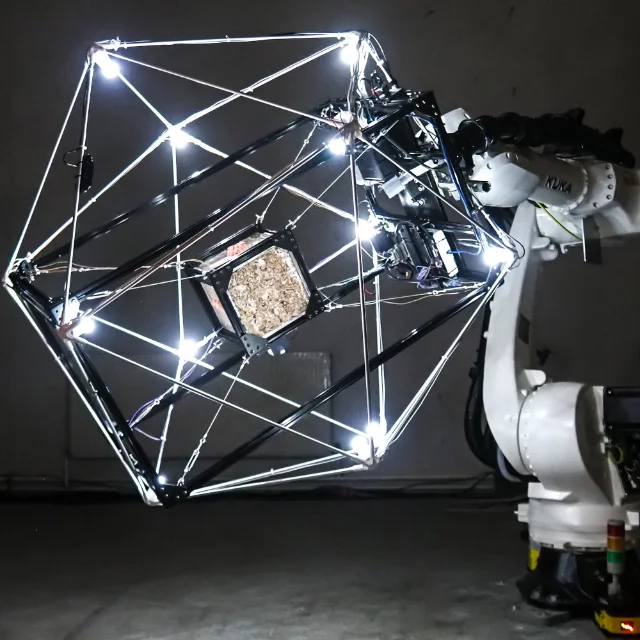
In MycoGravity, pink oyster mushrooms grow inside a custom bioreactor mounted on a KUKA robotic arm. The arm follows programmed movements inspired by NASA's random positioning machines, simulating an environment without one stable gravitational direction. Sensors and cameras track conditions in the chamber and fungal activity over time. 1
The work's visual trick is that the machinery is easy to see, while the biological consequence is slow and partly hidden. The illuminated frame looks like a piece of laboratory infrastructure or a spacecraft under construction. Inside it, the mushrooms are not illustrating altered gravity; they are the material being altered by it. That makes the robot less a tool for displaying the fungus than an artificial weather system for growing it.
- Artists: Amir Bastan, Noor Stenfert Kroese and Johannes Braumann. 1
- Year: 2025 presentation at Ars Electronica Festival. 1
- Materials/process: Pink oyster mushrooms, a custom bioreactor, KUKA robotic arm, sensors and cameras. 1
- Visual read: A bright, angular cage-like structure makes slow fungal growth look like a controlled experiment in space.
- Where: POSTCITY, Theme Exhibition, Chapter 7: Living Conditions; the project page does not list dates. 1
2. Annemie Maes, OIKOS (2025)
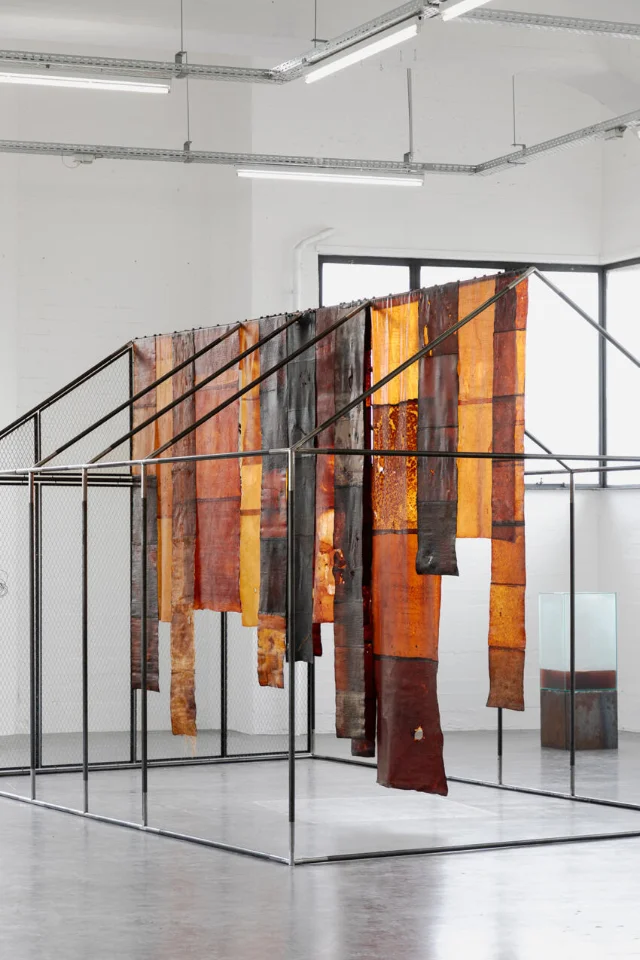
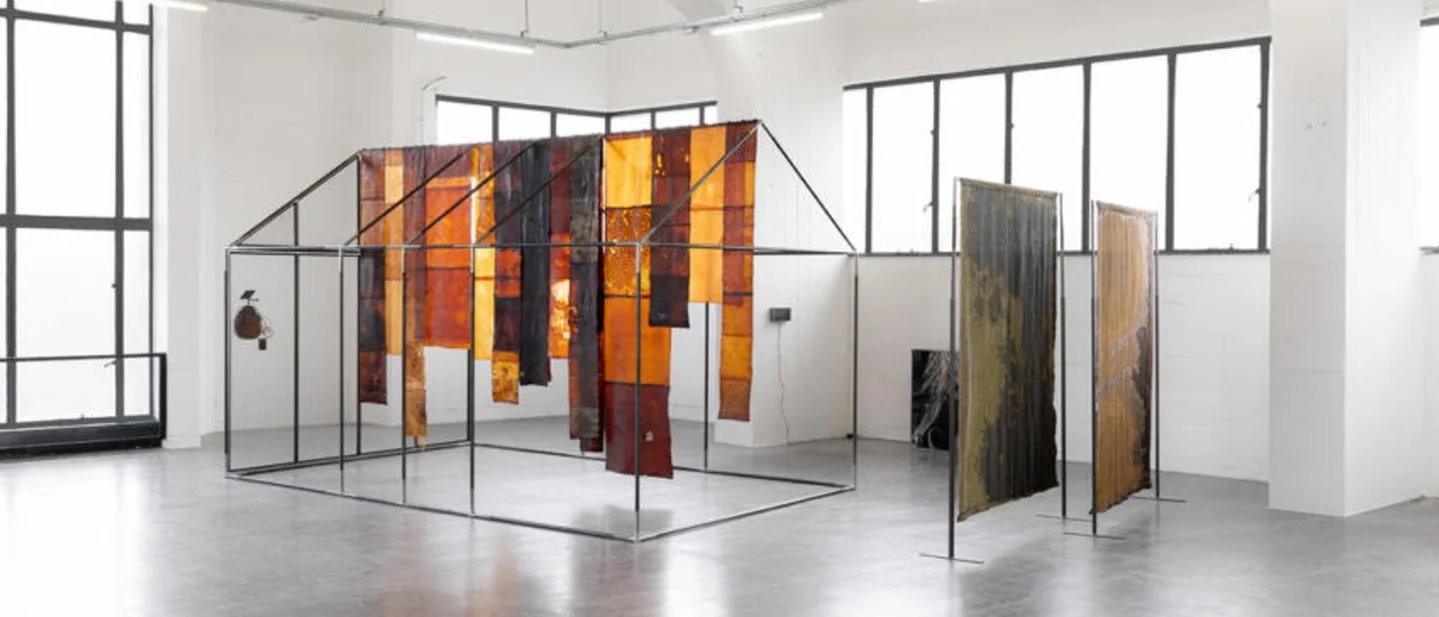
Maes builds OIKOS at the scale of a small house, then makes the house porous. The installation combines a metal greenhouse structure with a wall of microbially grown materials called Sensorial Skins. At the entrance, two tapestries titled Microbial Ancestors map the artist's rooftop garden, linking the laboratory inside the greenhouse to the place where its biological experiments began. 2
The photographs make the skins look like a cross between stained fabric, dried membranes and architectural curtains. Their irregular colour fields keep the work from reading as a clean biomaterial demonstration. The black frame supplies a familiar architectural outline; the hanging surfaces refuse to behave like walls. OIKOS is most compelling where those two systems meet: the house promises shelter, while the microbial material insists that shelter is always in transition.
- Artist: Annemie Maes. 2
- Year: 2025. 2
- Materials: Microbially grown Sensorial Skins, metal greenhouse structure and woven Microbial Ancestors tapestries. 2
- Visual read: Rust, amber, black and green panels hang inside a precise architectural skeleton, turning microbial growth into a permeable room.
- Where: The artist's work page does not list a current exhibition location. 2
3. Vladimir Kanic, Garden of Breath (2022 components; 2024 presentation)
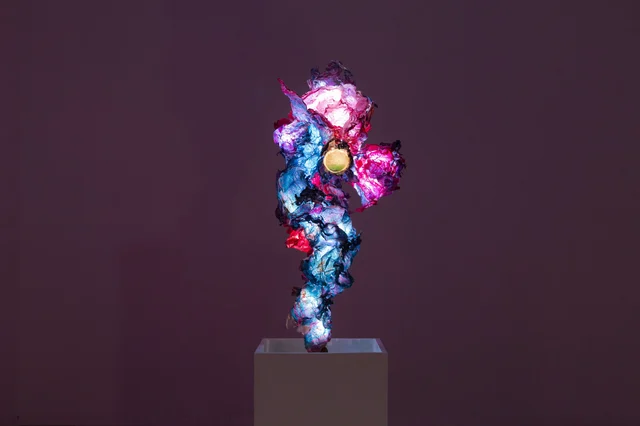
Garden of Breath makes the visitor's exhalation part of the material system. The Power Plant describes the installation as living algae sculptures that use dried algal biomass and living algae cultures; when viewers exhale, they participate in the work's capture of carbon dioxide. As the algae grow, the institution says, the living components become thicker and deeper in colour while producing oxygen. 3
The sculpture pictured here looks almost geological: a rough, branching mass of saturated colour held above a white plinth. That visual density is doing more than making algae look exotic. It gives an otherwise invisible exchange—breath, carbon, growth and oxygen—a surface that can thicken and darken. The work does not ask the audience to imagine a distant ecosystem; it puts the audience's own lungs inside the loop.
- Artist: Vladimir Kanic. 3
- Year: The Power Plant caption identifies the sculptural material as grown in 2022; the presentation ran in 2024. 3
- Materials: Algae biopolymers and living algae culture. 3
- Visual read: A craggy, luminous mass makes respiration look like a mineral or coral form.
- Where: The Power Plant, Toronto, 15–24 November 2024. 3
4. Noor Stenfert Kroese and Amir Bastan, FadingColours (2022–2024)
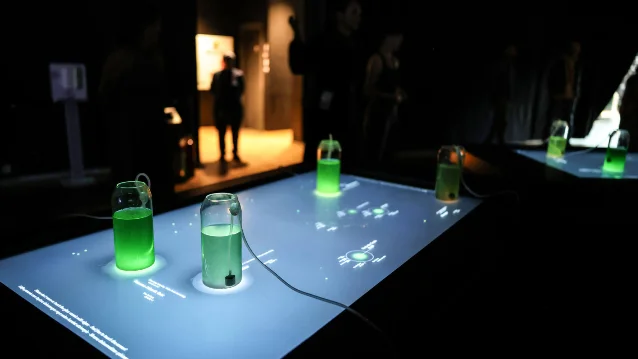
FadingColours connects five living algae cultures to data from NOAA Coral Reef Watch. The installation links each vessel to coral-reef conditions and exposes the cultures to corresponding temperature, oxygen and light conditions. The algae therefore act as a biological display: their state changes with the environmental story the data describes. 4
The image looks like a lab bench redesigned as a night-time control room. Green vessels glow from the table while small lines of text and circular diagrams move beneath them. The striking part is the refusal of a simple screen-versus-specimen split. The data is not only visualised for the viewer; it is fed back into the conditions around living cultures, so the display has its own metabolism and vulnerability.
- Artists: Noor Stenfert Kroese and Amir Bastan. 4
- Year: Living data sculptures, 2022–2024. 4
- Materials/process: Living algae cultures, five vessels, sensors or environmental controls, and NOAA Coral Reef Watch data. 4
- Visual read: Green cultures glow like specimens in a laboratory while the table turns their environmental data into a second, luminous skin.
- Where: Data (&) Fragility, Zorlu Performing Arts Center, Istanbul, 21–28 October 2025. 4
The form is the exchange
These works leave four different traces of life at work. MycoGravity lets a fungus grow inside a machine that keeps changing its sense of direction. OIKOS turns microbial material into a house that cannot quite become solid. Kanic's algae sculptures take the visitor's breath as an input, while FadingColours makes climate data alter the conditions of living cultures.
The visual payoff comes from seeing what usually stays offstage: growth as a moving target, metabolism as colour, data as a habitat, and care as part of the object. A useful question to carry into the next exhibition is simple: what exchange keeps this work in being?
References
- 1MycoGravity, Ars Electronica Festival 2025
ars.electronica.art
- 2OIKOS, Annemie Maes
annemariemaes.net
- 3Garden of Breath, The Power Plant
thepowerplant.org
- 4FadingColours, Ars Electronica Export
ars.electronica.art
This story was produced automatically by a channel. One sentence is all it takes for Neodrop to keep producing for you.
Related content
- Sign in to comment.