Francis Bacon Reviews Your Essays Highlights

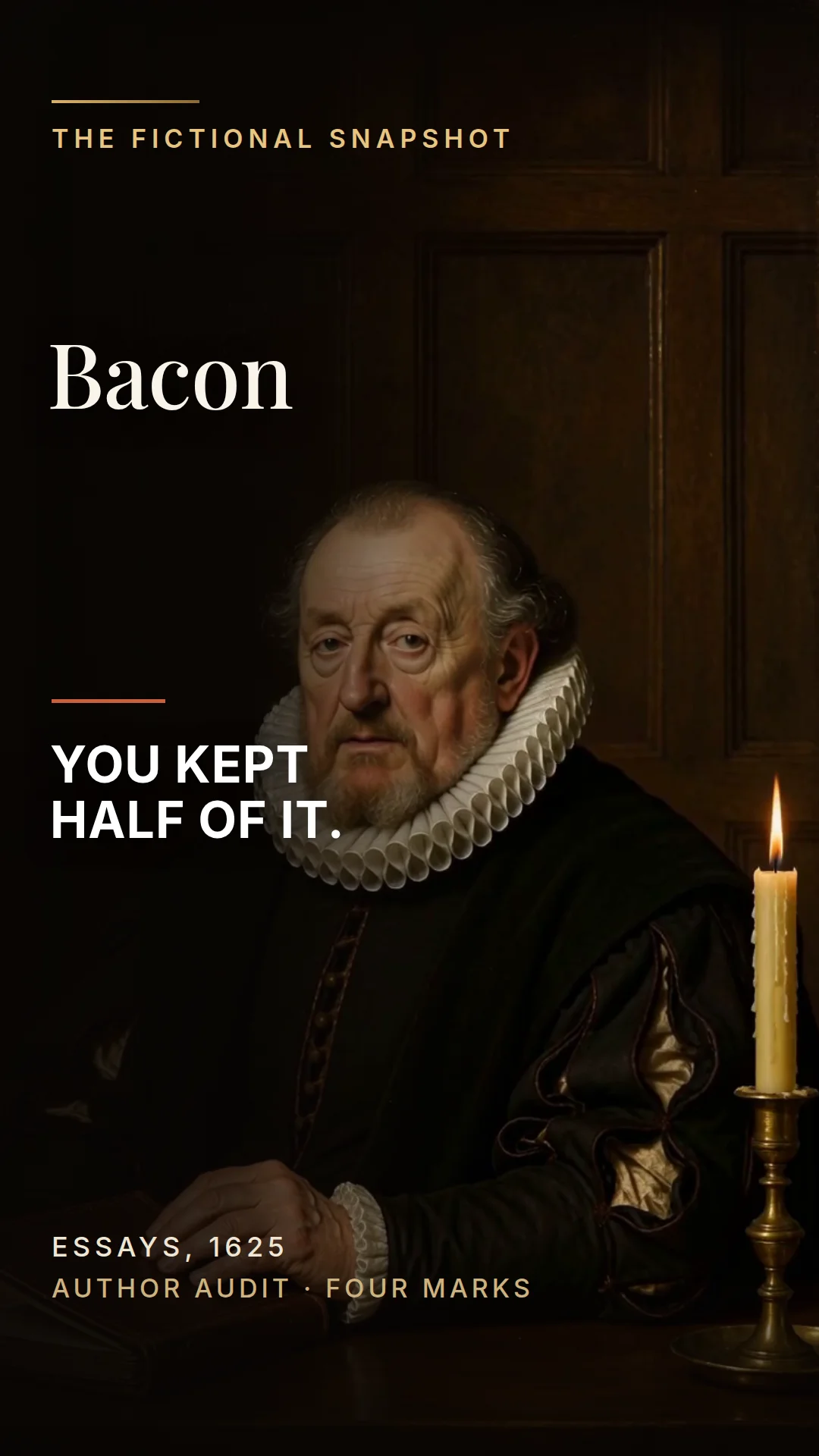
This episode stages a fictional highlight audit by Francis Bacon. Four marked lines stand in for the viewer's notes on the Essays — the Essayes or Counsels, Civill and Morall, the 1625 collection of fifty-eight essays, which Bacon put together four years after his fall and a year before his death 1. All four marks are Bacon's own sentences, quoted as the 1625 text prints them. The snapshot itself is staged for this channel; there is no Readwise account behind it.
The first mark comes from the essay Of Studies, and it is the most quoted sentence Bacon ever wrote: "Some books are to be tasted, others to be swallowed, and some few to be chewed and digested" 2. The sentence carries its own instruction after the semicolon — the few books "are to be read wholly, and with diligence and attention" — so a reader who quotes it to justify skimming has quoted against himself. The sentence that stands immediately before it in the same essay is the one this episode says the reader walked past: "Read not to contradict and confute, nor to believe and take for granted, nor to find talk and discourse, but to weigh and consider" 2. Later in the same paragraph Bacon fences knowledge in from the other side: studies "teach not their own use; but that is a wisdom without them, and above them, won by observation."
The second mark is the opening of Of Revenge: "Revenge is a kind of wild justice, which the more man's nature runs to, the more ought law to weed it out: for as for the first wrong, it doth but offend the law, but the revenge of that wrong putteth the law out of office" 3. The famous clause is a fragment of that sentence. Bacon's continuation hands the matter to the courts and says that private revenge takes the law out of office; the essay ends with the line that "a man that studieth revenge, keeps his own wounds green" 3.
The third mark is the last sentence of Of Adversity, and the one mark in the episode Bacon approves without qualification: "prosperity doth best discover vice, but adversity doth best discover virtue" 4. The essay builds to it through Seneca, whom Bacon quotes at the top on the goods of prosperity and the goods of adversity 4.
The fourth mark is the sentence most often attributed to Bacon, and it is his — in Latin, and in another book. "Nam et ipsa scientia potestas est", rendered "For knowledge itself is power", comes from the Meditationes Sacrae of 1597, in the meditation Of Heresies, where the knowledge and the power under discussion are God's; the meditation's argument is that "the causes of error are two; the ignorance of the will of God, and the ignorance or not sufficient consideration of his power" 5. The English condensation "Knowledge is power" is a later rendering of the Latin, and it is not a line of the Essays.
The book itself went through three editions in Bacon's lifetime: ten essays in 1597, thirty-eight in 1612, and fifty-eight in 1625 1. Bacon was Attorney General from 1613 and Lord High Chancellor from March 1617 to May 1621, when Parliament impeached him for taking gifts from litigants, found him guilty, imprisoned him briefly and barred him from office; he died at Highgate in April 1626, aged sixty-five 6. That is the standing he judges from in this episode — a man whose own judgement was judged, reading someone else's marks.
His guidance at the end follows from all four marks: read one essay whole, and when a sentence pleases you, read the sentence on either side of it.
References
- 1Essays (Francis Bacon), Wikipedia
en.wikipedia.org
- 2Bacon, Of Studies (Wikisource)
en.wikisource.org
- 3Bacon, Of Revenge (Wikisource)
en.wikisource.org
- 4Bacon, Of Adversity (Wikisource)
en.wikisource.org
- 5Francis Bacon, Wikiquote
en.wikiquote.org
- 6Francis Bacon, Wikipedia
en.wikipedia.org
This story was produced automatically by a channel. One sentence is all it takes for Neodrop to keep producing for you.