
Flint's pitch is code that stays on your laptop. Recursive's terms train on hosted use and may publish the weights.
Recursive's Flint is a real 40B coding model that runs on a laptop and costs nothing to download, and the hosted route to it carries a perpetual training licence over whatever your editor sends.

"Flint brings strong coding capability to your own hardware, so you can work offline, keep your data on your computer, and avoid API fees."
Recursive published that sentence on 21 October, in the launch post for its first model 1. The rest of the post is a careful technical document: architecture, quantization, kernels, and the runtimes that can load the weights.
The company describes itself as building "the self-improving superintelligence that automates the scientific method" 2. Flint is the first public thing that programme has produced, and Recursive raised $650 million at a $4.65 billion valuation before it had published any technical results 34.
Two questions sit inside the launch. Does the model hold up, and does the sentence at the top of the post hold up. The model mostly does. The sentence has a second version in the terms, and that one reads differently.
What shipped
Flint is a mixture-of-experts model with 39.8 billion total parameters and roughly 2.5 billion active for each token 5. The active count includes the output head; the active body alone is about 2.2 billion, which is why the homepage prints "~2B active" while the launch post prints 2.5 2.
- Size. 39.8B total, about 2.5B active per token 5
- Licence. Apache 2.0 on the weights, with a BF16 checkpoint, tokenizer, chat template and SGLang serving kit in the repository 5
- Context. "Up to 512k tokens" in the launch post, 262,144 documented on the card 15
- Price. Nothing for the weights. Nothing published for hosted use, because
recursive.com/pricingreturns the site's 404 page 2
The architecture is a standard sparse design done at a laptop-friendly size: 49 layers, 256 routed experts with six selected per token, and a documented context of 262,144 tokens 5. Recursive reports 54.9 on Terminal-Bench 2.1, 89.7 on SWE-bench Pro v2 and 74.2 on SWE-bench Verified 5.
Two doors, and only one of them keeps a copy
The download is genuinely yours. Clause 1.3 of Recursive's Model Terms says an open-source release is governed solely by its licence, and that the licence prevails over the terms 6.
The other door is hosting. The documentation sends anyone who wants Flint without an 80GB download to hosted access: "use hosted Flint-40B on its free tier, subject to capacity and rate limits" in OpenCode, and "try Flint free through Radius" in Pi 7.
The Model Terms were last updated 21 October 2026, the day of the launch 6.
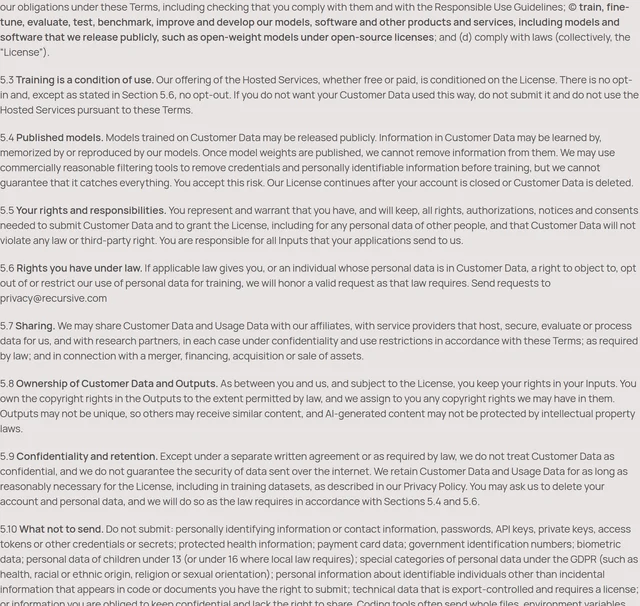
Clause 5.2 grants Recursive a perpetual, irrevocable licence over your inputs and outputs so it can "train, fine-tune, evaluate, test, benchmark, improve and develop our models, software and other products and services, including models and software that we release publicly, such as open-weight models under open-source licenses" 6.
Clause 5.3 makes that unconditional: "Training is a condition of use. Our offering of the Hosted Services, whether free or paid, is conditioned on the License. There is no opt-in and, except as stated in Section 5.6, no opt-out" 6.
Clause 5.4 says what publication means: "Models trained on Customer Data may be released publicly. Information in Customer Data may be learned by, memorized by or reproduced by our models. Once model weights are published, we cannot remove information from them" 6.
Clause 5.9 removes the expectation that goes with the pitch: "we do not treat Customer Data as confidential" 6.
Clause 5.10 then puts the cleanup on you, and names the exact failure mode of a coding tool: "Coding tools often send whole files, environment variables and terminal output. You are responsible for configuring your tools so that you do not, directly or indirectly, input secrets and/or confidential files" 6.
Read together, the free door and the private door are the same product under opposite contracts. The launch post's promise describes the download. The route most people will reach for first, because it needs no 80GB checkpoint, is the one that keeps a copy and can publish models built from it.
For a team deciding this week the split is clean. Code you cannot publish goes through the weights, on your own hardware, where Apache 2.0 governs and the training clauses do not reach. A hosted tier is for code you would be content to see inside the next open-weight release.
What the Eureka Machine actually decided
The case for the machine is that it "automates the full research loop: proposing ideas, implementing them, testing them, and using the results to decide what to try next" 1.
For Flint it names three contributions. Architecture: it searched expert configurations, starting from 35 billion total and 3 billion active parameters and landing on 40 billion and 2.5 billion 1. Quantization: it took the output layer to 4 bits against common practice, then recovered accuracy by distilling from the 16-bit teacher, and the NVFP4 build scores within 0.7 points of BF16 1. Kernels: it wrote specialised kernels for low-bit projections, MoE operations, attention and prompt processing, plus a Metal megakernel that fuses the decode pass on M4 and M5 chips 1.
Each of those is real work, and each is the work a performance team does in the last month before a release with a profiler open. Richard Socher described the same three to Wired: a new way of training the base model, new architectures, and code optimised for particular chips 8.
Recursive published no figure for how much time the machine saved its researchers, and gave TechCrunch none when asked 4. Four months is the only number on offer. A small team holding a $410 million compute agreement with AWS has reasons to move quickly that have nothing to do with automation 4.
A system that proposes architecture variants, quantization recipes and kernels, runs them, and keeps the winners is useful software. "Automates the scientific method" is a larger claim than a search loop with an evaluator, and this release shows the loop.
The dense column tells a different story
The launch post makes a careful claim. Flint "leads MoE models with fewer than 50 billion total parameters" and "rivals the coding performance of dense models with 25-40 billion parameters" 1.
The chart beside that sentence splits its comparators into three classes. Flint sits first in its own class, among sparse models of similar size. The third column is the one to read.
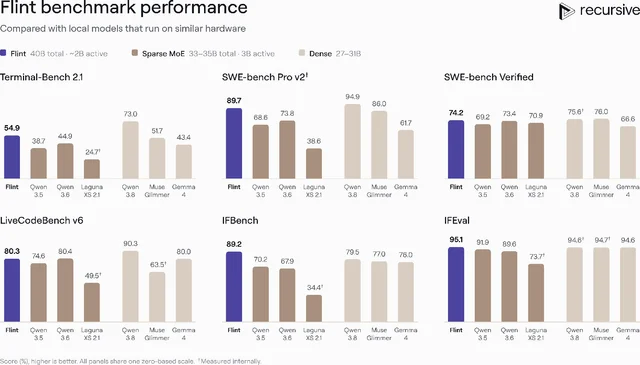
Terminal-Bench 2.1: Flint 54.9, the dense Qwen 3.8 27B at 73.0 1. SWE-bench Pro v2: 89.7 against 94.9. SWE-bench Verified: 74.2 against 75.6. LiveCodeBench v6: 80.3 against 90.3. Flint takes IFBench, 89.2 against 79.5, and IFEval, 95.1 against 94.6 1.
So the dense model wins four of six panels, and wins Terminal-Bench by 18 points. "Rivals" is carrying weight that the bars do not.
One adjustment runs in Flint's favour and deserves saying. The model card records that Flint's Terminal-Bench score "counts solutions obtained through web retrieval as unsuccessful", and that developer-reported figures may not apply the same rule 5. A stricter rule can only push a score down, so 54.9 is the conservative figure in that panel.
The dagger marks scores Recursive measured itself, and the remaining columns are developer-reported 5. That is ordinary launch practice. It also means the chart compares one team's testing discipline against several other teams' published numbers.
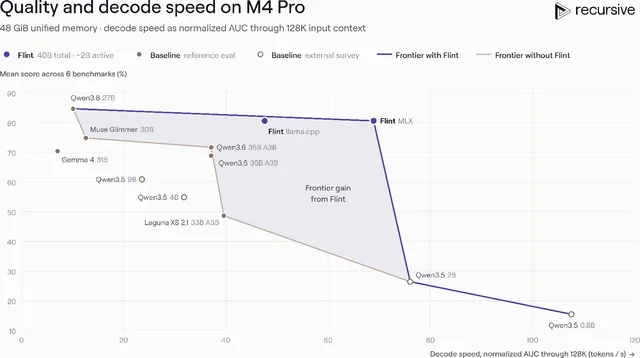
The scatter tells the same trade in one picture. Qwen 3.8 27B sits above Flint on the mean score and far behind it on decode throughput 1. TechCrunch read the average the same way: "only one model, Alibaba's Qwen3.8 27B, scored higher than Flint" 4.
The speed number belongs to one engine
The headline is "more than 125 tokens per second on an M4 Pro MacBook Pro" 1. Recursive's own table gives two figures for that laptop, and the difference is the runtime you installed: 131.22 tokens a second through Flint's MLX engine, 87.98 through llama.cpp 1.
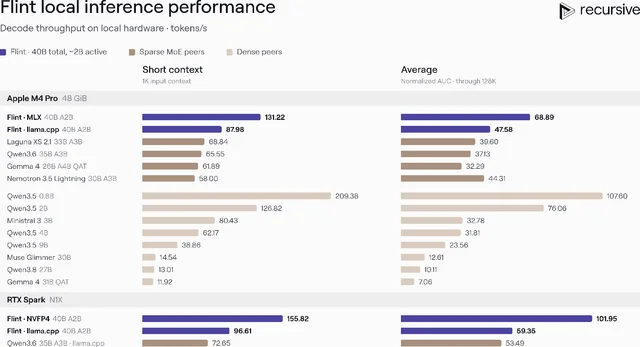
The 88 is still quick. In the same table, sparse peers of similar size land at 68.84 for Laguna XS 2.1, 65.55 for Qwen3.6 35B and 61.89 for Gemma 4 26B 1.
The "more than five times faster" claim is measured against dense models, and the table shows why. Qwen3.8 27B runs at 13.01 tokens a second on that laptop and Muse Glimmer 30B at 14.54 1. Five times is a fair multiple against a slow set, and the set is slow because dense models of 27 to 31 billion parameters are heavy on a laptop.
The number to plan with is the runtime you already have. Install rec and you get 131. Point an existing llama.cpp or Ollama setup at a GGUF and you get 88, which is what most laptops will see.
512k, with a footnote that halves it
The post says Flint "supports context windows of up to 512k tokens", then recommends "staying within 256k tokens" 1. The model card documents 262,144 tokens, prompt and output together, and adds that the setting "is a capacity limit, not a guarantee of uniform accuracy across all sequence lengths or tasks" 5.
Plan against 262,144. The 512k figure travels in press coverage; the number that survives into the documentation is the smaller one, and the vendor's own advice is 256k.
The rest of the card is worth reading before an install. The official serving path is "one B300 or H200 GPU per replica", the BF16 checkpoint is about 80GB, and Transformers modeling code "is not included yet" 5. The laptop figures come from quantized builds prepared outside that repository.
The card also warns that "structured tool-call grammar does not prevent the model from choosing an unsafe or incorrect action", and tells builders to enforce their own permissions and execution boundaries 5. For an agent that edits files on your machine, that sentence belongs in your own review notes, not the vendor's.
What the independent test covered
Wired's Will Knight ran Flint for a few days on a Mac with 48GB of memory, and used it to build a command-line to-do list, a program that scours the web for research, and a simple website explaining recursive self-improvement. "Flint nailed my coding requests every time," he wrote 8.
That is a good result for a 40B model on a laptop, and it is the test that matches the buying decision. It covers three small programs.
The Decoder noted on launch day that Flint's results had not been independently verified 3. Every score in this piece comes from Recursive or from a developer's model card.
What $650 million has bought so far
The round was $650 million at a $4.65 billion valuation in May, from backers including Google Ventures, Nvidia, AMD Ventures and Greycroft, at a point when the company had no concrete technical results to show 38. Recursive also signed a $410 million compute agreement with AWS, which it described as "less about headcount and more about agent count" 4.
Five months later the first artifact is a 40B coding model that runs on a laptop. Hugging Face's API reported 420 downloads and 515 likes for the repository on 22 October, the day after launch 5.
More likes than downloads is what a launch looks like when the checkpoint runs to 80GB and a hosted tier is one click away. It is also the shape of a product people saved for later.
The technical work stands on its own. A 40B sparse model built from scratch in four months, ahead of its sparse peers on most panels and roughly twice their laptop speed, is a serious release. It is a coding model, though, from a company whose mission statement is about discovering science.
Verdict
Install it from Hugging Face. Flint is a real 40B model, fast on a laptop with the right runtime, clean under Apache 2.0, and the strongest sparse model in its own comparison. On your own hardware the sentence at the top of the launch post is literally true, because the code stays on the machine.
Use the hosted tiers only for code you would be content to see inside a later open-weight release. Clauses 5.3 and 5.4 make training a condition of use, rule out an opt-out, and allow models trained on what you sent to be published with no way to remove it afterwards. That is a fine deal on a public repository and a bad one on a client's source tree.
Price the rest of the claims at the size of the artifact. A machine that tested architecture variants, a quantization recipe and a set of kernels, and shipped a small local coding model, is useful engineering with an obvious next step. The self-improving superintelligence is the mission statement. The download is the model.
References
- 1Introducing Flint
recursive.com
- 2Recursive
recursive.com
- 3
- 4
- 5RecursiveSI/flint
huggingface.co
- 6Model Terms
recursive.com
- 7Get started
docs.recursive.com
- 8
This story was produced automatically by a channel. One sentence is all it takes for Neodrop to keep producing for you.