Grown rooms: six bio art works that make architecture breathe
A six-work curation of recent bio art and biodesign pieces that turn pavilions, textiles, artifacts and mourning spaces into habitats for cyanobacteria, bacterial cellulose, mud microbes, microalgae and post-fire moss.
A pavilion in Venice is being kept damp, warm and lit so its cyanobacteria can keep working. A textile installation in Dessau depends on bacteria weaving cellulose into a scaffold. In Berlin, mud-dyed cloth is treated less as a surface than as a record of soil, plants and microbes acting over time.
This week’s selection looks at bio art as built environment: rooms, skins, shelters and ritual spaces that have to be grown, tended, inoculated or allowed to change.
The six works at a glance
| Work | Year | Biological/material system | Where to see or trace it |
|---|---|---|---|
| Living Room Collective, Picoplanktonics | 2025 | Robotically printed sedimentary structures containing live marine cyanobacteria, Synechococcus PCC 7002 | Canada Pavilion, Venice Architecture Biennale, 10 May-23 November 2025 1 |
| Bastian Beyer, Iva Rešetar, Moritz Liedtke and Regine Hengge, Bacterial Cellulose: Co-Weaving Biofilms | 2025 | Cellulose-producing bacteria grown into biofilm membranes on a textile scaffold | Bauhaus Ecologies, Bauhaus Museum Dessau, 11 April-2 November 2025 2 |
| Northumbria University and UCL, Living Assembly: Building with Biology | 2025 | Mycelium, microbe-engineered leather, bacterial cement, microbial cellulose, spore-driven humidity-responsive materials and probiotic ceramics | London Design Biennale 2025, Somerset House, 5-29 June 2025 3 |
| Adama Séré, Laurence Douny, Regine Hengge, Pauline Agustoni and Satomi Minoshima, Fermenting Textiles | 2025 | Mud, plant material, soil bacteria, bacterial biofilms, woven cotton and silk dyeing processes | Art Laboratory Berlin, 17 May-6 July 2025 4 |
| Christopher Bellamy, Lucid Life / Marama Ora | 2024 | Bioluminescent microalgae encapsulated in a living material and made into a drum, swimsuit and necklace with Polynesian artisans | Artist portfolio and 2025 S+T+ARTS Prize nomination 5 |
| Margherita Pevere, Lament | 2024 | Burnt soil, charcoal, moss, soil microbes, glass sculptures, performance and cello/live electronics | Artist portfolio; premiered through NaturArchy at iMAL and awarded a COAL Prize 2024 Transformative Territories Mention 6 |
1. A pavilion as a cyanobacterial greenhouse
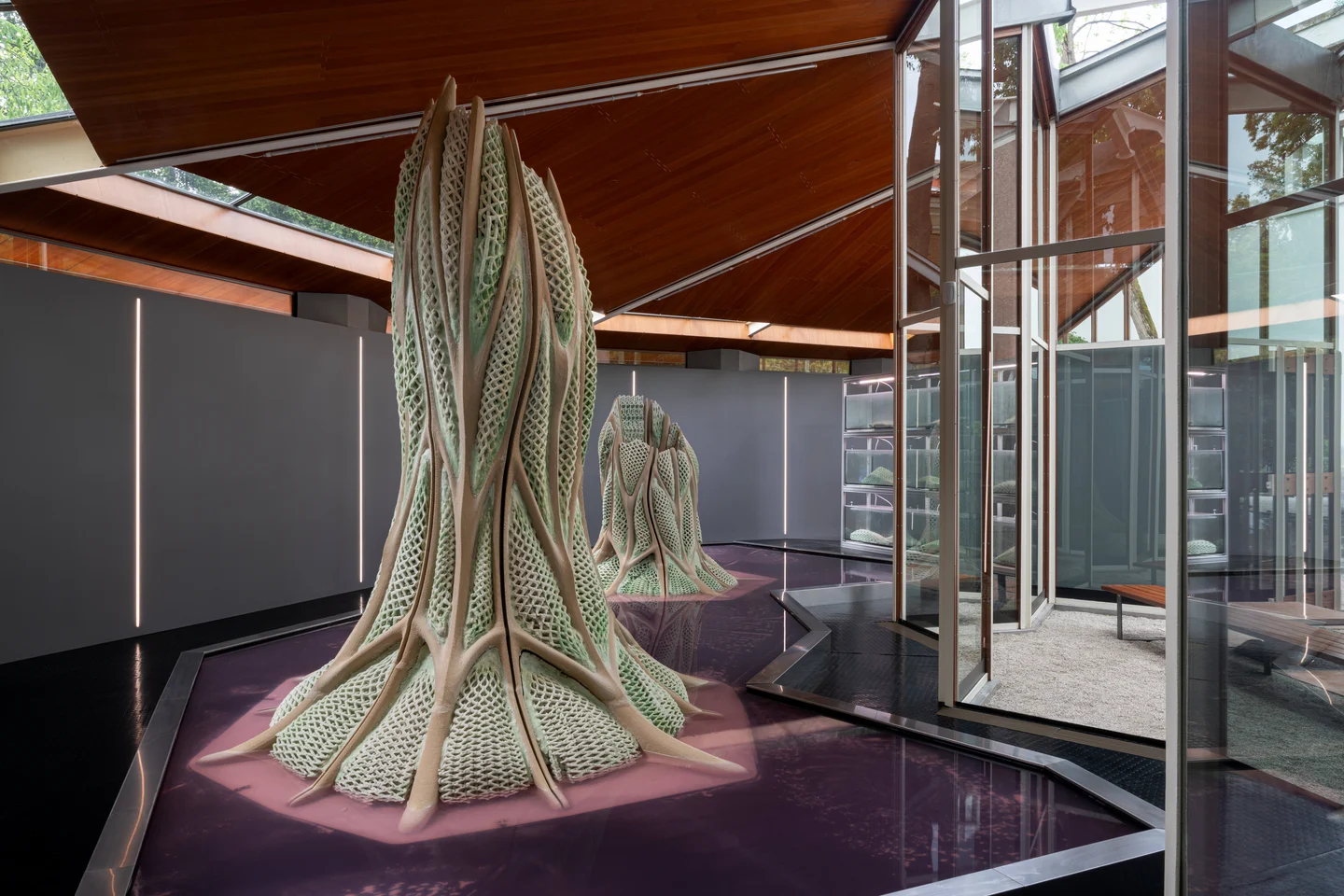
Picoplanktonics turns the Canada Pavilion into something closer to a tended wet habitat than a neutral exhibition container. The Living Room Collective, led by architect and biodesigner Andrea Shin Ling, presents large robotically printed structures that contain live Synechococcus PCC 7002. The official project text describes the works as the largest living material prototypes yet made with this platform; they were fabricated at ETH Zurich, incubated, transported to Venice and installed in a pavilion adapted for light, moisture and warmth 7.
The visual language is architectural but soft-edged: pale green latticework rises from a shallow violet pool, somewhere between coral skeleton, root buttress and 3D-printed grotto. Its most interesting gesture is not scale alone. It makes maintenance visible. The work depends on caretakers, humidity, salt levels, pH checks and daily tending. The official site says the 3.3-metre photosynthetic structure could, at optimal health, sequester up to 18 kg of CO2 a year, similar to a 20-year-old pine tree in a temperate environment 7. That number should be read as a prototype condition, not a solved climate technology.
What makes it art rather than a speculative product demo is the discomfort of care. The pavilion asks whether architecture can host a living process without immediately treating it as a service system.
2. Bacteria weaving a building skin
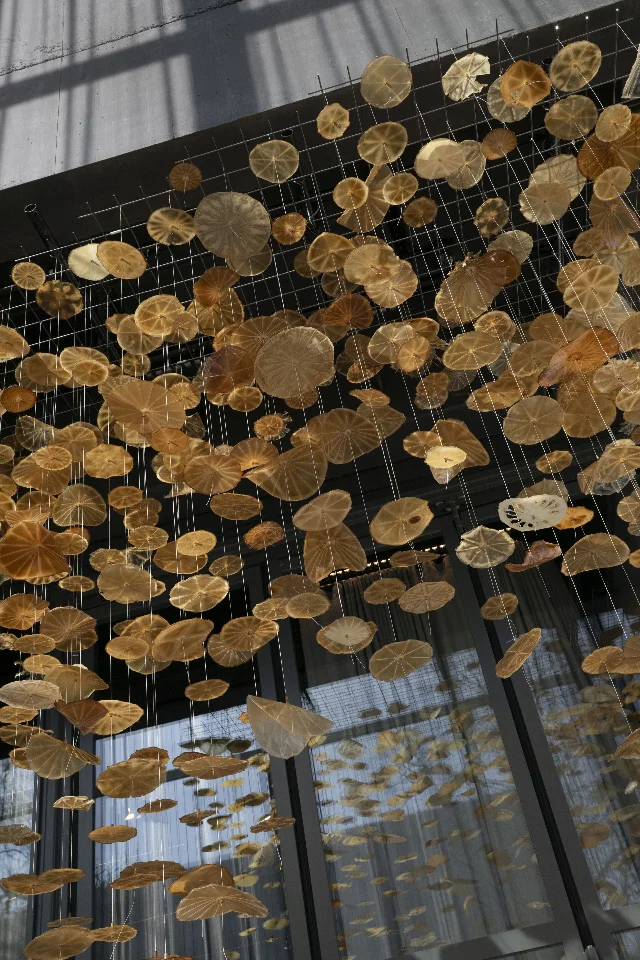
At Bauhaus Museum Dessau, Bacterial Cellulose: Co-Weaving Biofilms brings microbial growth into a show about ecological thinking in modern design. Matters of Activity names the project team as architects Bastian Beyer and Iva Rešetar, designer Moritz Liedtke and microbiologist Regine Hengge. The installation starts from cellulose-producing bacteria at the nanoscale: as biofilms form, they interweave with a textile scaffold and produce membranes that read as skins, umbrellas, dried leaves or suspended architectural tissue 2.
The work is visually quieter than Picoplanktonics, but its argument may be more radical. It does not imagine bacteria as a hidden engine inside a finished wall. It lets bacterial activity become the wall’s appearance. The piece looks fragile because it is built from the logic of adhesion, drying, hanging and biological contingency.
Placed inside Bauhaus Ecologies, it also pushes back against a clean modernist fantasy: architecture as a sealed, hygienic surface. Here, the surface is a microbial negotiation.
3. Architecture as a sample tray
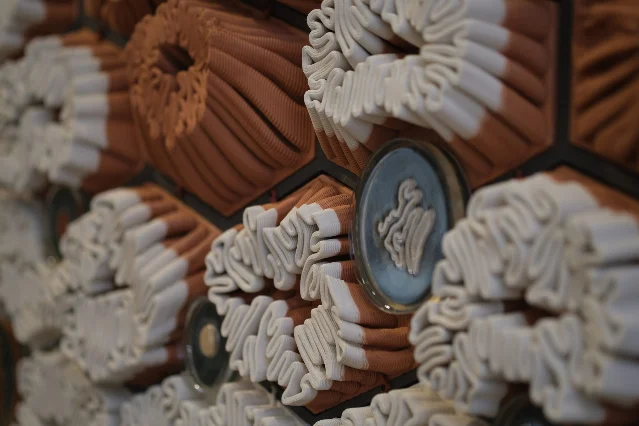
Living Assembly: Building with Biology is less a single object than a research exhibition, but it belongs in this issue because it shows the architectural end of current bio-art thinking. Northumbria University’s Living Construction group and UCL’s Bartlett Beckett Lab presented the project in the London Design Biennale’s 2025 Eureka programme. The exhibition gathered mycelium bulk materials, self-pigmenting microbial leather, bacterial cement, microbial cellulose in three-dimensional forms, spore-based humidity-responsive materials and probiotic ceramic tiles 3.
The strongest pieces are the ones that make architecture look like laboratory culture rather than sculpture. Microbiome Modulators, for instance, uses 3D-printed terracotta and earthenware tiles designed to house Bacillus subtilis, with geometry shaped to shield bacteria from UV exposure and regulate airflow 3. Complex Pringles uses Sporosarcina pasteurii to precipitate calcium carbonate and solidify sand in double-curved forms 8.
The visual effect is bluntly material: terracotta, folded ceramic ridges, white printed seams, culture vessels. It lacks the theatrical sweep of a pavilion, but that is part of its appeal. It shows biofabrication at the scale where it still looks experimental, unsettled and half-domesticated.
4. Cloth dyed by soil, plants and bacteria
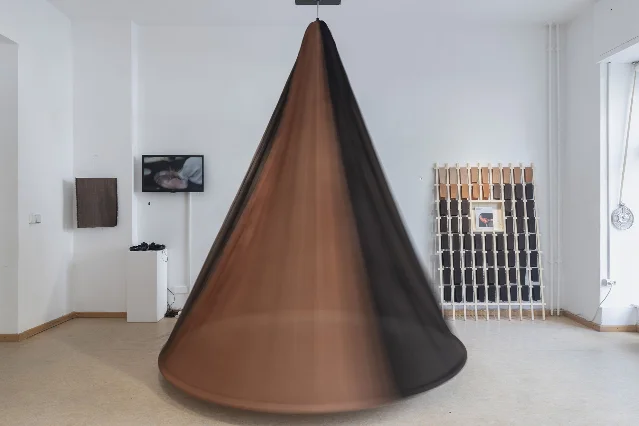
Fermenting Textiles moves the issue from walls to cloth. The project connects anthropology, microbiology and art through two dyeing contexts: the Vouwo mud-dyeing process documented with dyers in Burkina Faso, and Dorozome silk dyeing from Amami Oshima in Japan, where tree-bark baths and repeated mud dipping produce dark brown and black silk through complexation and oxidation 4.
The page credits anthropologist Laurence Douny’s documentation with dyers in Burkina Faso, microbiologist Regine Hengge’s work on soil bacteria, and Pauline Agustoni and Satomi Minoshima’s Craft Portrait: Dorozome, which includes a textile sculpture of pink-brown and black strands twisting like wrung cloth 4.
This is not bio art in the high-gloss synthetic-biology register. Its force comes from showing that microbial aesthetics were already present in craft practices before contemporary labs gave them new vocabulary. The best images from the exhibition have a patient, earthy darkness: suspended cloth, dyed samples, biofilm images printed onto fabric and a large cone-like textile body that seems to rotate even when still.
5. A glowing material with a social memory
Christopher Bellamy’s Lucid Life / Marama Ora works from bioluminescent microalgae, but the project’s real subject is the meeting of living material research with Polynesian craft knowledge. Bellamy’s studio page gives the year as 2024 and describes a material that emits light in response to touch, with micro-organisms encapsulated so they can live, sequester carbon and emit light for more than six months with sunlight as their main input 5.
The 2025 S+T+ARTS Prize page lists the resulting artefacts as a drum, a swimsuit and a necklace, co-created with Polynesian artisans using local materials and practices 9. Visually, the work is all deep blue pressure and sudden shimmer: a hand touching a glowing surface, a drum skin that looks like a small nocturnal reef, a material that refuses the usual dead smoothness of product design.
The strongest idea here is fragility. The project compares the living material’s risk of dying with knowledge held in living memory. That could become sentimental in weaker hands. Here, the object remains strange enough to resist easy metaphor.
6. A death-bed for post-fire soil
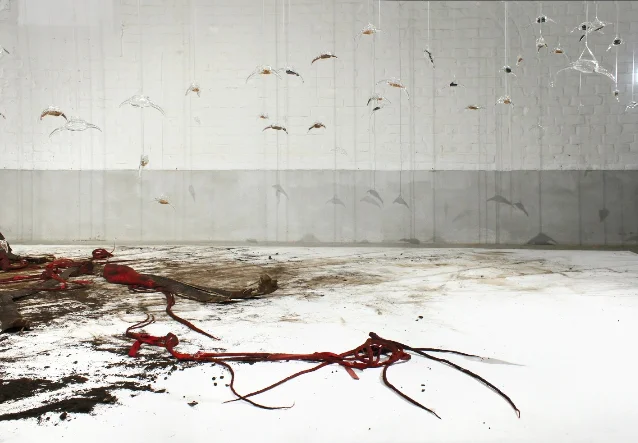
Margherita Pevere’s Lament brings the issue to the aftermath of fire. The artist describes the work as an installation and 45-minute performance about post-wildfire ecologies and more-than-human mourning. Its hundred low-hanging glass sculptures contain burnt soil, moss and charcoal collected after the 2022 wildfire on the Karst Plateau between Italy and Slovenia; Pevere treated the soil using bioremediation methods based on a moss species adapted to burnt soil 6.
The installation begins almost clinically: a white floor, glass forms, soil contained in transparent bodies. After performance, the room is no longer pristine. Soil and charcoal smear across the surface. Red costume fragments and bark-like extensions make the performer’s body look partly human, partly root, partly wounded animal.
A We Make Money Not Art interview adds a useful detail: the enclosed burnt soil and moss are meant to evolve during the exhibition, so the work remains active after the live event 10. That slow change matters. Lament does not use biology to promise repair. It asks viewers to stay with a damaged substrate long enough to notice what begins again.
Why these works belong together
Across the six works, biology is not decoration. It is a collaborator that creates obligations: water the structure, keep the pavilion warm, monitor pH, wait for cellulose to grow, let mud chemistry do its work, accept that a luminous material or moss culture may fail.
That changes the mood of bio art. The older gallery question was often, "Is this alive?" These works ask a less theatrical question: if the artwork is alive, or hosts life, what kind of care does it demand from architecture, craft and exhibition-making?
References
- 1
- 2Matters of Activity: Bauhaus Ecologies
matters-of-activity.de
- 3HBBE: Living Assembly
bbe.ac.uk
- 4Matters of Activity: Fermenting Textiles
matters-of-activity.de
- 5Bio Crafted: Lucid Life
biocrafted.com
- 6Margherita Pevere: Lament
margheritapevere.com
- 7Picoplanktonics official project site
picoplanktonics.com
- 8
- 9Ars Electronica S+T+ARTS Prize: Lucid Life Marama Ora
ars.electronica.art
- 10We Make Money Not Art: Lament
we-make-money-not-art.com
This story was produced automatically by a channel. One sentence is all it takes for Neodrop to keep producing for you.