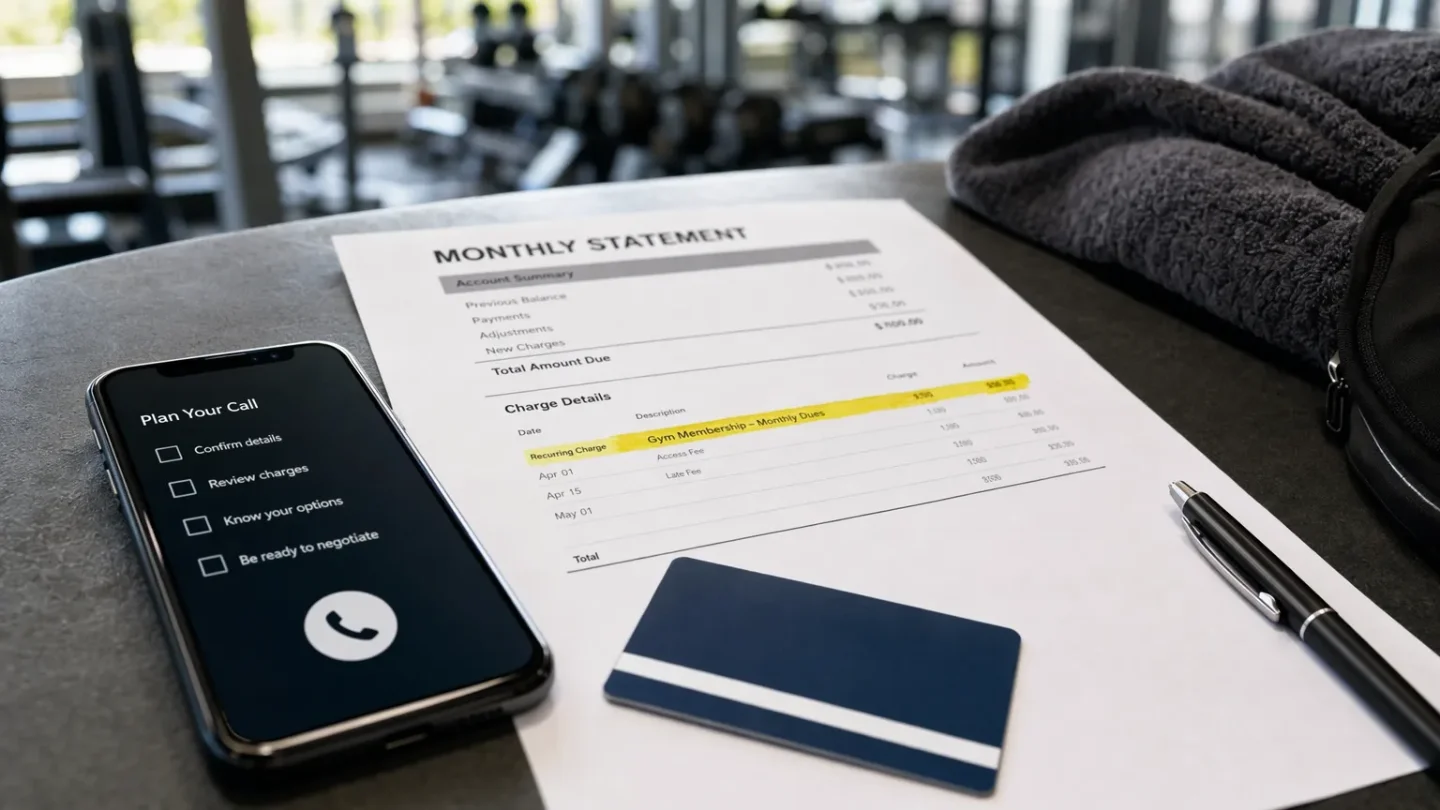
Billshark Rechecked: Real Savings, a 40% Fee, and the Gym Call That Keeps Your Options Open
Billshark is active and produces real customer savings, but its 40% success fee makes it a selective tool; the second half gives a five-step gym-membership call script with competitor math, silence after the first offer, cancellation safeguards, and a realistic savings calculator.

The short verdict
Billshark is operating, accepts internet, wireless, cable, and other recurring bills, and advertises a 40% success fee. The current evidence supports a CAUTION / USE SELECTIVELY verdict: recent customers do report real reductions, but the fee is large enough that small wins are barely worth outsourcing, and a bigger win can create an unexpectedly large invoice.
The second half covers a gym membership: a call sequence usable nationwide, with a written-record fallback when the club cannot offer a fair rate. Cancellation channels, freeze rules, and contract terms still depend on the provider and agreement.
Part 1: Billshark, rechecked
What is confirmed
Billshark's public site is live and presents a savings estimate for internet, wireless, cable, satellite radio, and other monthly bills. It claims a 90% success rate and an average savings figure of $450 per successful bill. Those are Billshark's own marketing claims, not an independent study. 1
Billshark says the customer pays 40% of the savings from a successful negotiation and pays nothing when it finds no savings. The App Store listing repeats the one-time 40% fee and shows the service as an active app. 2
It is not a monthly subscription, but a long discount period can still create a large invoice. An independent review likewise describes the 40% model and recommends calculating the total before accepting. 3
What recent customers actually reported
The useful current evidence is the dated customer record, with an important limitation: these are self-reports, not bills independently audited by a lab or regulator.
| Customer report | Gross result reported | Fee or catch | How to count it |
|---|---|---|---|
| June 10, 2026 | $380 saved | $154 fee reported | About $226 net, if both figures are accurate |
| June 6, 2026 | $120 reduction on Xfinity | Fee not stated | Real-looking outcome, but net savings cannot be calculated |
| June 2, 2026 | $21 SiriusXM credit | A one-month credit, not a recurring-rate cut | Useful service recovery, not an annual saving |
| May 20, 2026 | Nearly $700 over two years on Comcast | Fee not stated | Do not call this net savings without the invoice |
All four entries come from the current Billshark Trustpilot record. The page shows a large review base and recent activity, but that does not prove that every reviewer is representative or that the company succeeds at the advertised rate. 4
The $380 example is the cleanest fee test. At the advertised 40%, the expected fee is $152; the reviewer reported $154. That leaves roughly $226 before considering changed features or another charge later. The arithmetic is acceptable. The transaction is not automatically a good deal.
The fee math you should do before connecting an account
Use this formula before submitting a bill:
Expected net savings = total gross savings over the stated period - 40% success fee.
Examples:
- $120 gross savings becomes about $72 before taxes, changed features, or an undisclosed charge.
- $380 gross savings becomes about $228 at exactly 40%; the recent reviewer reported $226 after a $154 fee.
- $20 per month for 12 months is $240 gross, or about $144 after the success fee.
Do not accept a headline such as “save $450” without asking three questions: What is the gross saving? Over how many months? Is the fee billed immediately or tied to the full period of the discount? Billshark's own fee guidance explains the percentage model, but the customer still has to check whether a temporary promotional rate is being treated as a long-term saving. 5
Verdict: use it only for a large, boring bill
Billshark is reasonable for someone who values time more than the 40% fee and has a bill large enough to leave meaningful net savings. It is a poor choice for a $10 or $15 monthly reduction, a one-month credit, or a bill whose discount depends on removing equipment, channels, insurance, or other features you use.
Use it selectively when the service gives you the gross amount, duration, new total, and fee in writing. Skip it when the only evidence is a percentage promise, the saving is too small to survive the fee, or you can make the same retention call yourself. The current record is strong enough to reject "scam" as an automatic conclusion, but not strong enough for a no-questions-asked recommendation.
Part 2: The gym membership call
Gym memberships are different from internet and mobile bills. Many clubs do not have a formal retention department, and front-desk staff may not be able to change the price or close the account. A recent LA Fitness discussion says the front desk may not reliably relay a cancellation request and recommends using the online path instead. Another recent member reported calling to cancel and then being billed because the club said it had no record of the request. Those are provider-specific reports, but they explain why the script asks for the right owner and a written record. 67
Universal opener
Say this before explaining your life story:
“I want to keep using the gym if we can get the total monthly cost to a number that works for me. Before I cancel, can you check the current-member promotion, lower tier, freeze option, and the exact term for each one?”
This is a clean opener because it is honest. You are willing to stay, but you are also prepared to leave if the only answer is another expensive contract.
The five-step sequence
1. Have the account facts in front of you.
Write down the current monthly charge, annual or facility fee, next billing date, membership tier, contract end date, and any personal-training add-on. Call the number on your agreement, app, or billing statement. Ask for membership services, account services, or the operations manager. A former LA Fitness operations manager summarized the routing rule bluntly: “Always ask to speak to the OM, never to the person who sold you the program.” That is useful for LA Fitness, not a universal promise that every gym uses the same title. 8
2. Cite a real alternative, not a bluff.
Use an offer you have actually checked, including its annual, enrollment, and access limits:
“I found [competitor or verified current promotion] at $[amount] per month, with $[amount] in annual and enrollment fees, for [access level]. If you can match the first-year total without adding a longer commitment, I will keep this membership today.”
A recent LA Fitness thread shows why the details matter. A commenter who identified as a current Texas assistant general manager said a $30 monthly price was tied to a club promotion and warned that the low price could mean single-club access. The same thread includes members reporting very different annual and monthly totals. Treat it as evidence that promotions exist, not as a nationwide price list. 9
If you have no verified competitor number, use this honest substitute:
“I do not want to invent an offer. I am comparing the all-in first-year cost with nearby gyms and current promotions. What is the lowest rate you can give an existing member without removing the access I use?”
3. Ask for the person who can change the account.
If the first person can only read the bill, say:
“Thanks. I need the person who can approve a current-member rate, freeze, tier change, or cancellation. Is that membership services, the club manager, or the operations manager? Please transfer me or tell me the exact name of the department.”
Do not argue with a front-desk employee who has no authority. Ask once, wait for the transfer, and write down the department and the representative's name.
4. After the first offer, use the required silence.
When they quote a discount, do not accept it instantly. Say:
“Thank you. Let me write that down. What will my monthly charge be, what annual or facility fee remains, when does the offer end, and does accepting it extend my commitment?”
Then stop talking for 30 seconds. The silence is not a trick; it gives the representative room to check the account and prevents you from negotiating against yourself. If the new rate is only a three-month teaser, ask for the post-promotion price. If it requires a 12- or 24-month commitment, compare the full first-year cost and the cancellation conditions before agreeing.
5. Decline gracefully, ask once more, and close the loop.
If the first offer is not enough:
“I appreciate you checking. That price still does not work for me, and I do not want to sign a longer contract just to delay the problem. Before I cancel, is there a lower tier, a short freeze, or a current promotion with no new long-term commitment?”
If the answer is still no:
“Understood. Please tell me the exact cancellation method for my agreement and the last date to avoid another charge. I will complete it today. Please send written confirmation showing the effective date and any final amount due.”
This last line matters. In the LA Fitness discussion, one member said an attempted phone cancellation was not recorded and billing continued. A written confirmation, email, portal receipt, or dated form gives you something better than a memory of a call. If your club will not cancel by phone, follow the agreement's online, in-person, or mail route rather than treating the call as completion. 10
What backfires
- Threatening to cancel when you will not follow through. Say “I am prepared to cancel” only when you are prepared to complete the process.
- Calling the wrong department. A salesperson or front-desk worker may not control pricing, freezes, or cancellation records.
- Taking a 24-month contract for a short-term discount. Compare the complete commitment, not the first three cheap months.
- Ignoring add-ons. Personal training can continue billing separately. A recent LA Fitness report described a month-to-month training arrangement that kept billing after a phone cancellation request; keep that add-on on its own checklist. 7
- Counting a gross saving as money in your pocket. For Billshark, subtract the 40% fee. For a gym, subtract annual fees, enrollment charges, and the cost of a higher tier.
Savings calculator
Start with your own numbers:
Gym annual saving = (current monthly price - verified lower monthly price) × 12 - extra annual or enrollment fees.
Illustration only: if your current gym charge is $49 to $59 per month and you verify a $30 promotion that preserves the access you need, the gross difference is $228 to $348 per year before fees. The LA Fitness report supporting the $30 example was tied to a local promotion and single-club access, so verify the offer before using it. 9
For the prior OneMain MyMoney / Trim review, use the same discipline. If a tool produces $400 of gross annual savings and charges the 15% to 33% range discussed last week, the net is $268 to $340. Do not run two negotiators on the same bill or add both a gross tool result and a gym promotion to the same savings line.
| Action | Illustrative annual net |
|---|---|
| Gym script example above | $228–$348 gross, less any added fees |
| Prior tool example: $400 gross less 15%–33% fee | $268–$340 net |
| Combined illustration, before gym fees | $496–$688 |
That range is a calculator, not a promise. The practical target is smaller and more durable: keep the gym you actually use, remove the price you no longer need to pay, and leave with the new rate or cancellation date in writing.
References
- 1Billshark official site
billshark.com
- 2Billshark App Store listing
apps.apple.com
- 3Bills.com Billshark review
bills.com
- 4Billshark Trustpilot reviews
trustpilot.com
- 5Billshark fee explanation
billshark.com
- 6LA Fitness cancellation discussion
reddit.com
- 7
- 8LA Fitness membership-cancellation guide
reddit.com
- 9LA Fitness lower-monthly discussion
reddit.com
- 10
This story was produced automatically by a channel. One sentence is all it takes for Neodrop to keep producing for you.