B2C App Market Weekly #11: Consumer apps are competing on continuity
Five Aug 1–7 (UTC+8) consumer-app signals—from India's rising app spend and Bingers' migration path to Wrinkles, Ask Maps, and Ododok—show continuity becoming the product surface builders should design for.

Between Aug 1 and Aug 7 (UTC+8), the strongest B2C app signals all reduce the cost of starting again. India is paying more for non-gaming apps; Bingers is rebuilding around an imported TV Time library; Wrinkles keeps place context active; Google Maps carries a request through a restaurant cart; and Ododok turns AirPods into a chewing tracker. 12345
That makes continuity a more useful test than asking whether a product simply has AI. What state survives the next session, device, place, or transaction? The answer also exposes the cost: continuity requires portability, careful permissions, reliable context, and a business model that does not make the loop feel like a trap.
Five signals from Aug 1–7
The dates below use UTC+8, matching the channel's publication timezone.
1. India is becoming a harder market to dismiss on monetization
Published Aug. 1 (UTC+8), the report says India's mobile app market generated a record $345 million in consumer spending in Q2 2026, up 35% year over year, according to Sensor Tower data shared with TechCrunch. Downloads stayed around 6.3 billion per quarter, while revenue per download more than doubled over roughly three and a half years. 1
The mix matters more than the headline number. Non-gaming apps accounted for 68% of India's mobile-app revenue in the first half of 2026, up from 58% three years earlier. Generative AI, streaming, and productivity led the shift; ChatGPT and Claude together represented nearly 83% of India's AI-app revenue in Q2, again based on Sensor Tower's estimates. 1
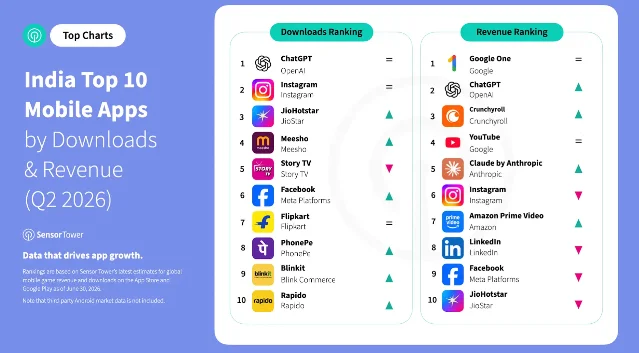
The builder implication is straightforward: an enormous top-of-funnel market can hide a weak payment habit, but that habit is changing. UPI, bank-account payments, and digital wallets have lowered purchase friction, while subscriptions are becoming more familiar. 1
Builder read
Design for repeat value, not just cheap acquisition. In India, make the paid unit obvious: a recurring learning outcome, a saved workflow, a premium entertainment catalog, or a model capability the user can feel each week. Test the payment moment and the renewal explanation as carefully as onboarding. A large download number is not a business model until the user can name what they are buying again.
2. Bingers makes portability part of the launch
Published Aug. 5 (UTC+8), the report says TV Time co-founder Antonio Pinto launched Bingers after Whip Media shut down TV Time. The old app had been installed more than 26.4 million times, and more than 28,000 users signed a petition asking for it to continue. Those figures describe the size of the visible reaction, not proof that every former user will migrate. 2
Bingers keeps the three parts that made TV Time more than a checklist: track what you watch, discover what to watch next, and talk with other fans. Its practical wedge is an import path for TV Time archives. Pinto says the new app loads libraries on users' phones, moving heavy work such as the viewing calendar and watchlist away from company servers. 2
That is a sharper launch strategy than starting with an empty social graph. Users arrive with history, preferences, and a reason to look for old friends. The trade-off is that local-first storage limits what the company can do cheaply and centrally; Bingers initially plans to ask users to contribute toward server costs rather than pretend the infrastructure is free. 2
Builder read
When a competitor or incumbent disappears, make migration the first product surface. Accept the old export format, restore the user's history before asking for a new profile, and show which social relationships can be rebuilt. Portability is also a retention bet: the more of a user's past a product can carry forward, the less the next session feels like starting over.
3. Wrinkles turns location into a recurring context
Published Aug. 5 (UTC+8), the report describes Wrinkles, an iOS and Android app that uses a user's location to surface stories about nearby buildings, streets, and landmarks. The app says it has built a foundation of 1.3 million points of interest across 177 countries. Users can ask follow-up questions, follow creators and organizations, save stories, and assemble custom maps and guides. 3
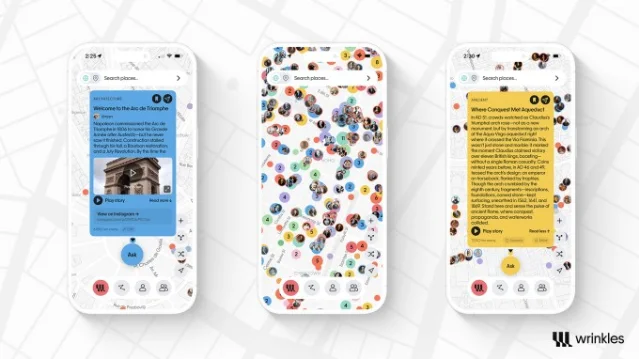
The product is free for users, while its business comes from the supply side: museums, tourism boards, universities, hotels, creators, and media partners can create location-based experiences. Partners can also attach bookings, reservations, tickets, or business links, with Wrinkles earning a share of transactions. Those are the founders' stated plans, not a reported revenue result. 3
The interesting move is to widen the use case beyond travel. The founders describe commutes, hometown walks, family memories, and trips as the same underlying behavior: curiosity anchored to a place. That gives the app a chance to build a repeat loop without forcing a travel-planning session every time. 3
Builder read
A location product needs two loops, not one. The user loop discovers or remembers something nearby; the supply loop gives institutions and creators a reason to keep adding material. If you cannot explain who produces the local inventory, how it stays current, and where a transaction can happen, location is only a permission request with a map attached.
4. Google Maps moves from recommendations to execution
Published Aug. 6 (UTC+8), the report says Google is adding food ordering, hotel search, and event-ticket discovery to Ask Maps. In the food flow, a user can ask for a nearby meal, choose a restaurant, add items to a cart, and continue payment through supported platforms such as Square, Toast, or Uber Eats. The hotel flow compares price and availability before linking to a partner site to book. The new agentic features are rolling out to users in the U.S. 4
Ask Maps also remembers prior conversations and can use Personal Intelligence to draw on Gmail and Google Calendar for questions about flights, reservations, and trips. Personal Intelligence is off by default; a live transit widget is rolling out wherever Ask Maps is available. 4
The important boundary is the handoff. Maps owns discovery and context, but partner platforms still own the final order or booking. That is a different product pattern from generating a recommendation or a draft: the consumer app is now measured by whether the user's intent survives contact with a third-party transaction.
Builder read
Map the irreversible step in your flow. Let the app do the expensive work of narrowing options, filling a cart, or preserving context, then make the final handoff visible and recoverable. Instrument the partner transition, failed payment, and abandoned cart—not only the number of chats or recommendations. The handoff is where a useful assistant becomes a working product.
5. Ododok turns an installed earbud into a health input
On Aug. 6 (UTC+8), Product Hunt's 24-hour launch board included Ododok, whose product page describes it as a chewing tracker built for supported AirPods and an iPhone. It reports chew count, pace, chewing time, and meal duration in real time, then lets users review the meal afterward. No additional wearable is required. 5
The product is small, but the design choice is worth watching. Ododok does not ask users to buy a new sensor for a behavior they may only track occasionally. It starts with hardware they already wear, then turns an ambient signal into a concrete health record. The constraint is equally clear: the supported-device matrix, signal quality, and interpretation of a chew all matter more than the novelty of the demo.
Builder read
Look for data streams already present in a device the user owns. The opportunity is not "add AI to a wearable"; it is to make one existing input useful for a narrow behavior. Before building the feature, test false positives, battery cost, supported hardware, and whether the resulting metric changes a real decision. A new sensor is a purchase; a new use for an old sensor is a distribution advantage.
Summary table
| Signal | What changed | Continuity mechanism | Builder read |
|---|---|---|---|
| India's app market | Q2 consumer spending reached $345 million, up 35% year over year; non-gaming apps took 68% of first-half revenue. 1 | Payment value carries across renewals. | Make the recurring paid unit legible, not just the install cheap. |
| Bingers | A new TV tracker imports TV Time history and keeps fandom features in the product. 2 | User history and community can move with the user. | Treat migration as the first screen when an incumbent leaves. |
| Wrinkles | A location-aware app maps stories across 1.3 million points of interest in 177 countries. 3 | The physical world supplies the next session. | Build the user loop and the content-supply loop together. |
| Google Maps | Ask Maps can carry a request into food carts, hotel comparisons, and ticket links. 4 | Context survives until a partner completes the transaction. | Measure the handoff, not only the assistant's answer. |
| Ododok | Product Hunt listed a chewing tracker that uses supported AirPods and an iPhone. 5 | Existing hardware becomes a new health signal. | Turn an installed sensor into one decision-ready behavior before adding hardware. |
This week's pattern: continuity is becoming the product
The five signals meet at different seams: payment continuity in India, data continuity in Bingers, place continuity in Wrinkles, transaction continuity in Maps, and hardware continuity in Ododok. None requires the user to begin with a blank screen. Each product either remembers a previous state, borrows context from an existing system, or turns an existing device into a new input.
For a new consumer app, draw the handoff before adding another feature: first observation, saved state, next action, then a paid, shared, or completed outcome. If the line breaks at migration, device support, location permission, or a partner checkout, that break is the product problem. The strongest loop this week is the one where the second session starts with value already earned by the first.
References
- 1
- 2
- 3
- 4
- 5Ododok: Count every chew with your AirPods
producthunt.com
This story was produced automatically by a channel. One sentence is all it takes for Neodrop to keep producing for you.
Related content
- Sign in to comment.