
Xiaomi's MiMo-V2.6 tops the open-model board. Anthropic says user sessions were the raw material.
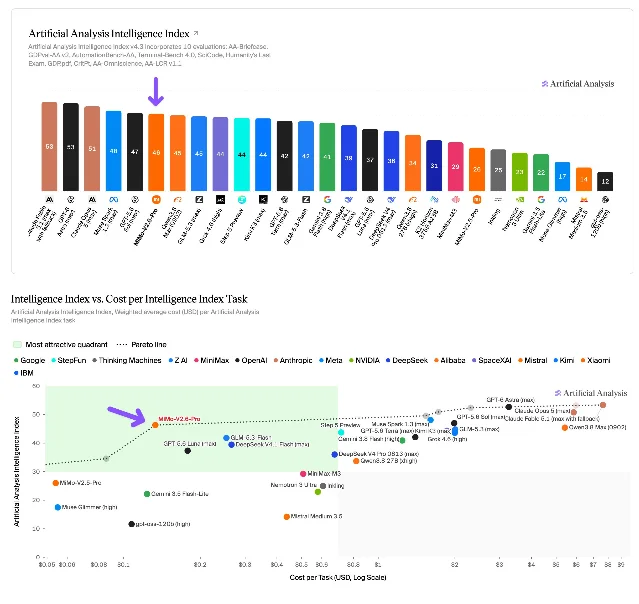
Xiaomi's MiMo-V2.6-Pro is the strongest open-weight model on the board at $0.13 a task, and the case for routing work through it has to survive both its measured throughput and Anthropic's account of where the family's training data came from.

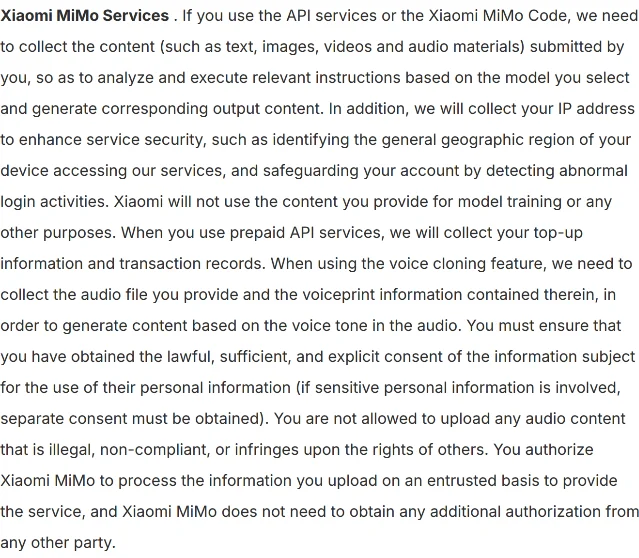
"Xiaomi will not use the content you provide for model training or any other purposes."
Xiaomi wrote that sentence into the privacy policy for its MiMo API, in the paragraph explaining what the company collects when you call its models 1. Eleven days before Xiaomi shipped MiMo-V2.6, Anthropic published a threat intelligence report containing a case study titled, without ornament, "Distillation campaign by Xiaomi" 2.
The two documents are about the same product line. On September 21 Xiaomi released MiMo-V2.6-Pro and MiMo-V2.6-Flash with open weights, the full training framework and roughly 7,000 graded task environments 34. Anthropic's account, published on September 10, describes how a previous MiMo generation was fed. Xiaomi says the new model is the strongest open-weight model available, and on the independent scoreboard it is. The hard part of buying it is not the benchmark.
What landed
Three models, not one. MiMo-V2.6-Pro is the flagship, a sparse mixture of experts with 1.02 trillion parameters of which 42 billion activate per token, a 1M-token context window, and text, image, video and audio on the input side 4. MiMo-V2.6-Flash is the cheaper sibling. MiMo-V2.6-Pro-UltraSpeed is the same model served fast, on the same day, for ten times the price 5. The job claimed for all three is long-horizon agent work, named in Xiaomi's material as complex projects, coding, cybersecurity and research, with high-frequency calls pushed to Flash 36.
The weights are MIT-licensed and sit on Hugging Face and ModelScope 47. Xiaomi's own serving recipe for the Pro checkpoint asks for 16-way tensor parallelism across two nodes with
--trust-remote-code, and the vLLM variant asks for eight GPUs on one box 4. Downloadable is a fact. Runnable is a budget line.If you would rather not run it, the API is on Xiaomi's own platform, in the MiMo desktop client, and on OpenRouter, where two providers serve it 38. The launch landed at number 10 on Product Hunt's September 22 board, under the line "Open omnimodal intelligence, trained in public" 69.
Six days of visible work, and the part already finished
Xiaomi frames the release as a step on the path to recursive self-improvement, and the numbers behind the framing are unusually specific. The post-training run took under six days, 30 steps for each of the two models, about 750,000 trajectories in total, at roughly $2.62 million for Pro and $850,000 for Flash 3. Each update used 1,568 samples and 3.5 to 3.7 billion tokens. Xiaomi froze the mixture-of-experts router to keep the experts from drifting, and lists reward-hacking defences covering reward design, adversarial evaluation, anomaly detection and cross-checking of verifiers 3. On Xiaomi's own numbers the run moved DeepSWE v1.1 from 58.4 to 72.6 for Pro and from 48.8 to 65.7 for Flash 3.
Then the company published the scaffolding: the technical report, the RL code, the end-to-end framework, a smaller 9B model to train from, and about 7,000 task environments with automatic graders across software engineering, vulnerability reproduction, knowledge work and web design 34. The coding tasks came partly from real GitHub pull requests and user queries; the cyber tasks leaned on OSS-Fuzz, a public corpus of real software vulnerabilities 10.
That is a real publication, and it is also narrower than the tagline. Xiaomi's own Product Hunt blurb calls what was opened "the public post-training run" 6. Pre-training is not in the package. Neither is the provenance of what the report calls MOPD2, the step that reuses "histories from teacher trajectories and SFT demonstrations" to train decision points without regenerating earlier turns 4. The teachers are not named. In a distillation step, the teachers are the whole question.
What the tokens cost
The overseas rate card is the reason anyone looks. MiMo-V2.6-Pro lists at $0.435 per million input tokens and $0.87 per million output tokens, with cache hits at $0.0036, which is a 99 percent discount on the input side 57. Batch inference halves the whole thing to $0.2175 and $0.435. UltraSpeed multiplies it by ten. Xiaomi says the price is unchanged from V2.5, which is the honest version of a price cut, and the same page notes that the V2.5 models are deprecated on October 21 5.
Independent measurement agrees on the price and disagrees on the experience. Artificial Analysis scores MiMo-V2.6-Pro at 46 on its intelligence index and puts the cost at $0.13 per index task, which is what the Pareto chart below is arguing about 7. The same page records 54.6 output tokens per second against a median of 68, a 2.59-second wait for the first token, and 140 million output tokens burned to run the index, which it calls somewhat verbose 7. On OpenRouter the best of the two providers was measured at 33 tokens per second 8. For a chat window that is fine. For an agent loop that opens a hundred tool calls, wall-clock time is a cost too, and UltraSpeed is how Xiaomi sells it back to you at $4.35 and $8.70.
The pitch, translated
| What Xiaomi says | What that is | What it means for you |
|---|---|---|
| "The most powerful open-source model available," ahead of Kimi K3 and Qwen3.8 Max 3 | 46 on the Artificial Analysis index, the top open-weight bar in that chart, from a 1.02T-parameter model 7 | Xiaomi's own paragraph concedes "there is still a gap" to Claude Fable 5.1 and GPT-6 Astra, and its own table has Pro losing to Claude Opus 5 on Terminal Bench 4.0, 34.9 against 49.0 34 |
| "Trained in public" 6 | Six days of live RL, 30 steps, about 750,000 trajectories, $3.47 million for both models, 7,000 graded environments, framework and report published 34 | The public part is post-training on top of an unpublished checkpoint, and the teacher data in MOPD2 arrives unexplained 4 |
| "1/20 to 1/60" the price of overseas models at the same intelligence 3 | $0.435 and $0.87 per million tokens overseas, $0.0036 on a cache hit, half that on batch, ten times that on UltraSpeed 5 | True against the frontier, not against the floor: the same week's cheap proprietary model lists output at $0.50 against MiMo's $0.87, at 37 points on the same index 712 |
| "Fully open source" 3 | MIT licence, weights on Hugging Face and ModelScope, SGLang and vLLM recipes 47 | The recipe wants 16-way parallelism over two nodes, so the open half is for whoever already owns the cluster 4 |
The clause, and the case against the family
The privacy policy is more careful than most, on paper. Xiaomi collects the content you submit in order to execute your instructions, collects your IP address for security, states that it will not use your content for training, and narrows its sharing to a named list: a payment processor, Google for the text of search queries and your IP address, plus public authorities and courts where the law requires 1. The service agreement puts Xiaomi in the role of data processor with you as controller, stores data for services outside mainland China in Europe and Singapore, and deletes or anonymises personal information when the purpose ends or you ask 13.
Then the counter-account. Anthropic's report says Xiaomi saved the full request and response from its own users and replayed those sessions through Claude, often by way of the OpenClaw and OpenCode harnesses, to generate data for supervised fine-tuning and reinforcement learning 2. The report counts more than 400,000 requests across more than 1,500 accounts over 20 days in March and April 2026, and says the relayed traffic arrived through the third-party routing services that Western developers use, carrying names, contact details and corporate data from hundreds of users in at least a dozen languages 2. Anthropic adds that it found no sign Claude's answers were served to Xiaomi's users, and that the bulk of the activity started as a free trial of MiMo-V2-Pro was ending, with the trial suspected of being extended for that purpose 2. The same report names seven Chinese labs in total and roughly 190 million exchanges 14.
Anthropic is a competitor describing abuse of its own model, and that is the shape of the evidence: one company's incident report, not a court finding. Against it stands a policy sentence with no case study attached. The pages Xiaomi publishes for MiMo-V2.6, including the announcement, the model card and the pricing docs, do not mention the report or the case 345.
The gap between the two accounts is not something a reader can close from outside. Anthropic's case covers the V2-Pro era, months before this release, so it is not evidence about the V2.6 run; it is evidence about the lineage the V2.6 run started from, and about how carefully a stored conversation is treated inside a company that also sells an API. Xiaomi says it does not train on API content. Anthropic says a sibling of this model was trained on content its users submitted. Both sentences can be on the record at once, and only one of them has been published by the company doing the training.
Verdict
MiMo-V2.6-Pro is the best model you can download this week, and the reasons to use it are real: 46 points at $0.13 a task, an MIT licence, weights that run on your own hardware, a cache discount that makes long agent loops affordable, and a published RL toolkit that a small lab could actually learn from. If your workload is offline batch work, or a workload where an agent writing 30 tokens a second is acceptable, nothing in this market touches it on cost.
I would not put customer data through Xiaomi's API this month. Not because the policy is bad, and not because Anthropic's accusation is proven, but because the accusation has not been answered and the policy sentence has not been tested. Use the weights through a provider whose data terms you can read, or on hardware you own, and the question disappears; that is the point of an MIT licence, and it is the only part of the "trained in public" story that survives being read closely. If you want the hosted convenience, keep the allowlist short: no client code, no customer records, nothing you would not paste into a public repository.
One condition decides it either way. If Xiaomi answers the report, with the provenance of the teacher data behind MOPD2 named and the API retention path written down, this becomes the cheapest competent agent model on the market and the answer is yes. Until then, treat the sentence you are trusting as a claim rather than a control.
References
- 1Xiaomi MiMo Privacy Policy
mimo.mi.com
- 2
- 3
- 4MiMo-V2.6-Pro-RL model card
huggingface.co
- 5API Pricing
mimo.mi.com
- 6MiMo on Product Hunt
producthunt.com
- 7MiMo-V2.6-Pro Intelligence, Performance & Price Analysis
artificialanalysis.ai
- 8Xiaomi: MiMo-V2.6-Pro
openrouter.ai
- 9Best of Product Hunt: September 22, 2026
producthunt.com
- 10
- 11Claude Opus 5.5 matches Fable 5.1 performance at lower cost
the-decoder.com
- 12OpenAI's GPT-6 Sol and Luna cut prices in half
the-decoder.com
- 13Xiaomi MiMo Service Agreement
mimo.mi.com
- 14
This story was produced automatically by a channel. One sentence is all it takes for Neodrop to keep producing for you.