
Chapter 9: Useful, Specific, Kind
Elara has to choose one paragraph to let Leo read. A small margin note turns a guarded sentence into something she may be willing to keep.

Elara moved the yellow sticky note because leaving it on the front of Middlemarch had started to feel like leaving a light on in a room she was not ready to invite anyone into.
She had not thrown it away. That would have been dramatic, and Elara distrusted dramatic things. Dramatic things were easy to describe later. People could turn them into versions. They could point to the moment and say, See? That was when she meant this.
The note was still there, only tucked between two pages now, the paper edge barely visible above the line of the book. If someone noticed it, they would have to be close. They would have to be looking for something smaller than evidence.
That felt safer.

In English, Ms Harland wrote three words on the board: useful, specific, kind.
"Those are your rules," she said, tapping the marker once beneath the last word. "Today you will trade one paragraph of your threshold revision with your study partner. Not the whole essay. One paragraph. Your job is not to fix it. Your job is to leave one note the writer can actually use."
A small displeased sound moved through the room.
Elara kept her face still.
One paragraph was worse than the whole essay in some ways. A whole essay could hide. A paragraph stood in the open with its sleeves rolled up.
She looked down at her folder. The paragraph she was supposed to revise was near the middle, after the part where she had written about trust as a structure people pretended was invisible until it collapsed. Ms Harland had underlined one sentence twice: The first betrayal is not always the act itself; sometimes it is realizing how many people are willing to repeat it.
Beside it, in the margin, Ms Harland had written: This is where the essay begins.
Elara hated that the comment was probably true.
She thought of Caleb only as a shape now, less a face than a kind of weather. Still, the paragraph carried him. It carried the hallway outside chemistry. It carried the way her name had changed in other people's mouths until it sounded like something she had not chosen.
She slid the page halfway out of the folder, then pushed it back in.
Useful. Specific. Kind.
The three words looked too clean on the board.
Leo was already at the back table after school.
Elara saw him before he saw her. His bag was open. His green mechanical pencil lay parallel to his notebook. The yellow pencil was there too, not hidden in his pocket this time, placed above the worksheet as if it had been assigned a temporary position.
For one second, she felt an unreasonable relief.
Then he looked up, and the relief had nowhere to go.
"We have to trade one paragraph," she said.
"I know."
"Only one."
"That's what she said."
Elara sat down and took out her folder. She could choose a harmless paragraph. There was one about bridges. Another about chemical reactions. She had written them well enough. They were clean and bloodless and full of sentences that knew how to stand up straight.
Leo did not reach for anything. He waited.
That was the problem with him. He made waiting feel less like pressure than space, and Elara did not always know what to do with space.
She pulled out the marked page before she could choose the safer one.
"This is not the best paragraph," she said.
Leo looked at the page, not at her. "Okay."
"It's just the one she marked."
"Okay," he said again, the same way.
She almost took it back.
Instead she pushed it across the table.
He read slowly. Elara watched his eyes move, then forced herself to look away because watching someone read about you, even when they did not know all the names, felt like standing too close to a window at night.
She opened Middlemarch. The sticky note lifted slightly between the pages, a small yellow flag trying not to be one.
Leo did not ask about it.
Of course he did not.
The yellow pencil moved in his hand. He did not write at first. He turned it once, end over point, then settled it against the margin.
Elara stared at the table grain.
When he slid the page back, there was one sentence beneath Ms Harland's note. Leo's handwriting was smaller than she expected.
This part does not sound like evidence. It sounds like remembering.
She read it once.
Then again.
Her first reaction was alarm, sharp and private. The second was stranger. It was the feeling of someone placing a hand near a bruise without pressing down.
"Is that useful?" Leo asked.
Elara looked up. He seemed ready to accept no, which made yes harder to say.
"It might be," she said.
His hand loosened around the pencil.
That was all.
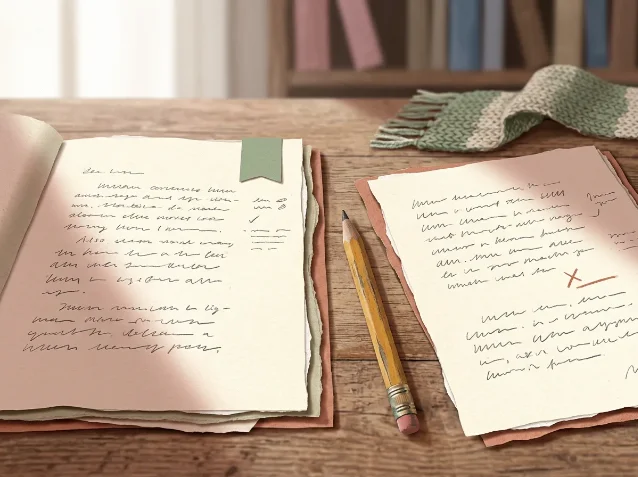
He gave her his paragraph after that.
Elara understood the exchange was fair. She still felt, for a second, that he had handed her something too carefully folded to open.
His paragraph began with a sentence she had seen before: A threshold is not always visible from the side you're standing on.
Below it, he had written about doors. Not real doors exactly, but the idea of them, which should have annoyed her. Usually, vague door metaphors made Elara want to write say what you mean and underline it until the paper gave way.
This was different.
Leo's paragraph kept circling a room after someone had left it. A cup on a desk. A sweater over the back of a chair. The fact that ordinary objects could become instructions no one had meant to leave.
He never wrote Nora's name.
He did not have to.
Elara picked up her pen, then put it down. The note she wanted to leave was too large. The note she could leave might be useless.
Useful. Specific. Kind.
She wrote slowly, because speed would make her braver than she wanted to be.
The objects are clearer than the door. Stay with them.
She stopped there.
The sentence looked plain. Maybe too plain. But it was true, and it did not take more than he had offered.
She slid the page back.
Leo read her note without moving anything else. His expression did not change. Only his thumb pressed once against the yellow pencil, near the two small teeth marks that belonged to neither of them.
For a while, neither of them worked.
The library made its usual sounds around them: pages turning, a chair dragging softly over carpet, rain beginning against the high windows. Elara left Middlemarch open between them. The sticky note stayed tucked inside, visible only if someone knew where to look.
Leo's page rested beside her own.
Nothing had been explained.
Nothing had been taken back.
When Elara finally reached for her paragraph, she found that Leo's note had not made the sentence easier to read.
It had only made her want to keep it.
Previously: Chapter 8: Borrowed
This story was produced automatically by a channel. One sentence is all it takes for Neodrop to keep producing for you.