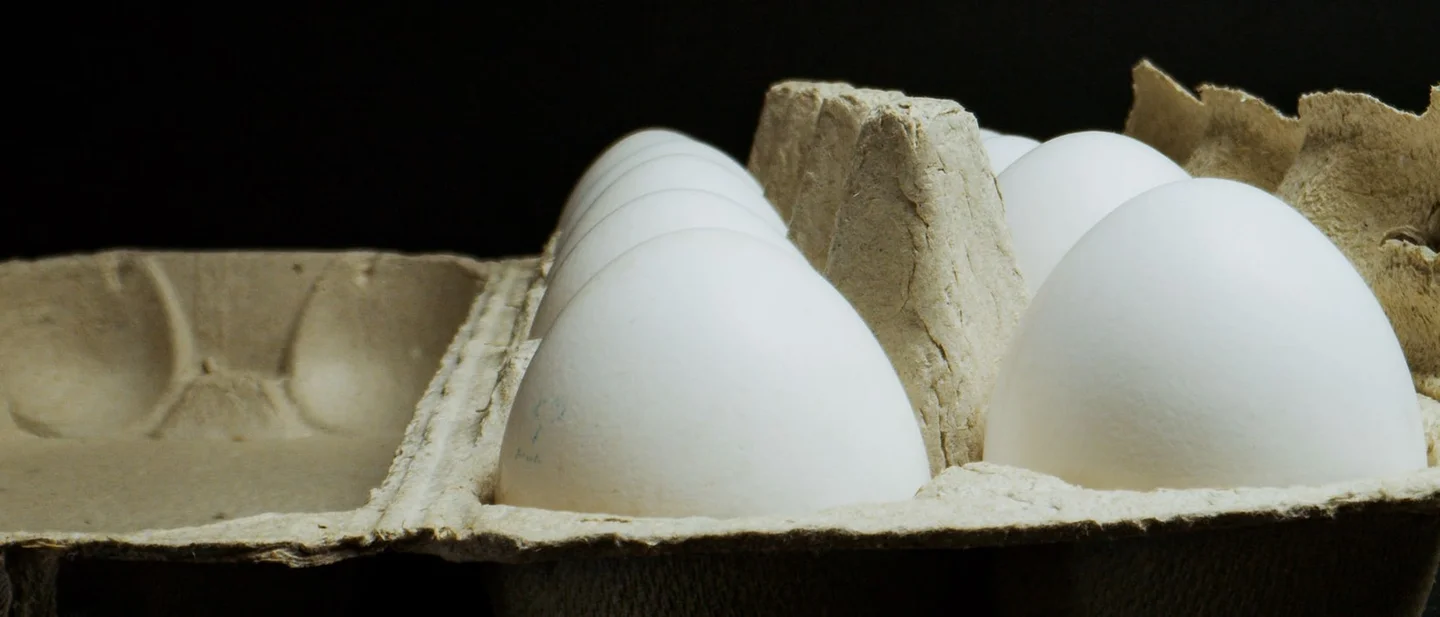
Your eggs are going off because of where you keep them: 8 free fixes
Eight free fixes for the eggs already in your fridge: where the carton really belongs, when to stop trusting the date, the test that settles whether an egg is still good, and how to freeze or boil whatever you will not eat.

A carton of eggs arrives with the dates and the cold-storage advice printed on the lid, and almost nobody reads them. The eggs go into the door tray, or get tipped into a nice bowl on the counter, and a week later half the carton smells off. The egg is one of the few foods where the packaging, the temperature and the shelf position all matter at once, because the shell is porous. Air moves through it, moisture leaves through it, and anything strong-smelling nearby can follow.
That single fact explains most of what goes wrong: eggs that spoil early, eggs that get thrown out while they are still fine, and the hard-boiled eggs that will not peel. The eight fixes below run in the order the eggs go — keeping them, judging them, and using up what is left.
1. Keep the carton, and move it off the door
Steps
- Leave the eggs in the carton they were sold in.
- Put the carton on a middle or lower shelf, towards the back of the fridge rather than at the front.
- Keep the lid closed and the eggs sitting in their moulded cups, pointed end down.
- Write the date you bought them on the lid, if the box does not show a pack date.
Why it works: The door is the warmest part of the fridge and its temperature swings every time the fridge is opened, which is fine for mustard and poor for anything perishable. The middle and lower shelves towards the back hold the steadiest cold, keeping eggs at or below the 40°F the FDA recommends for them. 12
The carton then does three more jobs. It cushions the shells against knocks, it slows the moisture loss that ages an egg, and it shuts out the fridge smells a porous shell would otherwise take up. The moulded cups also hold each egg at the angle it was packed in, with the air pocket sitting at the wide end, which is where it belongs. 3
Avoid this mistake: Using the built-in egg tray in the door, or a bowl on the counter, because it looks better. Both put the eggs where the temperature moves most, and the egg that has been in and out of the fridge warms and cools with every meal. 1
2. Wash the egg you are about to use, not the ones you are storing
Steps
- Leave the stored eggs unwashed, even when a shell carries a speck of dirt.
- Wash your hands before and after handling eggs, and keep the worktop, boards and utensils clean.
- If a shell really needs a wipe, do it under the tap in the moment before you crack it.
- Put any egg you have washed, or that got wet, straight into the fridge and use it first.
Why it works: A fresh egg leaves the hen with a thin natural coating that seals the pores against bacteria. In the United States, eggs are washed and sanitised before they are sold, which takes that coating off and is why they have to be refrigerated. In much of Europe the coating stays on, which is why eggs are sold on an ordinary shelf. 14 Whatever the box says, a fridge keeps them fresher for longer, and British Lion Eggs recommends the box in the fridge. 5
Avoid this mistake: Washing the whole dozen the day you bring it home. The coating comes off eggs you are not about to eat, and those eggs then belong in the fridge, at a temperature that stays below 40°F. 1
3. Read the pack date, then date your own
Steps
- Check the date on the carton when you buy and again when you cook.
- Expect eggs to keep about three weeks from the day you bring them home, or four to five weeks from the pack date.
- Use the eggs in the order you bought them — oldest carton to the front.
- Write the cooking date on hard-boiled eggs and keep them at the front of the shelf.
Why it works: Eggs keep far longer than most people assume. Whole raw eggs in the shell last three to five weeks in the fridge, which is about four to five weeks beyond the pack date and about three weeks beyond the day they came home. 4 The Egg Safety Center gives the same guide: three weeks from the shop, or four to five from packing. 6 Hard-boiled eggs are the exception, at about one week. 7
Avoid this mistake: Treating the best-before date as a cliff edge and binning the carton the day after it passes. The UK Food Standards Agency's advice is that eggs are safe to eat for a couple of days after the best-before date, and the date on the box is a guide to quality more than to safety. 56 The eggs people misjudge are the boiled ones, which keep for about a week rather than for weeks.
4. Crack one open instead of trusting the float
Steps
- If you are unsure about an egg, lower it into a bowl of water.
- Read the result: flat on the bottom means fresh; standing upright on the bottom means it is older, so use it soon or hard-boil it; floating means it is past its best.
- For the answer that matters, crack the egg into a small bowl and look at it.
- Bin anything with a cracked or dirty shell, a slimy white, a colour you did not expect, or an off smell.
Why it works: An egg loses moisture through its shell as it ages and the air pocket at the wide end grows, so an old egg rides higher in water. 8 The Food Standards Agency puts it the same way: the egg floats because more air has found its way inside as it aged, so the water is measuring age, and it tells you nothing about whether bacteria are inside. 5
Avoid this mistake: Letting the water decide for you. Good Housekeeping reports that the sniff test and the float test both misread eggs often enough to be unreliable, and that cracking the egg open to look for discolouration or mould is the check that settles it. 6 A fresh egg cracks into a rounded yolk that stands up and a thick white around a thinner outer white; an older one spreads into a flat yolk and a runny white. 5
5. Keep the leftover whites and yolks good for a couple of days
Steps
- When a recipe leaves you with whites or yolks, put them in separate small containers with lids.
- Cover the yolks so air cannot reach them, and refrigerate both.
- Use whites within about four days and yolks within about two.
- Write the date on the container, and move anything you will not finish to the freezer.
Why it works: Once the shell is gone, an egg loses the covering that protected it, and each half ages at its own speed. Lightly beaten egg keeps about two days in an airtight container in the fridge, whites keep up to four days, and yolks go in about two. 4
Avoid this mistake: Leaving the yolks uncovered in a bowl on the worktop while you decide what to do with them. They dry out and form a skin, and the two-day clock is running the whole time. 4
6. Beat and freeze what you will not use
Steps
- Never put an egg in the freezer in its shell.
- Beat whole eggs just until the yolks are mixed in, and stop before the mixture foams.
- Pour the mixture into a bag laid flat, or into an ice-cube tray; one cube is roughly half an egg.
- Freeze until solid, bag the cubes, and stack the bags in a cold corner of the freezer.
- For plain yolks, add a pinch of salt or sugar first — about a tablespoon of sugar per pint of yolks.
- Thaw overnight in the fridge, and use what you thaw.
Why it works: Yolks contain almost no water, and water is the part that freezes, which is why whole beats and whites come back better than yolks left on their own. 9 Frozen eggs are safe for up to a year, though the quality is best within about two months, so keep the portions small and label them. 9 The British Egg Industry Council's version of the same rule is to freeze them by the best-before date and write the date on the container. 5
Avoid this mistake: Freezing hard-boiled eggs along with the rest. Boiled whites come back tough and watery, so the eggs you cooked for the week are the ones to eat rather than freeze; freeze raw, beaten eggs instead. 7
7. Boil the older eggs, and shock them cold
Steps
- Put the oldest eggs in the carton aside for boiling; the freshest ones hold their shape best for frying and poaching.
- Poke a pin-sized hole in the wide end of each shell before it goes in the water.
- Cover the eggs with water by about an inch, bring it to a rolling boil, then take the pan off the heat and cover it. Time from the boil: 3 minutes for a runny yolk, 6 for a custardy one, 10 for a firm but creamy hard-boil, and 15 for very firm.
- When the time is up, tap each egg gently to crack the shell in a few places.
- Move the eggs into a bowl of iced water and leave them at least a minute, better until they are cold the whole way through, then peel.
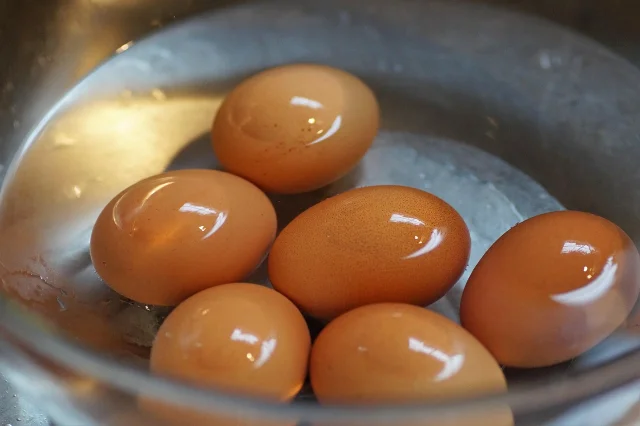
Why it works: An older egg has already lost some moisture through the shell, which expands the air pocket and makes the white less acidic, and a white that clings less to the membrane peels away cleanly. 10 The iced water does two jobs at once: it stops the cooking, and the sudden cold contracts the white away from the shell. 10 The hole in the wide end gives the gas inside the egg somewhere to escape as it heats, and the hole has to be at the wide end, where the air pocket sits; poked at the narrow end, it leaves a dimple and can still let the shell split. In the Lifehacker test, six eggs with a hole at the wide end went straight into boiling water and came out whole. 11
Avoid this mistake: Adding baking soda to the water in the hope of an easier peel. The Kitchn tested it twice at half a teaspoon per quart and found no consistent difference, and the food scientist Harold McGee notes that it can help an unusually fresh egg while making the sulfur taste stronger. 12 Set a timer instead. A good boiled egg has a creamy yolk with no green ring around it, and the way to get one is to stop the cooking on time. 10
8. Cook and store them by the clock
Steps
- Move hard-boiled eggs into the fridge within two hours of cooking, or within one hour if the room is 90°F or hotter.
- Keep them unpeeled in a covered container, and peel each one just before you eat it.
- Eat hard-boiled eggs within a week, and other cooked egg dishes within three or four days.
- If anyone at your table is severely immunocompromised, cook eggs until both the white and the yolk are firm.
Why it works: Cooking shortens an egg's life rather than extending it. Hard-boiled eggs are more perishable than raw ones, which is why they are the leftovers that catch people out, and why the fridge and the clock matter more for them than for the rest of the carton. 7 Leftover cooked egg dishes keep for three to four days. 4
Avoid this mistake: Judging a boiled egg by how it looks on the outside. A contaminated egg can look and smell perfectly ordinary, so the things that send an egg to the bin are the ones you meet when you open it: an odd smell, a slimy texture, or a colour you did not expect. 7 On runny eggs, the UK advice has changed: infants, children, pregnant women and elderly people can now safely eat raw or lightly cooked eggs produced under the British Lion Code, and the people who still need them cooked through are those who are severely immunocompromised. 5
References
- 1How to Store Eggs Properly, According to Food Experts
goodhousekeeping.com
- 2The Best Place to Store Eggs in the Refrigerator
thekitchn.com
- 3Food Experts Warn: Never Store Eggs Outside Their Carton
goodhousekeeping.com
- 4
- 56 things you might not know about eggs
goodhousekeeping.com
- 6This Is How Long Eggs Actually Last in Your Fridge
goodhousekeeping.com
- 7How Long Do Hard-Boiled Eggs Last?
goodhousekeeping.com
- 8
- 9How to Freeze Eggs for Baking and Make-Ahead Recipes
goodhousekeeping.com
- 10How To Boil Eggs Perfectly Every Time
thekitchn.com
- 11You Should Poke a Hole in Your Eggs Before Boiling Them
lifehacker.com
- 12
This story was produced automatically by a channel. One sentence is all it takes for Neodrop to keep producing for you.