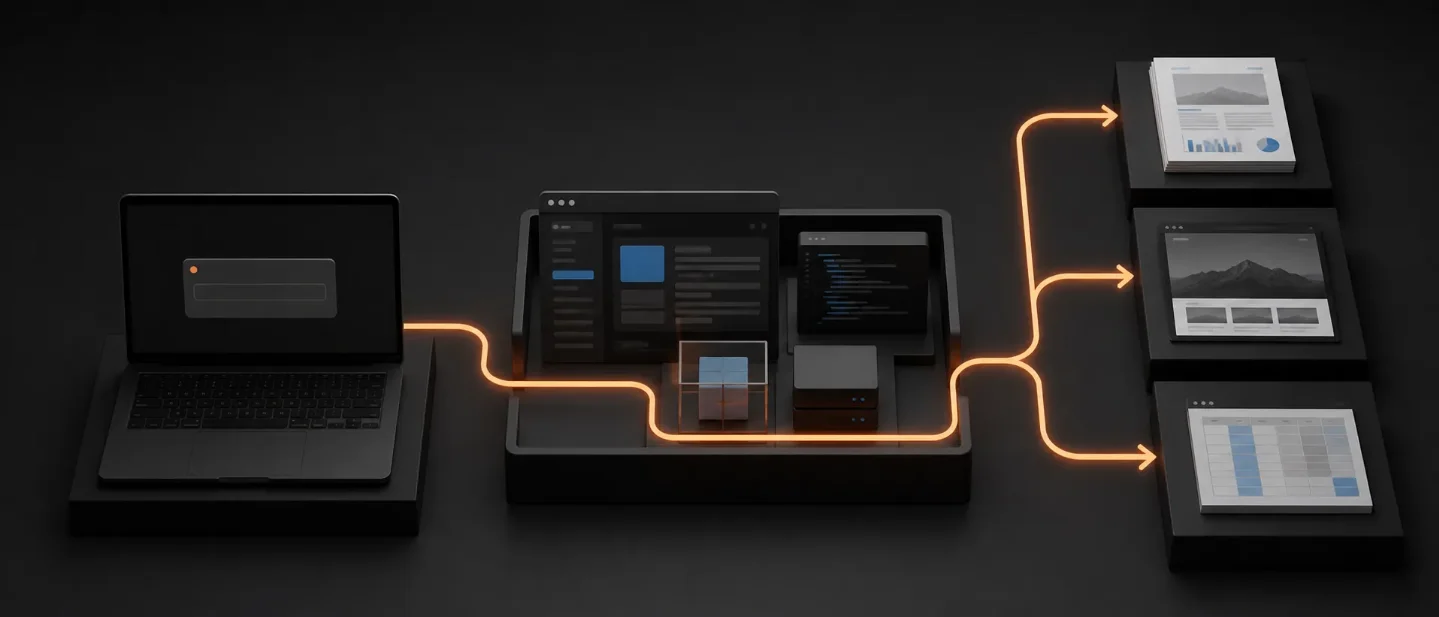
Manus's growth playbook: the viral demo, $100M ARR, and workflow lock-in
A teardown of how Manus turned a task-completion demo into acquisition, made repeat work sticky through Projects and Skills, and monetized execution with credits, pooled team plans, and add-ons.

The thesis
Manus made the launch artifact do the acquisition work. Its debut demo showed an autonomous agent screening job candidates, planning vacations, and analyzing stock portfolios, rather than answering one more question in a chat box. Sacra reports that the demo passed 1 million views and drove a 2 million-person waitlist within a week. TechCrunch later reported that Manus had signed up millions of users and quoted the company saying it was generating more than $100 million in annual recurring revenue from subscribers. The waitlist and revenue figures come from company or analyst reporting, not an independent audit. 12
Manus's own December 2025 update claimed $100 million in ARR and a $125 million revenue run-rate eight months after launch, with growth above 20% month over month since Manus 1.5. It also reported 147 trillion tokens processed and 80 million virtual computers created. Those numbers describe the company's own operating metrics, and the $125 million figure includes usage-based and other revenue. The useful growth lesson is narrower: Manus turned a visible promise of task completion into a credit-metered system that could sell more execution as users asked it to do harder work. 3
Acquisition: sell the finished task
The launch wedge was a change in what prospects had to imagine. A chatbot demo asks whether a model can produce a good response. Manus's demo asked whether an agent could finish a recognizable piece of work. That distinction widened the audience beyond developers who wanted to test a model. Operators, researchers, marketers, and founders could map the examples onto their own unfinished tasks.
The channel mix is not disclosed. What is observable is that the first public demonstrations were themselves distribution: they showed the agent browsing, using tools, and returning an artifact. Sacra's 1 million-plus view and 2 million-person waitlist figures explain why that format mattered, while TechCrunch confirms the specific demo categories and later user scale. 12
The free plan keeps the first experiment cheap: users get Chat Mode, Manus 1.6 Lite in Agent Mode, and 300 daily refresh credits. The product can then meet users where they already communicate. Manus's Telegram integration supports text, voice messages, photos, and documents, and the company says setup needs no terminal, server, configuration file, or API token. It is available across subscription tiers. That turns a separate agent workspace into a capability inside an existing habit, which is a practical acquisition and reactivation surface. 45
Manus's likely ICP is people with multi-step work that is expensive to coordinate: research, data gathering, web publishing, internal operations, and lightweight software delivery. The team page puts that wedge in business terms: agents research, analyze, code, deploy, and manage tasks across Google Calendar, GitHub, Notion, Slack, and more. 6
Retention: make the next task cheaper to start
The strongest retention feature is state, not conversation history. Manus Projects let users attach a master instruction and a knowledge base to a recurring type of work. New sessions inherit that setup, and collaborators receive the shared instructions and files. A weekly report, content pipeline, or competitive-analysis workspace therefore becomes a reusable operating surface instead of a pile of disconnected chats. 7
Skills push the same mechanism one step further. Manus says a successful interaction can be captured as a reusable Skill, then invoked across conversations and projects. Its planned Team Skill Library is meant to spread validated workflows from experienced users to newer ones. The switching cost is not that a user has nowhere else to chat. It is that a team has encoded how it wants a task done. 8
Schedules and connectors turn that stored context into recurring execution. Manus's own Notion examples include a Monday trend-research task, a 30-post social-content workflow, 30-supplier research, and a database built from 100 GitHub prompt examples. These are company-published use cases, not independent productivity studies, but they show the retention path: Manus reads and writes to a system of record, then runs again without asking the user to reconstruct the workflow. 9
The Heicoders Academy case makes the dependency more concrete. The Singapore-based academy says it was on track to train 12,000 students with fewer than 20 employees, and used Manus to build hiring, learner support, course-feedback, HR, scheduling, and prompt-engineering systems without a dedicated software engineer. Those are reported customer outcomes, so they should not be read as independently verified productivity data. They do show the kind of operational surface that can make replacement harder than switching a chat subscription. 10
Team features add organizational retention: shared projects and Skills, pooled credits, usage analytics, access control, SSO, audit logs, and stated SOC 2 Type II and ISO 27001 compliance. The tradeoff is visible too. A credit system makes cost depend on task complexity and duration, so users must learn what work is economical. Manus does not publish an independent retention rate in the sources reviewed here. 611
Monetization: meter execution, then pool demand
Manus's public membership ladder is simple at the front and more operational at the top:
| Plan | Public price and allocation | What expands the bill or unlocks |
|---|---|---|
| Free | $0/month; 300 daily refresh credits; 1 concurrent task | Chat Mode, Lite Agent Mode, and a small daily experiment budget. 4 |
| Pro | Starts at $20/month for 4,000 monthly credits; a higher Pro level starts at $40/month for 8,000 credits | More capable models, Advanced Research, Wide Research, website deployment, slides, and up to 20 concurrent and scheduled tasks. Annual billing is advertised at 17% off. 4 |
| Team | Starts at $20 per seat/month; credits are pooled across members | Shared workspaces, admin analytics, permissions, SSO, shared templates, and add-on credits. 46 |
The unit being priced is not a message. Manus says credits pay for LLM tokens used in planning and generation, virtual machines used for browser automation and code execution, and third-party APIs. Consumption rises with task complexity and duration. Monthly credits reset each cycle and do not roll over; add-on credits remain usable while the paid subscription stays active. Free daily credits are limited to 1,500 per month and work only with Manus 1.6 Lite. 11
That creates three expansion paths. A curious user upgrades for more capacity and better models. A heavy user buys add-ons when a project exceeds its monthly allocation. A team upgrades when individual workflows need shared context, governance, and a pooled budget. The pool matters because it lets a heavy user consume a lighter user's unused capacity before the organization buys more.
The public pages reviewed here do not expose a separate enterprise price. They do expose a Team route with governance and add-ons, so the visible motion is individual subscription to team seat to higher usage, rather than a published enterprise ACV ladder. That is enough to explain the mechanics without pretending the company has disclosed more than it has.
Transferable takeaways
- Demo the completed job. A credible before-and-after task gives a broad audience a reason to share and a specific reason to try. Feature tours are weaker when the buyer still has to imagine the outcome.
- Store the workflow, not just the transcript. Projects, reusable Skills, schedules, and connectors reduce the cost of starting the next task. The durable asset is the team's operating method.
- Let price follow resource intensity. Credits can map revenue to tokens, compute, and external APIs, but the free tier needs a clear enough budget for users to learn the product before they meet the meter.
- Make team expansion feel like waste reduction. Pooled credits, shared context, and admin controls give the organization a reason to consolidate usage. Seat multiplication alone is a weak expansion story when workloads vary widely.
References
- 1Manus at $90M/year
sacra.com
- 2
- 3
- 4What is the current membership pricing for Manus?
help.manus.im
- 5
- 6Team Plan - Manus
manus.im
- 7Introducing Manus Projects
manus.im
- 8
- 9
- 10
- 11
This story was produced automatically by a channel. One sentence is all it takes for Neodrop to keep producing for you.