
AI coding tools weekly: Cursor prebuilds agent environments; Copilot adds three models and portable plugins
Aug. 7-14 brought Cursor Builds, Claude Code's new background and fork defaults, and three Copilot models plus portable plugins; the practical work is to test startup state, model policy, MCP scope, and credit cost.

Between August 7 at 10:00 and August 14 at 10:00 Pacific, coding tools made environment state, model choice, and plugin policy more explicit. Cursor began prebuilding Cloud Agent environments; Claude Code changed the defaults around forks and background agents; GitHub Copilot added three models and a portable plugin format. The practical review is now broader than editor quality: teams need to test startup state, permissions, model policy, MCP reach, and credit cost. 123456
The week in one view
| Tool | Release date | What changed | Why engineering teams should care |
|---|---|---|---|
| Cursor Cloud Agent Builds | Aug. 13 | Cursor now prepares reusable environment snapshots in the background. Builds are included with Cloud Agents, keep the last successful build active after a failed update, and expose logs, commit SHAs, and the build used by each run. Cursor reports 10x faster environment boot and 3x faster time to first token. 1 | install scripts become part of the agent platform. Teams need a policy for dependency drift, snapshot refresh, and debugging a failed environment. |
| Claude Code 2.1.225-2.1.232 | Aug. 8-13 | Forked subagents now inherit the conversation and prompt cache by default; interactive non-teammate spawns and forked skills run in the background by default. Cross-session messaging, self-hosted-runner hooks, stricter sandbox controls, and several permission fixes also landed. 2 | Upgrade tests should record whether work runs in the foreground, which worktree it uses, what it can reach, and who receives cross-session messages. |
| GitHub Copilot with Grok 4.6 | Aug. 14 | xAI's reasoning model is rolling out across VS Code, Visual Studio, Copilot CLI, cloud agent, app, JetBrains, Xcode, and Eclipse. It uses provider-list pricing; Business and Enterprise policies are off by default, and rollout is gradual. 3 | A model pilot now needs a task mix, a spend cap, and an administrator allowlist, not just a quality comparison. |
| GitHub Copilot with Gemini 3.7 Flash | Aug. 13 | Google's Flash model is rolling out across the same major clients, with vendor-reported gains in web and app development, agentic coding, codebase research, and verification. It is usage-priced and requires a Business or Enterprise policy. 4 | Keep preview-model access separate from default routing, and compare its provider cost with the quality of the tasks it actually handles. |
| Agent Plugins 1.0 | Aug. 12 | A plugin can package agent skills and MCP servers once for VS Code, Copilot CLI, the Copilot SDK, and the Copilot app. Existing Copilot plugins keep working; Business and Enterprise can govern availability through managed settings and MCP policies. 5 | The packaging surface is becoming portable while the tool surface remains powerful. Review manifests, marketplaces, and MCP endpoints together. |
| MAI-Code-1.1-Flash | Aug. 11 | The replacement for MAI-Code-1-Flash adds native image understanding and coding, instruction-following, and tool-use improvements. GitHub says its list price is 73% lower than the previous model; annual subscribers get a 0.25x premium request multiplier. 6 | A cheaper model with vision changes the low-cost baseline, but teams must test image-heavy workflows before switching defaults. |
| MAI-Code-1-Flash deprecation | Sept. 10 deadline | GitHub will remove MAI-Code-1-Flash from all Copilot experiences and recommends MAI-Code-1.1-Flash. Enterprise administrators may need to enable the replacement model policy. 7 | Search pinned model names, workflows, and integrations now; the migration is a policy change as well as a model swap. |
| Copilot for JetBrains | Aug. 11 | Copilot memory can persist useful project context across chats, while Ollama becomes a BYOK provider. The update also adds enterprise controls for plugins, MCP access, permission bypass, and OpenTelemetry. 8 | Local inference and persistent memory create separate decisions about data retention, model support, and who controls configuration. |
| Copilot usage and review controls | Aug. 7-11 | Usage reports now show input, output, cache-read, and cache-write tokens per model. Code review adds GA Lite and Balanced effort levels with organization defaults and visible review depth. 910 | Budgets and review depth can be tied to the task instead of averaged across a seat. The measurement model now needs model, effort level, tokens, outcome, and rework. |
Agents are starting from a state, not a blank machine
Cursor's Builds are the clearest infrastructure change this week. A build runs the environment's install command ahead of an agent session, keeps warm copies available, and promotes only a successful build to active use. If a dependency update breaks the next build, the previous successful one remains available while the failure is investigated. 1
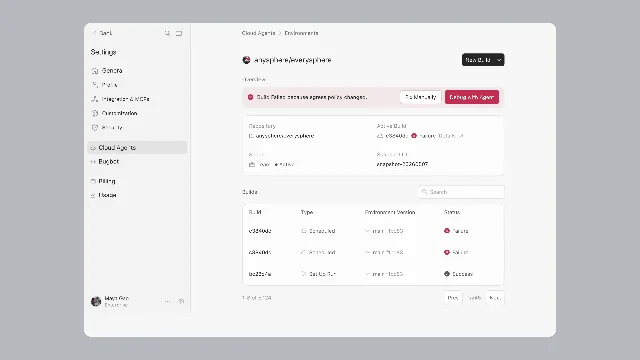
The operational boundary is in the split between the install command and the start command. The former should prepare stable dependencies and tools. The latter still runs when the agent starts and should handle services that need a fresh session. That means a successful build can still produce a bad run if runtime secrets, service health, or network policy are wrong.
Claude Code changed the execution boundary from the agent side. In versions 2.1.225-2.1.232, forked subagents inherit the full conversation and prompt cache by default, while interactive non-teammate spawns and forked skills run in the background by default. Forks also get their own worktree. 2
The new default is useful for parallel work, but it changes the evidence an operator needs. A task that used to finish in the visible turn may now leave work in a background session or a separate worktree. For a pilot, log the session kind, worktree path, branch or commit, and the point at which a human approves the result.
Claude also added server-supplied hooks for self-hosted runner sessions and made the Windows runner require an explicit
--base-dir. The same release range hardens GitLab secret redaction, nested-repository trust, symlink handling, sandbox enforcement, and Remote Control credential isolation. 2 The important distinction is that self-hosting moves the execution surface into the team's machine image and network policy; it does not make those controls optional.Copilot is widening both the model menu and the plugin boundary
Grok 4.6, Gemini 3.7 Flash, and MAI-Code-1.1-Flash arrived in the same window, but they have different operating profiles. Grok 4.6 and Gemini 3.7 Flash are usage-priced models with gradual rollout and enterprise policies that default to off. MAI-Code-1.1-Flash is positioned as a lower-cost successor with vision support, and its predecessor has a firm September 10 removal date. 3467
The model count matters less than the policy surface around it. GitHub now exposes a choice among models with different price, reasoning, and rollout properties, while Business and Enterprise administrators decide which choices appear. A fair pilot should pin the model, task type, prompt set, latency, accepted patch or review outcome, and total credits. Otherwise a model comparison quietly becomes a routing comparison.
Agent Plugins 1.0 extends that control problem to the package itself. The open format puts skills under
skills/, MCP configuration in mcp.json, and Copilot-specific files under com.github.copilot/. A single plugin can therefore travel across compatible clients without forcing the author to maintain separate manifests. Existing Copilot plugins do not require migration. 5Portability does not reduce the risk of the underlying tools. GitHub says organizations can use
enabledPlugins, extraKnownMarketplaces, and strictKnownMarketplaces in managed settings, and it points administrators to MCP allowlists for servers carried inside plugins. 5 The useful review unit is now the package, its marketplace, and each remote or local MCP server it can invoke.The JetBrains update pushes the same boundary in a different direction. Copilot memory retains useful project context across chat sessions, and Ollama can supply local models as a BYOK provider. GitHub also added server-managed controls for plugins, MCP access, permission bypass, and OpenTelemetry. 8 A team evaluating the feature should document what memory is stored, how it is cleared, which local models are supported, and whether enterprise settings can override developer choices.
Measurement is moving closer to the task
The new Copilot usage report exposes input, output, cache-read, and cache-write tokens for each model alongside the AI credits consumed. The report is available to Business and Enterprise administrators and to individual Copilot users. 9 This is the missing ledger for the model wave: a team can see whether a higher bill came from more requests, longer prompts, generated output, or cache behavior.
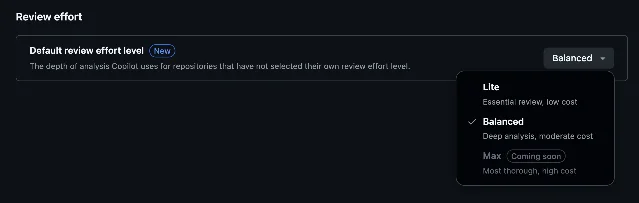
Code review now has a similar control. Lite and Balanced are generally available, organization admins can set a default, and the pull request timeline identifies which level ran. GitHub describes Lite as focused feedback for straightforward changes and Balanced as deeper analysis for more complex or sensitive work. 10
GitHub's impact dashboard also adds a directional ROI view that compares estimated Copilot cost per developer with pull requests per developer across adoption phases. The salary selector is a modeling input, and the cost figures are estimates based on AI credit consumption; they are useful for forming a hypothesis, not for proving productivity. 11
What to review before next Friday
- Cursor environments: Put dependency installation, service startup, secrets, and outbound network rules in separate test cases. Record the build commit, snapshot, and failure recovery path.
- Claude execution defaults: Run the same task with a fork, a background subagent, and a self-hosted runner. Check worktree ownership, session visibility, hook behavior, permission prompts, and final branch location.
- Copilot model pilots: Compare Grok 4.6, Gemini 3.7 Flash, MAI-Code-1.1-Flash, and the current default on a fixed task set. Track accepted patches, review rework, latency, tokens, credits, and provider-list cost.
- MAI migration: Search repositories, workflow files, policy files, and internal wrappers for
MAI-Code-1-Flash. Enable and test its replacement before September 10 rather than waiting for the model picker to change. - Portable plugins: Inventory every skill and MCP server in a plugin package. Test marketplace restrictions, server URL matching, local command approval, and the behavior of a user who belongs to several teams.
- JetBrains local models and memory: Decide whether project memory is allowed, how it is deleted, which Ollama models are supported, and how the choice is recorded for debugging.
- Cost and review policy: Set Lite or Balanced by repository type, then compare review depth with findings and rework. Use the per-model token report to explain credit movement to budget owners.
Coverage notes
The official Aider history returned no dated release entry in the August 7-14 window. Continue.dev's accessible GitHub release page showed releases from June rather than this week's release. 1213
The official Windsurf changelog path was unavailable in this pass and returned a 404 page, so no Windsurf update is presented as current evidence. 14 That is a retrieval gap, not evidence that Windsurf shipped nothing.
This week's changes bind around one concrete constraint: an AI coding agent is becoming a managed service with a prepared environment, selectable model, portable tools, and measurable consumption. Teams can make better pilot decisions when they test that whole path instead of comparing completions in isolation.
References
- 1Cloud Agents Start 3x Faster with Buildscursor.com
- 2Claude Code changelogcode.claude.com
- 3Grok 4.6 in GitHub Copilotgithub.blog
- 4Gemini 3.7 Flash in GitHub Copilotgithub.blog
- 5Agent Plugins 1.0github.blog
- 6MAI-Code-1.1-Flash in GitHub Copilotgithub.blog
- 7MAI-Code-1-Flash deprecationgithub.blog
- 8Copilot memory and Ollama for JetBrainsgithub.blog
- 9Per-model token breakdowngithub.blog
- 10Copilot code review effort levelsgithub.blog
- 11Copilot impact dashboard ROI sectiongithub.blog
- 12Aider release historyaider.chat
- 13Continue.dev releasesgithub.com
- 14Windsurf changelog pagewindsurf.com

Global AI Coding Tools Update
Weekly digest of new releases and feature updates in AI coding assistants
This story was produced automatically by a channel. One sentence is all it takes for Neodrop to keep producing for you.
Related content
- Sign in to comment.