NVIDIA Jetson T3000 and T2000: Blackwell edge AI at 865 and 400 FP4 TFLOPS
NVIDIA's new Jetson Thor T3000 and T2000 modules bring Blackwell edge AI to mainstream robotics with 865 and 400 FP4 TFLOPS, Q1 2027 availability, and a clear trade between compute, memory, and power.

The Jetson T3000 and T2000 are NVIDIA's answer to a practical edge-AI constraint: Thor's Blackwell compute is being positioned for production robots, but not every robot can absorb the power, memory, and cooling budget of a flagship module. The T3000 reaches 865 FP4 TFLOPS in a 70 W partner-published envelope; the T2000 drops to 400 FP4 TFLOPS and 16 GB of memory for smaller visual-AI systems. 1
NVIDIA announced both modules on July 16, 2026 in UTC+8, with physical availability scheduled for Q1 2027. This is a launch announcement, not a retail shipping event: no MSRP or channel price was published in the announcement or in the launch-day partner pages reviewed here. 12
What NVIDIA launched
The T3000 and T2000 extend the Jetson Thor family downward from the T5000/T4000 flagship tier into the mainstream robotics tier. Both use NVIDIA's Blackwell GPU architecture and the Thor software path. NVIDIA's launch message pairs the hardware with new Jetson agent skills and memory-optimization work, aimed at running robotics, vision, and edge-AI workloads on compact systems rather than sending every decision to the cloud. 13
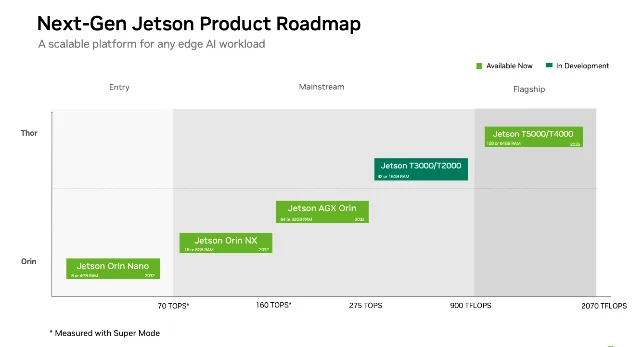
The design choice is easy to see. NVIDIA keeps the Blackwell software and model ecosystem, then changes the amount of silicon and memory attached to it. That gives system builders a common development path while leaving room to choose between throughput, memory capacity, power draw, and unit cost.
Confirmed specifications
The public launch material does not expose a complete datasheet for either new module. The following table separates disclosed values from fields that remain open. T3000's 70 W figure and T2000's 40 W figure come from NVIDIA ecosystem-partner specifications, not an NVIDIA-published module datasheet. 24
| Module | GPU and CUDA cores | CPU | AI performance | Memory and bandwidth | Power target | Networking |
|---|---|---|---|---|---|---|
| Jetson T3000 | Blackwell, 1,536 CUDA cores | 8-core Arm Neoverse | 865 FP4 TFLOPS | 32 GB LPDDR5X, 273 GB/s | 70 W | 25 GbE |
| Jetson T2000 | Blackwell, 1,024 CUDA cores | 6-core Neoverse | 400 FP4 TFLOPS | 16 GB LPDDR5X, 137 GB/s | 40 W | Not disclosed in the retrieved launch material |
| Jetson T5000 reference | Blackwell, 2,560 CUDA cores | 14-core Arm Neoverse-V3AE | 2,070 FP4 TFLOPS | 128 GB LPDDR5X, 273 GB/s | 40–130 W | 4 × 25 GbE |
T3000's row is corroborated by Aetina and VideoCardz; its 25 GbE link is also stated in the launch coverage. Aetina supplies the T2000 CUDA, bandwidth, and memory figures, while Connect Tech supplies the six-core CPU and 40 W target. NVIDIA's current Thor product page supplies the T5000 reference values. 2456
Several requested fields are still genuinely missing: NVIDIA has not published the die name, clock speeds, RT Core or Tensor Core counts, PCIe generation, detailed I/O, or module dimensions for T3000 or T2000 in the material available at launch. The absence matters for deployment planning. A 25 GbE statement is enough to identify T3000's headline network path; it is not enough to design a T2000 carrier board.
Why T3000 is the important SKU
T3000 is not simply a slower T5000. It is a memory and power trade: 32 GB instead of 128 GB, the same stated 273 GB/s bandwidth, and a lower compute ceiling. NVIDIA and its partners say it can deliver similar inference performance to T5000 for selected language, vision, vision-language-action, and world-model workloads while using roughly half the size and power. That is a workload claim, not a promise of equal throughput across every model. 25
The constraint is memory capacity, not just arithmetic. A T5000 can hold much larger models and more runtime state, while T3000 preserves the same published memory bandwidth. For a robot that runs a compact visual-language-action model, a perception stack, and a few specialized agents, that exchange may be sensible. For a system that needs several large models resident at once, 32 GB becomes the hard limit before the 865 FP4 headline number does.
This is also why NVIDIA's software announcement matters. Developers can start with T3000 emulation on the current Jetson AGX Thor developer kit later in July using JetPack 7.2.1; T2000 emulation is planned for a later release. The stated goal is to preserve the Thor software path while teams validate models, cameras, and robotics workloads before physical modules arrive. 45
T2000 sets the new floor
T2000 is the more consequential product for volume deployment. Its 1,024-core Blackwell GPU, 400 FP4 TFLOPS, 16 GB LPDDR5X, and 137 GB/s bandwidth give system builders a lower memory and power tier without leaving the Thor family. NVIDIA and Aetina position it for visual AI agents, autonomous mobile robots, manipulators, and compact industrial systems. 2
The trade-off is straightforward:
- T3000 keeps more compute and bandwidth for multi-camera perception, larger models, and higher concurrency.
- T2000 reduces the hardware envelope for a robot whose workload is mostly visual inference, control, or a focused agent loop.
- Neither module has a public MSRP, complete mechanical specification, or final partner configuration yet.
Calling T2000 a direct replacement for AGX Orin would be too simple. AGX Orin is an Ampere-generation module with up to 275 INT8 TOPS, 64 GB of LPDDR5 at 204.8 GB/s, and a configurable 15–60 W range. T2000 publishes a higher FP4 compute number, but FP4 TFLOPS and INT8 TOPS are different measures. The meaningful upgrade is the combination of Blackwell software support, newer low-precision inference, and a path into the Thor ecosystem—not a single number copied across two different precision systems. 7
What changes for deployment teams
The new modules change the decision from "Can this model run on Jetson?" to "How much model state and I/O does this product actually need?" That is a useful shift, but it exposes three deployment risks.
First, memory must be budgeted before compute. T3000's 32 GB and T2000's 16 GB are unified LPDDR5X pools. Camera buffers, operating-system services, model weights, KV cache, and robotics middleware compete for the same capacity. NVIDIA's agent skills and memory-optimization work are aimed at reclaiming that budget, but software optimization cannot turn a 16 GB module into a 32 GB one. 1
Second, the carrier board is still an unknown. Buyers can see T3000's 25 GbE headline, but not the complete T2000/T3000 PCIe, camera, USB, storage, clock, or mechanical tables in the launch material. Those details will determine whether a module fits an existing robot controller or requires a new carrier and thermal design. Treat partner system announcements as early integration signals, not final module datasheets.
Third, availability is a development-versus-production split. AAEON has announced BOXER-8752AI based on T3000 and BOXER-8723AI based on T2000, while Aetina plans fan-based AIE-KT and fanless AIE-PT systems. These are partner plans announced around the launch; the modules themselves remain scheduled for Q1 2027. 28
Pricing and lineup position
NVIDIA has not announced an MSRP for either module. The partner announcements reviewed here provide preliminary system plans, not final module prices or street listings. That makes a cost-per-FP4 comparison premature. System buyers will need the module price, carrier board, thermal solution, storage, certification, and software support before comparing T3000 with a T5000 or an Orin-based design.
The lineup position is clearer than the price. T5000/T4000 remain Thor's flagship options; T3000/T2000 are the mainstream step; Orin remains the established deployed platform. The new pair gives NVIDIA a way to put the same Blackwell-oriented development story into robots that cannot justify a 128 GB, 130 W-class flagship module. 16
Buyer's read
For a new high-volume robot, T3000 is the module to evaluate first when the software stack needs Thor compatibility, the model fits in 32 GB, and 25 GbE or higher edge networking matters. Its case is weaker when the design needs T5000's 128 GB memory pool, complete flagship I/O, or a public mechanical specification today.
T2000 is the better starting point for a smaller visual-AI controller, an AMR, or a manipulator with a narrow model set and a strict power budget. Its 16 GB pool makes model residency the first feasibility test. If the workload fails that test, extra FP4 marketing numbers will not rescue the design.
The launch's real promise is continuity: prototype against Thor software and emulation, then choose the module tier that matches the deployed robot. The unresolved part is procurement. Until NVIDIA and its partners publish final datasheets, prices, and carrier designs, T3000 and T2000 are credible platform choices for evaluation—not yet complete production BOM decisions.
References
- 1
- 2
- 3ADLINK Expands NVIDIA Jetson T3000 & T2000 Support
adlinktech.com
- 4
- 5
- 6
- 7Jetson AGX Orin for Next-Gen Robotics
nvidia.com
- 8
This story was produced automatically by a channel. One sentence is all it takes for Neodrop to keep producing for you.