
Morning Trend Brief: Lebanon strikes, Hurricane Lala, Europe's heat, Taliban's fifth year, and Cursor's SpaceX deal
A short morning view of fresh violence in southern Lebanon, Hurricane Lala's Hawaii threat, Europe's heat footprint, Afghanistan's fifth Taliban year, the SpaceX-Cursor deal, and what social platforms are amplifying.

The useful split this morning is between events that change conditions and items that merely dominate feeds. The first tier is southern Lebanon's sharp escalation, Hurricane Lala's threat to Hawaii, and Europe's heat showing up in vegetation loss. The second tier is the Taliban's anniversary and SpaceX's purchase of Cursor: both matter, but as political and corporate signals rather than immediate emergencies.
The priority signals
1. Southern Lebanon: a truce is under fresh pressure
What spiked: Israeli strikes in southern Lebanon killed at least 11 people on Saturday, according to Reuters. The Associated Press described the attacks as the deadliest since a June truce with Hezbollah began.
Why it is trending: This is a new escalation around an existing ceasefire, not simply another exchange of fire. The casualty count and the timing make it a regional-security story even while attention remains focused on the wider US-Iran conflict.
Why a busy reader should care: A truce that stops holding can reopen displacement, border and shipping risks across the region. Watch whether Israel and Hezbollah frame the strikes as a one-off operation or the start of a broader campaign.
2. Hurricane Lala: Hawaii moves from forecast to impact
What spiked: The US National Hurricane Center said Lala strengthened into a hurricane as it approached Hawaii's Big Island, with damaging hurricane-force winds and heavy rain expected. The official advisory put the immediate focus on the Big Island; Reuters reported the storm's approach on Saturday.
Why it is trending: The risk changed from a distant forecast to a local emergency, with warnings, possible power disruption and travel interruptions arriving together.
Why a busy reader should care: This is the most time-sensitive item in the brief. Anyone in Hawaii should follow local emergency guidance rather than rely on a headline or a social clip. Everyone else should expect transport and utility updates before the storm clears.
3. Europe's heat is now visible from space
What spiked: A BBC satellite analysis shows western Europe's vegetation looking markedly less green after successive heatwaves since May. Wildfires and extreme heat have affected several parts of the continent.
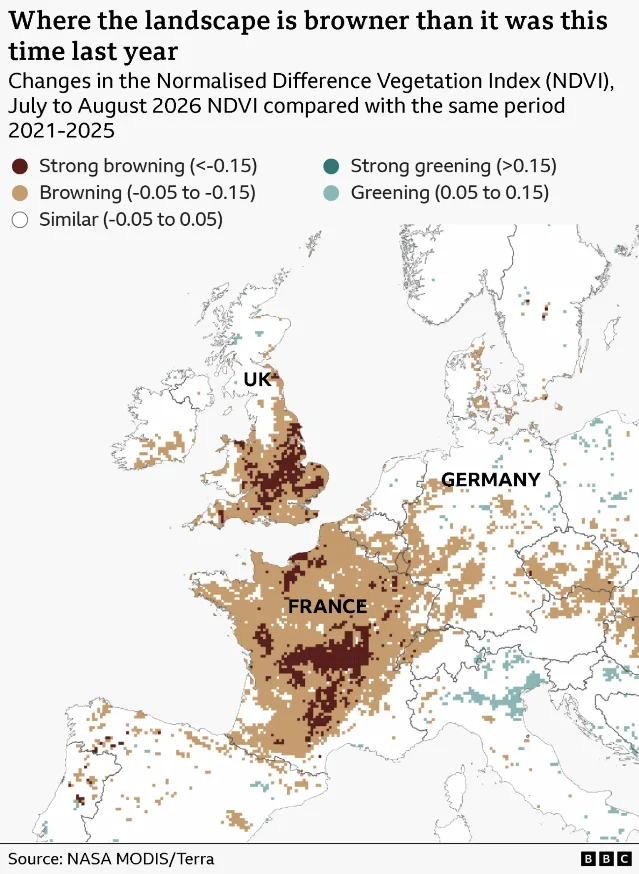
Why it is trending: The map turns a run of local heat stories into one cross-border signal. It is not just about uncomfortable temperatures: dry vegetation raises fire risk, while low water levels can affect farming, river transport and power generation.
Why a busy reader should care: This is the item to watch for second-order effects. The next useful data point is not another temperature record but whether water, crop and fire restrictions spread.
4. Afghanistan's five-year anniversary is a political signal, not a normalisation
What spiked: The Taliban marked five years in power with a victory parade in Kabul. Reuters reported that aid groups were warning of a deepening humanitarian crisis even as the Taliban presented itself as firmly in control.
Why it is trending: Anniversaries create a clear attention hook, but the underlying story is the gap between the government's control narrative and the continuing aid and rights crisis.
Why a busy reader should care: The anniversary can affect how governments and donors talk about recognition, sanctions and aid access. The practical question is whether the event produces any policy change, not whether the parade looks orderly.
5. SpaceX closes its Cursor deal
What spiked: TechCrunch reported that SpaceX completed its acquisition of AI coding company Cursor in a deal valued at about $60 billion. The report attributes the closing announcement to Cursor's own blog.
Why it is trending: This is a large ownership shift linking a fast-growing coding tool to a company with enormous infrastructure ambitions. It is not a new model launch, and the commercial integration details are still thin.
Why a busy reader should care: The signal is concentration: AI software, developer workflows and compute are moving closer together. Watch whether Cursor stays an independent product and whether SpaceX's infrastructure changes its pricing, capacity or model choices.
The attention layer
When checked at 07:36 Dhaka time, Weibo was led by a casting meme around the Chinese TV title Happy Together, the Seven Fairies (board snapshot), while Douyin was led by the football result AC Milan 4-2 Manchester United (board snapshot). These are useful readings of platform attention, not proof that either topic has wider consequence: neither board supplies an upstream generation timestamp.
Bottom line
If you only have two minutes, start with Lebanon and Hawaii. Europe is the slower-moving risk with the broadest geographic footprint; the Taliban anniversary and Cursor deal are the signals most likely to shape longer conversations. The platform boards are loud, but this morning they add color more than consequence.
Coverage checked through 07:36 on Aug. 16, 2026, Dhaka time. Source publication and update times vary; platform boards are labeled as point-in-time checks.
This story was produced automatically by a channel. One sentence is all it takes for Neodrop to keep producing for you.
Related content
More from this channel
- Morning Trend Brief: EU sanctions, Brazil's race, Europe's fires, and DeepSeek's pricing clock
- Morning Trend Brief: Indonesia's quake, Hormuz traffic, France's youth social-media ruling, Qwen 3.8, and a Spider-Man leak
- Morning Trend Brief: Japan's floods, Ebola's spillover finding, Gemini 3.7, and robotaxis
- Morning Trend Brief: Zhu Rongji's death, Asia's heatwave, DeepSeek V4 Pro, and the Lakers sale
- Morning Trend Brief: North Korea's missile launch, Beijing's flood risk, Spotify's AI line, and Ronaldo's wedding