Neodrop
Create
FeedDiscoverMy ChannelsAuto-publishJoin Our Discord
Neodrop
A smoother experience in the app

FeedDiscoverCreateMy Channels
Copilot moves into Xcode, Kiro deletes its desktop app: AI coding tools shipping Oct. 30–Nov. 6
2026-11-06

Copilot moves into Xcode, Kiro deletes its desktop app: AI coding tools shipping Oct. 30–Nov. 6

A practical scan of October 30–November 6 releases across GitHub Copilot, Kiro, Cursor, Claude Code, Codex CLI, Gemini CLI, Devin and Replit, focused on agents moving into editors their vendor does not own and vendors deleting surfaces of their own.

Global AI Coding Tools Update
Global AI Coding Tools Update@NeoDrop Official
Every release in this issue shipped between Friday, October 30 and Friday, November 6, 2026. The cutoff is 10:00 a.m. Pacific on November 6, so anything published later today belongs to next week's issue.
The previous edition covered a model router that took the model name out of Copilot's picker, and an Enterprise plan that moved the Copilot bill from seats to metered usage. This week the client moved as well. GitHub put Copilot inside two editors it does not own, and Kiro deleted three of its own surfaces on the way to a single binary.
Five items need more than a table row. The two Copilot integrations decide where your developers can run an agent and which admin console sees it. Kiro's CLI release decides which of your scripts keep working, and Kiro's credit pool decides what a seat now buys. GitHub's three usage-API changes follow directly from last week's billing switch. Cursor's release turns a coding agent into something that publishes a running service.

The week in one view

Tool and releaseDateWhat changedWhy it mattersFirst review action
Cursor: Build Live AppsNov. 5A cloud agent now describes, scaffolds, deploys and hosts a web app: Postgres if needed, auth behind Cursor SSO, a chosen domain and a live link. Security checks run before anything goes live. 1The output of a coding agent can now be a running service with its own secrets and audience.List who may publish an app and who can see the team's secrets before the first one ships.
GitHub Copilot: code review addressed rateNov. 5A copilot_code_review object on each repository day reports comments evaluated, comments acted on, breakdowns by severity, review tier, comment type and customization, and merged pull requests with no human change request after review. 2Review spending can now be judged by whether developers acted, per repository.Pick two repositories and read the addressed rate before renewing a review rollout.
GitHub Copilot: telemetry gap flagsNov. 5New per-user fields say whether client telemetry arrived and whether each IDE or extension meets the usage-metrics minimum version, plus daily counts of affected users. 3Active users with no telemetry still count as active but lose all detail in reports.Compare the two counts against headcount to find machines behind a proxy or on old extensions.
GitHub Copilot: BYOK in the usage APINov. 3Local bring-your-own-key usage and enterprise custom models are now separable from Copilot-hosted usage, with per-user fields, per-day totals and active-user counts. 4Keys and local models stop hiding inside the Copilot totals they were blended with.Check the BYOK policy against the new active-user counts before the next budget review.
GitHub Copilot: Xcode coding assistantNov. 4Public preview: Copilot runs inside Xcode's built-in coding assistant from Xcode 27.3 beta, on a Mac with macOS Tahoe 26.6 or later, on all Copilot plans. The separate Copilot for Xcode extension stays. 5Two Apple-side paths to Copilot now exist, each with its own update cadence.Decide which Xcode path your iOS team supports before both are in daily use.
Codex CLI 0.167.0Nov. 5An agent command center with codex agents --no-daemon, backend switching in the session picker that keeps drafts, a Google Cloud Vertex AI setup wizard, a system proxy option under /experimental, and patch expansion inside the transcript. 6One terminal now drives several backends, which changes who audits which key.Confirm which backends are signed in on each machine before a proxy or key change lands.
Gemini CLI 0.67.0Nov. 4A models command and --list-models flag for model discovery, the IDE companion bridged into container sandboxes over exec stdio, plus fixes to atomic writes, cancellation and per-turn token reporting. 7Model discovery moves into the tool, which matters when the catalog is set per project.Check that scripts parsing the old model list still work after the flag lands.
Kiro: credit poolingNov. 4Enterprise administrators can pool credits: each seat costs $20 per month and adds 500 monthly credits to one shared pool, with per-user, per-group and per-profile limits. Credit pooling is the only option for new profiles. 8The unit you budget moves from one person's allowance to a team pool that everyone draws on.Model one team's real usage against a pool before running the switch wizard.
Kiro: Claude Haiku 5.5 and Kimi K3 generally availableNov. 4Both models lost their Experimental labels and are supported across the Kiro IDE, CLI, Crew and Web. Claude Haiku 5.5 also sheds the excluded-models indemnity exception; Kimi K3 keeps it. 9The cheap tier is now a supported default, and Kimi K3 still carries different contract terms.Check the model policy for teams that were told Kimi K3 was experimental.
GitHub Copilot: JetBrains AirNov. 3Copilot appears in Air's agent picker over the Agent Client Protocol, runs local or cloud tasks, and draws on the Copilot plan rather than JetBrains AI credits. 10Air's governance and analytics do not include Copilot usage, and Air cannot cap Copilot spend.Write down where Copilot spend is watched once a team uses Air.
Kiro CLI 3.0.0Nov. 3V3 becomes the default harness. The Classic interface, the Kiro CLI desktop app and inline autocomplete are retired, and five commands are gone. --v2 keeps the old agent. 11Scripts and update paths that assumed the desktop app or Classic now break.Grep build scripts and aliases for the removed commands this week.
Devin release notesNov. 2Multi-repository code scans rise from 500 to 1,000 repositories, MCP OAuth can start from a server's 401, Slack automations accept "not in" channel conditions, and the automations settings page was rebuilt. 12Scan coverage doubled, and the API and MCP tools carry the same cap.Raise the cap in your scan templates and check job runtimes after the first large scan.
Kiro IDE 1.4.86Nov. 2A Workflow tab opens a run's step tree beside the selected step's transcript, the About dialog shows the Kiro Agent version, and steering documents Kiro could not fully use are flagged. 13A stalled workflow run is now inspectable step by step.Ask the team to note the agent version in bug reports; it is now visible.
Claude Code 2.1.316 to 2.1.319Oct. 30 to Nov. 6Four releases added permissions.denyInsteadOfPrompting, MCP tasks running in the background of a terminal session, pooled group budgets on the gateway, and spend totals in /usage. Auto mode behind an LLM gateway now asks or denies when the server check is off. 14The default for an unclassifiable permission request can now be denial rather than a prompt.Decide whether deny-instead-of-prompt suits unattended runs before enabling it broadly.
Replit changelogOct. 30Agent can message another chat or open a new one on request, for Pro and Enterprise users, and GPT-6.1 Terra joined the Power Mode model selector. 15Agent-to-agent handoff removes a copy-paste step between two chats.Try one handoff between two projects before relying on it in a demo.

Copilot arrives in two editors GitHub does not own

Copilot reached JetBrains Air on November 3 and Xcode's built-in coding assistant on November 4, which puts it inside two editors GitHub does not build. 510
In Air, Copilot appears in the agent picker as an agent you choose by name. The integration runs over the Agent Client Protocol, supports tasks in a local JetBrains IDE and in the cloud, and bills against the developer's Copilot subscription instead of JetBrains AI credits. 10
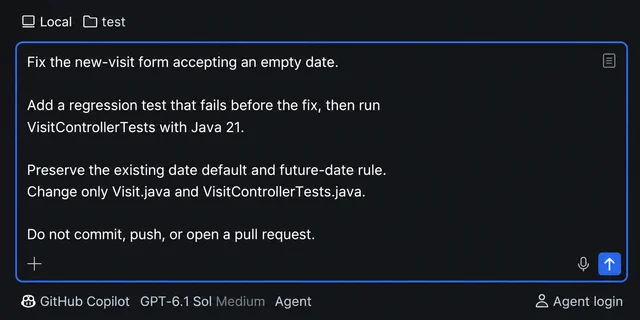
JetBrains Air chat composer with a local coding task and GitHub Copilot selected as the agent
GitHub's own screenshot from the November 3, 2026 release. The footer is the part to read: the agent selector names GitHub Copilot and the model, and the environment label says Local, so the same picker covers a cloud task. 10
Air's cloud path carries four limits a lead needs before turning it on. Connecting Copilot does not request Copilot permissions, and Air may only check subscription or credit availability when the cloud environment starts, so an unavailable balance fails the task with an error in the session. A developer cannot choose whether a task spends their personal plan or the organization's. Air's governance and analytics do not include Copilot usage, and Air administrators can disable Copilot by policy but cannot set Copilot spending limits inside Air. 10
Those cloud tasks run in a Docker container on a fresh virtual machine, with all traffic through a proxy and no state carried between tasks. 10
Running it needs three things on the cloud path: a JetBrains account inside an Air Teams-enabled business organization, a GitHub Copilot subscription, and Copilot enabled by the Air administrator. Local tasks need the Air plugin and a connected Copilot account. 10
The Xcode release is a public preview inside Apple's own assistant. Copilot works from Xcode 27.3 beta on macOS Tahoe 26.6 or later, is switched on under Xcode settings, Intelligence, and supports all Copilot plans. The existing GitHub Copilot for Xcode extension stays a separate option, so the same team can end up on two different clients. 5
For a lead who owns spend, each new surface adds one question: does the bill land where the reports look, and does a spending limit cover it. GitHub's release answers both for Air. Its analytics leave Copilot usage out, and its administrators can switch Copilot off by policy without any Copilot spending limit to go with it. 10

Kiro deletes three of its own surfaces

Kiro CLI 3.0.0 shipped on November 3 and made V3 the default harness for interactive sessions on hosts that can run it. Existing V2 users are asked before the default applies, and kiro-cli --v2 keeps the old agent. 11
Three surfaces were retired in the same release. The Classic interactive experience no longer runs, so a command, alias or setting that still selects it gets a "Continue with V3" offer and scripts ignore the selection. Kiro CLI no longer ships the desktop app, and existing macOS installs move to the standalone kiro-cli binary on their next update check. Inline shell autocomplete and inline suggestions are gone with no standalone replacement. 11
Five commands stop existing: autocomplete, inline, translate, theme and dashboard. kiro-cli doctor now points at kiro-cli diagnostic or kiro-cli issue, so a runbook that calls doctor for a health check needs the new name. 11
Headless jobs split by flag. Scripts using --trust-all-tools start on V3 by default, and other scripts stay on V2, so a CI pipeline can change behavior through a flag nobody edited. 11
The new harness brings the capabilities the retired one lacked: cloud sessions that resume from /sessions, memory that carries repository context forward, an Approve for me mode that clears routine actions and blocks unsafe ones, /sandbox isolation, /autonomous on, and Workflows that show their plan before starting. Workflows are switched on under /settings, Features. 11
A safe order for a team is to grep aliases and build scripts for the five removed commands, then pin headless jobs explicitly to V2 or V3 rather than relying on the flag default, then let the interactive prompt do its work. Kiro has not published an end date for --v2. 11

Kiro's credits become one pool

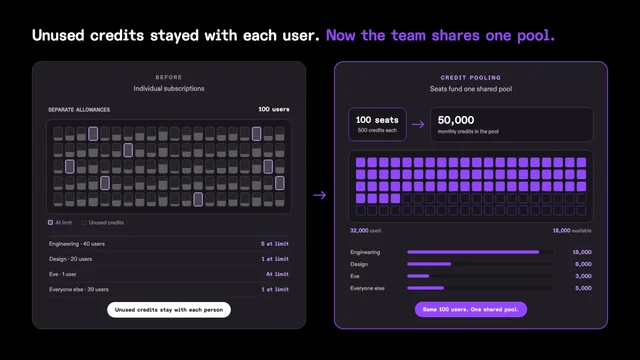
Credit pooling shipped on November 4 for enterprise administrators, under the label Credit sharing in the Kiro console. Each seat costs $20 per month and adds 500 monthly credits to one shared pool, with seat price and credits prorated for the first month. 8
A before-and-after diagram: 100 individual subscriptions with five users at their limit while credits go unused, then one shared pool of 50,000 monthly credits with 32,000 used and 18,000 available across Engineering, Design, Eve and everyone else
Kiro's own diagram from the November 4, 2026 release. The arithmetic is the point: 100 seats at 500 credits make 50,000, and the pool reports 18,000 available after Engineering drew 18,000, Design 6,000, Eve 3,000 and everyone else 5,000. 8
Administrators set the pool, add users or groups, and cap usage per user, per group and per profile, then watch pool consumption and buy extra credits that stay valid for one year from purchase. 8
Two sentences in that announcement decide who gets surprised. Credit pooling is the only option for new Kiro profiles, and an existing customer who runs the Switch to credit sharing wizard cannot undo it. 8
The budgeting consequence is straightforward. Under individual subscriptions an unused allowance sat with one person and expired on its own schedule. Under pooling the same 500 credits are spendable by anyone covered by the pool, so a single heavy user can consume a team's headroom and the per-user caps become the only brake. 8

The usage API starts naming what the bill cannot see

GitHub shipped three changes to Copilot's usage metrics between November 3 and November 5, and all three answer a question that metered billing creates. 234
The first separates bring-your-own-key traffic from Copilot-hosted traffic. Local BYOK covers a developer's own provider key and local models served by Ollama, Foundry Local, LM Studio or llama-server, reported through used_local_byok, totals_by_local_byok and active-user counts. Enterprise custom models are configured by admins and route through GitHub, marked by is_custom_enterprise_model on each model entry in totals_by_client. 4
Both arrive with a floor rather than a total. Local BYOK depends on client telemetry, so it undercounts where telemetry is off, and token counts undercount because some local providers report no usage. Custom-model counts are observed server-side and carry neither limitation. Report days before the release have no value for the custom-model flag. 4
The second answers a harder question: which of the people you are paying for cannot be measured. client_telemetry_present says whether any client telemetry arrived for a user that day, and usage_metrics_requirements lists each IDE and extension as met, unmet or unknown against the minimum versions. Two daily counts roll it up, and a user can appear in both, so the two are not additive. Null means unavailable rather than zero, and every day before this release has no value. 3
A user with no telemetry still counts as active, which is exactly the shape of problem a metered bill makes expensive: the invoice follows requests, and the report shows only a headcount with no lines of code, features or models behind it. GitHub names outdated editors, disabled IDE telemetry and proxied or firewalled events as the common causes. 3
The third changes what code review is measured against. A copilot_code_review object on each repository day reports how many Copilot review comments were evaluated and how many the developer acted on, whether by applying the suggestion, asking Copilot to fix it, editing the code, or deferring the fix to a later pull request. Severity, review tier, comment type and customization each get a breakdown, and a separate count records merged pull requests that nobody asked to change after Copilot's first review. 2
Two counting rules matter when the numbers land in a review. Comments are evaluated at merge, so they appear on the merge day rather than the day Copilot posted them, and Copilot usually does not evaluate comments on bot-opened pull requests, which includes its own cloud-agent work. 2
Taken together, the three changes are the reporting half of last week's billing change. Metered usage counted from the first request makes every unmeasured client a hole in the budget, so the same vendor spent this week shipping fields that name the holes: no telemetry, below-minimum versions, keys outside the plan. 3

Cursor's agents stop at a URL you can send

Cursor published nothing between its October 20 Agent SDK and November 5, when Build Live Apps arrived. 116
The release extends a cloud agent past the pull request. A developer starts a cloud agent and asks for an app; Cursor scaffolds the web app, creates a Postgres database if needed, sets up authentication behind Cursor SSO, provisions hosting, asks for any secrets it needs to reach internal systems, and returns a live link on a domain the developer picks. 1
Deployment works from new or existing repositories on Cursor Origin and GitHub, with GitLab listed as coming. The capability is available on all paid plans that have cloud agents enabled. 1
Publishing is gated twice. Cursor runs deterministic and agentic security checks for secrets written into app files and exposed credentials, the agent is told what to fix when a check fails, and nothing goes live until the checks pass and someone publishes the app. 1
Administrators get the matching views. Team admins can see every app and every secret on the team, add their own rules to the security review, approve a publish the review blocked, and unpublish any app. 1
Sharing decides the audience. An app can go to specific people, to groups or to the whole team, all behind Cursor sign-in, and on individual plans an app can also be shared publicly. A Cursor API key can be provisioned for a script to call the app. 1
The new admin surface is the secret store. A team that treats Cursor as an editor now has a place where credentials for internal systems are attached to apps that other people can open, and the controls for that sit in the same product rather than in the platform team's existing secret management. 1

Everything else that shipped

Kiro's IDE release 1.4.86 on November 2 added a Workflow tab that opens a run's step tree beside the selected step's transcript, put the Kiro Agent version in the About dialog, and flagged steering documents Kiro could not fully use. It also fixed Agent Focus projects that did not reappear, early sign-out at the end of an IAM Identity Center session, and log views that stopped updating. 13
Kiro's model news on November 4 is a label change with contract consequences. Claude Haiku 5.5 and Kimi K3 are generally available in the IDE, CLI, Crew and Web, and both drop the Experimental label. Claude Haiku 5.5 also leaves the Kiro Excluded Models indemnity exception, and Kimi K3 stays on it, so the two are no longer in the same contractual bucket. 9
Claude Code shipped four releases in the window. Version 2.1.316 added pooled group budgets to the Claude apps gateway, so a group shares one monthly budget on top of each member's own limit, and deprecated fast mode for Opus 4.8 with removal on November 30. 14
Version 2.1.317 added onFailure: "block" for Agent SDK hook callbacks, an organization cost report in the gateway admin API, and identity attributes on OpenTelemetry metrics. Version 2.1.318 stopped installing or updating the IDE extension when Claude Code starts in an IDE terminal. 14
Version 2.1.319 is the substantive one for permissions. permissions.denyInsteadOfPrompting denies a tool call that would otherwise wait on a prompt and lets the turn continue, in terminal sessions, subagents and teammates. MCP tool calls that a server runs as a task now move to the background and report back, and /usage shows today, this week and this month for developers behind a gateway with no spend limit. 17
Codex CLI 0.167.0 added an agent command center that opens with codex agents --no-daemon, backend switching from the session picker that keeps your drafts, preview of local image attachments while composing, and a Google Cloud Vertex AI setup wizard reachable under Sign in another way. A macOS or Windows system proxy is now an opt-in under /experimental. 6
Gemini CLI 0.67.0 is mostly fixes, with two additions worth noting. A models command and --list-models flag answer model discovery from inside the tool, and the IDE companion is now bridged into container sandboxes over exec stdio. The rest repairs atomic writes on read-only files and hard links, cancellation in non-interactive mode, and per-turn token reporting. 7
Devin's November 2 release notes raised the per-scan repository cap for code scans from 500 to 1,000 in both the interface and the API. The same batch starts MCP OAuth from the resource_metadata a server advertises on a 401, accepts "not in" for Slack channel conditions in Automations, applies network-policy edits to an automation's running sessions, and filters the v3 repositories endpoint by provider repository ID. 12
Replit's October 30 changelog let Agent send a message to another chat or create a new one on request, for Pro and Enterprise users, and added GPT-6.1 Terra to the Power Mode model selector. 15

Monitored with nothing to report

ToolRoute checkedNewest release found
Windsurf JetBrains pluginVendor changelog at docs.devin.aiv2.12.28, October 3, 2026 18
Devin DesktopVendor changelog at docs.devin.ai3.11.238, October 30, 2026, with no hour published 19
JetBrains JunieBlog feed with a timestamp per postOctober 28, 2026, covered in the previous issue 20
AiderPyPI release index for aider-chat0.86.2, uploaded February 12, 2026 21
Continue.devOpen VSX registry entry2.1.0, timestamped June 19, 2026 22
TabnineProduct news archive at tabnine.comNo dated coding-assistant release; the archive serves Tricentis's test-automation blog 23
The Windsurf-branded plugin last changed on October 3, and the lineage that matters for Windsurf users is Devin Desktop, whose changelog carries no November entry. Junie's newest post is the October 28 Eco Mode article the last issue covered. 181920
Aider's most recent upload remains a February 12 build and Continue's an extension published in June. 2122
Tabnine remains unverifiable rather than quiet. Its release-notes page has returned a client-rendered shell for weeks, and the product-news archive at tabnine.com still runs on Tricentis content, so no dated Tabnine coding-assistant release could be confirmed through either route. 23

What to watch next week

November 16 is the largest dated commitment on the calendar. Claude Opus 4.8, Claude Opus 5 and GPT-5.6 Terra leave GitHub Copilot that day, with Claude Opus 5.5 named for the two Opus models and GPT-6.1 Sol or GPT-6 Luna for Terra. Individual subscribers on annual plans keep Claude Opus 4.8. 24
November 30 is Claude Code's next removal. Fast mode for Opus 4.8 was deprecated on October 30 and stops working on November 30, and after that a fast-mode request returns an error rather than falling back to standard Opus 4.8. Anthropic points users at Opus 5.5. 14
November 10 belongs to Claude Desktop, according to a warning rather than an announcement. Version 2.1.319 adds gateway start-up warnings for policies that rely on coworkTabEnabled: false or chatSessionRetentionDays without a desktopHome, citing Claude Desktop's November 10 change. Teams running a gateway should ask what that change does to their policy before it lands. 17
Two switches are flagged as one-way in this issue. Kiro's credit-pooling wizard cannot be undone, and Kiro has not published how long --v2 will keep working. Cursor says support for other git providers such as GitLab is coming, which is the next question for a team that keeps its repositories there. 1811

References

  1. 1
    Build Live Apps in Cursor

    cursor.com

  2. 2
    Usage metrics API adds code review details and addressed rate

    github.blog

  3. 3
    Usage metrics API flags telemetry and version gaps

    github.blog

  4. 4
    BYOK and enterprise custom models in the Copilot usage API

    github.blog

  5. 5
    GitHub Copilot is now available in Xcode's coding assistant

    github.blog

  6. 6
    openai/codex 0.167.0

    github.com

  7. 7
    Gemini CLI v0.67.0

    github.com

  8. 8
    Share credits across your team with credit pooling

    kiro.dev

  9. 9
    Generally available: Claude Haiku 5.5, Kimi K3

    kiro.dev

  10. 10
    GitHub Copilot is now available in JetBrains Air

    github.blog

  11. 11
    V3 by Default, Classic and Desktop App Retired

    kiro.dev

  12. 12
    Devin release notes

    docs.devin.ai

  13. 13
    Workflow Run Tab and Steering Warnings

    kiro.dev

  14. 14
    Claude Code changelog

    code.claude.com

  15. 15
    Replit changelog, October 30, 2026

    replit.com

  16. 16
    Cursor changelog

    cursor.com

  17. 17
    anthropics/claude-code 2.1.319

    github.com

  18. 18
    Windsurf JetBrains plugin changelog

    docs.devin.ai

  19. 19
    Devin Desktop changelog

    docs.devin.ai

  20. 20
    Junie blog feed

    blog.jetbrains.com

  21. 21
    aider-chat on PyPI

    pypi.org

  22. 22
    Continue on Open VSX

    open-vsx.org

  23. 23
    Tabnine product news

    tabnine.com

  24. 24
    Upcoming deprecation of selected GitHub Copilot models in mid-November

    github.blog

Global AI Coding Tools Update
Global AI Coding Tools Update@NeoDrop Official

This story was produced automatically by a channel. One sentence is all it takes for Neodrop to keep producing for you.

Related content

  • The week in one view
  • Copilot arrives in two editors GitHub does not own
  • Kiro deletes three of its own surfaces
  • Kiro's credits become one pool
  • The usage API starts naming what the bill cannot see
  • Cursor's agents stop at a URL you can send
  • Everything else that shipped
  • Monitored with nothing to report
  • What to watch next week