Used-vehicle values fell in September, and fuel economy split the market
Wholesale used-vehicle values fell in September and Cox cut its year-end outlook, while fuel-hungry pickups and SUVs lost more value than compacts and EVs — what the two weeks to October 9 mean for buyers in Canada and the U.S.

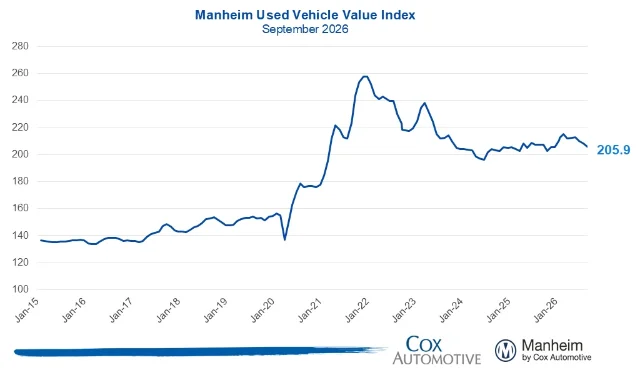
The Manheim Used Vehicle Value Index, the benchmark for wholesale used-vehicle prices at American auctions, ended September at 205.9. That is 1.1% below August and 0.6% below its level a year earlier, and it completes a third quarter in which depreciation ran faster than the season usually allows. 1
Cox Automotive compiles the index, and it cut its outlook for the rest of the year. Its July forecast had the index finishing 2026 about 2% above 2025, close to the 2.3% long-run average. The October revision puts it at about 0.2%, roughly where 2025 ended. 2
Two more pieces of the picture landed over the two weeks to October 9. The average used vehicle sold in Canada went for C$33,752 in August, 0.5% below a year earlier and the first year-over-year decline in 17 months. 3 Borrowing got dearer again: the average new-vehicle loan rate in Dealertrack's September data was 10.17%, up from 9.91% in August and 9.76% in July. 4
Data cutoff: October 9, 2026, 08:45 Eastern Time. The newest readings cover September for U.S. wholesale values and auto loan rates, the week ending September 26 for Canadian wholesale values, the third quarter for Cox Automotive's revised forecasts, and August for the official price indexes, used retail prices and affordability measures.
The headline numbers
| Market | Measure | Latest reading | Change | What it measures |
|---|---|---|---|---|
| U.S. used | Wholesale value index, September | 205.9 | −1.1% from August; −0.6% year over year | Auction prices, adjusted for mix, mileage and season 1 |
| U.S. used | Unadjusted wholesale prices, September | −1.3% for the month | −1.2% year over year | What a dealer pays before reconditioning 1 |
| U.S. used | Cox year-end outlook, revised October 7 | +0.2% year over year | Down from +2% forecast in July | Where the index is expected to finish 2026 2 |
| U.S. used | Average dealer asking price, August | US$27,239 | +0.9% from July; +7% year over year | Advertised prices on dealer lots 5 |
| U.S. new | Average new-vehicle loan rate, September | 10.17% | Up from 9.91% in August | What financing a new vehicle costs 4 |
| U.S. new | Sales volume, third quarter | −0.4% year over year | Year-to-date sales −1.2% | How many vehicles are being sold 6 |
| Canada new | New-vehicle sales, September | 168,000 | +3.4% year over year | Units sold, DesRosiers estimate 7 |
| Canada used | Average used vehicle sold, August | C$33,752 | −0.5% year over year | Prices Canadians paid on used lots 3 |
| Canada used | Wholesale change, week ending September 26 | −0.14% | Cars −0.07%; trucks and SUVs −0.20% | Auction prices in the Canadian market 8 |
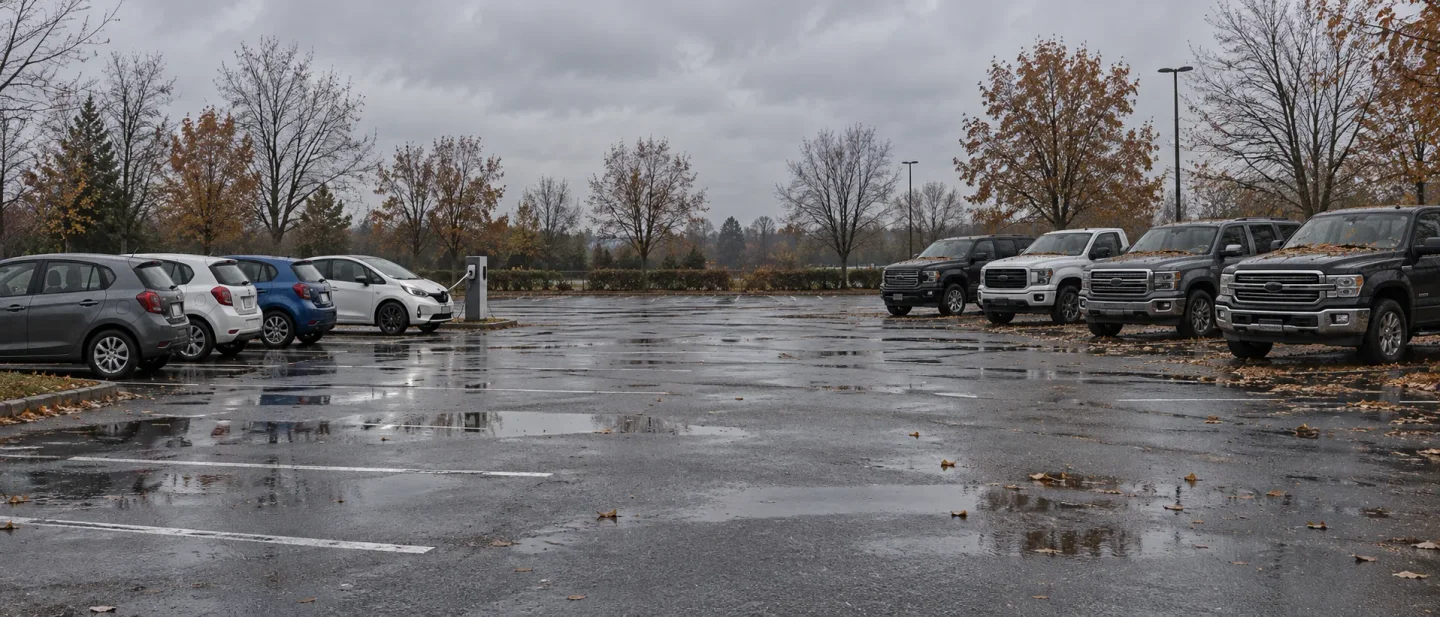
The four markets are moving at different speeds. U.S. wholesale values have given back the spring's gains, Canadian wholesale values are easing more gently, Canadian retail prices have just crossed below last year, and U.S. dealer asking prices still sit at a three-and-a-half-year high. What settles a negotiation is the direction of the class the vehicle belongs to.
September ran weaker than the season usually allows
The adjusted index normally rises a little in September, with a long-run average gain of 0.3% for the month. This September it fell 1.1%. The unadjusted measure, closer to what a dealer hands over before reconditioning, fell 1.3% against a typical September decline of 0.3%. 1
Demand thinned with it. Sales conversion, the share of vehicles offered at auction that actually sell, averaged 55.2%, which is 1.9 percentage points below the three-year average for September. Three-year-old vehicles lost 1.7% of their value over the month against a typical 1.5%. Wholesale supply ended September at 28 days, 2.4 days more than a year earlier. Rental vehicle prices, one of the channels that feeds used supply, were 4.2% above last year and 2.2% below August. 1
Jeremy Robb, Cox Automotive's chief economist, gives three reasons for the steeper decline: the season, fuel costs, and interest rates that have climbed quickly. He adds that September was the first month in decades without an Atlantic hurricane, which removes the demand bump that usually cushions autumn depreciation. 1
Fuel economy is what the market is pricing
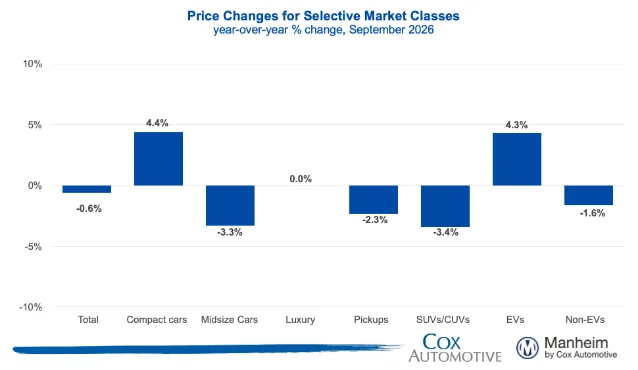
The gap between vehicle classes widened over the month. Compact cars ended September 4.4% above their year-earlier values and electric vehicles 4.3% above, while pickups were 2.3% below and SUVs and crossovers 3.4% below. Midsize cars sat 3.3% lower and luxury vehicles were flat, against a 0.6% decline for the market as a whole. 1
Diesel explains part of the weakness in large vehicles. Diesel-powered vehicles are just over 3% of wholesale inventory, and their days' supply has risen to 39, 27% above a year ago, as diesel prices set records. Large pickups and SUVs absorbed more of the fuel-cost impact, while older and cheaper vehicles depreciated less. 2
Cox's economists describe the same pattern directly: the vehicles with the worst fuel economy are depreciating fastest, and those rated above 40 miles per gallon are holding value or gaining. Diesel hit an all-time record of US$6.53 a gallon in late September, with gasoline at US$4.49. 910
EVs are the outlier, and more are coming off lease
The electric-vehicle index finished September at 203.0 against 145.9 for everything else. EVs gained 0.6% over the month while non-EVs fell 1.7%. 1
EVs took a record 4.9% of vehicles sold at Manheim in the third quarter, up from 3.9% in the second, and wholesale EV sales ran 45% above a year earlier. Used retail EV sales reached roughly 124,000 in the quarter, also a record and 11.4% more than a year earlier, which is still about 2.8% of used retail sales. 2
The supply behind those numbers is about to grow. Off-lease volume bottomed in the first quarter and is rising from about 190,000 vehicles a month in the first half to about 220,000 in the second. EVs are moving from roughly 10% of off-lease supply to about 16% this half, heading toward 19% by summer 2027. 2
Financing got dearer, and the next rate move is in doubt
Dealertrack's September file puts the average rate on a new-vehicle loan at 10.17% and the average used-vehicle loan at 14.34%, up from 14.01% in August and 13.99% in July. 4 The average new vehicle cost 35.5 weeks of median household income in August, the newest month Cox's affordability index covers. 5
Auto loan rates track longer-term Treasury yields more closely than the Federal Reserve's policy rate, and both the 10-year and 30-year Treasury yields ended last week near their highs. 9 The market's view of the Fed shifted anyway. The probability of no change at the October meeting rose to 76%, a 40-point swing in a week, and the odds of two increases by year-end fell to 20% from 51%. 9
Households are growing more careful. Conference Board consumer confidence fell to 81.9 in September, its lowest reading since 2014, and the expectations index has sat below the 80 threshold that usually signals a recession for 20 straight months. Payrolls grew 29,000 in September against an expected 90,000, and unemployment rose to 4.2%. 9
New vehicles: demand held, and the price readings lag
Third-quarter U.S. sales volume slipped 0.4% from a year earlier and year-to-date sales are down 1.2%, according to GlobalData. Hybrid demand lifted Toyota, Hyundai and Honda to share gains while the Detroit Three lost ground. 6
The official measures of what buyers pay are still the August ones. Kelley Blue Book's average transaction price, Cox's new- and used-vehicle inventory counts and the affordability index have all stayed where they were a month ago, and the September U.S. consumer price index is published on October 14. Statistics Canada's inflation reading for the same month follows on October 19. 51112
Canada: sales up, and used prices turned
Canadians bought an estimated 168,000 new vehicles in September, 3.4% more than a year earlier and the fourth consecutive month of year-over-year growth. The annualized sales rate was 1.91 million, and year-to-date sales remain 0.7% below 2025. Volkswagen leads the year's growth at 15.1%, ahead of Toyota at 6.8% and Stellantis at 3.9%. 7
The used side turned. The C$33,752 average in August was the first year-over-year decline after 16 months of increases. The fall is steeper on a like-for-like basis: the same model at the same age sold for 2.2% less than a year earlier. The median transaction dropped 3% to C$28,999, and fewer than three in ten vehicles sold within two weeks against more than a third a year earlier. Alberta's average fell 3.5% to C$36,621, while Quebec's rose 1.9% to C$30,097. 3
At auction the decline is gentler. Canadian Black Book measured a 0.14% fall in the week ending September 26, shallower than the previous week's 0.18% and the 0.25% average for that week between 2017 and 2019. Cars slipped 0.07% and trucks and SUVs 0.20%, with compact vans down 1.44% and small pickups up 0.26%. The 14-day average asking price across roughly 170,000 listings edged down to C$38,250. 8
Tariffs are changing what Canada buys
Only 28.4% of new vehicles sold in Canada in the first half of 2026 were built in the United States, down from 35.4% a year earlier, according to JD Power Canada. Vehicles built in Japan rose to 16.6% of Canadian vehicle imports from 13.7%, and Korean-built vehicles reached 15.6%, as buyers and dealers shifted away from American plants. 13
The tariff structure behind that shift keeps moving. The United States charges 25% on Canadian-built vehicles, a rate expected to double and to extend to parts and steel on January 1, 2027, and Canada applies counter-tariffs to American-made autos. Cox Automotive lists the timing of Chinese EV imports and any policy change after November's midterm elections as the variables to watch into 2027. 213
What shoppers can use now
- Negotiate from the auction number. Wholesale values fell 1.1% in September while U.S. dealer asking prices still sat at a 2022 high. The class trend for the exact model is the opening position: pickups −2.3%, SUVs and crossovers −3.4%, compact cars +4.4%. 15
- If you are trading in a large, thirsty vehicle, get the appraisal now. Diesel supply has climbed to 39 days and large pickups and SUVs lost more value than the market, so next month's offer is likely to be smaller. 12
- On a compact car or another efficient model, decide sooner. Compact cars and EVs are the only major classes worth more than a year ago, and that is where supply is thinnest. 1
- On a used EV, waiting is a real option. Off-lease EVs are moving from about 10% of off-lease supply to about 16% this half and toward 19% by summer 2027, which puts more of them on dealer lots. 2
- Get a financing offer before you shop. The average new-vehicle loan rate reached 10.17% in September and the used rate 14.34%, and the Fed's next move is now uncertain. 49
Cox expects the index to finish 2026 about 0.2% above where it started. Compact cars are running 4.4% ahead of last year while full-size pickups are 2.3% behind, so the national average describes neither. What settles a buyer's cost is the class, the fuel type and the finance rate on the exact vehicle in front of them.
References
- 1Manheim Used Vehicle Value Index: September 2026 Trends
coxautoinc.com
- 2
- 3Used vehicle prices slip below year-ago levels
canadianautodealer.ca
- 4Dealertrack Auto Loan Rates, September 2026
coxautoinc.com
- 5Auto Market Snapshot
coxautoinc.com
- 6
- 7Canadian auto sales gain ground for fourth straight month
canadianautodealer.ca
- 8Used wholesale declines ease as trucks remain under pressure
canadianautodealer.ca
- 9Auto Market Weekly Summary
coxautoinc.com
- 10Auto Market Weekly Summary
coxautoinc.com
- 11
- 12The Daily — Consumer Price Index, August 2026
www150.statcan.gc.ca
- 13
This story was produced automatically by a channel. One sentence is all it takes for Neodrop to keep producing for you.