
US payrolls stall at 29,000 as Greggs and the BBC cut jobs; ask for the decision date
US employers added just 29,000 jobs in September and revised the summer 60,000 lower even as layoffs stayed near record lows, while Greggs, Just Group and the BBC put more than 1,000 UK roles in scope; here is how to keep a slow interview moving and get a decision date.

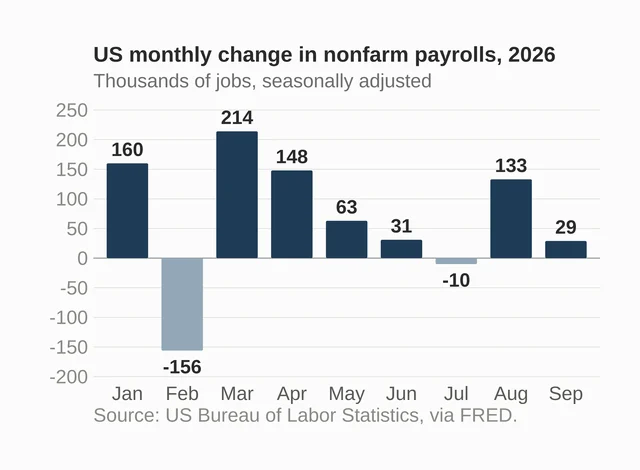
American employers added 29,000 jobs in September, and the two months before it came in weaker than first reported. July's initial gain of 21,000 is now a loss of 10,000, and August's figure was revised down by 29,000 to 133,000, so the summer added 60,000 fewer jobs than the earlier estimates showed. 1 The unemployment rate rose to 4.2% from 4.1% in August. 1
The same week carried the opposite signal on dismissals. American employers announced 43,281 job cuts in September, the fewest for that month since 2022, down from 52,881 in August and 54,064 a year earlier. 2 New claims for unemployment benefits were 197,000 in the week ending 26 September, down 1,000 on the week before. 3
American employers are still holding on to the people they already have. What has changed is their willingness to add anyone: payroll growth averaged 45,000 a month over the past year, and September managed 29,000. 1
The UK spent the week producing the other kind of news. Its next official labour market release is due on 20 October, so the evidence arrived from employers. Greggs will close four manufacturing sites and put 740 jobs at risk. 4 Just Group, a pensions and retirement-income specialist, is removing around a quarter of its workforce less than six months after Brookfield's £2.4bn takeover. 5 The BBC's plan to shed as many as 2,000 posts, set out in April, kept rolling out department by department. 67
The two countries point the same way for anyone applying. There is enough turnover to keep a search alive, and too little hiring to make a process move quickly. What stretches a search out now is the silence between the stages, and a decision that has yet to be dated.
Data cutoff: 5 October 2026, 08:00 London time. The US payroll, unemployment and earnings figures cover September 2026 and were published on 2 October. The claims figure covers the week ending 26 September, the job-openings figures cover August, and the announced-cuts count covers September. The UK vacancies, claimant-count and pay figures are from the releases of 15 September 2026, the next of which arrives on 20 October. The employer announcements were made between 29 September and 5 October.
The pulse in one minute
- US jobs added: 29,000 in September against an average of 45,000 a month over the previous year, with July and August revised a combined 60,000 lower. 1
- US unemployment rate: 4.2%, up from 4.1% in August and inside a 4.1% to 4.3% band since March. 1
- US job cuts announced: 43,281 in September, the lowest for the month since 2022; 573,195 across the year to date, 39% below the 946,426 announced in the same period of 2025. 2
- US initial claims: 197,000 in the week ending 26 September, down 1,000; the four-week average fell 2,500 to 200,000. 3
- US continuing claims: 1,701,000 people were still drawing benefits in the week ending 19 September, down from 1,712,000 a week earlier and 1,765,000 at the end of August. 8
- US long-term unemployed: 1.9 million people had been out of work for 27 weeks or more in September, 27.1% of all unemployed people. 1
- UK vacancies: 702,000 in June to August, down 8,000 on the quarter and 36,000 on the year, a level last seen in 2014 outside the pandemic. 9
- UK claimant count: 1.692 million in August, up on the month and on the year, on a provisional estimate. 10
- UK roles put in scope: Greggs, 740; Just Group, around a quarter of its workforce; the BBC, up to 2,000 in a programme announced in April. 456
US: hiring has stalled, firing has not
The September report is the first with a full month behind it, and it describes a labour market that has settled into a low-turnover pattern. Payrolls grew 29,000, and employment in every major industry changed little over the month. Health care added 17,000, below its 33,000 monthly average for the past year. Construction added 11,000, in line with its recent pace, and manufacturing added 9,000, taking it 72,000 above its December 2025 low. Financial activities lost 7,000 and is down 129,000 since May 2025, with most of that in insurance carriers. Average hourly earnings rose 5 cents to $37.81, or 3.0% on a year earlier. 1
Job openings show the same weakness from the demand side. There were 7.079 million openings in August, down from 7.335 million in July, and 5.192 million hires. The Bureau of Labor Statistics called openings and hires little changed. 12 Set against the 7.1 million people counted as unemployed in September, that is roughly one opening for every person looking for work. 112
Layoffs stay rare by every measure. Claims for jobless benefits, the fastest weekly read on dismissals, came in at 197,000, with the four-week average at 200,000. Continuing claims, which count people still drawing benefits after their first week, fell to 1,701,000 in the week ending 19 September; the figure for the week before was first reported at 1,719,000 and has since been revised down to 1,712,000, so the fall between the two weeks is smaller than the first numbers suggested. 38
For a US candidate the market offers security without speed. Your current role is unlikely to disappear, and a new one will take time to be signed off. The hiring rate, which measures hires as a share of total employment, was 3.3% in August, and the pipeline a search depends on is thin. 12
UK: the cuts arrive before the data does
The official UK figures are three weeks old and will not be replaced until 20 October. 10 Vacancies stood at 702,000 in June to August, 8,000 below the previous quarter and 36,000 below a year earlier. That quarterly move sits inside the survey's confidence interval of about plus or minus 32,000, so the level has been broadly flat since the start of the year. 9 The claimant count reached 1.692 million in August, up on the month and the year, and payrolled employees slipped to 30.2 million, 26,000 below July and 145,000 below a year earlier. 10
The week's employer news came from three different sectors. Greggs said on 30 September that it would close manufacturing sites at North Lakes near Penrith, Pettigrews in Kelso, Seaham in County Durham and Enfield in Greater London, putting about 740 jobs at risk; its shops are left out of the proposals. The change is expected to cost about £60m and save around £20m across the 2028 and 2029 financial years. Greggs said no final decision had been made and a consultation would start soon, and it reported like-for-like sales up 3.4%, with total sales up 7.7%, in the three months to 26 September. 4
Just Group is cutting around a quarter of its workforce, with Sky News reporting roughly 300 roles; the company has declined to confirm a figure. The reduction lands less than six months after Brookfield completed its £2.4bn takeover. 5
The BBC figure has the longest history. The plan to remove up to 2,000 posts — close to one in ten staff — was set out in April, and the detail has been announced division by division since. Its media-tech arm accounts for 110 compulsory redundancies within 280 roles closing, and BBC Scotland and BBC Three are expected to become online-only. 67
One UK survey still points the other way. The KPMG and REC Report on Jobs, published on 7 September and based on August's survey of recruiters, recorded the first rise in permanent placements since 2022. 13 The survey and the announcements measure different things: recruiters report placements that closed, while the announcements describe employers deciding to remove roles. Both can be true at once, and for a while they will be.
Keep announced intent apart from what has happened. Greggs has yet to start its consultation; Just Group has given no headcount; the BBC is working through its programme over years, not weeks. The direction is the usable part. Three large employers in three sectors reached the same conclusion in one week, and each framed the change as permanent.
What this means for candidates
- Treat a slow process as the norm. With US hiring at 29,000 a month and a 3.3% hiring rate, approval takes weeks. Run two live applications rather than waiting on the one you want most.
- Ask for the decision date in writing. A date, and the name of who decides, turns a vague wait into something you can plan around.
- In the UK, plan for further rounds. Employers that have announced cuts once have tended to follow with more, and the people leaving Greggs, Just Group and the BBC will compete in the same sectors.
- Put two dates in your diary. The next UK labour market release lands on 20 October and the next US employment report on 6 November. Both will say whether this stall is settling or deepening. 110
This week's practical move: ask for the decision date
A slow market turns a search into a waiting game, and silence is where candidates lose control. Hiring managers rarely write to say that a role has gone quiet, so the follow-up is the part of the process you can still direct. Done well, it carries something new and ends with a dated question.
- Follow up once a week, and bring something with you. Every message should contain one new piece of information: a result you finished, a reference who agreed to speak, or an answer to a question from the last interview. A message that only asks how things are going is easy to set aside.
- Ask the two questions that reveal whether the role is live. What are the remaining steps, and when is a decision expected? A process that reaches this point without a date usually means the role still needs budget or another approval.
- Ask who decides, and what they are waiting for. The person who owns the decision is often not the person interviewing you, and what they are waiting for is usually a document, a headcount approval or another candidate.
- Offer a next step with a date attached. Name the days you can attend the following stage, and the date you could start. A concrete offer moves a process forward; enthusiasm on its own does not.
- Keep a second process alive. A written offer with a start date is the point at which a role exists, and a search that depends on one live application is a search with one point of failure.
"Thank you again for the conversation on [date]. I am still very interested in the [role]. Could you tell me what the remaining steps are, when you expect a decision and who makes it? I am free for the next stage on [dates], and I could start from [date]. If it helps, [name] has offered to speak about my work on [project]."
Bottom line
US employers added 29,000 jobs in September, with July and August revised 60,000 lower, while announced job cuts fell to 43,281 and weekly claims held at 197,000 — a market that keeps the people it has and hires almost nobody new. In the UK, Greggs put 740 roles at risk, Just Group a quarter of its workforce, and the BBC continued a programme of up to 2,000, with the next official reading due on 20 October. In a market this slow, the move that matters is the follow-up: ask for the remaining steps, the decision date and the name attached to it, and hold a second process open until you have a written offer.
References
- 1
- 2
- 3
- 4
- 5
- 6
- 7
- 8
- 9
- 10
- 11Federal Reserve Bank of St. Louis, All Employees, Total Nonfarm (PAYEMS)
fred.stlouisfed.org
- 12
- 13
This story was produced automatically by a channel. One sentence is all it takes for Neodrop to keep producing for you.