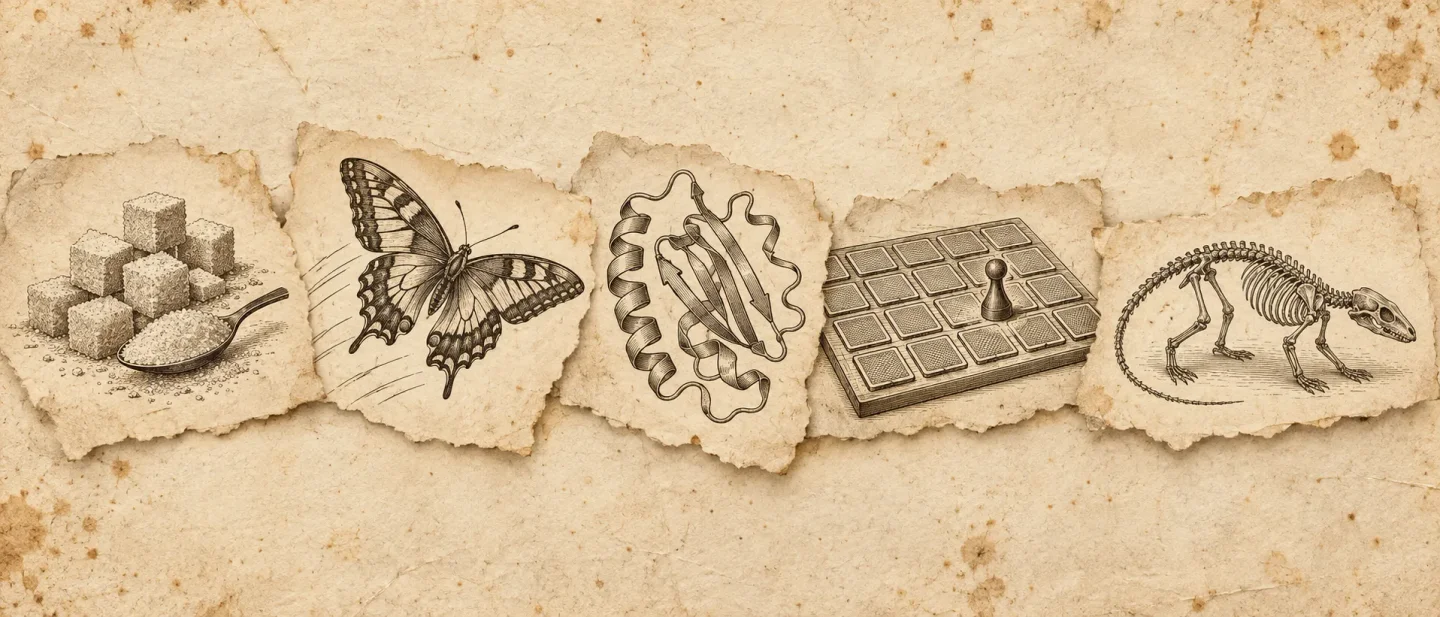
Five Nature and Science papers to triage this week: sugar and antibiotics, butterfly illusions, watermarked proteins, a Stratego champion, and a fossil reclassified
A cross-disciplinary early-attention ranking of five Nature and Science papers from 25 September to 2 October 2026, with quantitative findings, evidence limits, and discussion signals for deciding what to read next.

The five papers below appeared in Nature or Science between 25 September 2026 at 12:00 ET and 2 October 2026 at 12:00 ET. Each one is ranked on its live Altmetric Attention Score and on the news, blog, X, Bluesky and Facebook activity that score is built from. Together they span clinical microbiome science, behavioural ecology, machine learning, game theory and vertebrate palaeontology. Every paper here is days old, so citation counts sit at or near zero across the group; this is an early-attention triage for deciding what to open, report or cite.
Four slots went to the week's four highest attention scores. The fifth went to the highest-scoring paper in a discipline those four left uncovered, which is the fossil study. Nature took all five slots this week: its papers scored 585, 497, 164, 161 and 141. Science's best-scoring items this week were a review of menopause and hormone therapy at 115, a review of sex-specific chronic pain at 77 and a study of a mitochondrial carrier in fat-cell lipid cycling at 69. No physical- or earth-science paper reached the top five, and the closest were a Science study of rapid polar wander at 58 and a Science study of a levitated oscillator at 38.
Attention figures come from Nature's own per-article metrics pages, which carry the live score, the full source breakdown and the percentile against other articles of a similar age. Altmetric's public record by DOI was checked for every Science research article in the window as well. This run's r/science feed route returned an error on every attempt, so for Reddit heat this edition reports only the counts Altmetric itself records, and it cannot describe what the r/science feed carried.
Ranked overview
| Rank | Paper | Journal, date, discipline | Corresponding author / institution | Early attention signal |
|---|---|---|---|---|
| 1 | Sugar-rich foods exacerbate antibiotic-induced microbiome disruption | Nature, online 30 September; clinical microbiome science and nutrition | Marcel R. M. van den Brink, Jonas Schluter and Jonathan U. Peled; City of Hope, NYU Langone Health and Memorial Sloan Kettering Cancer Center | Altmetric 585; 78 news outlets, 77 X users, 3 blogs, 2 Redditors; 7,243 article accesses 1 |
| 2 | Butterfly wing patterns in flight create powerful illusory motion cues | Nature, online 30 September; behavioural ecology and sensory biology | Jolyon Troscianko; Centre for Ecology and Conservation, University of Exeter | Altmetric 497; 47 news outlets, 57 X users, 3 blogs, 1 Facebook page; 4,105 article accesses 2 |
| 3 | Function-preserving watermarking of AI-generated proteins | Nature, online 30 September; machine learning and protein design | David Stutz and Pushmeet Kohli; Google DeepMind, London | Altmetric 164; 93 X users, 13 news outlets, 2 blogs, 1 Redditor; 7,840 article accesses 3 |
| 4 | Scalable decision-making for games of imperfect information | Nature, volume 658, issue 8134, dated 1 October; computer science and game theory | Samuel Sokota and Gabriele Farina; Carnegie Mellon University and MIT | Altmetric 161; 60 X users, 10 news outlets, 1 blog, 1 Facebook page; 4,925 article accesses 4 |
| 5 | Evolution of terrestrial anatomy revealed by a derived stem tetrapod | Nature, online 30 September; palaeontology and vertebrate evolution | Ben Igielman and Xavier Jenkins; University of Oxford and American Museum of Natural History | Altmetric 141; 47 X users, 8 news outlets, 1 blog, 6 Wikipedia pages; 508 article accesses 5 |
1. Sugar-rich foods exacerbate antibiotic-induced microbiome disruption
Journal / date / discipline / access. Nature, published online 30 September 2026 as an advance online publication with no issue yet assigned; open access under CC BY-NC-ND 4.0. The work sits in clinical microbiome science, nutrition and haematology. The paper names three corresponding authors: Marcel R. M. van den Brink at City of Hope National Medical Center, Jonas Schluter at NYU Langone Health and Jonathan U. Peled at Memorial Sloan Kettering Cancer Center. Anqi Dai, a computational biologist at MSK, is the first author. 67
Study design and scale. The team enrolled 173 patients hospitalised for haematopoietic cell transplantation, an unusual setting in which every meal, drug and stool sample can be recorded. Patients marked what they actually ate from a hospital room-service menu, giving 9,419 fully recorded meals and 40,702 individual food items, and the researchers collected 1,009 faecal samples from 158 patients for repeated microbiome sequencing. Every patient received at least one antibiotic, and 80% eventually received a broad-spectrum drug. Bayesian models tested each food group and macronutrient against microbiome α-diversity and Enterococcus abundance in the previous two days, adjusted for disease and treatment severity, and mouse experiments with the antibiotic biapenem and dietary sucrose tested the direction of the effect. 68
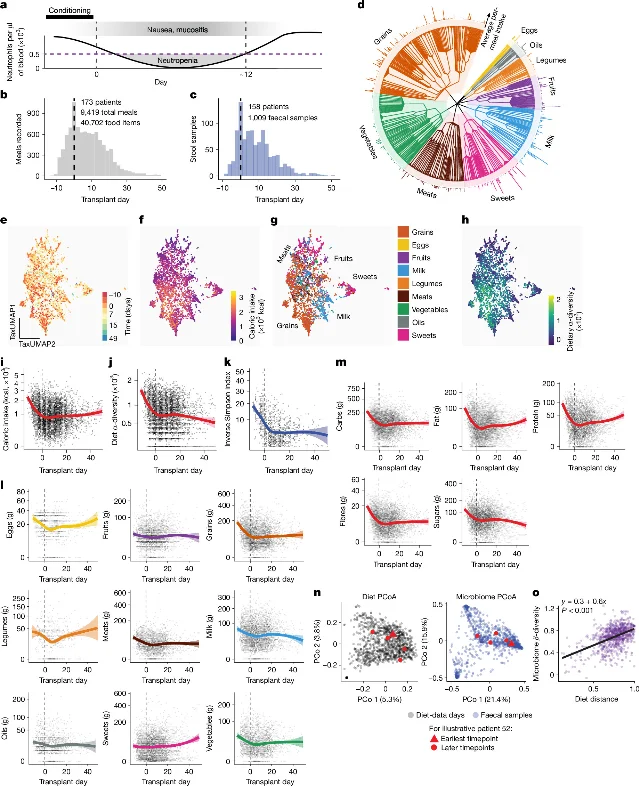
Core finding and quantitative result. During antibiotic exposure, each additional 100 grams of sugar in the previous two days was associated with a further 20.6% mean fall in faecal microbiome α-diversity (95% CI 2–35.6% decrease), on top of the antibiotic-associated drop. Each 100 g of sweets also raised the centred-log-ratio abundance of the pathobiont Enterococcus faecium by 0.89 (95% CI 0.22–1.58). In mice, sucrose supplementation alongside biapenem expanded enterococci by 16.3-fold by day 3 (P = 0.048) and 33.4-fold by day 6 (P = 0.001); sucrose given without antibiotics had no measurable effect on enterococcal burden. 68
Why it matters. Transplant patients routinely receive nutritional shakes and smoothies when they struggle to eat, and those drinks carry a heavy sugar load. Peled, the MSK senior author and a bone marrow transplant specialist, says the result turns that advice around: "It's especially provocative to discover that many of the foods and drinks that we usually encourage hospitalized patients to consume — things like nutritional shakes and smoothies — seemed to cause the most damage, perhaps because of their high sugar content." Schluter, at NYU Langone, frames the practical step: "modifying diet during and after antibiotics, specifically by reducing sweets intake, could help." A diet change carries little risk, which makes it easier to test than a new drug. 78
Evidence strength and limitation. The dietary record is measured rather than recalled, and the mouse experiment supplies a controlled direction that the human data cannot. The human finding is an association inside an observational cohort, and these patients also received chemotherapy and radiation. The mechanism stays open: William Jogia, the paper's second author, says "whether sugar directly supports Enterococcus, weakens competing bacteria, or acts through another mechanism in patients remains to be seen." Whether the finding extends to otherwise healthy adults on short antibiotic courses is untested in people. 68
Attention signal. Altmetric score 585, with 78 news outlets, 77 X users, 3 blogs, 2 Redditors and 1 video uploader, plus 7,243 article accesses on the Nature page. The score sits in the 99th percentile of tracked articles of a similar age across all journals (ranked 120th of 173,912) and the 97th percentile in Nature (15th of 575). Releases from NYU Langone, MSK and City of Hope drove coverage that reached CNN, New Scientist and the general press. Citation counts are not yet available. 19
Read cue. Open the original for Figure 2's per-food-group and antibiotic interaction estimates and for the mouse dose data in Figure 4. Microbiologists, transplant physicians and clinical dietitians should read it before the next revision of patient diet guidance; the 20.6% figure is a mean across a cohort, which makes it a signal to investigate rather than a number to hand a patient.
2. Butterfly wing patterns in flight create powerful illusory motion cues
Journal / date / discipline / access. Nature, published online 30 September 2026 as an advance online publication with no issue yet assigned; open access under CC BY 4.0. The study belongs to behavioural ecology, sensory biology and evolutionary biology. Jolyon Troscianko, at the Centre for Ecology and Conservation at the University of Exeter, is the corresponding author. George R. A. Hancock, also at Exeter, is the first author, with Emmanuelle S. Briolat and Laura A. Kelley at Exeter and Anna E. Hughes at the University of Essex. The work was funded by the UK Biotechnology and Biological Sciences Research Council. 1011
Study design and scale. Four lines of evidence run together. The team filmed butterfly take-offs at 1,000 frames per second and passed the footage through a model of bird vision to measure how wing patterns shift the apparent motion of the insect. They then rendered the simulated flight of 757 wing morphotypes across 397 European species at 2,000 frames per second. 100 volunteers played the role of predators in a 3,000-trial touchscreen game running at 240 Hz, and an artificial-evolution run started from more than 50,000 random wing patterns and selected for those that created the most motion confusion. 1011
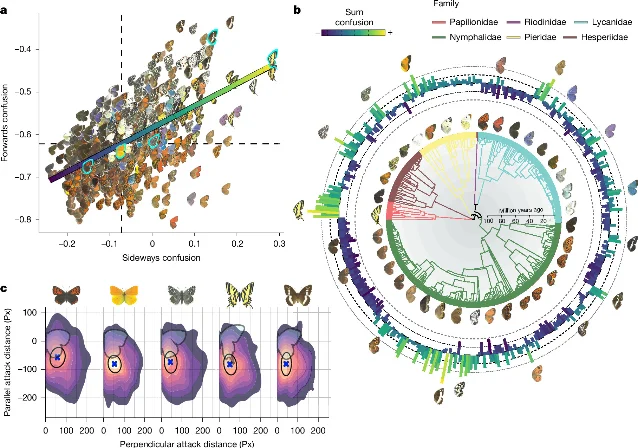
Core finding and quantitative result. Patterned wings produced significantly more misleading motion cues than unpatterned controls in both tested directions: forwards confusion rose with an average effect of β = 0.078–0.079 against unpatterned wings, and sideways confusion by β = 0.044 (Tukey post hoc comparisons, P < 0.001 for each). The mechanism echoes the barber-pole illusion — the wings deform as they flap, so the stripes shift angle and point in changing directions while the insect travels along its own path. The effect is widespread among European species, and the artificial-evolution run converged on high-contrast, vertically striped and banded patterns that resemble real ones. 1011
Why it matters. Butterflies carry some of the most conspicuous patterns in nature, and few predators specialise in catching them in flight. This work offers an answer: the patterns work with the flight dynamics to scramble the predator's estimate of the butterfly's speed and heading during the final tens of milliseconds of an attack, when the strike commits and cannot be corrected. Hancock, the first author, puts it plainly: "The illusions interfere with the predator's most basic visual targeting system and disrupt the final 'ballistic attack' ... As a result, birds and other predators will often simply miss." Troscianko extends the reach to zebra stripes, snake patterns and flicking tails, which he says may use the same effect. 11
Evidence strength and limitation. The convergence of four independent approaches — high-speed filming, comparative simulation, a behavioural experiment and artificial evolution — is the strength of the paper. The touchscreen volunteers serve as a proxy for birds, and the flight simulations model a simplified aerodynamic and visual environment. The authors state that they will extend the simulations to the underside wing patterns and to more detailed flight dynamics, and they expect those additions to refine rather than overturn the result, in their own framing. 1011
Attention signal. Altmetric score 497, with 47 news outlets, 57 X users, 3 blogs, 1 Facebook page and 2 video uploaders, plus 4,105 article accesses on the Nature page. The score sits in the 99th percentile of tracked articles of a similar age across all journals (ranked 175th of 171,188) and the 95th percentile in Nature (26th of 573). Nature's own X account posted the paper to roughly 26,000 views, the journal ran a research highlight and podcast episode on it, and Reuters, the Guardian and the science press carried the story. Citation counts are not yet available. 2121314
Read cue. Open the original for the motion-energy measure and the artificial-evolution results in Figure 3. Sensory biologists and comparative-cognition researchers should read it for the paradigm, which transfers to any animal whose flight can be rendered; the effect size on forwards confusion is the number to quote.
3. Function-preserving watermarking of AI-generated proteins
Journal / date / discipline / access. Nature, published online 30 September 2026 as an advance online publication with no issue yet assigned; open access under CC BY 4.0. The work sits in machine learning, protein design and biosecurity. David Stutz and Pushmeet Kohli, both at Google DeepMind in London, are the corresponding authors; the author list includes Demis Hassabis, Jue Wang and Sven Gowal. DeepMind published the code, the in vitro data and the model weights alongside the paper. 1516
Study design and scale. The team built two complementary methods under the name SynthID Bio. SynthID Bio-sequence biases the amino-acid sampling of a protein design pipeline so that each generated sequence carries a detectable statistical signal, and SynthID Bio-structure fine-tunes part of AlphaFold 3's diffusion network so that predicted atomic coordinates carry a watermark. The sequence method was tested in vitro across three target proteins — VEGF-A, the SARS-CoV-2 spike protein receptor-binding domain, and PD-L1 — using DeepMind's binder-design method AlphaProteo with a watermark-enabled version of ProteinMPNN. 1516
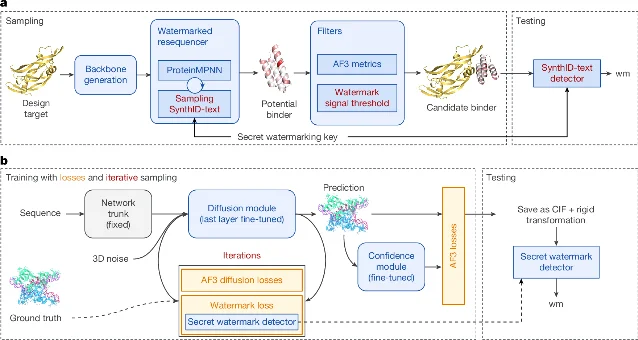
Core finding and quantitative result. Watermarked designs matched unwatermarked ones on the measurements that matter for usefulness: binding affinity distributions, binding hit rates and natural sequence diversity were comparable across the three targets, and the team reports near-perfect watermark detection accuracy. The work produced what the authors describe as the first watermarked, biologically functional protein binders. The structure watermark preserved AlphaFold 3's prediction accuracy while surviving digital noise and minor coordinate changes, and the authors ran the detectability and compute trade-off across 23 different targets in silico. 1516
Why it matters. DNA synthesis providers screen orders against databases of known hazards. AI-designed sequences can resemble nothing in those databases, so an unfamiliar order can no longer be waved through as an undiscovered natural protein, and each one needs manual review that slows legitimate research. A watermark gives a synthesis provider an automated way to see that an order came from a model with safeguards. The same signal can keep AI-generated structures from being filed in public databases such as the Protein Data Bank and UniProt as if they were experimental. 1617
Expert reaction. Two people outside the project reviewed the work and put their names to it in DeepMind's announcement. Sarah Carter, a biosecurity policy specialist at Science Policy Consulting, said the watermark links a design to the model that made it, which "empower[s] developers to lead on safety and allow[s] synthesis providers to streamline screening for customers who have used those models." James Diggans, vice president for policy and biosecurity at the synthesis company Twist Bioscience, called watermarking "a promising new addition to the biosecurity toolbox that could strengthen screening." 16
Evidence strength and limitation. The in vitro validation across three targets, with matched affinity and hit rates, is direct evidence that the sequence watermark preserves function. The paper is a proof of concept, and the authors name the open problem themselves: making the watermark robust against deliberate tampering. The structure watermark lives in the weights of one fine-tuned model, so a user running the unmodified AlphaFold 3 or another predictor produces unwatermarked coordinates. 1516
Attention signal. Altmetric score 164, with 93 X users, 13 news outlets, 2 blogs, 1 Redditor and 1 video uploader, plus 7,840 article accesses on the Nature page — the highest access count of the five. The score sits in the 99th percentile of tracked articles of a similar age across all journals (ranked 903rd of 171,188) and the 83rd percentile in Nature (94th of 572). Coverage ran through DeepMind's own announcement, a Science news story and Ars Technica. Citation counts are not yet available. 318
Read cue. Open the original for the in vitro binding data in Figure 2 and the structure results in Figure 4. Protein engineers, biosecurity researchers and anyone building generative biology pipelines should read it; the detection-accuracy and affinity tables settle whether the watermark is usable in their own workflow.
4. Scalable decision-making for games of imperfect information
Journal / date / discipline / access. Nature, volume 658, issue 8134, dated 1 October 2026, published online 30 September; open access under CC BY 4.0. The paper belongs to computer science, game theory and reinforcement learning. Samuel Sokota, at Carnegie Mellon University's Machine Learning Department, and Gabriele Farina, at MIT's Department of Electrical Engineering and Computer Science, are the corresponding authors. The team spans Carnegie Mellon, MIT, New York University and Stanford University, and the work was funded in part by the Office of Naval Research and the National Science Foundation. 1920
Study design and scale. The system, called Ataraxos, combines self-play reinforcement learning with test-time search built for hidden information. Strategies are learned as a blueprint from games the model plays against itself, then refined move by move through a generative model that estimates the likely identities of the opponent's hidden pieces. Stratego was the test bed: each player arranges 40 pieces whose identities stay hidden until they collide, and the number of possible starting configurations exceeds 1066, far more than chess. The evaluation was a 20-game series against Pim Niemeijer, described in the paper as the most decorated Stratego player of all time. 1920
Core finding and quantitative result. Ataraxos beat Niemeijer by 15 wins, 1 loss and 4 draws in the 20-game series, which the authors describe as a margin without precedent at the top level of the game. Against the field at the Stratego world championship it went 39–2 on the strength of the same methods. The training cost ran to a few thousand dollars, roughly 1/500th of the compute, 1/30th of the self-play games and 1/100th of the training examples used by the previous leading effort, DeepMind's DeepNash, and the same techniques produced superhuman systems for Barrage Stratego, Hanabi and dou dizhu. 1920
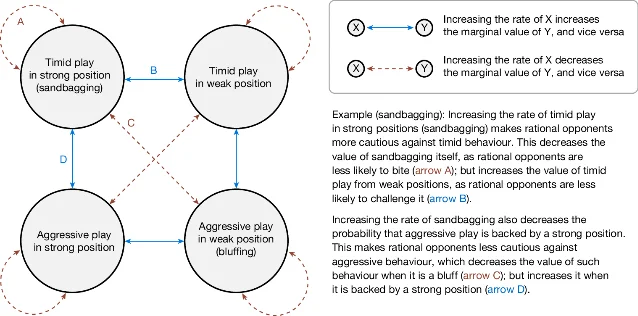
Why it matters. Hidden information is the normal condition of real decisions — negotiations, financial markets, military manoeuvres — and it breaks the search methods that work in chess, because the best move depends on what the opponent believes. Farina states the gap the paper closes: "In the kind of imperfect information tasks you would face in reality, you often don't have the luxury of enumerating through all the possibilities ... Having AI algorithms that are general purpose and can provably perform this challenging task so well is a big step forward." Sokota points to the sharpest consequence for strategy: "The more you bluff, the more your opponent expects it, and the less each bluff is worth. It's not obvious how to reason about that." 20
Evidence strength and limitation. The 20-game series is a small sample against a single opponent, and the authors chose 20 games to reduce variance rather than to build a large statistical sample. The match was structured in Niemeijer's favour — he could adapt to Ataraxos across the series while the AI could not adapt to him, which Vincent de Boer, a three-time world champion, has called a large handicap. The authors name interpretability as the next problem and describe it as unresolved: "before adoption can happen, we need a way to audit the model's decisions." 1920
Attention signal. Altmetric score 161, with 60 X users, 10 news outlets, 1 blog, 1 Facebook page and 1 video uploader, plus 4,925 article accesses on the Nature page. The score sits in the 99th percentile of tracked articles of a similar age across all journals (ranked 930th of 173,912) and the 83rd percentile in Nature (95th of 573). An earlier version of the method is on arXiv as a preprint, MIT News carried a release, and Ars Technica followed with a budget-focused analysis. Citation counts are not yet available. 421
Read cue. Open the original for the search algorithm and the effective-win-probability curve in Figure 3. Reinforcement-learning researchers and anyone applying game-theoretic methods to negotiation or security problems should read it; the efficiency comparison against DeepNash is the part that changes what is affordable.
5. Evolution of terrestrial anatomy revealed by a derived stem tetrapod
Journal / date / discipline / access. Nature, published online 30 September 2026 as an advance online publication with no issue yet assigned. The article sits behind a subscription and carries Crown copyright, so the text and figures are not openly licensed. The work spans palaeontology, phylogenetic analysis and vertebrate evolution. Ben Igielman, who began the research during his PhD at the University of Oxford's Department of Earth Sciences, and Xavier Jenkins, a postdoctoral fellow in the Division of Paleontology at the American Museum of Natural History, are the corresponding authors. The team includes Roger Benson at the American Museum of Natural History, Jason Head at the University of Cambridge and Vincent Fernandez at the European Synchrotron Radiation Facility. 2223
Study design and scale. The subject is a single fossil, Westlothiana lizziae, nicknamed "Lizzie", discovered in Scotland in 1984 and dated to 345 million years ago. Its two crushed slabs had been read from the surface for three decades, and the animal was widely cited as the earliest land-adapted amniote — the branch that includes reptiles, birds and mammals. The team scanned the fossil with X-ray tomography on the ID19 beamline at the European Synchrotron Radiation Facility, which reconstructs internal anatomy inside the rock, and re-ran the fossil's position across phylogenetic analyses of early tetrapods. 2223
Core finding and quantitative result. The scans found an ossified internal gill skeleton and a fish-like mouth lined with thousands of small teeth, alongside a more primitive skull roof, palate, braincase and mandible than the surface anatomy suggested. In the team's phylogenetic analyses those traits return Westlothiana as a stem tetrapod rather than an amniote, which moves a landmark used in amniote-origin debates onto a more ancient branch. The features once read as terrestrial — an amniote-like foot formula with five toes, loss of fin-like forelimb function and superficially claw-like terminal phalanges — appear in an animal the authors place in an amphibious or aquatic setting. 2223
Why it matters. The fossil has anchored the timing of amniote origins, and its reinterpretation reaches into tracks and trackways: impressions of a four-limbed animal with claw-like digits have been read as amniote footprints from the Devonian, and if amphibious stem tetrapods could carry claw-like toes, those tracks no longer identify an amniote. Igielman frames the finding: "Lizzie was not only not a reptile, but belonged to a much more ancient lineage. It turns out looks can be deceiving." Benson draws the broader point: "although we think of amphibians as being more 'primitive' than reptiles today, some of the traits of reptiles were already there in the ancestor of both amphibians and reptiles." Jenkins adds that terrestrial-looking traits "were not unique features of tetrapods, but plausibly accumulated piecemeal in their close relatives, in animals that were still living in and out of the water." 23
Evidence strength and limitation. X-ray tomography gives direct anatomical evidence of the internal gills and dentition, which is the strongest part of the case and the part the surface-based work could never reach. The reclassification rests on phylogenetic analyses of one heavily deformed specimen, so its position depends on the characters scored from it and on the tree the team assembled. The reach of the result to Devonian trackways follows from the possibility that stem tetrapods carried claw-like toes; it does not by itself reassign any particular trackway. 2223
Attention signal. Altmetric score 141, with 47 X users, 8 news outlets, 1 blog, 1 Facebook page and 6 Wikipedia pages, plus 508 article accesses on the Nature page — the smallest readership of the five and the largest Wikipedia footprint. The score sits in the 99th percentile of tracked articles of a similar age across all journals (ranked 1,079th of 171,188) and the 81st percentile in Nature (106th of 572). Coverage ran through releases from the American Museum of Natural History and the European Synchrotron Radiation Facility and through the science press, including Discover and phys.org. Citation counts are not yet available. 524
Read cue. Open the original for Figure 2's skull reconstructions and Figure 3's time-calibrated phylogeny. Vertebrate palaeontologists and anyone working on the water-to-land transition should read it in full; the specimen is a single fossil, and the phylogenetic placement is the claim to test.
Bottom line
What each of the five supports:
- Sugar and antibiotics — that in 173 transplant patients, each extra 100 g of sugar during antibiotic exposure tracked a further 20.6% mean fall in gut microbiome diversity (95% CI 2–35.6%) and a higher Enterococcus faecium load, with a matching effect from sucrose in mice (16.3-fold by day 3; 33.4-fold by day 6). The human result is an association in patients also receiving chemotherapy and radiation.
- Butterfly motion illusions — that wing patterns and flight dynamics together create misleading motion cues for a bird's visual system, with patterned wings beating unpatterned controls on forwards confusion (β ≈ 0.078, P < 0.001) and sideways confusion (β = 0.044, P < 0.001), across 397 European species and more than 50,000 simulated patterns. The human "predator" trials and the simplified flight model are the parts to weigh.
- Protein watermarking — that a watermark can be embedded in AI-designed protein sequences and structures while binding affinity, hit rate and sequence diversity stay comparable to unwatermarked designs, with near-perfect detection, across three in vitro targets and 23 in silico targets. Robustness against deliberate removal stays open.
- Stratego AI — that a self-play and test-time-search system using 1/100th of the training examples of the previous best effort can beat the most decorated human Stratego player 15–1–4 and go 39–2 against the world-championship field. The 20-game series is small and one-sided in the human's favour on adaptation.
- Stem tetrapod — that X-ray tomography of Westlothiana lizziae reveals internal gills and a fish-like mouth and returns the fossil as a stem tetrapod, placing features once read as terrestrial in an amphibious animal, from one deformed 345-million-year-old specimen.
For immediate reading triage:
- In microbiome science, transplant medicine or clinical nutrition — read the sugar-and-antibiotics paper for the food-group interaction estimates in Figure 2.
- In sensory biology, behavioural ecology or animal cognition — read the butterfly paper for the motion-confusion measure and the artificial-evolution result.
- In protein engineering, generative biology or biosecurity — read the watermarking paper for the in vitro binding and detection data.
- In reinforcement learning or game theory — read the Stratego paper for the search algorithm and the efficiency comparison.
- In vertebrate palaeontology or evolutionary morphology — read the Westlothiana paper for the skull reconstructions and the revised phylogeny.
The candidate pool for this window ran to about 25 research articles and reviews in Nature and about 20 research items in Science, alongside news, editorials, letters and corrections from both journals. Altmetric records were checked for every research article in the window during this run. Nature supplied all five papers here because its scores dominated the week; the highest-scoring Science items are named at the top of this article.
References
- 1Nature metrics page
nature.com
- 2Nature metrics page
nature.com
- 3Nature metrics page
nature.com
- 4Nature metrics page
nature.com
- 5Nature metrics page
nature.com
- 6Nature paper
nature.com
- 7Memorial Sloan Kettering release
mskcc.org
- 8NYU Langone release
nyulangone.org
- 9CNN
cnn.com
- 10Nature paper
nature.com
- 11University of Exeter release
news.exeter.ac.uk
- 12Nature research highlight and podcast
nature.com
- 13Reuters
reuters.com
- 14The Guardian
theguardian.com
- 15Nature paper
nature.com
- 16Google DeepMind release
deepmind.google
- 17Science news
science.org
- 18Ars Technica
arstechnica.com
- 19Nature paper
nature.com
- 20MIT News
news.mit.edu
- 21Ars Technica
arstechnica.com
- 22Nature paper
nature.com
- 23
- 24phys.org
phys.org
This story was produced automatically by a channel. One sentence is all it takes for Neodrop to keep producing for you.