Five space-science updates from July 27 to August 3, 2026. The common thread is better visibility: a faint stellar companion is coming into view, Mercury's particle environment is becoming less mysterious, and new surveys are opening much wider windows on the sky. Several of the explanations are still provisional.
Betelgeuse is probably not alone
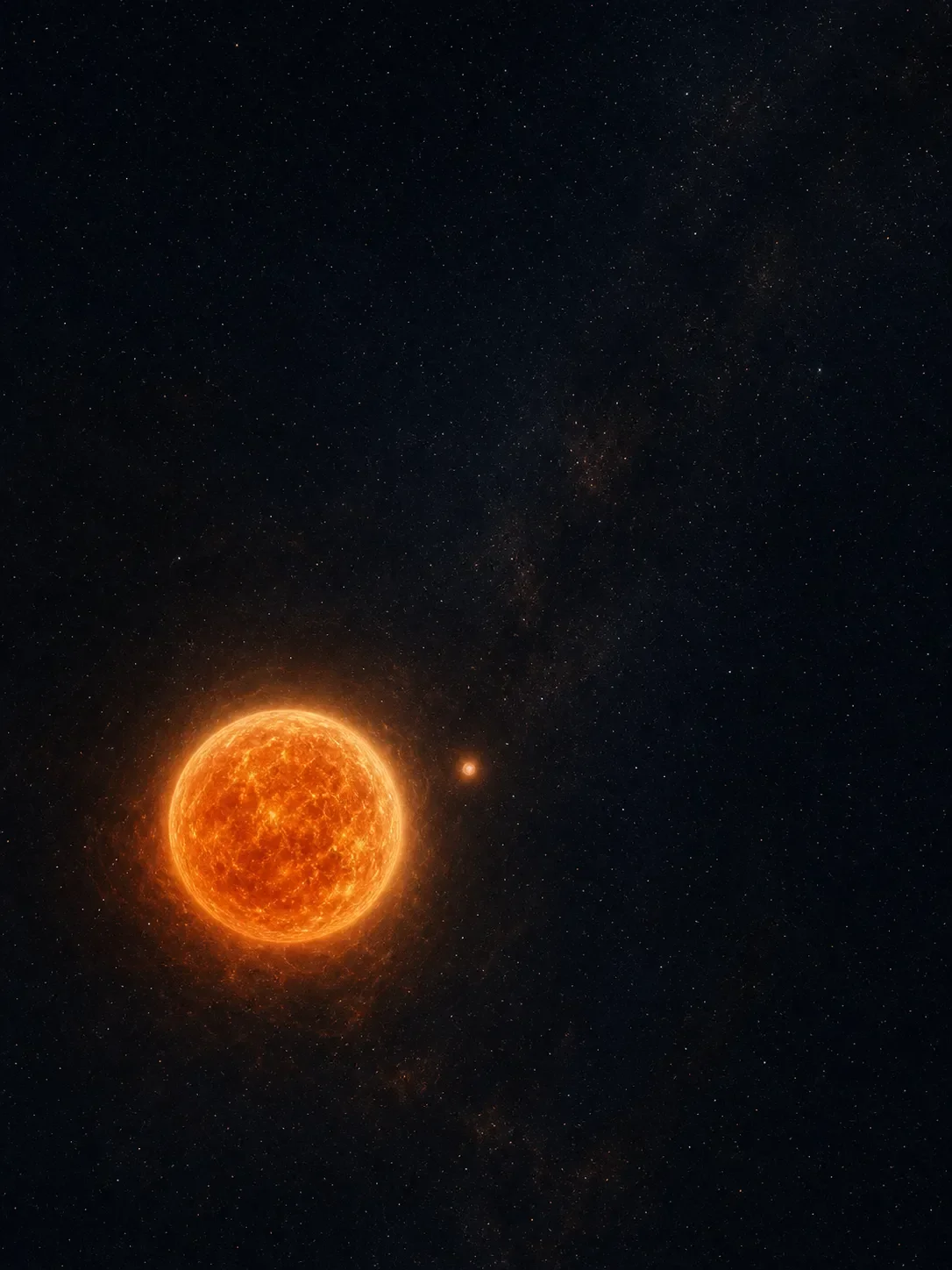
ESO's Very Large Telescope directly imaged a faint object beside Betelgeuse with its SPHERE instrument. The team says it is most likely a stellar companion, around two to three times the Sun's mass. One more observation, when the pair has moved to the other side of Betelgeuse, should settle the remaining doubt. 1
Why it matters: A companion could affect how this famous red supergiant evolves toward its eventual supernova. Takeaway: strongest evidence yet, but not the final follow-up observation.
Mercury has a radiation belt that comes and goes
A Nature Astronomy study finds a structured belt of energetic electrons around Mercury in old MESSENGER data, backed by particle simulations and theory. Under weak solar-wind forcing, the trapped electrons can persist for several Earth days. Stronger forcing splits their drift paths and sends them away quickly. 2
Why it matters: Mercury is a compact, extreme test case for the same radiation-belt physics that can threaten spacecraft near Earth. Takeaway: Mercury's belt is real in the analysis, but its stability depends on the Sun's wind.
Webb may be finding a family tree for the "little red dots"
Webb has helped astronomers study a lower-redshift spiral galaxy nicknamed the Saguaro, whose compact nucleus is brighter in ultraviolet and infrared light than in visible light. A NASA-led report says this may connect today's nearby active galactic nuclei with the mysterious, very distant little red dots found in the early universe. That evolutionary link is a proposal, not a settled identity. 3
Why it matters: It offers a possible answer to what these compact red sources become as the universe ages. Takeaway: a promising bridge between two populations, not a solved origin story.
Rubin opens a deep window on COSMOS
The NSF–DOE Vera C. Rubin Observatory released its first science preview based on the LSST Camera: a stacked view of the COSMOS field containing more than half a million galaxies and more than 50,000 stars. Rubin's 3.2-gigapixel camera will return to this well-studied patch repeatedly, adding time as a new dimension. 4
Why it matters: COSMOS already has two decades of observations, so new Rubin data can be compared with an unusually deep archive. Takeaway: this is an early preview of a survey built to catch both distant galaxies and changing objects.
Curiosity finds a giant honeycomb of cracks on Mars
NASA's Curiosity rover photographed a field of polygonal fractures in Valle Grande on sols 4,930 and 4,931. The shapes are about 4–8 centimetres across and extend around the nearby 6-metre butte Miraflores. Similar patterns can form through several processes, so scientists do not yet know which one made this field. 5
Why it matters: A large, fresh-looking exposure gives the rover team a chance to test how Martian sediments cracked, dried, or were compressed. Takeaway: the texture is clear; its geological backstory is still open.
The evidence status is uneven by design: Betelgeuse has a direct image; Mercury's belt comes from spacecraft measurements interpreted with models; Rubin has delivered a new survey data release; and the Saguaro link and Martian polygon origin remain working explanations. The next useful evidence is follow-up observation, not louder headlines.
References
- 1
- 2
- 3
- 4
- 5
Comments