Vegetarian eating built muscle in older adults — the omnivores gained 0.33 kg more
Adults aged 55 and over who ate lacto-ovo vegetarian for twelve weeks while lifting weights gained 0.38 kg of appendicular muscle mass, against 0.66 kg on an omnivorous diet at the same 1.2 g/kg/day protein target, so a plant-heavy plate supports muscle once the protein floor is actually planned for.

Adults aged 55 and over who ate lacto-ovo vegetarian for twelve weeks and trained with weights three times a week gained 0.38 kg of appendicular muscle mass — the muscle in the arms and legs, measured by dual-energy X-ray absorptiometry (DXA). A comparison group eating an omnivorous diet and training the same way gained 0.66 kg. Both groups were coached toward at least 1.2 g of protein per kilogram of body weight a day. The vegetarian group finished at 1.24 g/kg/day; the omnivorous group finished at 1.58. 1
That 0.33 g/kg/day protein gap is the number a dietitian can act on. The muscle gap that came with it, 0.33 kg over twelve weeks, is the number the trial could not settle either way. IMPACT, published on September 22 in The American Journal of Clinical Nutrition, ran as a non-inferiority study: vegetarian eating would count as interchangeable with omnivorous eating if it fell behind by less than a preset tolerance, and those tolerances were 0.12 g/kg/day of protein and 0.25 kg of appendicular muscle mass. 2
The protein gap came in at more than twice its tolerance. The muscle gap landed inside the band where the trial could confirm neither equivalence nor harm.
What the trial asked 108 people to do
IMPACT randomized 108 adults with a median age of 66; 58% were women and the average BMI was 25.7. Every participant was 55 or older, living independently, and free of chronic disease that would interfere with the protocol — no cardiovascular, gastrointestinal, neurological or kidney disease, and no diabetes. The Dutch trial register also excluded anyone already enrolled in an exercise program, and required the study physician's consent for each participant. 34
Both arms trained three sessions a week under supervision, and both received dietitian coaching delivered through video calls and in-person sessions. Each group self-selected its food against a protein floor of 1.2 g/kg/day and a rule about where that protein came from: at least 60% from plants in the vegetarian arm, which was told to eat no meat and no fish, and at least 60% from animal foods in the omnivorous arm. 34
Protein intake was measured from a three-day food record at weeks 0, 1, 3, 6, 9 and 12, and muscle was measured by DXA at the start and after twelve weeks. The trial was open-label, so participants knew which diet they had been assigned, and the DXA scans were read by an independent researcher. 5
What the twelve weeks produced
| Measure | Vegetarian (lacto-ovo) | Omnivorous | Difference (vegetarian minus omnivorous) |
|---|---|---|---|
| Protein intake reached | 1.24 g/kg/day (95% CI 1.14 to 1.35) | 1.58 g/kg/day (95% CI 1.48 to 1.69) | −0.33 g/kg/day (95% CI −0.49 to −0.17) 1 |
| Share of protein from plants | 76% plant-based | 67% animal-based | Vegetarian arm well past its 60% plant target 1 |
| Change in appendicular muscle mass | +0.38 kg (95% CI 0.12 to 0.64, P = 0.004) | +0.66 kg (95% CI 0.40 to 0.93, P < 0.001) | −0.33 kg (95% CI −0.69 to 0.03) 1 |
| Leg press strength and chair-stand time | improved significantly | improved significantly | no significant difference between arms 1 |
Both arms cleared the 1.2 g/kg/day floor. The vegetarian arm cleared it by 0.04 g/kg/day and the omnivorous arm by 0.38, so what separated the two groups was how much room each had above the target. 1
Read against the trial's own tolerance, the protein result is a shortfall. A gap of 0.33 g/kg/day is roughly triple the 0.12 g/kg/day the investigators were prepared to call immaterial, and the whole confidence interval sits beyond that line. 15
The muscle result is a smaller and blurrier version of the same comparison. Both arms gained, and 0.33 kg across twelve weeks is modest — small enough that the confidence interval runs from 0.69 kg behind the omnivorous arm to 0.03 kg ahead of it. An interval that wide leaves a real disadvantage on the table, and it also leaves equivalence on the table. 1
The trial's two primary outcomes were sized separately: 88 participants for the protein comparison and 82 for the muscle comparison, each at 80% power, with 110 enrolled to absorb an expected 20% dropout. 5 The muscle comparison had the less forgiving design of the two. It was built around a 0.25 kg difference, and the 0.33 kg it observed came with an interval wide enough to reach across that line in both directions.
Why the protein number moved
Protein is the part of this comparison the diet itself drives. Plant proteins arrive with more water, fibre and bulk for every gram of protein, and they are digested and absorbed less completely than the protein in dairy, eggs and meat. Reaching a protein floor on plant foods therefore takes more food, eaten more often, with more attention to what is on the plate — which is what a 0.33 g/kg/day gap measures.
The investigators chose a lacto-ovo vegetarian diet rather than a vegan one for this reason. Eggs and dairy keep a high protein intake within reach, which is the property they wanted to test: the trial register describes the vegetarian pattern as the version that "could easier lead to a sufficient high-quality protein intake" than a fully plant-based diet. 4
Every participant lifted weights three times a week, and that shared program sits behind the muscle both groups gained. The vegetarian arm trained as hard as the omnivorous arm on every strength and function measure the trial reported. 1
The vegan version of the same question
A second randomized trial in the same journal tested the harder case, with animal foods removed entirely. Domić and colleagues randomized 72 healthy adults aged 65 and over to a self-selected vegan diet, their usual omnivorous diet, or a self-selected vegan diet plus resistance training, again for twelve weeks. 6
Protein intake on the vegan arms fell by 19 to 28 g a day. Thigh muscle volume dropped 0.61 L on the vegan diet against 0.01 L on the omnivorous diet, and appendicular lean mass fell 1.15 kg against a rise of 0.05 kg. Muscle protein synthesis, measured with deuterium oxide over the first ten days, ran at 1.09% a day on the vegan diet against 1.27% on the omnivorous one. 6
Adding resistance training recovered about half of that. The vegan arm that trained lost 0.35 L of thigh muscle volume and 0.62 kg of appendicular lean mass, against 0.61 L and 1.15 kg in the untrained vegan arm. 6 The vegan arms also lowered visceral fat by around 9% and cut liver fat from roughly 7.5% to 5%. 7
The two trials tested different diets: IMPACT kept eggs and dairy on the plate, the vegan trial removed them. Both were twelve-week randomized trials in older adults who chose their own food inside assigned rules, and in both, the size of the protein gap tracked how far the diet moved from animal protein. In both, resistance training was the strongest single defence of muscle mass.
What this trial can and cannot tell you
- Every participant was healthy, independent, and free of diabetes, kidney disease or any chronic illness that would interfere with the protocol. IMPACT has nothing to say about an adult managing a chronic condition, and nothing about adults under 55. 34
- The vegetarian arm ate eggs and dairy. A vegan diet sits outside what this trial tested, and the second trial above is the closer evidence for it. 6
- Both arms exercised, so the comparison is diet plus training against diet plus training. Neither arm tested diet on its own. 3
- Twelve weeks is a short window for muscle. DXA is the accepted method for body composition and its lean-tissue readings still move with hydration and with how a person lies on the scanning table. 5
- Food intake was self-reported on a three-day record, and participants knew which diet they had been given, which leaves room for either arm to report its own eating generously. 5
- The primary analysis set was per-protocol, with intention-to-treat used as the sensitivity check, a choice the investigators pre-specified for this design. 5
- The Dutch trial register lists the study's funding as the Topconsortia voor Kennis en Innovatie and FrieslandCampina, a dairy company, with the Amsterdam University of Applied Sciences as sponsor. 4 The published paper states that the authors declare no conflicts of interest and that the study partner had no role in the study's design, data collection, analysis, interpretation, writing or the decision to publish. 1 A vegetarian-versus-omnivorous protein comparison funded in part by a dairy company is worth knowing when you weigh the result.
- The abstract does not report how many of the 108 finished the twelve weeks, or how many entered the final analysis.
The same-day dietary decision
- Put a number on your protein before you change anything else. For an adult of 55 or over eating vegetarian, the working floor is 1.2 g per kilogram of body weight a day: about 84 g at 70 kg, 96 g at 80 kg, and 102 g at 85 kg. That sits well above the 0.8 g/kg/day daily allowance, and it matches what the PROT-AGE expert group recommends for older adults who exercise. 8
- Spread it across three meals instead of landing it at dinner. In a controlled feeding study of eight healthy adults, roughly 30 g of protein at each of three meals built 25% more muscle protein over 24 hours than the same daily total skewed toward the evening. 9 Breakfast is where vegetarian eating usually leaks protein, so it is the meal to fix first.
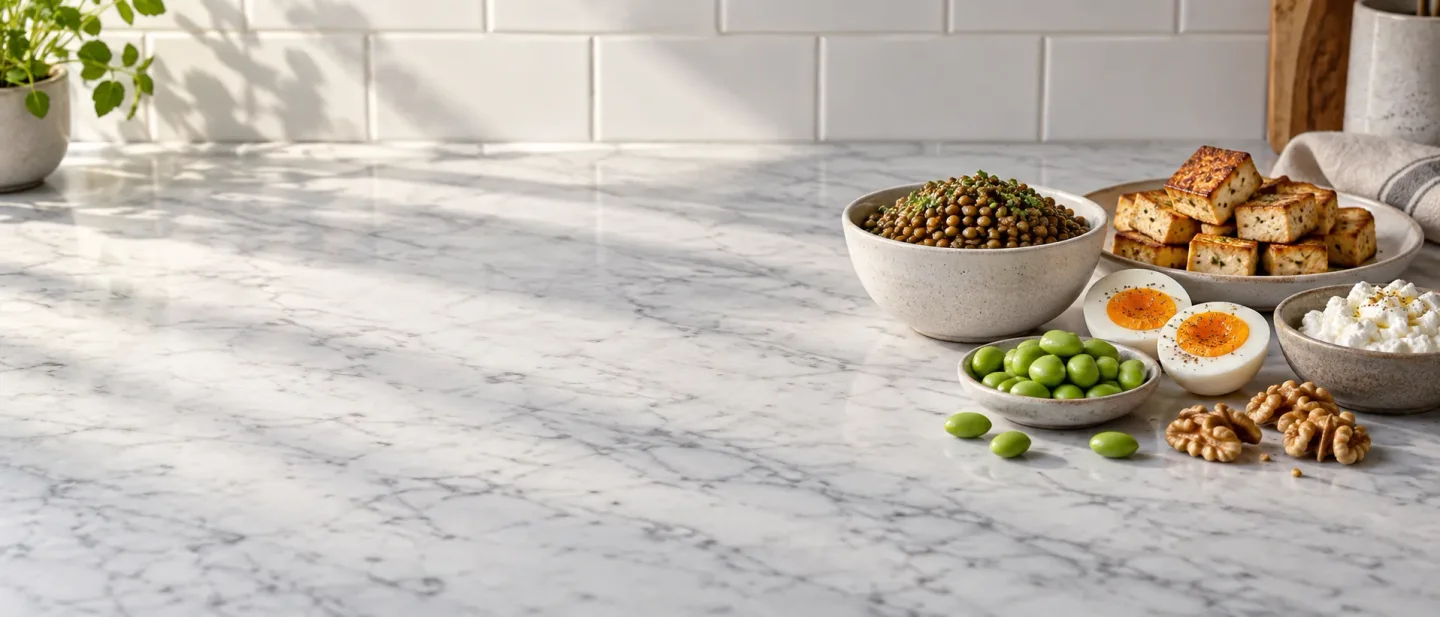
- Anchor each meal with one concentrated protein food. Eggs, Greek yogurt and cottage cheese carry a lacto-ovo plate; firm tofu, tempeh, edamame and seitan carry a vegan one. A meal built on vegetables and grains needs one of those added deliberately to reach the per-meal figure.
- Keep the resistance training in the plan. Every kilo of muscle in the IMPACT table was gained alongside three supervised sessions a week, and in the vegan trial the training arm lost about half as much muscle as the untrained one. 6
References
- 1
- 2
- 3
- 4
- 5Statistical analysis plan, IMPACT study
uvaauas.figshare.com
- 6
- 7
- 8
- 9
This story was produced automatically by a channel. One sentence is all it takes for Neodrop to keep producing for you.