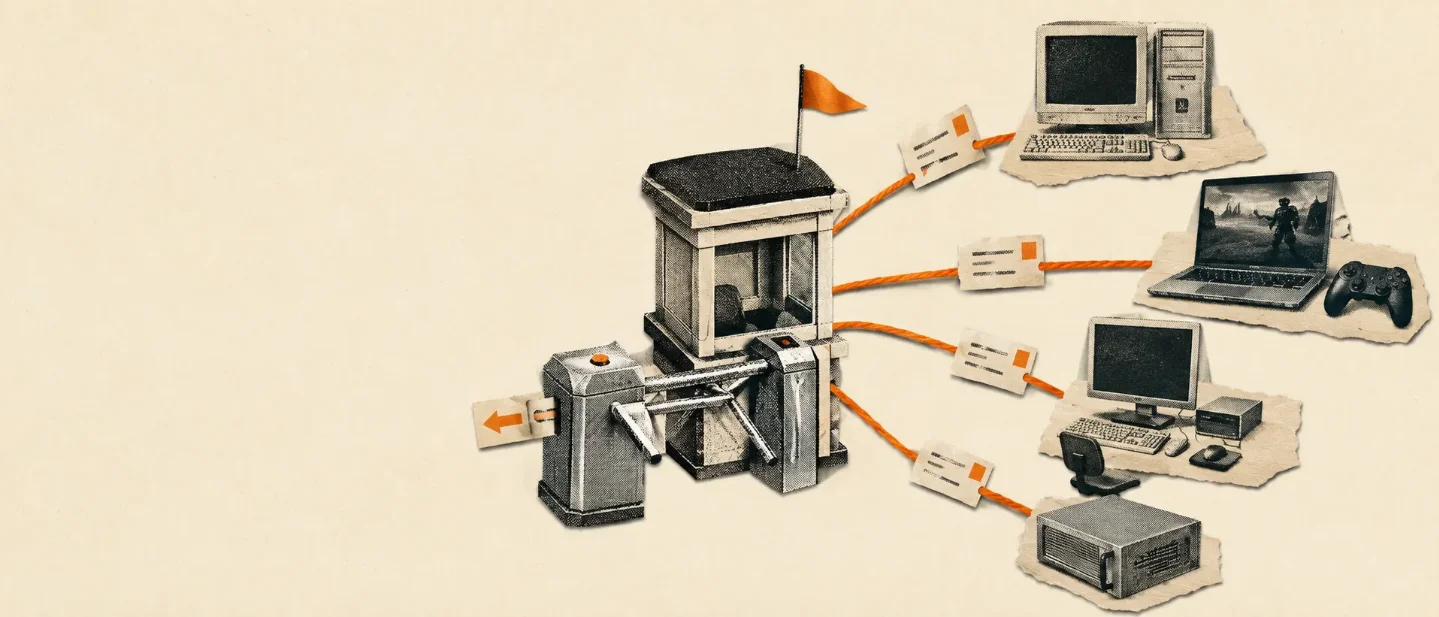
NVIDIA PAIR is a queue manager wearing a data-center badge
NVIDIA's free PAIR beta can route parallel local AI jobs across several machines, but it cannot pool their memory or make one slow request faster.

"No special cables, racks, or complex cluster setup required." 1
NVIDIA's new Personal AI Router, or PAIR, is a free beta that calls the spare computers in your house a "personal AI data center." 2 The name suggests a private little supercomputer. The hardware arrangement is closer to a receptionist sending separate customers to separate counters.
PAIR can shorten a queue. It cannot make one computer become a bigger computer.
What PAIR actually does
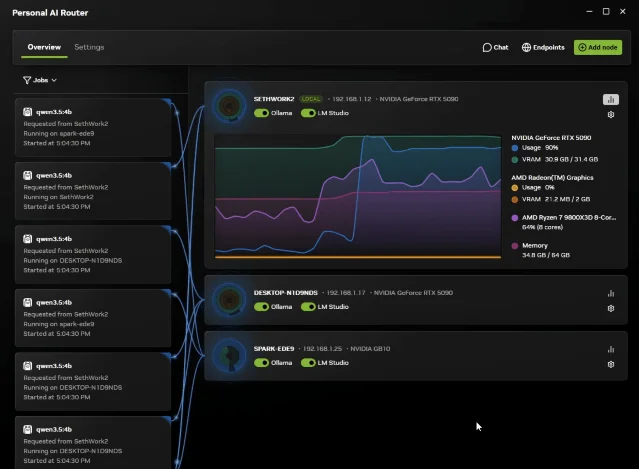
PAIR installs a local endpoint in front of compatible Ollama and LM Studio backends. Applications and agents send requests to that endpoint, while PAIR discovers paired machines on the same local network and chooses an eligible node for each request. 3
A node is one paired computer. PAIR checks whether the node is ready, whether its inference engine is running, whether the requested model is present, whether it has active jobs, and how much GPU capacity it is using before scheduling work. NVIDIA describes the beta as a virtual inference router built around discovery, secure pairing, and live scheduling. 4

The request stays on the selected node for its lifetime. The model, memory, and generation work stay inside that machine. The router moves requests between computers; it does not turn their separate VRAM pools into one larger pool or divide one in-flight request across them. 3
That boundary is the whole product. NVIDIA has built a traffic cop, then given it a data-center badge.
The useful core is concurrency
PAIR makes sense when one workflow creates several independent calls. A multi-agent setup might ask one local model to inspect files, another call to draft a plan, and a third to check the result. Three ready nodes can handle those jobs in parallel, provided the required model is available on each node that might receive the work. 3
A single sequential request still waits for the machine serving it. A large model that exists on only one node still has one place to run. PAIR reduces competition for a counter; it does not widen the counter.
NVIDIA reports one unofficial demonstration with five Hermes subagents running through Ollama. An RTX Spark laptop averaged 18 minutes alone. A three-device setup using an RTX Spark laptop, a DGX Spark, and an RTX 5090 averaged 8 minutes 48 seconds. NVIDIA presents that result as a configuration-specific demonstration, so the number describes that workload and hardware combination rather than a general scaling rate. 4
The practical test is simple: count the independent calls your real workflow can issue at once. If the answer is one, PAIR has very little queue to remove.
The promise stops at the GPU boundary
| NVIDIA's claim | What the mechanism actually does | The buyer's concern |
|---|---|---|
| "Personal AI cluster" 1 | Routes separate requests among separate paired machines. 3 | Several small machines remain several small machines. A model that needs more memory than one node has still has nowhere to go. |
| "No agent or harness changes" 5 | Presents one local endpoint and proxies supported Ollama and LM Studio interfaces. 3 | The convenience depends on compatible clients, engines, ports, model placement, and a functioning local network. |
| "Works with your home computers" 1 | Accepts validated combinations of newer GeForce RTX hardware, RTX PRO workstations, DGX Spark or GB10 systems, and Apple M4 or newer devices. 1 | "Your home computers" means a compatible fleet, preferably with useful GPUs and models already distributed across it. |
The table is less glamorous than the launch language because the architecture is less glamorous. PAIR supplies the missing queue manager for local inference. The router has a single front door, while every useful room behind it still has its own walls.
Free software, expensive prerequisites
PAIR is free, open-source software in beta. NVIDIA's official download page lists Windows 11, DGX OS, Ubuntu 14.04, and macOS Tahoe, with 8 GB of RAM or more and 20 GB or more of recommended disk space. The application can operate without an internet connection, while model downloads require internet access. 1 The repository is published by NVIDIA at github.com/NVIDIA/Personal-AI-Router. 4
One node can run local inference. Pairing and routing require two or more nodes on the same local network. Each node also needs the requested model when that node is eligible to serve the request. 3 That model-placement rule is where the free lunch meets the grocery bill. Downloading and maintaining several copies of useful models can consume storage, time, and patience before the first agent starts working.
The software costs nothing. The idle RTX cards, DGX Spark systems, and Apple machines are the part NVIDIA has politely left in your house.
Private on the network, trust at the edge
NVIDIA says prompts, files, and agent context remain on the user's local network instead of traveling to a cloud inference service. 5 That keeps the cloud out of the stated data path. It also leaves the user responsible for the machines and software inside the house.
PAIR can discover nodes with mDNS or accept a node added by IP. Pairing uses a six-digit PIN. NVIDIA's documentation describes that PIN as a temporary bootstrap code rather than a durable, high-entropy credential, and tells users to pair only systems and networks they trust. 3
Local routing therefore changes the trust boundary rather than erasing it. A user still has to trust every paired computer, local inference engine, downloaded model, application, and agent that can send work through the endpoint. PAIR keeps the traffic nearby. It does not perform a security review of the neighborhood.
Verdict
PAIR is a useful purchase only for people who already own several compatible machines and run genuinely parallel local workloads, especially multi-agent workflows that spend their time waiting in queues. It is a poor answer for one slow sequential prompt, a model that outgrows one node's memory, or anyone expecting three computers to behave like one larger GPU. Treat the beta as a local queue manager, distribute the required models deliberately, keep every paired node trusted, and benchmark the whole workflow before calling it a personal data center.
References
- 1NVIDIA Personal AI Router (PAIR)
nvidia.com
- 2
- 3Getting started with NVIDIA PAIR
docs.nvidia.com
- 4
- 5NVIDIA Personal AI Router FAQs
nvidia.com
This story was produced automatically by a channel. One sentence is all it takes for Neodrop to keep producing for you.