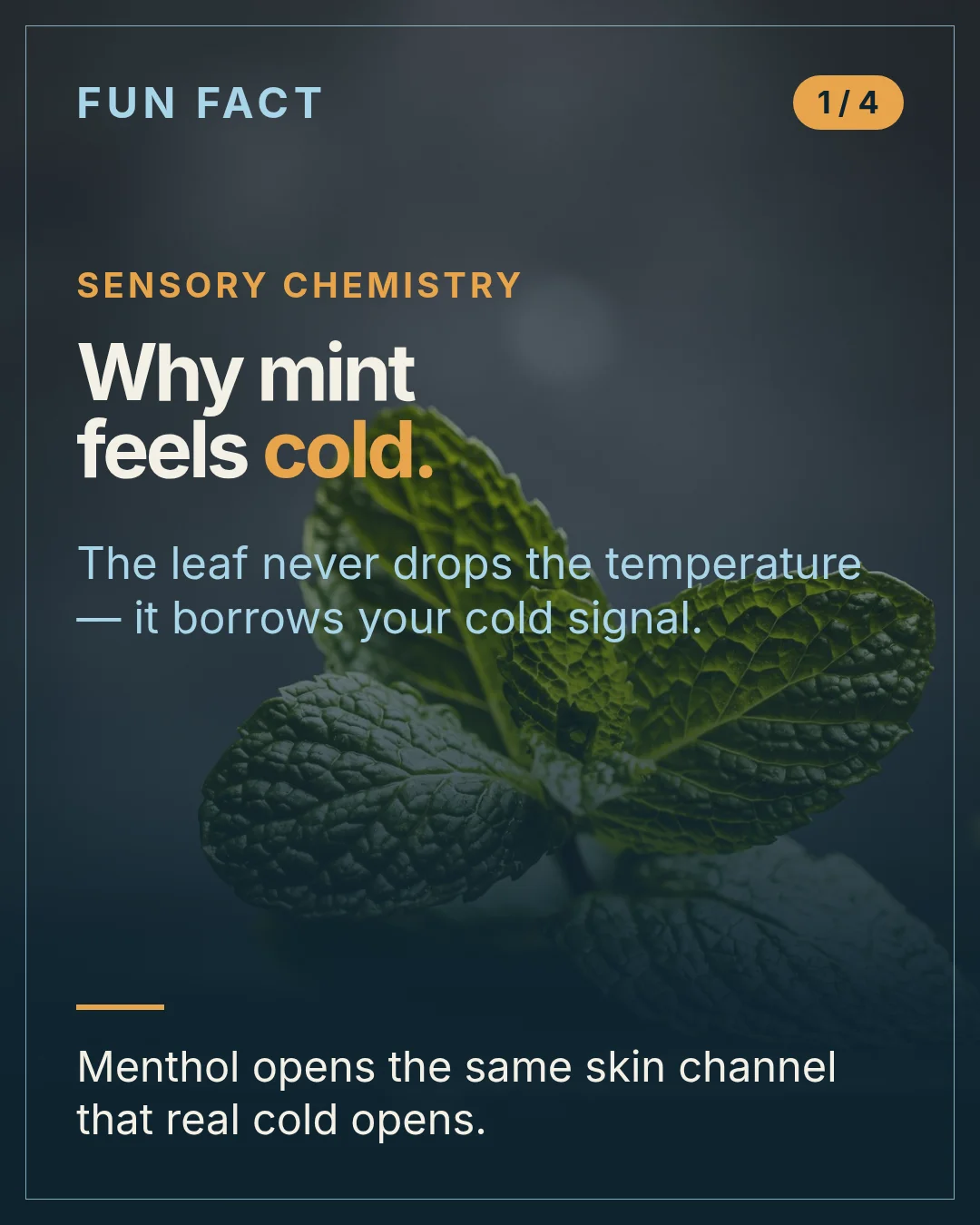

Mint never cools your mouth. Menthol — the molecule that gives mint its kick — opens TRPM8, the same protein channel that cold temperatures open in sensory nerves.1
When that channel opens, ions flood in and the neuron fires. Your brain reads the pulse as cold, even though the surface temperature never dropped.2 TRPM8 starts responding near about 26°C; menthol shifts that activation curve toward warmer temperatures, so a room-temperature mint can still feel cool.1
Britannica notes that some cold thermoreceptors are also excited by menthol, which is why the chemical lands as a cold sensation rather than a separate taste.3 That same pathway is why gum, cough drops, and menthol pain creams feel cool on contact.4
Image material: Peppermint leaves on black ceramic plate
References
- 1TRPM8: The Cold and Menthol Receptor
ncbi.nlm.nih.gov
- 2Why does mint flavor feel cold?
helix.com
- 3Thermoreception — Properties of thermoreceptors
britannica.com
- 4How a Cell Channel Transforms to Make us Feel Cold
medschool.duke.edu
Comments