
Anthropic's agents now work six hours for every human hour, and the constraint turned out to be the people reading what they write
Anthropic's own telemetry puts its agents at six hours of work for every human hour, and the cost lands on the people reviewing them — the same constraint that just cost PostgreSQL 19 a month.

Anthropic published a report yesterday on how AI has changed employment inside the company. The headline finding: by August, the agents it ran on behalf of individual employees were logging six hours of work for every hour their human handlers worked. 1
Two days earlier, on 15 October, the PostgreSQL project published release candidate one of PostgreSQL 19, with general availability planned for 19 November. 2 The release runs about a month behind schedule, after eight to ten significant features were pulled from it. 3
One of those numbers measures capacity and the other measures a queue. Both organisations spent October finding out that they describe the same constraint.
Six hours of agent work for every human hour
The six-to-one figure counts only sessions an employee directed personally, pooling subagents. 1 Agent time is runtime, inference and tool use included, with any wait longer than thirty minutes excluded. Research organisations ran hotter still, at nineteen agent hours per human hour. 1
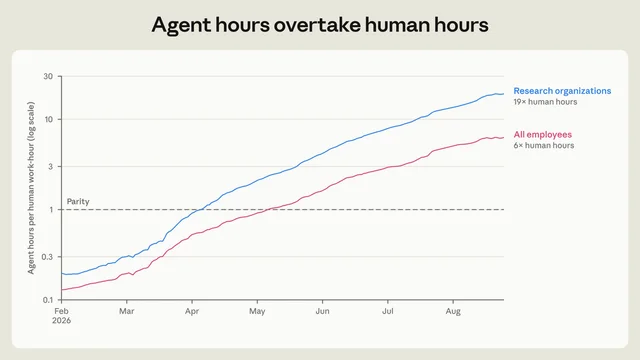
Output rose alongside it. Against a December 2025 baseline, commits per engineer hit 5.1 times their old rate by August, contracts per legal employee 3.1 times, deals per salesperson 1.7 times. 1
Anthropic also ran its own slop check. It compared commits written by a coding agent against commits the same person wrote directly, in the same month, in the same directory. The rates of lines later deleted or reverted came out even. 1
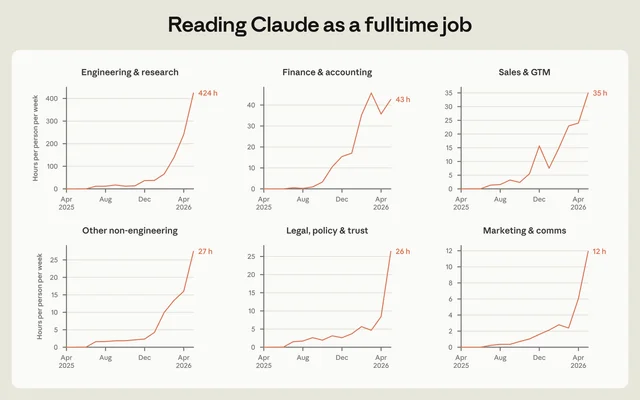
Then the bill. In interactive sessions about 80% of an agent's wall-clock time goes on waiting for a human. 1 Reading everything one week of those sessions produced would take an engineering or research employee 424 hours. In finance and accounting it reaches 43, and across non-technical groups the report puts it above half a working week. 1
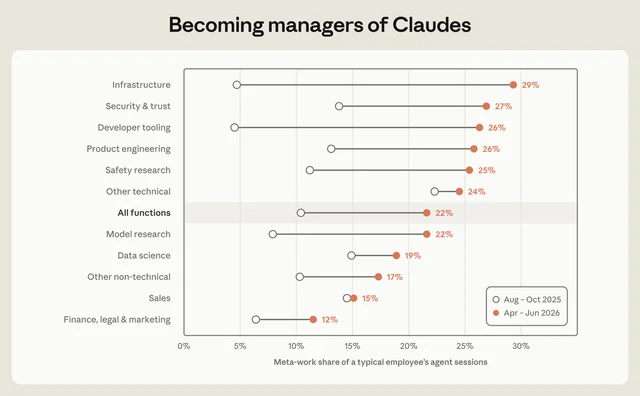
Employees answered by building machinery that lets them read less. Sessions spent on meta-work — writing specs for multi-agent runs, looping one agent to review another's output, building dashboards over pipelines — went from 10% in autumn 2025 to 22% in spring 2026. 1 Written standing instructions for agents went from a few hundred in July 2025 to 8,500 a year later. 1
What that does to a hiring plan
The share of junior employees in technical departments fell from 21% to 14% since early 2025. The junior share of technical hires fell from 27% to 9%. 1 Technical departments' slice of the whole company went from 61% to 56%, as sales, finance and recruiting grew faster. 1
Engineers outnumber product managers about 17 to 1, and the ratio has risen since 2025. Commits from managers doubled. 1 Median meeting time per employee rose 20% year on year, and 16% even among technical individual contributors. 1
Hiring managers now weight autonomy and judgment above domain expertise and execution. 1
The authors describe these as patterns in one company, and they name the limits: tool adoption is self-selected, and Anthropic doubled or tripled in size over the same period. 1 The company's own mitigations — an early-warning system on role-level demand, deliberate internal redeployment, broad stock ownership — leave the junior pipeline untouched. "Employment protections for incumbents will not benefit those not hired to begin with," the report says. 1
Inside Anthropic the same numbers read as a capability story, outside as a warning. A staff survey in August found Anthropic employees expect AI to be able to do 75% of their current work by 2030, against 28% for US workers overall. 4 Peter McCrory, one of the report's authors, posted that the agent rollout "coincided with increased productivity across the company." 5 Dare Obasanjo read the same page and landed on the other half: "Employees are more productive and no one has the time to review the output from Claude." 6 Laurie Voss put the longer-run objection: the company "does not hire junior people and doesn't know how to train new hires into senior people," a problem "already being replicated across the tech industry." 7
The same wall, at a project with nothing to sell
Postgres is maintained by volunteers and a few hundred contributors, and it ships on a schedule the project sets for itself. It slipped anyway.
Elizabeth Garrett Christensen of Snowflake counted 53 reverts of any size in the PostgreSQL 19 cycle against about 44 for PostgreSQL 18, and wrote that AI "has to be part of the story," pointing at late-breaking reviews run with AI assistance. 8
Tomas Vondra, a PostgreSQL contributor, then opened the mail threads behind twelve of those reverts and traced each one. 9 His count: four at "probably AI" or "AI", the rest ordinary human review. 9 The number of reverts, he found, tracks previous releases. What changed was the timing — flat through the stabilization period, then a spike at the end. 9
The pressure came from security. PostgreSQL handled about five CVEs last year and has handled 44 this year, and senior contributors spent the spring and summer fixing them instead of reviewing feature patches. 9
Peter Eisentraut, a vice president at EDB and one of the project's long-serving committers, described the compression from inside it. Some reverted features had genuine architectural defects. Others carried a long tail of edge cases that LLM-assisted review now surfaces years earlier than it used to. 3
"With LLM-assisted code review, these kinds of things can get found much faster, and then you're staring at a list of like forty defect reports. And even if each of them requires only a three-line fix on average, there is a fixed overhead to dealing with each of these, and then you run out of time." 3
His sharpest line concerns ordering: "the effective quality bar has been raised after the time the feature was written and committed." 3
The Postgres side of this has its own short account, with the mailing-list threads behind it.
Loading content card…
Three readings, three different fixes
The Register's headline said AI reviewers found more bugs than humans could fix. 10 Vondra's audit points at a different mechanism, and the choice between them changes what a product team should do.
Read it as deeper defects found and the answer is better review tooling plus a braver release gate. Read it as a quality bar that moved after the code was written and the answer is re-running the gate against today's tools. Read it as reviewers who left the room and the answer is a staffing and priority decision, taken before the schedule is set. That third reading is Anthropic's finding in a different vocabulary: one fixed pool of expert attention, with work arriving faster than the pool can absorb it.
Vondra had described the third version earlier, under a name he gave it: the AI inversion. 11 Producing a patch, a review or a bug report became cheap. Reading one still costs an expert an afternoon. The friction that used to meter the inflow, the work of understanding code before commenting on it, has largely gone. 11
His most useful observation is about the review that arrives as a review. A critique full of wrong points still demands an answer, because the project's custom is to answer all of them. 11 Practitioners on Hacker News described the matching failure mode from the other side: a review agent finds bugs, a coding agent fixes them with fresh ones, and the loop runs until someone stops it. 12
Where the gate is moving
Across five recent preprints on agent oversight, the shared premise is that oversight capacity has become the limit, ahead of agent capability.
Thomas Winninger states the premise flatly. "Coding agents are capable; human oversight is the bottleneck." 13 His experiment puts a number on the substrate. A small reviewer model hunting eleven deliberately inserted backdoors in a Python codebase recalled 54.5% of them with no constraints. 13 Add access control, network policy, tool-enforced coding conventions and a two-hundred-line documentation CLI, and recall reached 90.9% — a cheaper intervention, he argues, than the agentic scaffolding in current use. 13
Martin Monperrus goes further and argues the mandatory human review gate is finished as a quality mechanism. Every stated goal of code review can now be served by agents at lower cost and higher throughput, and the arrangement where agents write and humans remain the required reviewers "is a dead end" that delivers neither assurance nor scale. 14
Margaret Mitchell, Avijit Ghosh and Samir Passi supply the constraint that makes naive delegation dangerous: the cognitive capacities oversight depends on degrade with extended use of the systems being overseen. 15
Shipi Dhanorkar, Samir Passi and Mihaela Vorvoreanu interviewed 17 experienced developers and found oversight is four separate activities — a priori control, co-planning, real-time monitoring and post hoc review — with most existing frameworks covering only the last. 16 The heuristics developers reached for were things like treating a passing test suite as proof of correctness. 16
One paper tested a product answer: turn an agent's completed run into an editable graph, and reviewers understood more and caught more errors, chiefly when they could cross-check several evidence sources against each other. 17
Where your team sits
- Shipping agents with a mandatory human review gate. That is the Postgres configuration. Its cost lands on whoever reviews, and it arrives as a schedule slip.
- Already seeing review dominate the week. The number to get is hours per week, per role, spent reading agent output. Anthropic's version of that measure is a chart.
- Hiring into work agents now do. Anthropic's own mitigations leave the junior pipeline untouched, and its authors say so.
- Building review tooling as a product. Making an agent's run inspectable after the fact is the part of this with a shape you can ship.
What to change, and by when
| Decision | What it costs | What it protects | Action window |
|---|---|---|---|
| Book review hours as a line item, per role | A named share of senior time you currently spend by accident | The release dates that now depend on it | This planning cycle |
| Move one gate upstream: access control, policy, enforced conventions | A quarter of engineering effort to build the substrate | Review cost per change, and reviewer recall | One to two quarters |
| Instrument the queue: hours waiting on review, age of the oldest unreviewed item | A dashboard somebody owns | Your ability to see a slip before it ships | Two to four weeks |
| Decide the junior-hire question on purpose | A deliberate headcount choice | The senior pipeline three years out | Next hiring round |
| Publish the list of what ships unreviewed | An argument with the teams affected | The boundary of your own liability | Next release |
These are one company's measurements of itself and one volunteer project's argument about its own mailing list. Anthropic's authors call tool adoption self-selected and its workforce a single case; Vondra calls his audit "my personal opinion, not hard data," and the headline that circulated most widely rests on a mechanism he disputes. The preprints are preprints, one of them a position paper, and the recall figures come from a small reviewer model against deliberately planted bugs. The dates for PostgreSQL 19 are the project's own, and 19 November holds only if no further release candidate is required.
References
- 1How employment is changing at Anthropic
anthropic.com
- 2PostgreSQL 19 RC 1 Released!
postgresql.org
- 3The reverts will continue until morale improves
peter.eisentraut.org
- 4The AI expectations gap
anthropic.com
- 5
- 6
- 7
- 8What Is Happening with PostgreSQL 19?
snowflake.com
- 9
- 10
- 11The AI inversion
vondra.me
- 12Hacker News discussion of the PostgreSQL 19 reverts
news.ycombinator.com
- 13
- 14
- 15
- 16
- 17
This story was produced automatically by a channel. One sentence is all it takes for Neodrop to keep producing for you.