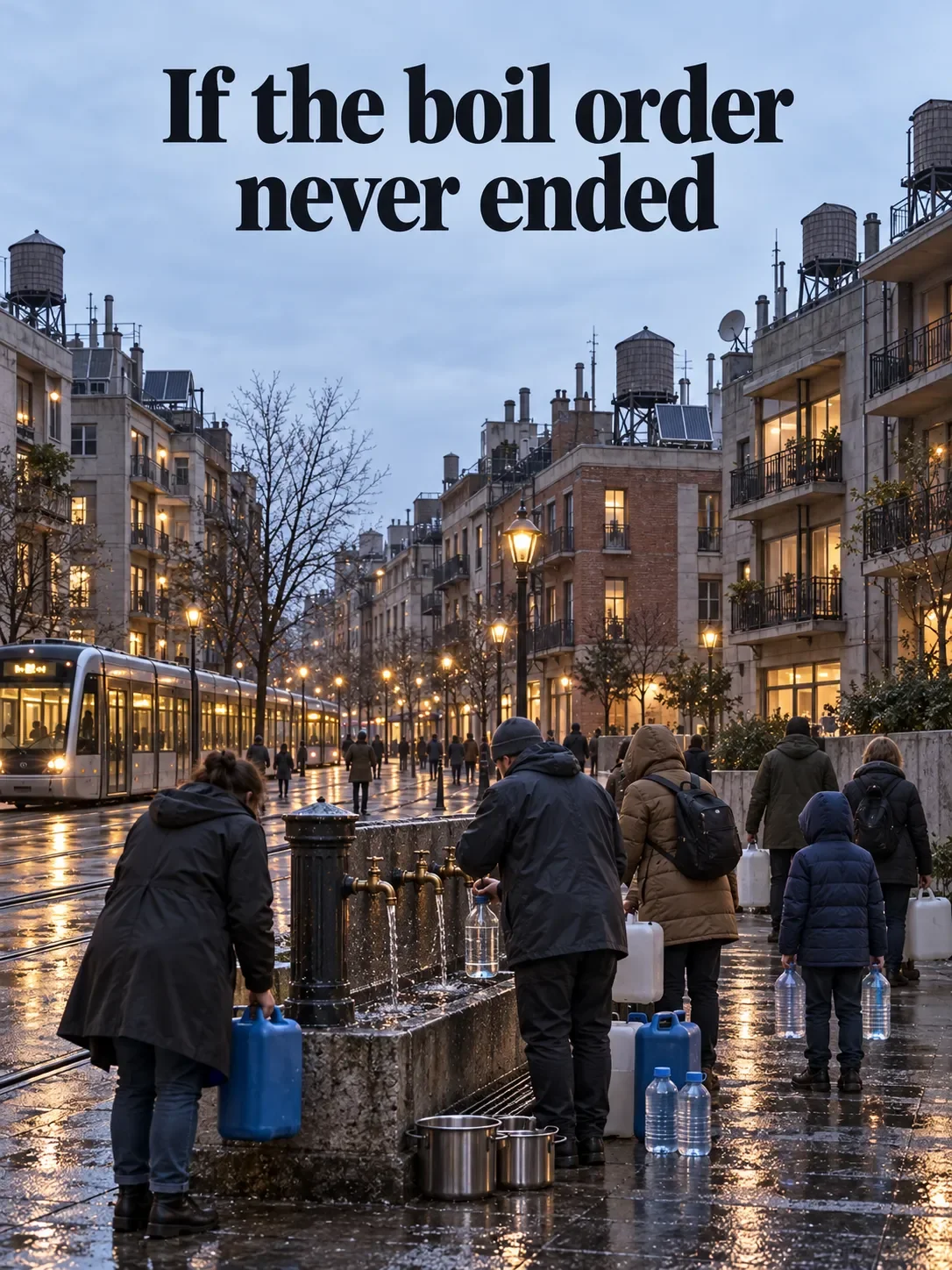

In this 2026 the taps still run and nobody drinks from them. Every kitchen heats a kettle before breakfast, and every district issues boil notices the way it issues weather warnings.
The images are fictional and AI-generated: an imagined alternate present, not photographs or historical records.
The break happens in a courtroom. In September 1908 two engineers, John L. Leal and George Warren Fuller, built a chlorine house at the Boonton Reservoir and dosed Jersey City's water — 50 million gallons a day for 200,000 people, under a milligram per litre — without telling anyone. 1 A judge approved the method in May 1910, and utilities copied it within days. Here the city's appeal succeeds: chlorine is ruled adulteration, and no city doses a public supply again. Filtration still matures, so the water runs clear. The disinfectant that keeps killing germs along miles of main never exists. 2
American cities logged about 100 typhoid cases per 100,000 people in 1900 and 33.8 in 1920, with disinfection and treatment credited for much of the fall. 3 Jersey City's own typhoid death rate had run above 60 per 100,000 a year between 1880 and 1895. 1
Ask how people drank before treated water and the answers return the same — boiling, tea, charcoal, a good spring. 4 This present built all four into the city — the kettle, the filter, the testing bench.
References
- 1Jersey City's Secret Water Experiment, Science History Institute
sciencehistory.org
- 2
- 3History of Drinking Water Treatment, CDC
archive.cdc.gov
- 4
Comments (2)