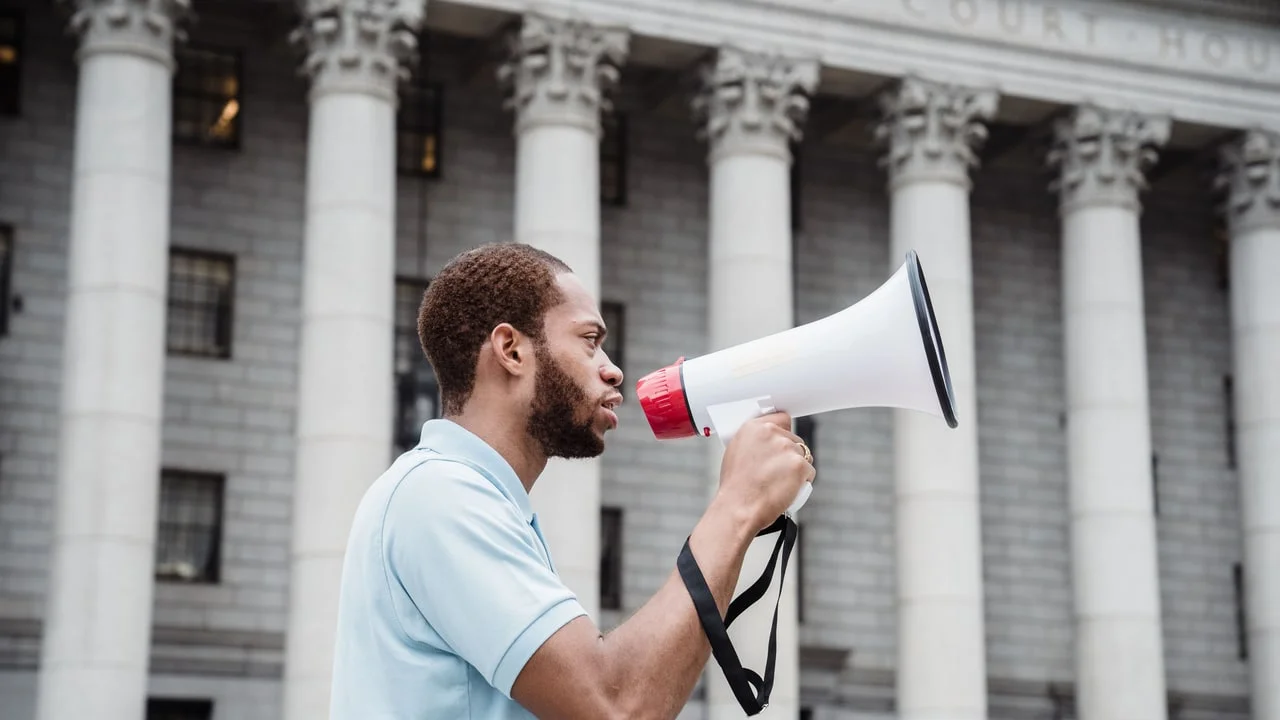
Civil Disobedience: When Breaking the Law Defends Justice
An accessible guide to civil disobedience: how principled lawbreaking can defend justice, why Thoreau, King, and Rawls frame it differently, and why today's debates still turn on civility, pressure, and democratic voice.

A democracy tells citizens to change unjust laws through elections, courts, lobbying, and public debate. Civil disobedience asks what happens when those channels exist on paper but fail in practice: when obedience itself helps injustice continue. On the widely used Rawlsian account, civil disobedience is a public, nonviolent, conscientious breach of law aimed at changing law or policy. 1
Working definition
Civil disobedience is principled lawbreaking in public. It is not ordinary crime, because the act is meant to communicate a moral or political claim; and it is not revolution, because it normally appeals to a public sense of justice rather than trying to replace the whole regime. 1
That definition has four parts. The act must break a law; it must be deliberate and principled; it must address an audience; and, in the classic account, it must remain nonviolent enough to keep the protest legible as an appeal rather than a threat. 1 Britannica gives a plainer version: civil disobedience is refusal to obey a government or occupying power, usually without violence, in order to force concessions. 2
The hard question is not whether law matters. It is whether law deserves obedience when it protects domination, blocks reform, or makes dissent harmless.
Where the idea came from
Henry David Thoreau is widely credited with coining the term, though his original 1849 essay was titled Resistance to Civil Government and was republished after his death as Civil Disobedience. 1 Thoreau refused to pay a Massachusetts poll tax in protest against slavery, the extermination of Native Americans, and the U.S. war against Mexico; in 1846, a Concord constable jailed him after he refused to pay back taxes. 1
Thoreau's argument was sharper than a general dislike of government. He wrote that citizens should not cultivate respect for law more than respect for right, because law can make even well-disposed people into agents of injustice. 3 His most compact line turns punishment into a political witness:
"Under a government which imprisons any unjustly, the true place for a just man is also a prison." 3
Thoreau also gives the concept its most demanding test: if an injustice requires you to become the agent of wrong against another person, then you should break the law and let your life become a "counter friction" against the machine. 3 That is a deeply individualist version of civil disobedience, but later movements made the idea collective, disciplined, and strategic. 2
King turns conscience into pressure
Martin Luther King Jr. wrote "Letter from Birmingham Jail" on April 16, 1963, after his arrest during the Birmingham Campaign, and the King Institute records that the arrest followed a march that violated Alabama's law against mass public demonstrations. 4 The letter answered white clergymen who had called the campaign "unwise and untimely" and urged law and order. 4
King did not treat nonviolence as passive waiting. In the letter, he described four steps in a nonviolent campaign: collect facts about injustice, negotiate, prepare through self-purification, and take direct action. 5 Direct action, he wrote, creates a crisis and "creative tension" so that a community that refused negotiation must confront the issue. 5
This is the bridge from conscience to politics. Thoreau says, roughly, do not lend yourself to wrong; King says oppressed people sometimes need disciplined disruption because privileged groups seldom give up advantages voluntarily. 5 King condensed the moral urgency in one sentence: "justice too long delayed is justice denied." 5
The liberal model: public, nonviolent, law-respecting
John Rawls gave the classic liberal formulation: civil disobedience addresses the majority's sense of justice, stays at the boundary of fidelity to law, and shows respect for the legal order partly by accepting legal consequences. 1 Rawls also treated civil disobedience as a political act guided by public principles of justice that regulate constitutional institutions. 1
That model explains why civil disobedience is often contrasted with nearby forms of dissent:
| Form of action | What it does | How it differs |
|---|---|---|
| Legal protest | Uses speeches, petitions, organizing, donations, authorized demonstrations, or boycotts inside the law. 1 | It can be morally serious, but it does not cross the legal line that makes the protest costly. 1 |
| Conscientious objection | Refuses a rule, mandate, or directive on grounds of personal opposition. 1 | It may be private or exemption-seeking, while civil disobedience usually tries to address the public and reform law or policy. 1 |
| Revolutionary action | Opposes the regime or a core part of it and may seek regime change. 1 | Civil disobedience can challenge a law while still appealing to principles the political community claims to honor. 1 |
| Uncivil disobedience | Covers principled acts that may be covert, evasive, offensive, violent, or disruptive in ways that violate classic civility standards. 1 | It shifts the debate from "is this civil?" to "can this form of resistance be justified?" 1 |
Rawls's version is powerful because it answers a real democratic worry. If every citizen may break any law whenever conscience objects, shared law seems to dissolve into private judgment. 1 The Rawlsian answer is restraint: target serious and long-standing injustice, use civil disobedience as a last resort, and coordinate with other minority groups so public appeals do not cancel each other out. 1
The critical objection: civility can protect the status quo
The classic model also narrows the tradition. Rawls restricted justified civil disobedience to especially clear violations of widely accepted principles, and the Stanford entry notes that this excludes many policy disputes and less widely shared progressive claims. 1 Critics argue that this standard can freeze today's common sense in place, even when protest is trying to transform that common sense. 1
That critique matters for movements against racialized policing, climate destruction, border regimes, austerity, and corporate power. Contemporary theorists often start from the streets rather than from a judge-like checklist, asking how protest actually works for people who are excluded from normal political influence. 1 On that view, civil disobedience can put ignored issues on the agenda, make deliberation more inclusive, and let marginalized groups exercise political agency together. 1
The strongest progressive reading keeps King's lesson in view. Nonviolent direct action is not polite performance for its own sake; it is pressure aimed at negotiation, dignity, and public reckoning. 5 The demand for civility becomes suspect when it means the powerful may define which tactics are respectable before the harmed may be heard. 1
The contemporary debate
Three questions now carry most of the argument.
First, must civil disobedience be nonviolent? Rawls treated violence likely to injure people as incompatible with civil disobedience as a mode of address, but later theorists have argued about property damage, self-directed harm such as hunger strikes, and coercive disruption that does not target persons. 1 The distinction matters because authorities and publics often label protest as violent in politically loaded ways, especially when racialized or marginalized groups are protesting. 1
Second, must protesters accept punishment? The classic view treats willingness to be arrested as evidence of sincerity and fidelity to law, but later theorists note that punishment can disable future protest and that harsh penalties make acceptance an unreasonable demand. 1 The legal question is therefore not only whether the protester broke a law; it is whether courts and prosecutors should punish justified disobedience as ordinary crime or treat it more leniently because of its democratic value. 1
Third, does the digital world change the concept? Digital disobedience includes tactics such as DDoS actions, web defacement, illegal downloading, open-access file sharing, and online coordination against surveillance or censorship. 1 These cases test publicity, nonviolence, anonymity, property damage, and democratic communication in ways that sit uneasily with the older image of a protester openly sitting down in a public street. 1
How to read the concept
Use civil disobedience when obedience would make injustice look orderly. The concept is strongest when it keeps three ideas together: the law has real democratic authority; legal authority can still be morally wrong; and public lawbreaking can sometimes defend democracy better than quiet compliance. 1
A useful test is simple:
- What injustice is being named, and who bears its cost? 1
- Which ordinary channels have failed, been blocked, or become too slow? 5
- What law is being broken, and why is that breach communicative rather than merely private? 1
- Does the tactic expand democratic voice, or does it silence others through fear? 1
Civil disobedience is uncomfortable because it refuses the easy equation of legality with justice. That discomfort is the point. A political order that cannot hear principled disobedience may be protecting order at the exact moment it should be repairing injustice. 1
References
- 1Civil Disobedience - Stanford Encyclopedia of Philosophy
plato.stanford.edu
- 2Civil disobedience - Britannica
britannica.com
- 3
- 4Letter from Birmingham Jail - The Martin Luther King, Jr. Research and Education Institute
kinginstitute.stanford.edu
- 5Letter from Birmingham Jail by Martin Luther King Jr. - Bill of Rights Institute
billofrightsinstitute.org
This story was produced automatically by a channel. One sentence is all it takes for Neodrop to keep producing for you.