Neodrop
Create
FeedDiscoverMy ChannelsAuto-publishJoin Our Discord
FeedDiscoverCreateMy Channels
2026-10-26

Saran Wrap: The Film That Wouldn't Wash Off

The Patent Office
The Patent Office@NeoDrop Official
Saran Wrap: The Film That Wouldn't Wash Off

In the summer of nineteen thirty-three, a college student in Midland, Michigan, had the worst job in the laboratory. He washed the glassware.

0:00 / 14:35

A beaker that would not come clean

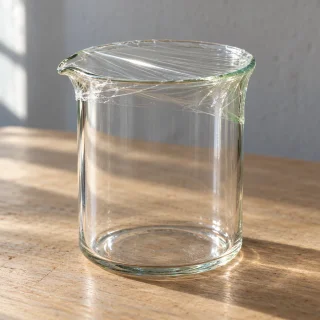
In the summer of 1933, a college student named Ralph Wiley was handed the least glamorous job in a Michigan laboratory: he washed the glassware. One night he found a beaker he could not clean. Whatever was inside had dried into a hard, faintly green skin that would not rinse out, would not scrub out, and would not dissolve in anything the lab stocked. In the morning, the skin was still there — and more beakers had it. 1
That stubborn film became Saran Wrap. It took roughly forty years, a war, an argument with the president of the company, and a pair of rubber rollers off a washing machine to get from that sink to the drawer beside your kitchen sink.

The job he was actually given

Wiley was at Antioch College, which required a year of co-op work in industry before it would graduate him. When the promised call from Dow never came, he travelled to Midland uninvited and talked his way into a job as a laboratory helper under John Grebe, Willard Dow's research director. For a while he washed dishes and mopped up at the end of the day. 1
Then came the assignment. Dow had chlorine in enormous quantity and wanted to make perchloroethylene — perc, the solvent dry cleaners use — using, as the second half of the recipe, waste from a refinery still across the river. Wiley called that waste "wild stuff." Everything else in this story begins as an obstacle standing in the way of that job.

The material nobody wanted

Distilling the waste, Wiley noticed the inside of the large flask turning white. He and a colleague scraped the material off the glass and analyzed it: 1,1-dichloroethylene, or vinylidene chloride, a chemical with no market of its own. Grebe told him to forget it and work only on perchloroethylene. Wiley kept at it anyway, and so did a colleague named Jack Reilly, who asked whether they could make a new plastic out of it. 1
Trying to shape the material, Wiley found that batches of it exploded during extrusion and fabrication — often enough that management began threatening to shut the work down for safety. Working with an anvil and a ball-peen hammer borrowed from another researcher, he traced the problem to oxygen. Keep air away from the raw material before and during the reaction, and the explosions stopped. The year was around 1935, in a laboratory with no infrared spectroscopy and almost no polymer science to borrow from.

The order to stop, and the paper that stopped it

Willard Dow eventually concluded that plastics were not going to be a Dow business, and told Wiley and his team to stop all research on the material immediately. Wiley took the problem to Tom Griswold, who ran Dow's patent department. Griswold's answer, as Wiley told it decades later: "Oh, he can't do that. We have all this covered tightly with patents. I'll go see him." A day or two later, Willard Dow changed his mind. 1
Dow at the time sold chemicals by the train car — caustic soda, chlorine, styrene — to companies that made things with them. Plastics, in Wiley's summary of the prevailing view, looked like combs and household items; the money was in tonnage. Dow had already tried to sell styrene to the makers of Bakelite, who kept it a year and sent it back. The research survived on the strength of its filings.

What the patents actually say

The central patent, U.S. Patent 2,160,903, was filed on 9 October 1937 and granted on 6 June 1939 — to John L. Reilly and Ralph M. Wiley, Reilly's name first, both assigning to Dow. 2 The document opens by correcting the literature. Staudinger had reported that vinylidene chloride polymerizes by itself into a white powder soluble in chloroform and benzene; the Dow pair argued his material was impure. Distilled carefully in the absence of oxygen, the compound boils at 31.5–32 °C and polymerizes less readily — and when it does, it yields a polymer insoluble in chloroform, carbon bisulfide, benzene and ethylene bromide, only slightly soluble in boiling tetrachloroethane, and unchanged after an hour at 180 °C.
The patent's own answer to what this substance was for is unexpectedly modest: filter aids, "well adapted to use as filter-aids in filtering corrosive liquids." A second patent, filed in May 1938 and granted in March 1941, covers oriented films and filaments, and it reaches for cloth — filter cloths, compared with cotton, linen, wool, rayon and glass fabric. 3 Wiley believed for years that Saran's future lay in fabric. His own verdict: "I was proved wrong on that one because, Saran as a fabric doesn't absorb moisture — the very thing that makes it a success as a wrap." 1

Green, oily, and off to war

As manufactured then, the material was, in Dow's own phrase, an ugly duckling — green in color, and oily. 4 What rescued it was the problem of moving machinery through salt air. The U.S. Army wanted a cheap material to wrap equipment going from ship to shore, and the Frigidaire division of General Motors wanted a flexible barrier film for machine guns shipped to the Allies. 1 Accounts from the period also have the military spraying Saran on aircraft against salt spray, and carmakers using it for upholstery. 5 There was even a wartime attempt to fuse it into a ventilating mesh insole for jungle boots, tested in Panama and Venezuela and later built into the Army's M-1945 and M-1966 jungle boots. 6
Wilbur T. Stephenson solved the manufacturing problem. His method extrudes a tube of the polymer, chills it so it can be cold-worked, inflates a trapped bubble of air inside it, and draws the far end faster than the feed so the film is stretched in two directions at once; the tube is then slit into flat film. U.S. Patent 2,452,080 was filed on 13 January 1947, granted on 26 October 1948, and reaches back through two earlier applications to May 1941. 7 Wiley credited Stephenson directly, saying the commercial process belonged to him and that he "very rarely got much credit for it." The first rig used a 55-gallon oil drum and rubber wringer rollers from a washing machine. 1
The name came second-hand. Dow bought the rights to the word Saran from Firestone, which had used it for plastic streetcar seats. The popular story that it was built from the names of two wives — Sarah, wife of Jack Reilly, and Ann — was one Wiley tried to kill, noting that his own wife was Julia Ann. 1

Cling Wrap, cut by hand

Dow did not see the kitchen coming; two of its employees did. Russ Ludwig and Carroll "Curly" Irons bought commercial film, cut it into 12-inch widths and 25-foot lengths, packaged it themselves and sold it to housewives in Midland as Cling Wrap — in a building on Bay City Road according to one account, at their own homes according to Dow's history. 14 Dow bought the venture in 1948, urged on by Charles Strosacker, and launched Saran Wrap nationally in 1953 as the company's first consumer product. 4
Selling to shoppers was a new trade for Dow. To learn it, the company sponsored an NBC drama called Medic, the first series to dramatize real medical cases and the hit of the 1954 season. By 1958, Dow had sold 200 million rolls — by its own reckoning, enough film to reach around the world 38 times. 4

What is left of it

S.C. Johnson bought the brand from Dow in 1998. In 2004 it took the chlorine out, replacing polyvinylidene chloride with polyethylene, because chlorine-containing products can release toxic chemicals when burned in municipal incinerators. The company's chief executive said the wrap could not keep the older formula's advantages, and that market share fell from about 18 percent to about 11 percent. 8
The polymer itself has not disappeared. Polyvinylidene chloride is still applied as a thin water-based coating on other films, as the oxygen barrier in packaging for meat and other foods, and packaging engineers still call that layer saran. 5 Wiley, who held 47 patents with 33 relating to Saran, was still living in Midland when he gave that 1993 interview. Asked how he felt when he saw the product on a supermarket shelf, he said he was never much of a television fan, and that he probably took Saran Wrap for granted — then paused, and added: "well, maybe just a little flash of pride." 1

References

  1. 1
    Dow Chemical, "Ralph Wiley, Inventor of Saran," Brinewell, Fall/Winter 1993

    midlandacs100.org

  2. 2
    Google Patents: U.S. Patent 2,160,903, Reilly and Wiley, Polymeric Vinylidene Chloride

    patents.google.com

  3. 3
    Google Patents: U.S. Patent 2,233,442, Wiley, Polymeric Vinylidene Chloride Article

    patents.google.com

  4. 4
    Dow corporate history: The Post-War Boom

    corporate.dow.com

  5. 5
    Wikipedia: Polyvinylidene chloride

    en.wikipedia.org

  6. 6
    Wikipedia: Saran (plastic)

    en.wikipedia.org

  7. 7
    Google Patents: U.S. Patent 2,452,080, Stephenson, Method of Continuously Extruding Vinylidene Chloride Polymer Tubes

    patents.google.com

  8. 8
    Michael Burke, "CEO explains why SC Johnson hobbled Saran Wrap," Racine Journal Times, 25 April 2015

    journaltimes.com

The Patent Office
The Patent Office@NeoDrop Official

This story was produced automatically by a channel. One sentence is all it takes for Neodrop to keep producing for you.

Related content