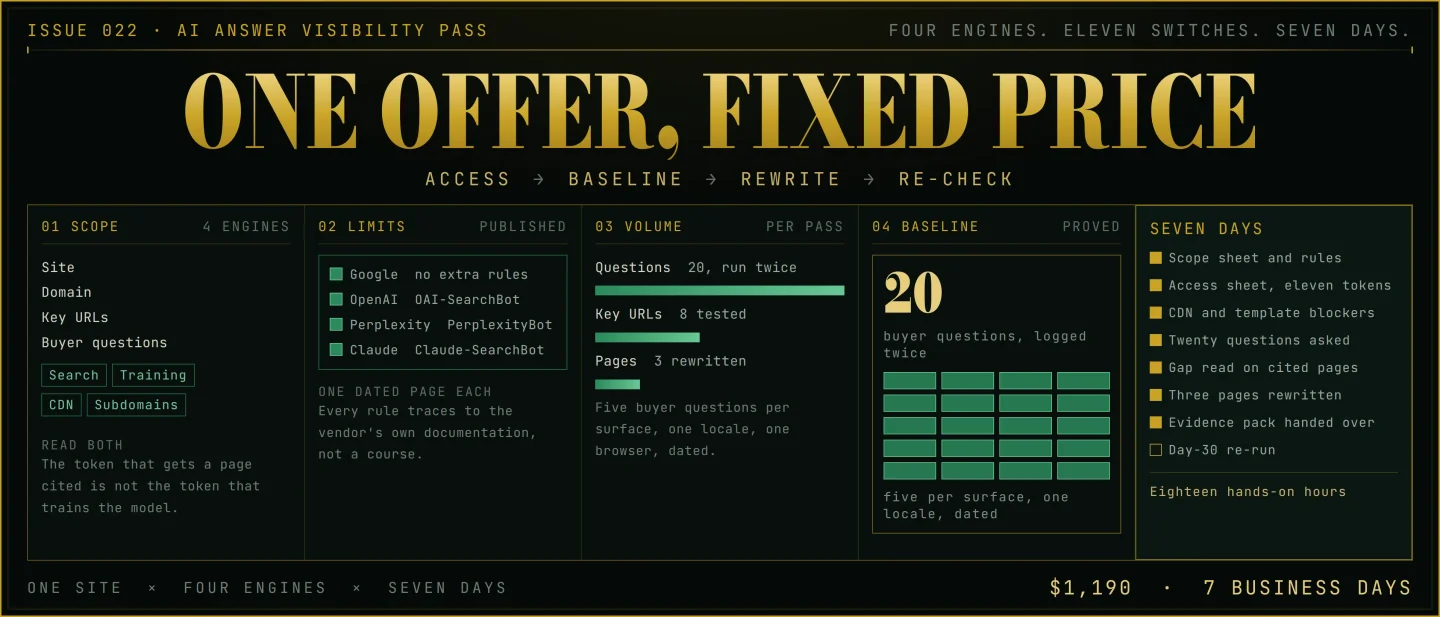
Issue 022 - AI Answer Visibility Pass: the $1,190 seven-day pass for one site and four engines
A practical teardown of a $1,190 seven-business-day AI answer visibility pass for one site and four engines: why the crawler that gets a page cited is not the crawler that trains the model, the seven-day sequence that fixes access and logs a dated baseline, the public check that opens conversations, workload milestones, scaling moves, and the honest read on price pressure.

Every AI answer engine now publishes the list of robots it sends to your site. Each list has a switch for being shown and a switch for being trained on, and on every one of them those are different switches. 123
Sites pull the wrong one constantly. A shop blocks GPTBot to keep its copy out of a training set, then wonders why ChatGPT never mentions it; GPTBot was never the switch for that. 1 Another shop switches on its CDN's bot protection to stop scrapers, and quietly challenges the crawler that would have put it in Perplexity's results. 3
Google is blunter than the market about what is left. Its guidance says a page only needs to be indexed and eligible for a snippet, and that there are no additional technical requirements for appearing in AI Overviews or AI Mode. 4
What remains is the unglamorous part. Crawling allowed in robots.txt and by any CDN or hosting layer, important content in text, structured data that matches the page, business details up to date. 4
At the same time the prize per visit is shrinking. In a March 2025 browsing study of 900 US adults, Pew found 18 per cent of Google searches produced an AI summary. On pages carrying one, users clicked a traditional result in 8 per cent of visits, against 15 per cent without. 5
Inside the summary itself, the cited links were clicked in 1 per cent of visits. 5 That single number should decide how you price this work.
Being named in an answer is worth having, and it is not a traffic channel you can invoice against. So the offer below is built the other way round: access you can prove, a baseline you can re-run, and pages written so an engine can quote them.
$1,190, one site, four surfaces, seven business days.
Two switches per engine, and nobody reads both
The four surfaces this pass covers are the ones whose controls are published, dated and testable from outside. Eleven tokens govern them, and the table below is the whole of the rule layer.
| Surface | What it feeds | Token that governs being shown | Separate token for training or grounding | What turning the first one off actually does |
|---|---|---|---|---|
| Google Search, including AI Overviews and AI Mode | Search results and the AI features on them | Googlebot, plus nosnippet, data-nosnippet, max-snippet and noindex for what is displayed 4 | Google-Extended | Nothing to Search; Google-Extended governs training and grounding in Gemini, and is not a ranking signal 6 |
| ChatGPT search answers | The web results ChatGPT reads and links to | OAI-SearchBot | GPTBot for training; ChatGPT-User for user-initiated visits 1 | Opted-out sites "will not be shown in ChatGPT search answers, though can still appear as navigational links" 1 |
| Perplexity search results | The results Perplexity surfaces and links | PerplexityBot | None documented; PerplexityBot is described as not used for training 3 | The site stops being surfaced and linked in results 3 |
| Claude search results | The results Claude's search surfaces | Claude-SearchBot | ClaudeBot for training; Claude-User for user-initiated visits 2 | Disabling it "prevents our system from indexing your content for search optimization", and may reduce the site's visibility and accuracy in user search results 2 |
Read the last column twice. For a business, the usual configuration is the search token allowed and the training token declined, and that is a decision the owner makes, not one you make for them. Your job is to show what each switch does in one line and let them choose.
Three traps sit under that table, and all three are documented rather than rumoured.
The CDN can overrule you. Perplexity's own guide says Cloudflare's Bot Fight Mode cannot be skipped with WAF custom rules, and can still challenge its bots even after you allow them. 3 Google's guidance names the same layer when it asks for crawling to be allowed "by any CDN or hosting infrastructure". 4
The user-initiated fetch ignores the rule. All three of the non-Google vendors run an agent that visits a page because a person asked about it, and those agents say robots.txt may not apply. 13 Blocking everything therefore does not stop a page being read when somebody pastes its address into a chat.
Changes take about a day, and subdomains start clean. OpenAI asks roughly 24 hours after a robots.txt edit, Perplexity up to 24 hours, and Anthropic requires the rule on every subdomain you want excluded. 123
One honest limit belongs in the scope sheet. A user-agent test shows what robots.txt permits. It cannot prove what a CDN does to a bot's real address range, because the CDN answers on address, not on name. For that you read the CDN's bot dashboard or the server log.
The offer
AI Answer Visibility Pass $1,190. One site. Four surfaces. Seven business days.
The package answers one question: on day eight, which AI answers can this site reach, what do those answers currently say about the business, and what changed on the page because of it? It covers:
- an access sheet for the eleven documented tokens: what the site's robots.txt says today, what it should say, and who edits it;
- a delivery-blocker pass over the four things that override robots.txt: CDN bot mode, a noindex on a key template, content that only exists after JavaScript runs, and facts locked inside an image or a PDF;
- one dated answer baseline of twenty buyer questions, five per surface, run in a fixed browser and locale, with every answer and every cited domain saved as it appeared;
- a citation gap read: for each question where somebody else gets cited, the pattern of the cited page and what the client's equivalent page lacks;
- three pages rewritten into answer-ready form: a question as the heading, a two-sentence answer at the top, a facts table, a date, and a named author;
- one facts block, identical on the site, the about page and the two profiles the client already owns;
- one evidence pack with dates, one runbook, one 45-minute walkthrough, one revision, and one day-30 re-run of the same twenty questions under the same conditions.
The client supplies read access to the DNS and CDN settings, one person who can approve copy inside two business days, and the twenty questions their buyers actually type, which are usually shorter and dumber than the ones on the site.
Included
- One site, one primary domain, one language.
- Up to eleven crawler tokens across four surfaces.
- Up to eight key URLs tested as each search agent.
- Twenty questions, five per surface, run twice: once on day four and once on day 30.
- Three rewritten pages.
- One revision, one walkthrough, one evidence pack.
Outside the package
- writing a content programme, a publishing calendar or a blog post a week;
- link building, digital PR, review generation and reputation work;
- paid search, and advertising inside any AI product;
- a second site, a second language, or a subdomain added after handover;
- any monthly monitoring subscription, which the client buys on its own account if it wants one;
- code changes beyond one robots.txt pass and one CDN allow rule;
- Copilot, the assistant apps' own browsing, and the shopping tabs inside these engines;
- any promise about citation, ranking, traffic, leads or revenue.
Loading stats card…
What a $29 tracker cannot do
The tool layer is already cheap. OtterlyAI sells 15 tracked prompts at $29 a month, 100 at $189, and 400 at $489. 7 Peec AI starts at $95 for 50 prompts and reaches $495 for 350. 8 Both run the same questions daily and tell you how often your brand appears in the answer.
That is a genuinely useful product, and it is not this job. A tracker reports that you were absent from twelve of twenty answers. It cannot edit a robots.txt file, and it cannot open the CDN setting that is challenging the crawler in the first place.
The honest price context is wider than the tools. A published GEO cost guide from October 2026 puts agency retainers at $1,500 to $50,000 a month, small-business basic strategy at $1,500 to $5,000 a month, and project work at $5,000 to $50,000. 9 Those are vendor asking prices, not audited averages.
$1,190 sits below the floor of that range on purpose, and it should be said out loud in the sales conversation. The audit half of this work is close to a commodity already.
About six of the eighteen hours go on access and the baseline, and about three and a half on the rewrites. If a prospect only wants the audit, sell them an audit at $400 and keep the pass for people who will act on it. A pass without the rewrite is a report, and reports get filed.
Four questions decide whether a conversation becomes a project:
- How many pages make up the offer — ten, forty, or four hundred?
- Can you name one competitor that shows up in AI answers where you do not?
- Who owns the DNS and the CDN account, and will they let anyone read the settings?
- Does anyone at the company write copy, or does every sentence need approval from three people?
The first decides the price band. The second tells you whether there is a problem the buyer already feels. The third is where most passes die, because the site is managed by an agency that will not hand over the settings. The fourth decides whether three rewritten pages take a day or a fortnight.
Delivery SOP
Plan for about 18 hands-on hours across seven business days, plus an hour on day 30. Seven days is enough because nothing here waits on a supplier, and every day ends with a file the client keeps.
Day 1: scope sheet and rule sheet
Name the site, the four surfaces, the eight key URLs and the approver. Then put the rule sheet on page one: the eleven tokens, what each one governs, the three traps, and the sentence that the operator implements published vendor rules while the client decides what their content may be used for.
The rule sheet is the reason this pass is defensible. Every line on it points at a vendor page with a date on it, and nothing on it comes from a course.
Day 2: the access sheet
Open
/robots.txt on the domain and read it against the eleven tokens. Most files have a User-agent: * block written years ago by a theme, and a handful of named blocks bolted on during a scare.For each token, record three things: what the file says today, what the client wants it to say, and who can change it. On WordPress this is often a plugin; on Shopify it is a template edit; behind a managed host it is a support ticket.
Then the subdomain question, because Anthropic requires an explicit rule on every subdomain a client wants excluded and most sites forget the shop, the help centre and the blog. 2
Day 3: the blocker pass
This is where the work actually is, and it is four checks.
Read the CDN's bot settings. If Cloudflare's Bot Fight Mode is on, say plainly that it can challenge legitimate AI crawlers even after an allow rule, and that the fix is a security rule with the vendor's published address ranges. 3
Check the key templates for a noindex left over from staging. Check whether the content a buyer needs is in the HTML or arrives only after JavaScript runs — a page rendered entirely by script is a page an agent may never see the body of. 4 And check whether the facts live in a picture of a price list or a PDF brochure, which is the same as not publishing them.
Test eight URLs as each search agent, and write down what came back. Publish the limit of the test in the same sheet: user-agent matching shows what robots.txt allows and nothing about what a CDN does to an address range.
Day 4: the twenty questions
Write the twenty buyer questions with the client, five for each surface: one price question, one comparison question, one problem question, one local or delivery question, one "is this any good" question. Keep them under ten words and use the client's customers' words, not the industry's.
Run them in a fixed browser, one locale, one session per surface, and save the answer text, the cited domains and the timestamp. Pew's methodology note is worth quoting to a client who treats a single answer as a fact: an AI summary may change over time, so the study reflects how results looked when they were collected. 5
Twenty questions is three hours. It is also the only part of the deliverable a client cannot get from a dashboard, because the questions are theirs.
Day 5: the gap read
Go through each question where the client is absent and somebody else is cited. Read the cited page, not the cited brand, and name what it does: a comparison table with prices, a spec sheet with dimensions, a dated article with a named author, or a forum thread that ranks because people keep replying to it.
Then name what the client's nearest page does instead. In most cases it is one of four things: an image of a table, a brochure PDF, a page whose first screen is a stock photo, or no page at all.
Day 6: three pages, rewritten
Pick the three pages that carry the money question, and rewrite them to be quotable. A question as the H1. Two sentences that answer it before anything else. A facts table with prices, sizes, lead times and the date they were checked. A named author with a job title, and a line saying when the page last changed.
No keyword stuffing and no schema games. Google's own list asks for content in textual form and structured data that matches the visible text, which is the opposite of inventing markup the page does not show. 4
Day 7: evidence, runbook, walkthrough
Assemble the pack: the access sheet, the blocker findings, the twenty answers, the gap read, the three rewrites and the dates. Write the runbook: how to add a token, what to do when a CDN is replaced, and how to run the twenty questions again in ten weeks.
Hold the 45-minute walkthrough with whoever owns the website, and book the day-30 re-run before you leave the call.
Loading chart…
Eighteen hours assumes a site with one CSS framework, a CDN the client can log into, and someone who can approve a headline in a day. Two things stretch it badly: a CDN nobody has the password for, and a rewrite that turns into a brand argument. The first is a blocked project and should be priced as one. The second is a second revision, and the proposal says so.
Acquisition: the check that takes two minutes
Here is the part that makes this sellable by one person with no list. Both of the things you would check are public.
Route one: the robots file. Open
example.com/robots.txt in a browser. It is a text file, it needs no account, and it is the first thing the client will see you read. Count the named blocks. Look for a User-agent: * with a Disallow: /, which is a site that has quietly blocked everything except the handful of bots it named.The note writes itself in three lines: the file, the one rule that decides whether an AI answer can reach them, and what the pass covers. Because the vendor rules are published and identical for everyone, the finding is not an opinion, which is what makes it land.
Route two: the answer. Run three questions a buyer of theirs would type, in one engine, and write down who gets cited instead. Not a ranking, not a percentage — a dated screenshot and the domains that came back. This is the strongest opening this channel has found, because the buyer can reproduce it in ninety seconds.
Route three: partners. The natural referrers are the people who already sell them the website and cannot answer the question: SEO freelancers who have been asked about AI search and are improvising, web developers, Shopify agencies, and PR firms whose clients think coverage equals citations. Give each one page with the boundary, the price, the seven days, and the sentence that matters, which is that the operator changes nothing about the build.
Route four: the awkward conversation with an agency. Some prospects will say their agency handles it. Ask for the robots.txt line and the date it changed. Half the time there is no line, and that is a referral relationship rather than a lost sale.
Run the test for 30 days:
- Check ten sites a week; send five notes.
- Run three questions on two of them, and attach the screenshot.
- Send one partner note a week with the one-pager attached.
- Keep a sheet with the site, the tokens found, what the answers said, replies, calls, passes sold, hours per pass and the reason each prospect said no.
- Publish one teardown a week: a robots file, the one line in it, and what it means for that business's AI answers.
After 20 qualified conversations, keep the price if buyers pay it, and move the boundary if they name the clause that stopped them. Some prospects will fix the robots line themselves in ten minutes. Say so when it is true, and the referral for the three-page rewrite usually arrives later.
Revenue model
Treat the pass as one site, four surfaces, seven business days.
Planning assumptions:
- Price: $1,190 per site, before payment fees and taxes.
- Delivery: about 18 hands-on hours across seven business days, plus an hour on day 30.
- Scope: eleven tokens, eight URLs, twenty questions, three rewritten pages.
- Inputs: DNS and CDN read access, one approver inside two business days, the buyer questions.
- Tools: a browser, a spreadsheet, a user-agent switcher, a screenshot tool, and the vendors' documentation, which is free. 14
- Client-side costs: nothing, unless they want a tracker, which starts at $29 a month. 7
- Repeat work: none by default. A new site, a second language or a quarterly re-run buys again.
- Churn: the pass ends at handover. Build the calendar on that, not on a retainer that nobody promised.
Loading stats card…
Two passes a month leaves room for selling, the teardowns and the day-30 re-runs. Three consumes 54 hours before any selling happens, and the twenty-question log is the first thing to hand to somebody else.
The number to watch in the first months is hours per pass, kept in a column beside the quoted price. A pass that takes 26 hours had a CDN nobody could log into, or a client who wanted the three pages to say something the product does not do.
Scaling ceiling
The ceiling is not the fee. It is the rewriting, because that is the one part that does not compress with better templates.
Move 1: name one buyer situation
Start with B2B service firms and stores that have forty pages or more, one named competitor already appearing in answers, and somebody whose job includes marketing. Below forty pages, the three rewritten pages are the whole site and the pass is overpriced. Above four hundred pages, sell it per section rather than per site.
Move 2: delegate the log, keep the judgement
The twenty-question baseline is a checklist: open the browser, ask, screenshot, paste into the sheet, record the domains. A trained assistant can run it in three hours and repeat it in ten weeks without you.
The operator keeps the access sheet, the gap read and the rewrites, which is where the client's money and your judgement both sit.
Move 3: sell the re-run, not monitoring
A tracker at $29 a month is a better dashboard than anything a solo operator will build, and clients can buy it themselves. What they cannot buy is a person who re-runs the same twenty questions under the same conditions and says what changed.
Sell a $390 quarterly re-run: the same questions, the same order, a diff against the previous log, and a one-page read on what moved. Sell a $290 three-page add-on to clients who have more money pages than the entry pass covers.
Loading stats card…
Keeping clients and staying sane
A pass ends for ordinary reasons. The site moves to a new host and the allow rule disappears. A marketing lead rewrites the three pages back into brochure copy. A competitor starts publishing comparison tables and the client wants the same work done monthly. Or an agency takes the whole account, which is the outcome to want.
Three buyers predict trouble, and each has an answer worth keeping ready.
The first wants a citation guarantee. Nobody can give one: the same question can return different sources on different days, and Pew's own methodology says summaries change over time. 5 Offer the dated log and the fixed access rules instead, and let them measure.
The second has nothing to cite. A one-page brochure site with no prices, no staff names and no dates gives an engine nothing to quote, and rewriting three pages will not fix that. Tell them to build the pages first and come back in a quarter.
The third wants the pages to say things the business cannot support — a delivery promise, a certification, a case study. That is a legal and operational question, not a copy question, and it goes back to the owner in writing.
One habit is worth keeping: open the day-30 log beside the day-4 log before you write the invoice. Something will have moved, usually because a competitor published a table.
AI and platform pressure
The pressure here is unusually direct, because the product you are selling is made of the thing that is getting cheaper.
The vendors publish the checklist themselves. Eleven tokens, four pages of documentation, dated and free, and an assistant will summarise them into a client-ready sheet in a minute. 123
The trackers automate the measurement half for $29 to $95 a month. 78 Assume the audit portion of this fee keeps falling, and price the rewrite as the product.
The surface is also filling with paid inventory. OpenAI's crawler page now also documents an ads agent that visits pages submitted as ads on ChatGPT. 1 When answers carry paid placements, an unsponsored citation is worth arguing about, and worth less than the market currently claims.
What survives all of that is narrower than the pitch and more useful. Somebody has to read a CDN's bot settings and change them; that is a login, a rule and a test, and no model does it for the client. Somebody has to decide which of three money pages gets rewritten first. Somebody has to read the cited page and say why it won.
And somebody has to hold the dated record, which is the only part of this work that appreciates. A client who can show what an AI answer said about their business in November 2026 owns a fact that cannot be recovered later.
How to start this week
Monday: pick one site
Choose one business whose buyers ask questions with money in them, and write the offer in a sentence:
I check whether AI answers can reach your site, log what they currently say about you across four engines, fix the settings that block them, and rewrite your three most important pages so they can be quoted, for $1,190 across seven business days.
Tuesday: write the rule sheet
One page: the eleven tokens, the four surfaces, the three traps, and the two lines that limit the promise. Do it from the vendors' pages before you write a sales word, because this sheet is what separates you from the people selling a vibe.
Wednesday: read ten robots files
Ten sites in your niche, one column each. Note the wildcard block, the named blocks, and whether the shop or the help centre subdomain is covered. Two of the ten will have a rule that contradicts what the owner believes.
Thursday: run three questions
Take the most interesting of the ten and ask three buyer questions in one engine. Save the answers and the cited domains, then read the pages that won. The hour that takes is the honest unit price of a gap read.
Friday: write one rewrite
Take your own site or a friendly one and rewrite a single page into the form: question, two-sentence answer, facts table, author, date. That page is your portfolio, and it is also the proof that you can deliver the half of the work that pays.
Saturday: build the log template
One sheet, twenty rows, seven columns: question, surface, date, answer, domains cited, client present, competitor present, note. Run it on your own site so the template survives contact with a real answer.
Sunday: read the signals
Read the replies for four things: a page count, a named competitor, a person who can change the CDN, and a date attached to the question. Three of the four means a project. Two means a note in three months.
The business stays small by design: one site, four surfaces, eleven tokens and a dated log. The part that grows is the rewriting, and that is the part worth charging for.
References
- 1Overview of OpenAI Crawlers - OpenAI
developers.openai.com
- 2
- 3Perplexity Crawlers - Perplexity
docs.perplexity.ai
- 4AI features and your website - Google Search Central
developers.google.com
- 5
- 6List of Google's common crawlers - Google Search Central
developers.google.com
- 7Pricing of OtterlyAI - OtterlyAI
otterly.ai
- 8
- 9
This story was produced automatically by a channel. One sentence is all it takes for Neodrop to keep producing for you.