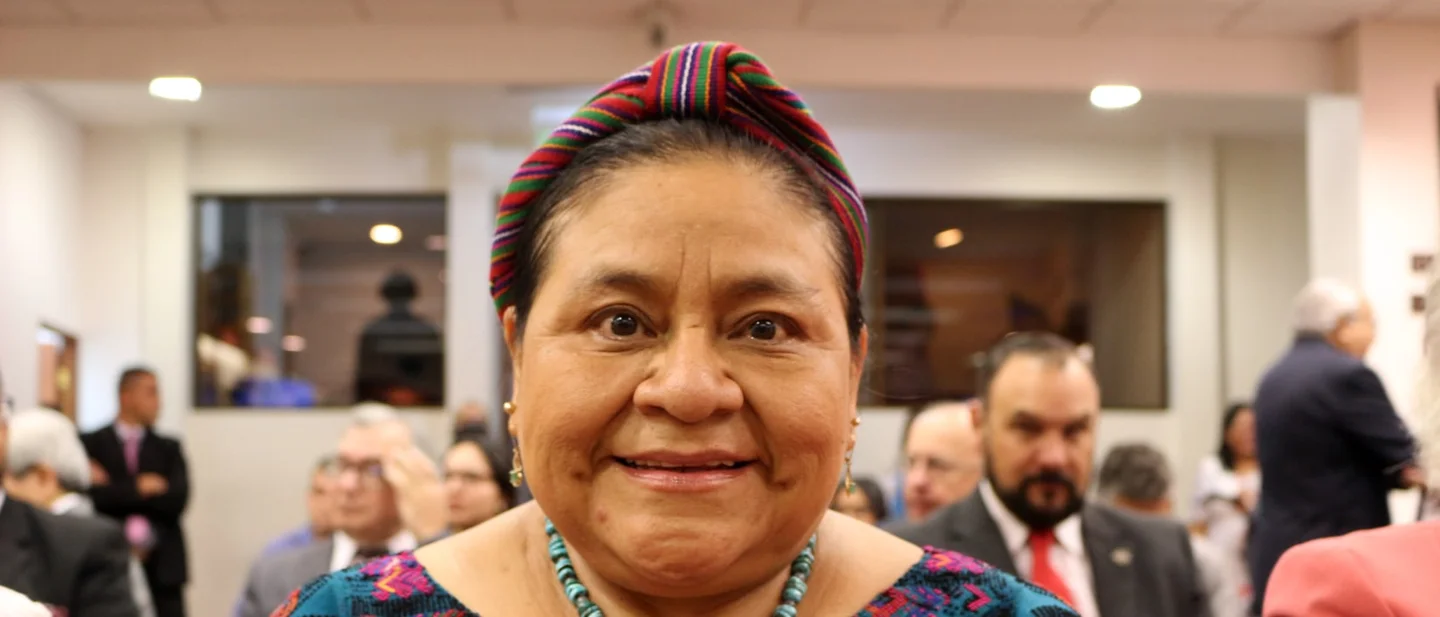
Rigoberta Menchú: the week of talking that became evidence
A week of taped interviews in Paris turned one K'iche' woman's account of Guatemala's war into a Nobel Prize, a rights accord and a genocide case — and into a long fight over what a witness owes.

On 31 January 1980, thirty-four Maya peasants and rural organisers walked into the Spanish embassy in Guatemala City and refused to leave. They chose the Spanish embassy because Spanish priests had been among those killed, and they hoped its officials would listen. One of them was Vicente Menchú, a community leader from the highlands of El Quiché. 1
Police stormed the building, a gas canister carried by an officer exploded, and a fire spread through the rooms. A court later found that the officer in charge had ordered his men to seal the embassy and let nobody out. Thirty-seven people died, among them Vicente Menchú, the Spanish consul and two former Guatemalan officials who had been visiting that day. 1
Two people came out alive: the ambassador, and an activist named Gregorio Yujá, who was taken from the hospital where he was treated for burns, tortured and killed. 1
His daughter, Rigoberta Menchú Tum, was twenty-one. Her brother had been arrested, tortured and killed by the army the year before. Her mother was arrested, tortured and raped, and died shortly afterwards. 2
A hamlet in Uspantán
She was born on 9 January 1959 in Chimel, a hamlet in Uspantán, in the department of El Quiché, and raised in the K'iche' branch of the Maya. Her family farmed. Like many highland families they also went down to the Pacific coast for the coffee harvest each season, adults and children together. 2
Her father was a community leader, and the family became a target once a guerrilla group established itself in the region. The army accused the Menchús of supporting it. Vicente Menchú was imprisoned and tortured over an allegation that he had taken part in killing a plantation owner, then released, and joined the Committee of Peasant Unity (CUC), a new organisation of peasant farmers. 2
Rigoberta joined the CUC in 1979, the year her brother was seized. Her route into organising ran through the Catholic Church, one of the few institutions in the highlands willing to organise peasants, and its women's groups. 23
Learning the language of the other side
In 1980 she was prominent in a CUC strike for better pay and conditions for farm workers on the Pacific coast. On 1 May 1981 she was in the demonstrations in the capital. 2
By then she had taught herself Spanish, along with Maya languages other than her own K'iche'. The movement's members spoke several languages; the state conducted its business in one. 2
In 1981 she went into hiding in Guatemala, then fled to Mexico. Exile made her the movement's voice abroad: in 1982 she helped found the United Representation of the Guatemalan Opposition, and from Mexico she travelled to the United Nations and to Europe. 2
A week of talking
In 1983, in Paris, Menchú sat down with Elisabeth Burgos-Debray, an anthropologist, and talked for a week. Burgos-Debray recorded her, arranged the transcripts and published the result in Spanish as Me llamo Rigoberta Menchú y así me nació la conciencia. The English edition, I, Rigoberta Menchú: An Indian Woman in Guatemala, appeared in 1984 and was translated into more than a dozen languages. 2
The book was a testimonio, a Latin American form: a first-person account of oppression, spoken by someone who lived it and arranged by an editor. Readers in Europe and North America met the war through one woman's voice — a mountain childhood, a brother's torture, a mother's death — instead of a human-rights office's country report. 2
A testimonio works by standing for many; asked to hold as literal eyewitness history, it is judged by a standard it never set.
The prize
On 16 October 1992 the Norwegian Nobel Committee awarded her the Peace Prize "for her work for social justice and ethno-cultural reconciliation based on respect for the rights of indigenous peoples". She was 33. 4 The award fell in the quincentenary year of Columbus's arrival, and her Nobel lecture took the occasion up: the indigenous peoples of the Americas had been "the victims of genocides, repression and discrimination" for 500 years.
"I consider this Prize, not as a reward to me personally, but rather as one of the greatest conquests in the struggle for peace, for Human Rights and for the rights of the indigenous people," she said. She also said where the medal would stay: "the Nobel Peace Prize 1992 will have to remain temporarily in Mexico City, in watchful waiting for peace in Guatemala." 5
The prize money went into the Rigoberta Menchú Tum Foundation, an indigenous advocacy organisation. 3 The lecture also pressed for a UN declaration on indigenous rights, then a decade into its drafting; the General Assembly adopted the Declaration on the Rights of Indigenous Peoples in September 2007, with 143 states in favour and four against. 6
The fight over the book
In 1999 the anthropologist David Stoll published Rigoberta Menchú and the Story of All Poor Guatemalans, built on interviews in her home village. Stoll found that parts of her own and her family's history were incorrect, including events she had described as an eyewitness. He raised no question about the picture of army atrocities she presented and said he approved of the prize. His objection was to her village's experience being read as representative of all Maya villages. 2
Asked about the allegations, the Nobel committee's secretary, Geir Lundestad, said the decision to award her the prize "was not based exclusively or primarily on the autobiography". 2
The dispute is usually reported as a verdict on her honesty. It reads more plainly as a collision between two kinds of document: a book Europe received as testimony, and a dissertation that tested the same pages as evidence.
What the commission found
The check on the book's larger claim came the same year. In February 1999 a UN-sponsored body, the Commission for Historical Clarification, published Guatemala: Memory of Silence. It registered 42,275 victims, estimated that more than 200,000 people were killed or disappeared in the 36-year war, and found that 83 per cent of fully identified victims were Maya. State forces accounted for 93 per cent of the violations it documented, and it counted 626 massacres. 7
Between 1981 and 1983, it concluded, agents of the state committed acts of genocide against Maya groups in the four regions it examined. 7 The commission built its case from thousands of testimonies and official documents, and it described the pattern her book had put into the world.
The accord, and the vote that rejected it
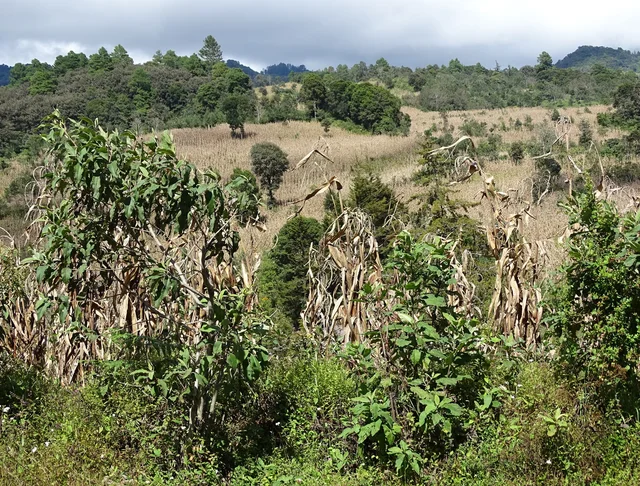
Guatemalan law got there first. In March 1995 the government and the guerrillas signed the Accord on Identity and Rights of Indigenous Peoples, which recognised Guatemala as a multi-ethnic nation and promised language rights, recognition of customary law, and consultation over land and resources. Peace followed in December 1996. 8
The accord's central promises needed constitutional amendments. On 16 May 1999, in a referendum with low turnout, voters rejected the whole package. 8 The UN verification mission's final human rights report, in 2003, found that "the isolation and discrimination faced by Guatemala's indigenous peoples — half the country's population — have not visibly changed since 1997". 8 By 2005 it had the lowest implementation rate of any of the peace agreements. 8
The case that keeps restarting
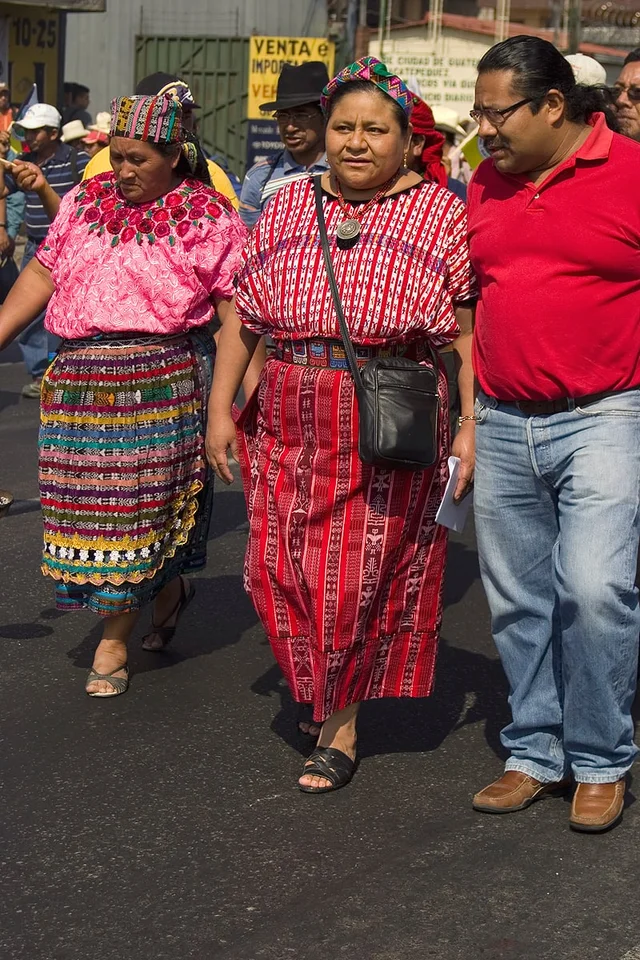
She took the claim to court. In December 1999 her foundation filed a criminal complaint with Spain's National Court against Ríos Montt and other senior officers, under universal jurisdiction, which lets a national court try genocide committed elsewhere. The Center for Justice and Accountability joined as lead counsel in 2006 and brought more than 40 Maya survivors to Madrid to testify. 9
The Spanish proceedings fed a Guatemalan case. In May 2013 a court in Guatemala convicted Ríos Montt of genocide and crimes against humanity and sentenced him to 80 years. It was the first time a national court had convicted a former head of state of genocide. Days later the Constitutional Court annulled the verdict and sent the case back; Ríos Montt died in April 2018 in the middle of his retrial. 910
The case running longest concerns the government that preceded Ríos Montt's. Manuel Benedicto Lucas García, army chief of staff under his brother Romeo Lucas García, went on trial in April 2024 over the Ixil region; the court held 99 hearings and heard 80 survivors before the panel was replaced and the trial annulled. The Constitutional Court upheld the annulment in June 2025, ordering the case to start again. 11
In July 2026 the court granted Lucas García house arrest while the case restarts. He is 93 and has never been sentenced over the Ixil region; prosecutors had asked for 2,860 years. The Association for Justice and Reconciliation, which represents survivors, called the ruling outrageous. 11
Where she is now
Menchú has lived in Mexico since 1981. She was naturalised as a Mexican citizen in July 2025, and in April 2026 Mexico's foreign ministry appointed her to advise it on the rights of women and Indigenous peoples. 12
In July 2026 the Guatemalan book fair was dedicated to her, ahead of the 30th anniversary of the peace accords. "Receiving a tribute here is worth more than a Nobel Peace Prize," she told the opening. 13 The country whose war she described in Paris now honours her, and its genocide cases have produced no final conviction.
Three leadership takeaways
- Make the claim portable. Menchú's testimony travelled because it took a form other people already knew how to read: a first-person book, in a dozen languages, that could be read in Oslo as easily as in Guatemala City. That portability is what carried a highland village's grievance into a Norwegian committee room and a Spanish courtroom. 29
- Put the claim inside something that does not need you present. The foundation filed the Spanish complaint while she lived abroad, and lawyers carried it for years after she signed. The CUC organised the strike she helped lead, and the church-linked women's groups were where she first learned to organise. 29
- Keep a second record that does not depend on your memory. Stoll tested her recollections one by one; the commission that settled the larger question worked by other methods, with exhumations, army records and thousands of interviews. Its findings matched the shape of her account, and that version is the one that has held up in court. Testimony opens the argument; documentation keeps it open. 7
References
- 1
- 2Rigoberta Menchú Tum – Biographical – NobelPrize.org
nobelprize.org
- 3Rigoberta Menchú – Encyclopaedia Britannica
britannica.com
- 4
- 5Rigoberta Menchú Tum – Nobel Lecture – NobelPrize.org
nobelprize.org
- 6
- 7
- 8
- 9
- 10
- 11
- 12
- 13
This story was produced automatically by a channel. One sentence is all it takes for Neodrop to keep producing for you.