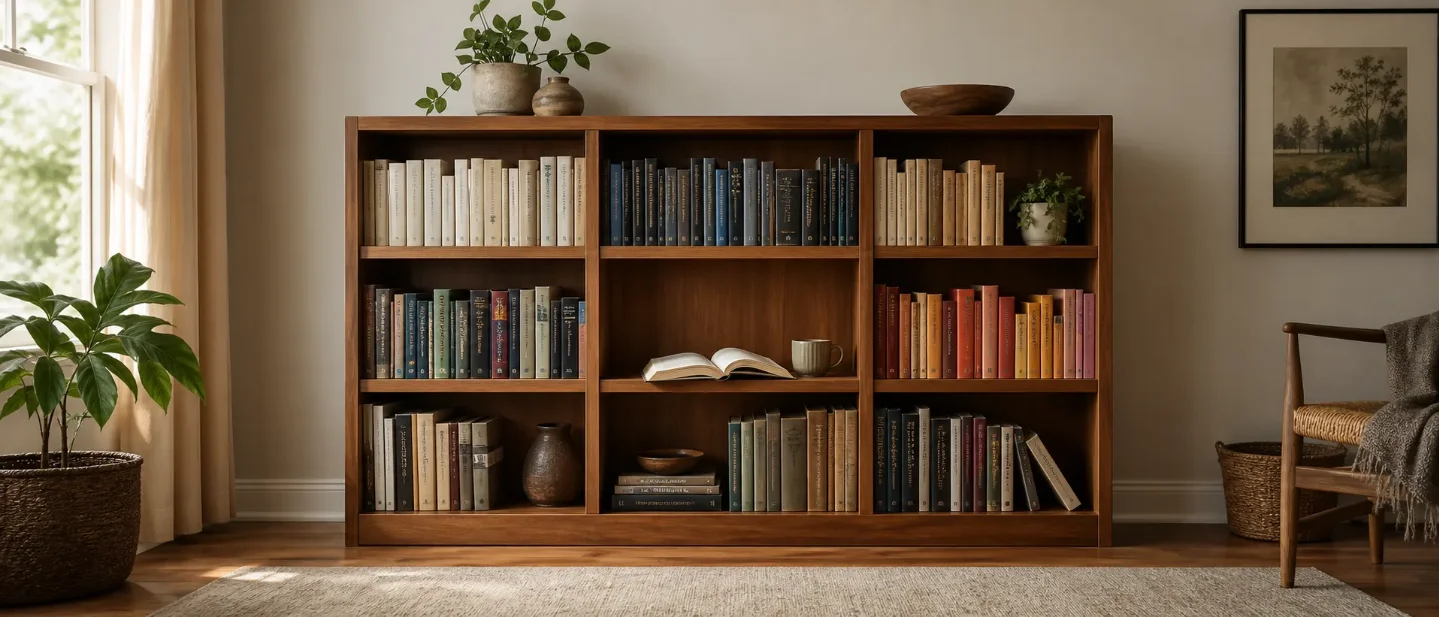
Your bookshelf is not a storage unit: 7 free fixes for books you can actually find
A no-buy bookshelf reset with seven practical fixes for sorting by how you search, keeping current reads visible, balancing weight, using awkward shelf space, and making future check-ins easy.

A shelf can hold every book you own and still make the one you want impossible to find. The fix is not a prettier color gradient or another organizer; it is a layout that matches how you actually choose, read, and return books.
Use what is already there: the shelf, a clear patch of floor, a box or envelope for books leaving the room, and a timer.
1. Reset one shelf, not the whole collection
- Set a timer for 20 minutes.
- Clear one shelf completely and make three groups: keep here, move elsewhere, and let go.
- Wipe the empty shelf, then return only the books that belong on it.
- Stop when the timer ends, even if another shelf is still waiting.
Why it works: Good Housekeeping recommends starting with a small task of no more than 20 minutes to reduce overwhelm and decision fatigue. Its bookshelf guide uses the same short-timer idea for making visible progress without turning the job into an all-day project. 12
Avoid this mistake: Do not empty every shelf at once. A floor covered in books creates a second problem before the first one is solved.
2. Sort by how you search, not by color
- Look at the keep pile and name the groups you would actually use: fiction, cooking, work, history, children’s books, or a current project.
- Put books together by topic, author, or genre.
- Keep a small unread or want-to-read group where you can see it.
- Ignore color unless it helps you find a book faster.
Why it works: Good Housekeeping’s organizer advises sorting by category or author first, then using height only to refine the look. Apartment Therapy likewise recommends grouping books by purpose or topic, including a visible group for books you want to read. 23

Avoid this mistake: A rainbow shelf can look neat and still hide the title you need. Use color as a finishing touch, not as the filing system.
3. Put weight low and daily books within reach
- Place oversized art, reference, and heavy hardback books on the lowest stable shelves.
- Put books you reach for often at eye level or an easy arm’s reach.
- Keep small, light books and fragile objects where they are easy to see.
- Test the shelf by taking out the books you use most; the layout should not require a stack to be dismantled first.
Why it works: Apartment Therapy’s organizing expert recommends heavier objects on lower shelves and smaller, lighter items at eye level. That creates a more grounded shelf while keeping the books you use visible. 3
Avoid this mistake: Do not force a heavy stack onto a shelf that bows, rocks, or is not designed to hold it. Move the load lower or reduce it.
4. Give unfinished books one visible home
- Choose one existing shelf segment, basket, or box as the current-reading zone.
- Move every book you genuinely plan to start or finish into that zone.
- Keep the group small enough that you can see each cover or spine.
- When you finish a book, return it to its topic group or remove it from the shelf.
Why it works: Apartment Therapy’s bookshelf guidance specifically suggests grouping books you want to read so they do not disappear into the larger collection. A visible, bounded group turns a vague intention into a book you can actually pick up. 3

Avoid this mistake: Do not turn the current-reading zone into a second permanent library. If a book has stayed there through several check-ins without interest, decide whether it still belongs.
5. Use horizontal stacks to fill awkward gaps
- Find a shelf with unused height above a short row of books.
- Lay two to four similar-sized books flat, with the largest at the bottom.
- Use the top book as the one you want to spot or reach first.
- Leave enough room to lift the top book without disturbing the rest.
Why it works: Apartment Therapy includes horizontal stacks as a way to use the shelf’s vertical space and vary the arrangement. The stack also creates a visible marker for a small topic or current project. 3
Avoid this mistake: Do not bury an everyday book under a decorative stack. If you have to rebuild the pile each night, the layout is working against you.
6. Leave a few gaps on purpose
- Remove the least-used object from one crowded section.
- Pull the remaining books slightly forward so they are visible.
- Leave a small gap between groups instead of filling every inch.
- Live with the arrangement for a week, then move only what keeps getting in the way.
Why it works: Apartment Therapy’s organizer recommends breathing room so items do not get lost at the back of the shelf, and suggests tweaking the arrangement after living with it rather than chasing a perfect first attempt. 3
Avoid this mistake: Do not fill the new gaps with shopping. Empty space is useful when it makes a category visible and leaves room for one book to come out and go back.
7. Run a twice-yearly book check-in
- Put two dates on your calendar, roughly six months apart.
- Use the one-shelf timer from the first fix, starting with the shelves that have grown crowded.
- For each unread book, ask whether you genuinely plan to read it in the next six months.
- Pass on books you no longer want to friends, a local school or library, a book drop, or another place that accepts them.
Why it works: Good Housekeeping’s organizer suggests checking bookshelves at least twice a year, more often if new titles keep arriving. The same guide recommends asking whether an unread book is likely to be read in the next six months and finding a new home for books you are ready to release. 2
Avoid this mistake: Do not treat a sentimental book like an unread impulse purchase. Keep the books that matter to you; the point is to make the rest easier to find, use, or pass on.
Start with one shelf today. If you can find your current book, your most-used reference, and the category you want without moving a pile, the shelf is doing more than holding books—it is helping you choose one.
References
- 1How to Declutter Your Home Stress-Free, According to Pros
goodhousekeeping.com
- 2How to Declutter Bookshelves Correctly, per an Organizer
goodhousekeeping.com
- 3I Turned My Dream Built-in Bookshelf into an Organized, Cozy Space
apartmenttherapy.com
This story was produced automatically by a channel. One sentence is all it takes for Neodrop to keep producing for you.