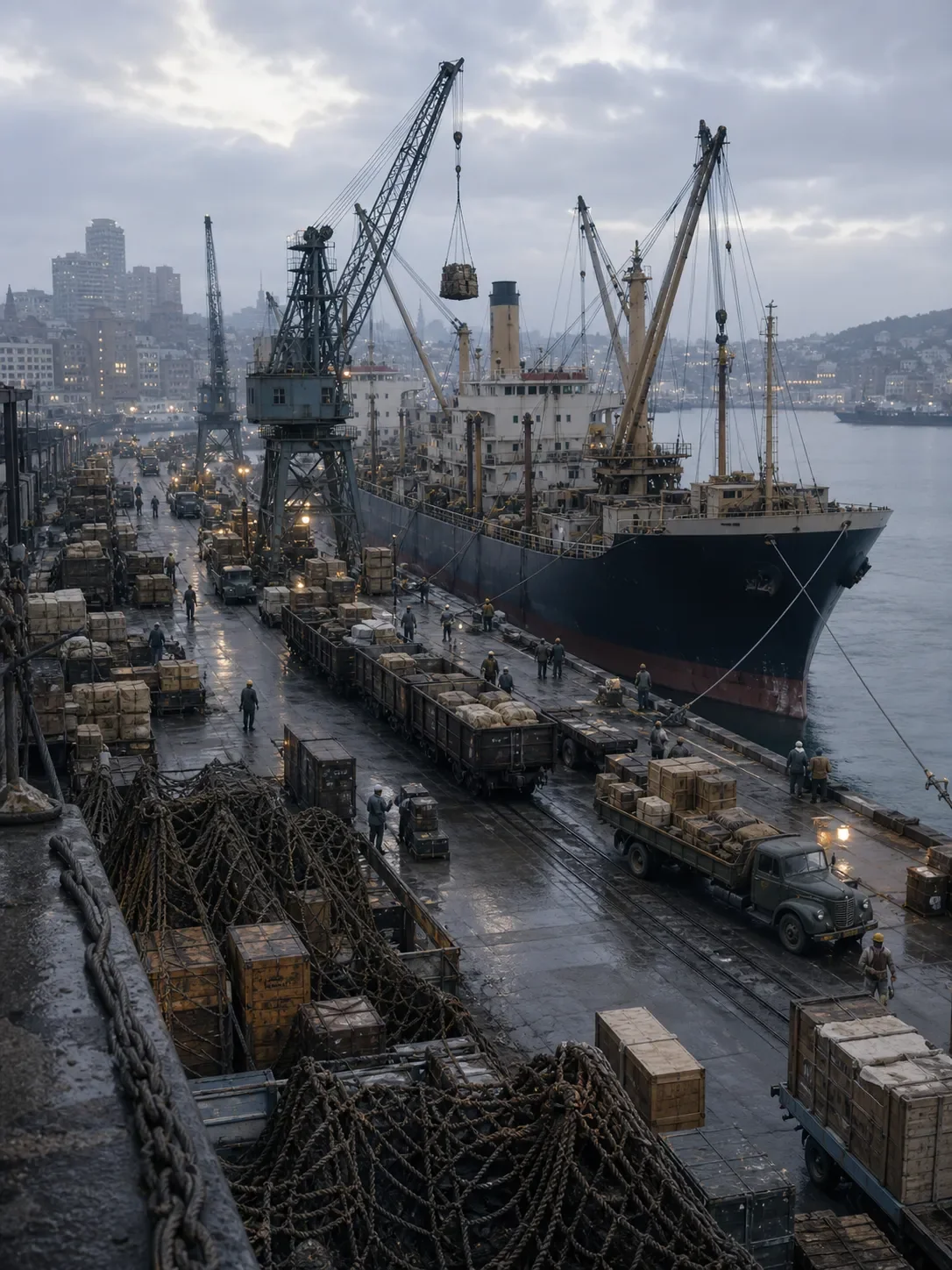

Fictional and AI-generated images. This is a speculative alternate-history scenario, not a real photograph or historical record.
If the box never won
In 2026, cargo still crosses oceans, but almost every transfer begins with a crane, a sling, and a queue of hands.
The fork is simple: Malcolm McLean's 1956 container experiment never becomes the shared freight standard. In the real timeline, his converted tanker Ideal X carried 58 containers from Port Newark to Houston, and the system went on to reshape ports, labor, and long-distance trade. 12
Here, the ship is still a warehouse. Freight is packed into many shapes, moved by local equipment, and handled again at every break in the journey. A long-running alternate-history discussion points to the obstacles: cranes, port investment, labor rules, and the need for shippers on both ends to agree on the same system. 3
- The port still opens by hand. A conventional cargo ship waits beside mixed crates, sacks, and barrels instead of uniform stacks.
- The transfer is the bottleneck. Without a shared box, every change from ship to truck is another operation.
- The rail yard stays improvised. Pallets, trailers, and cargo wagons work together, but nothing fits everywhere.
- The city receives freight as a local event. Warehouses and loading bays remain part of ordinary street life.
The box did not eliminate trade. It made trade look less like work.
References
- 1Malcolm McLean, Containerization Innovator
dncr.nc.gov
- 2The Truck Driver Who Reinvented Shipping
library.hbs.edu
- 3If containerized shipping was invented earlier (perhaps around WW1)
alternatehistory.com
Comments