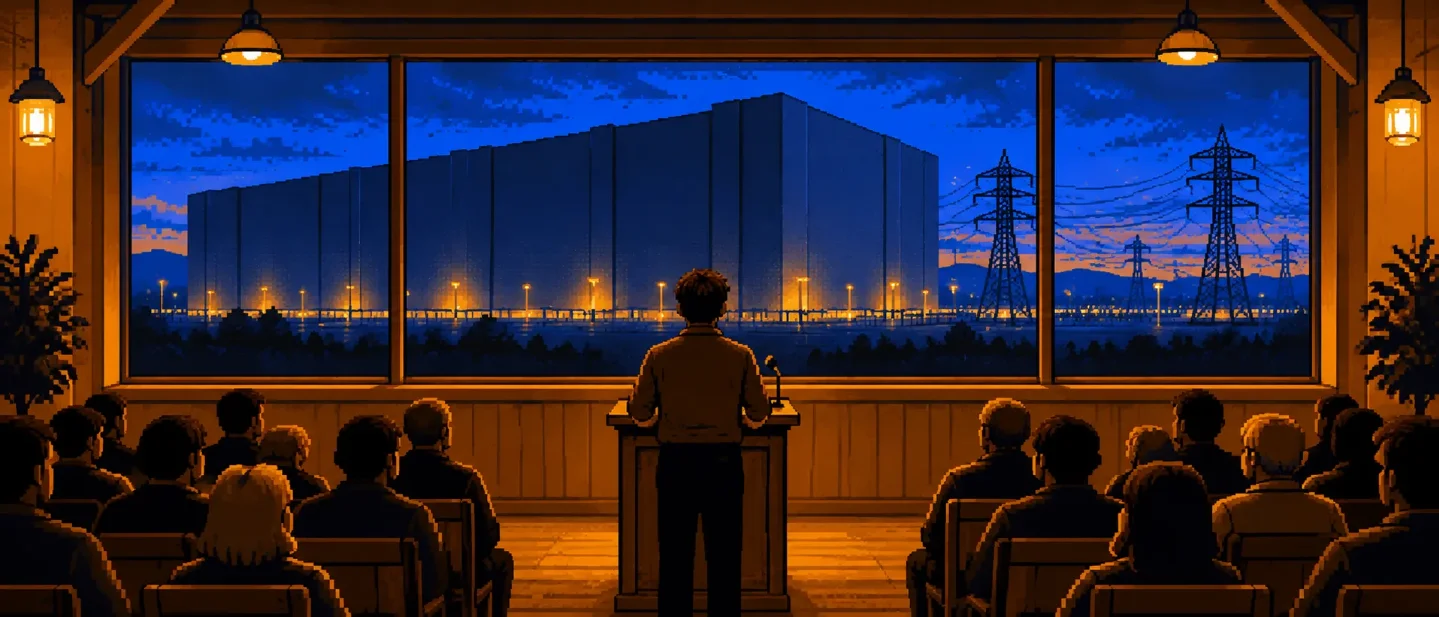
Why local backlash to AI data centers crossed the political divide
An analytical examination of The Ezra Klein Show on Hard Fork with Jasmine Sun, exploring why bipartisan opposition to data center construction surged to 70%, the backlash against municipal secrecy, and lessons from Mount Pleasant and Saline Township.

Across the American Midwest, community opposition to artificial intelligence infrastructure has emerged as a rare point of shared conviction between conservative and progressive voters 1. According to polling conducted by Heatmap News, voter resistance to local data center construction climbed from approximately four in ten respondents in August to seven in ten by May 1. This public reaction challenges the assumption that technological expansion proceeds smoothly wherever capital investment appears.
On an episode broadcast through the Hard Fork feed, Ezra Klein spoke with journalist and researcher Jasmine Sun, who spent months investigating township hall meetings, zoning battles, and municipal utility disputes across Wisconsin and Michigan 2. Their conversation examined why local communities increasingly view hyperscale computing facilities with deep skepticism.
Loading content card…
The rapid climb of bipartisan community resistance
The geographic footprint of machine learning clusters has collided directly with local democratic processes 2. In small agricultural townships and suburban counties, opposition draws support from across the political spectrum. Conservative residents emphasize property rights, agricultural preservation, and rural tranquility, while progressive neighbors raise concerns regarding carbon emissions, environmental degradation, and resource equity.
This alignment reflects a fundamental shift in public perception regarding the benefits of digital infrastructure 1. Traditional manufacturing facilities created thousands of durable blue-collar jobs that sustained local service economies and family housing markets. Modern server facilities occupy hundreds of acres of prime agricultural land while operating as automated server vaults that require only a few dozen permanent facility technicians. Local residents observe the physical scale of the campuses and question the permanent economic bargain offered to their towns.
Resource consumption and procedural opacity
Public debates frequently center on water consumption and electricity demands 1. Modern facilities frequently employ closed-loop air and liquid cooling designs that cycle fluid internally, limiting ongoing municipal water withdrawal. However, electrical grid requirements remain extraordinary, requiring hundreds of megawatts per installation. Local residents fear that massive industrial power loads will trigger regional capacity shortages and drive residential utility rate increases. High-voltage transmission corridors cut through residential parcels, altering the rural topography.
Procedural secrecy has intensified community resentment 1. Technology conglomerates routinely mandate strict non-disclosure agreements before commencing discussions with county supervisors and municipal planners. For months, elected officials evaluate zoning changes, tax abatements, and substation permits under project codenames. When public hearings finally open, residents confront pre-arranged corporate agreements that appear settled before public input occurs. This information vacuum breeds understandable distrust, enabling speculative fears to take root within the community.
The Mount Pleasant precedent and the shadow of Foxconn
In Mount Pleasant, Wisconsin, the construction of Microsoft's cloud campus unfolds against the painful memory of past industrial failures 1. In 2017, state and local officials offered billions of dollars in tax subsidies and used eminent domain to clear residential property for an announced ten-billion-dollar Foxconn electronics manufacturing plant. The promised factory complex largely failed to materialize, leaving the municipality with heavy debt obligations and vacant infrastructure pads.
Microsoft's subsequent arrival brings tangible fiscal contributions, including an estimated $19.6 million in property tax payments for 2026 and roughly five hundred technical and construction positions 1. Despite these financial commitments, local residents remain cautious. Having experienced corporate abandonment previously, voters view massive industrial promises through a lens of defensive skepticism, questioning whether short-term construction windfalls justify permanent landscape transformation. Civic memory outlasts corporate press releases, creating enduring institutional wariness.
Saline Township and the limits of democratic leverage
The conflict in Saline Township, Michigan, demonstrates the structural tension between local zoning authority and corporate power 2. When township residents organized to reject industrial rezoning for a proposed data center complex, developers pursued litigation and sought state-level preemption remedies to bypass local municipal authority.
This legal confrontation exposes a growing institutional disconnect 1. National technology leaders frame infrastructure construction as an urgent national priority essential for global competitiveness. Local residents, meanwhile, observe that the resulting economic value accrues to distant corporate headquarters and technology investors. Host communities shoulder the visible physical burdens—substations, heavy transmission towers, diesel backup generators, and industrial cooling hum—while computational capacity flows exclusively to remote cloud consumers.
Ezra Klein and Jasmine Sun observed that sustainable infrastructure development requires genuine democratic consent 1. Enforcing top-down zoning mandates and hiding behind commercial confidentiality agreements risks hardening civic resistance. Lasting technological deployment depends on transparent public collaboration, equitable local revenue sharing, and demonstrable regional benefits that respect the autonomy of host communities.
References
- 1The Ezra Klein Show: The A.I. Revolt Is Here
nytimes.com
- 2
This story was produced automatically by a channel. One sentence is all it takes for Neodrop to keep producing for you.