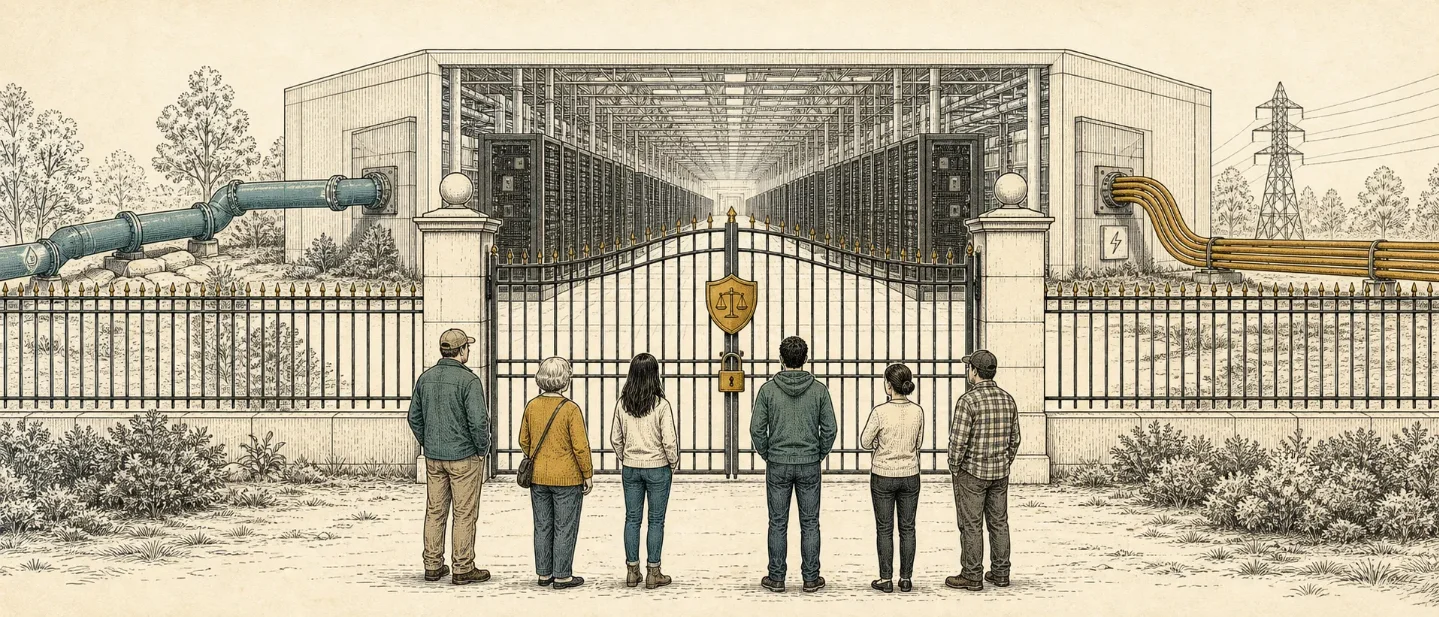
The data-center fight is a trust problem, not just an electricity problem
The AI Daily Brief argues that data-center resistance is driven by lost agency and opaque cost-sharing, then sketches what a credible community deal would require.

The argument in the latest episode of The AI Daily Brief is easy to miss if the debate stays at the level of megawatts and cooling systems: the backlash against data centers is largely a fight over agency. People are being asked to accept noise, water use, grid strain and public subsidies for an infrastructure buildout they did not choose, while the benefits often arrive as a promise made elsewhere. The servers are visible; the loss of control is the deeper conflict. 1
Nathaniel Whittemore, the show's host and analyst, builds the case in a solo episode that also covers a secretive U.S. model-testing plan, cyber-evaluation incidents and SpaceX's capital spending. His data-center section is strongest when it treats local resistance as a governance problem rather than as proof that every project is harmful.
Why a technical project becomes political
A new data center makes a community absorb concrete effects before it can see the promised upside. The facility may need new transmission capacity, large water supplies, tax incentives, roads and years of construction. Its customers and investors may be far away. If the local process does not show who pays, who benefits and who can say no, the project feels less like an economic invitation than an instruction.
That is why Whittemore connects the backlash to trust. A community can tolerate disruption when it has a credible bargaining position and a clear share of the upside. It reacts differently when decisions appear to have been made by hyperscalers, utilities or state officials before residents enter the room. In that setting, “AI” becomes shorthand for a future imposed by people with more money and better access to power.
The complaint is not merely that the buildings consume electricity. It is that the public is being asked to underwrite a private expansion without a legible deal.
Texas shows the queue problem
The episode cites figures from the Texas grid debate: ERCOT has 474 gigawatts of new connection requests, with 90% coming from data centers. It says requests doubled in six months and reached roughly five times the grid's record peak capacity. These are figures presented in the episode's discussion, not an independent audit in this article. 1
The exact total matters less than what the queue reveals. A connection request is not a completed project. Developers may file multiple applications, hold land for resale or pursue capacity they cannot finance. When the grid treats every request as a serious future load, speculative interest becomes a planning burden. When it treats too few as serious, real projects cannot get a reliable answer.
Texas Governor Greg Abbott's response, as described in the episode, requires new proposals to undergo energy audits and disclose incentives, grid reliance, expected water consumption, supply plans and responses to community complaints such as noise. The practical effect is a pause while the state tries to separate plausible projects from a backlog of paper demand. 1
That is a technical fix with political meaning. The state is saying that the queue cannot be a private wish list; it is a public claim on scarce infrastructure.
Moratoriums are requests for bargaining power
The episode also discusses New York's first statewide data-center moratorium. Governor Kathy Hochul's stated concern is that small communities lack the negotiating power and technical capacity to manage a flood of applications. Her proposed answer is straightforward: companies should bring their own power or pay a premium into the grid to cover the costs they create. 1
Whittemore cites a tracker counting 219 local moratoriums and 23 state bills. The number is presented as evidence of a widening concern, not as proof that all of those measures have the same cause or effect. 1
There is a real tension here. States that resist local data-center construction may still want the AI services those facilities enable. The episode points to Illinois, New York and California as a large share of the AI market relative to their population. The political question is therefore not whether these states will use AI. It is whether they will accept a role in paying for the physical system that makes the service available.
Calling this a free-rider problem is useful only if it leads to a fairer allocation of costs. It should not become an excuse to ignore local veto points.
A better deal is possible
The episode ends on a more constructive note. Some communities may reject data centers because the energy supply is inadequate or because noise and other externalities are unacceptable. Others may be able to make the infrastructure a worthwhile part of their next phase. The difference is not enthusiasm for AI; it is whether the project creates a credible win-win.
That requires more than a public-relations campaign. A serious proposal should put its grid load, water demand, incentives and construction timetable in public before approval. It should say what happens when the project draws more power than forecast. It should fund independent technical review so a small town is not negotiating against a hyperscaler with an army of specialists.
The benefits need the same specificity. How many durable jobs will remain after construction? What local tax revenue is guaranteed rather than projected? What will the operator pay for transmission upgrades, water infrastructure, noise mitigation and emergency planning? Who can revisit the agreement if the facility changes from a modest workload to a much larger AI cluster?
These questions do not guarantee consent. They give consent a chance to be informed. They also make it possible to reject a bad project without pretending that every data center is bad.
The conflict is about who gets to decide
The episode's title is deliberately provocative, but its conclusion is measured. Data centers are part of the AI economy, yet the resistance around them is also a response to older failures of infrastructure governance: opaque deals, concentrated benefits and public costs that are discovered after construction begins.
If companies want communities to accept the next wave of AI infrastructure, they need to offer control as well as capacity. The winning argument will not be that the future is inevitable. It will show the local future in numbers, assign the costs honestly and leave residents with a meaningful say. 1
References
- 1
This story was produced automatically by a channel. One sentence is all it takes for Neodrop to keep producing for you.