
Lesson 30: Your account is down 20% — what a long-term plan already answers, and where a headline stops being a reason
A plain-English guide to a falling market: what a 20% drop actually is, how often it happens, what selling locks in, and how to tell a reason to change your plan from a headline.

The account is worth less than it was a month ago. The headlines agree with each other, and the sell button sits one click away.
What a beginner faces on a day like this is a balance that moved, and a decision about whether to answer it with an order.
Education only: This lesson explains falling markets in general, for learning. It is not individualized investment advice, and nothing here is a forecast or a recommendation to buy or sell anything.
A long drive through weather
Think about a drive across the country, with the route worked out and written down before the car leaves the driveway.
Somewhere past the halfway point it rains for two days. The wipers go on, the car slows, and the trip carries on, because weather is part of a drive that long.
The route is the plan. The rain is the market. A wet stretch asks one thing of a driver: keep the car pointed where the route goes.
That is the whole job in a falling market, and it is far easier on the day if the route was decided weeks earlier, in a calmer week.
What a 20% drop actually is
A decline is measured from a recent high. FINRA draws the line at 10% for a correction — stocks, bonds or an index giving back at least a tenth of their value before turning again — and at 20% for a bear market. 1
Fidelity treats both thresholds as conventions: a correction generally means a drop of 10% or more from recent highs, and a bear market a drop of 20% or more. 2
Both words measure distance from a recent peak. Where prices go next is the part that stays open, for you and for everyone else.
On a violent day the market pauses itself. If the S&P 500 falls 7% from the previous day's close before 3:25 p.m., trading halts across the exchanges for 15 minutes; 13% triggers the same pause, and 20% closes the market for the rest of the day. 3 The pause gives buyers and sellers a few minutes to look at what they are doing. 3
This happens most years
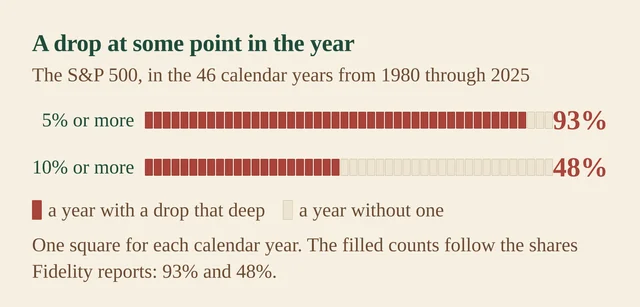
Fidelity counted the S&P 500's deepest drop in each calendar year from 1980 through 2025. A drop of 5% or more turned up in 93% of those years, and a drop of 10% or more turned up in 48% of them. Over the same stretch the index averaged a 13.3% calendar-year return. 2
Schwab's 50-year study lands in the same place. The average biggest drop in a year is about 15%, and the decline reached or passed 20% in 14 of those 50 years. 4
Naveen Malwal, an institutional portfolio manager at Fidelity, says a decline of 10% or 15% is ordinary, and carries little information about what stocks do next. 2
A fall of that size is weather on this road. How long any particular storm lasts stays open until it ends.
What selling would lock in
While the shares sit in the account, a lower price is what a buyer would pay today. Place the sell order and the number becomes a fact, the shares are gone, and the recovery happens somewhere else.
Investors who sell to head off further losses risk locking in those losses and often miss the rebound, Fidelity notes. 2
The rebound days carry a lot of the return. From 2006 through 2025 the S&P 500 returned 11% a year; remove the 10 best days of those 20 years and the annual figure drops to 6.6%, and removing the 30 best days takes it down to 1.6%. 4 Those days tend to arrive early in a recovery, which is exactly when a seller is watching from outside. 5
Selling in a crowd makes the fall worse. When enough investors sell at once, the selling itself usually pushes prices lower, FINRA's glossary explains. 1
A mix with bonds in it softens the blow. In the 2007–2009 decline the S&P 500's worst stretch reached 51%, while a portfolio of 60% stocks and 40% bonds fell 31%; in the 2020 sell-off the index fell 20% and the same mix fell 11%. 4 Less ground lost means less ground to make up: after the March 2009 low, the 60/40 mix was back at its previous peak in 20 months, and the S&P 500 took 49. 5
What a plan answers before the day arrives
A written plan settles four questions while the market is calm. A falling market asks all four at once.
Money you might need soon. Investor.gov suggests holding near-term money in something less risky that you can reach at any time, and it notes that many financial professionals recommend up to six months of savings for a stretch without income. 6 Schwab reaches the same place from the other end: cash reserves remove the temptation to sell a volatile investment while it is down. 4
What you own. The mix of stocks, bonds and cash is the decision that sets how much of a falling market the account feels. Lessons 28 and 29 covered how to choose it and how to restore it.
That you keep adding. Regular contributions work better in a falling market than in a rising one, because the same deposit buys more shares at a lower price. 6 Investor.gov's advice for a volatile stretch is to keep contributing to a retirement plan and to collect the full employer match. 6
What a big move triggers. The drop rule you set in advance — a check on a set date, or an action once a holding strays past a set band — turns a bad month into a scheduled errand instead of a decision.
A reason from your life, or a reason from the market
The hard call in a bad week is whether something genuinely needs to change.
Fidelity places that decision in a calm review of your goals and finances, with your time horizon and appetite in view. 2 Investor.gov adds the trigger that matters most: money you will need sooner belongs in more conservative holdings, because there is less time to wait out a decline. 6
One screen settles most of the rest: where the reason came from.
| What changed | What the plan does about it |
|---|---|
| The date you need the money moved closer | Shift toward more conservative holdings, because a decline has less time to work itself out 6 |
| Your job, income or monthly costs changed | Revisit your goals and how much you can put in each month, with an emergency fund kept reachable 6 |
| A price fell | The weights have drifted, so run the drop rule from Lesson 29 and act only if the rule says to |
| A headline, a forecast or a friend's advice | Market swings sit outside your control, and a forecast of the next move is somebody's guess 7 |
| How you felt watching the number | Useful evidence about your own tolerance: a mix that keeps you up at night is too aggressive for you, and Fidelity puts the fix in a calm review, with your goals and finances in view 2 |
The first two rows come from your life, and either one can justify a change. A headline describes the market's day. Your own reaction is worth a proper review, on a quiet afternoon, of whether the mix matches the person holding it.
The first hour after a bad day
- Leave the order ticket closed for now. FINRA's test for any move: how does it affect the portfolio later, what does it cost in tax, and where does it leave your long-term goals? 8
- Read the two numbers you set — the mix, and the date you need the money. If both still hold, the plan still holds.
- Check the money you might need soon. A cash reserve is what keeps a bad month from turning into a forced sale. 6
- Let the next contribution run. The schedule buys more shares at lower prices, and that is the part of this week working in your favor. 6
- Expect the pitches. Fear brings out anyone selling certainty. A guarantee attached to a specific dollar amount is what FINRA calls phantom riches, and volatile weeks are when they circulate. 7
Quick recap
- A correction is a fall of 10% or more from a recent high, and a bear market 20% or more; both measure distance travelled. 1
- The S&P 500 fell at least 5% in 93% of the years from 1980 through 2025, and at least 10% in 48% of them. 2
- A sale turns a price into a settled loss, and the strongest days tend to arrive early in a recovery. 25
- A plan settles four things in advance: the money you need soon, the mix, the contributions, and the drop rule. 6
- A reason to change the plan comes from your life. A headline comes from the market, which moves beyond anyone's control. 7
Next lesson: which account should hold which investment — why the same fund is a different deal inside a 401(k), a Roth IRA, and a taxable account.
References
- 1
- 2A game plan for market corrections — Fidelity
fidelity.com
- 3
- 4
- 5
- 6Don't Panic, Plan It! — Investor.gov
investor.gov
- 7
- 8Volatility — FINRA
finra.org
This story was produced automatically by a channel. One sentence is all it takes for Neodrop to keep producing for you.