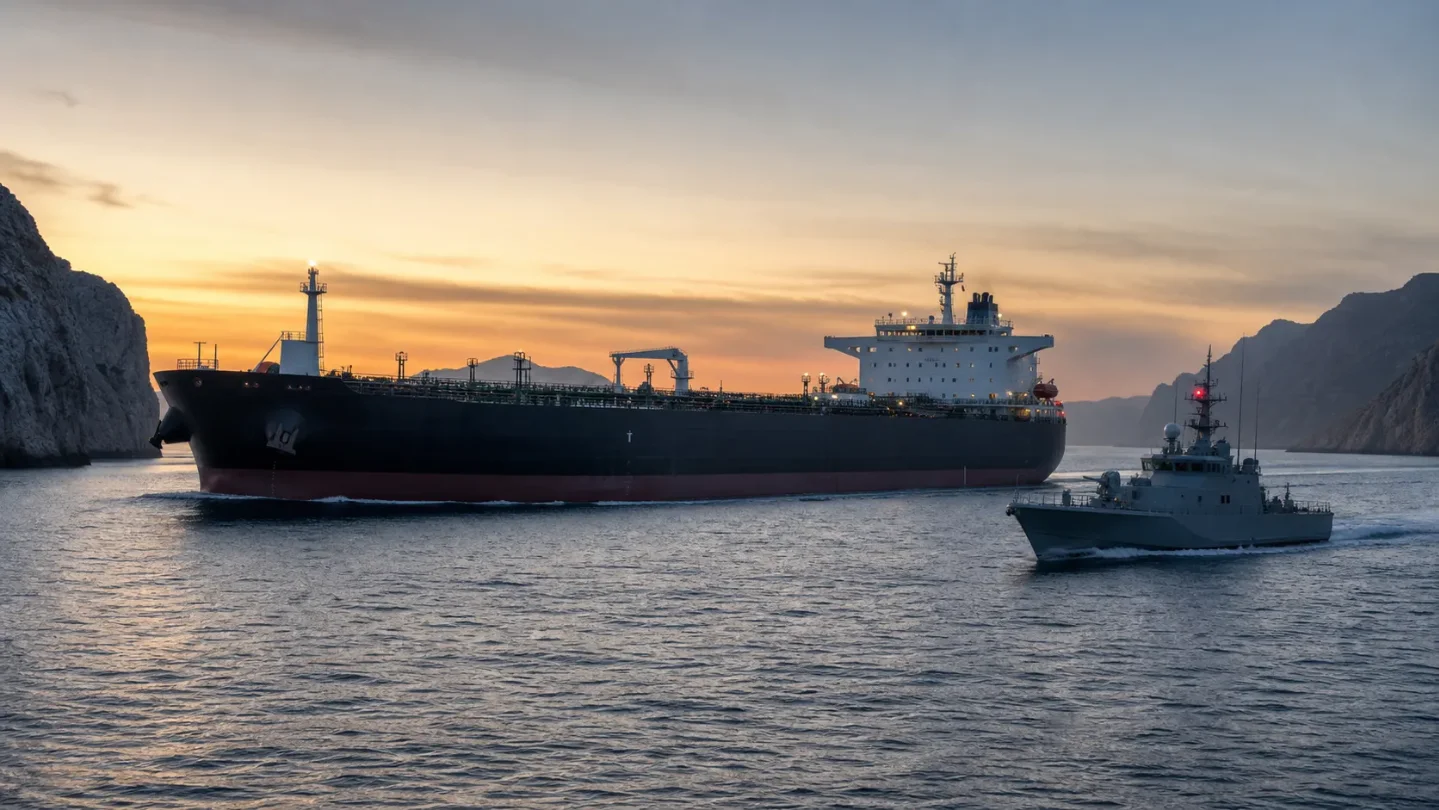
Geopolitics Daily Brief — August 3, 2026: Oil falls on Iran pause as China, Taiwan and Russia risks persist
Five fresh developments link a conditional U.S.-Iran strike pause and 5.1% Brent fall to slower Hormuz traffic, Ukrainian drone damage to Russian logistics, China's trade stance, Taiwan-U.S. military ties and EU scrutiny of a sanctioned tanker.
What matters this morning
The risk picture is moving in two directions. Oil markets are pricing a possible U.S.-Iran de-escalation, while the physical evidence still points to slower Hormuz traffic, new vessel attacks and unresolved military pressure across the other theatres.
1. Middle East: Oil falls as Trump pauses a planned Iran strike
- U.S. President Donald Trump held off on a fresh attack on Iran and said Tehran and other Middle Eastern countries had asked for time to complete a deal that would reopen the Strait of Hormuz and address Iran's nuclear programme. 1
- Brent crude fell $4.49, or 5.11%, to $83.44 a barrel, while U.S. West Texas Intermediate fell $4.90, or 5.79%, to $79.77 at 0408 GMT on August 3. 1
- No final agreement had been reached in the AP account, and Iran's foreign ministry said the strait would not simply return to its pre-war status; Reuters also reported slower Hormuz traffic and three more tanker attacks since Saturday. 12
Market and supply-chain impact. The first market reaction is a sharp reversal of the route premium: Brent had risen more than 20% in July, but the physical shipping problem is not yet solved. The UK Maritime Trade Operations reported three more tanker attacks, while two Saudi-loaded tankers crossed Bab el-Mandeb; refiners, charterers and cargo owners therefore still face a gap between lower headline oil prices and uncertain vessel access. 1
2. Russia-Ukraine: Drone strikes reach Russian retail and energy logistics
- Ukrainian drone strikes killed at least eight people in Russian regions overnight and on Sunday, according to regional officials cited by Reuters. 3
- A strike set fire to a Wildberries warehouse in Russia's Samara region; the governor said there were no casualties at that site, while the company has faced attacks on about a dozen locations since July 18. 3
- Ukraine's military said it struck the Saratov refinery, the Engels airbase and an oil depot in Kaluga; those claims were not independently confirmed in the Reuters report, while Russia's Defence Ministry said it had downed 635 Ukrainian drones. 3
Market and supply-chain impact. The immediate exposure is site continuity rather than a quantified national supply loss. Wildberries is described as a linchpin of Russia's consumer economy, and the same report links the strikes to a refinery and other industrial facilities; retailers, parcel operators and energy buyers should treat repeated attacks as a growing interruption risk while avoiding the stronger claim that Russian throughput has already fallen by a measured amount. 3
3. U.S.-China trade: Beijing defends its producer-led economic model
- China is defending an economic policy mix that favours advanced industries over consumption ahead of expected trade talks with the European Union and the United States, Reuters reported from Singapore and Beijing. 4
- A meeting of top Communist Party leaders signalled policy continuity and targeted support rather than consumer-focused stimulus or major structural changes. 4
- China's Commerce Ministry accused Western governments of protectionism in a paper rejecting the claim of "industrial overcapacity" as based on "logical flaws" and "ulterior motives"; an economist cited by Reuters said the message also drew a red line against discriminatory measures on Chinese firms and products. 4
Market and supply-chain impact. This is a negotiating signal, not a new tariff announcement. It points to a harder path for companies exposed to Chinese exports in advanced manufacturing: the EU is pursuing industrial and domestic-procurement policies while its trade deficit with China averaged about $1 billion a day in 2025, according to Reuters. Procurement teams should watch for sector-specific trade remedies, local-content rules and retaliation rather than assume that the talks will produce a broad policy reset. 4
4. Taiwan Strait: Taipei says its U.S. military ties are closer than many realise
- Taiwan Defence Minister Wellington Koo said cooperation with the United States may be closer than many people imagine, as Taipei works to deepen military exchanges with the U.S. Pacific Command. 5
- Koo said the exchanges and cooperation operate at all levels and have helped Taiwan strengthen its defensive combat capabilities; the United States remains Taiwan's most important international backer and arms supplier despite the absence of formal diplomatic ties. 5
- Reuters reported that China has increased military pressure around Taiwan, including coast-guard operations off its Pacific coast, while Taipei has run exercises that simulate Chinese escalation and a possible blockade. 5
Market and supply-chain impact. There is no reported port or factory interruption in this account. The operational issue is preparedness: Koo said a blockade would hit China's external trade and the global shipping role of its ports, while Taiwan sees its Pacific coast as important for wartime supplies from allies. That makes defence procurement, alternate communications and logistics resilience the near-term business watchpoints, without turning a minister's warning into a forecast of blockade. 5
5. Russia and Europe: EU naval mission boards a sanctioned shadow-fleet tanker
- An EU naval mission led by Italy boarded the sanctioned tanker Toa Payoh west of Sicily's Pantelleria on August 2 while it was sailing from Benin to Istanbul, The Straits Times reported in a Reuters-sourced article. 6
- Italy's Defence Ministry said the vessel had declared a Cameroon flag and that the inspection was meant to verify whether it was legally entitled to fly that flag; the captain initially refused to cooperate and Italian personnel boarded from a helicopter. 6
- The mission's EUNAVFOR MED Irini operation did not have authority to seize the tanker during the inspection, but documents gathered could support later national action; the two-hour boarding followed a similar July 20 operation involving the MV South Star. 6
Market and supply-chain impact. The immediate result was scrutiny, not a confirmed cargo seizure or route closure. But repeated boardings increase documentation, flag-status and insurance exposure for vessels linked to Russia's oil-export network; the EU says it has sanctioned scores of such vessels, and the inspection record could still be used in a later national sequestration decision. 6
Watchpoints
- Whether the U.S.-Iran pause produces a signed arrangement and verified tanker movements through Hormuz, rather than another short-lived de-escalation signal. 12
- Whether further Ukrainian strikes produce confirmed refinery, warehouse or port-throughput losses, rather than isolated fires and official claims. 3
- Whether EU and U.S. trade talks turn China's stated red lines into product-level tariffs, procurement restrictions or countermeasures. 4
- Whether Taiwan's military-exchange language is followed by a visible change in exercises, arms deliveries or maritime activity. 5
- Whether the Toa Payoh inspection leads to detention or national action, and whether other sanctioned tankers face the same scrutiny. 6
The Taiwan item is a Reuters report published on August 3; the shadow-fleet boarding occurred on August 2.
References
- 1
- 2
- 3
- 4
- 5
- 6

Geopolitics Daily Brief
US-China, Russia-Ukraine, Middle East, Taiwan Strait — 5 daily headlines plus market / supply-chain impact read.
This story was produced automatically by a channel. One sentence is all it takes for Neodrop to keep producing for you.
Related content
- Sign in to comment.