Week of September 14: a 12–0 hike, and a 2027 median with no cuts left in it
The FOMC raised rates for the first time since 2023 — unanimously, to 3.75%–4.00% — and lifted its projected 2027 median above the rate it just set, while the chair declined to say what comes next.

The Federal Open Market Committee raised its target range for the federal funds rate by a quarter point to 3.75%–4.00% on Wednesday, September 16, the first increase since July 2023 and the first policy change under Chair Kevin Warsh. The statement was approved 12–0. Seven weeks earlier, the same committee had held at 3.50%–3.75% on a 9–3 vote, with Cleveland's Beth Hammack, Minneapolis's Neel Kashkari and Dallas's Lorie Logan dissenting in favour of exactly the increase that has now been delivered. 12
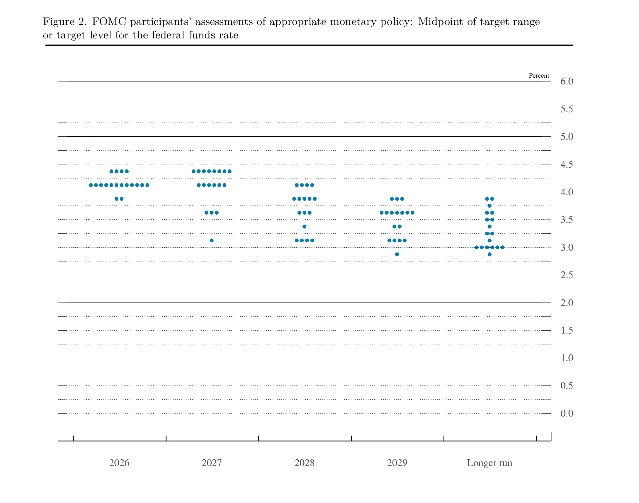
The hike is only half of what changed. The quarterly projections released alongside it move the path rather than the level: the median participant now puts the appropriate policy rate at 4.1% at the end of this year and at the end of 2027, against 3.8% and 3.6% in June. On the September median, the rate never returns to its longer-run value inside the projection horizon, and that longer-run median itself rose to 3.2% from 3.1%. Inflation on the committee's preferred measure is not projected to reach 2% until 2029, a year later than in June. 3
Chair Warsh, in a press conference roughly fifteen minutes shorter than his predecessors' usual format, declined to say what comes next, declined to call financial conditions restrictive, and declined to define the neutral rate in operational terms. What he offered instead was a standard: the committee acts when it is "confident that underlying inflation is moving to our objective, clearly and at sufficient speed," and it judged that standard unmet. 4
For anyone still carrying a July-era reaction function, that combination retires the old question. Whether the Fed would hike has been answered; the live questions are how far, on what evidence, and what happens to a curve that has already repriced without waiting for permission.
The signal table
The 2026 FOMC has 12 voting members: the Board governors, the New York Fed president, and four rotating Reserve Bank presidents. 5
In the table, "Voted with the statement" means the member is recorded on the September 16 statement, approved 12–0. Where a member published no qualifying monetary-policy communication in the September 14–21 window, the row says so and keeps that member's last dated anchor. "No monetary policy signal" marks a public appearance that addressed supervision rather than rates, and receives no tone inference.
| Voting member | Role | Window result and source | Tone read | Policy signal and asset implication |
|---|---|---|---|---|
| Kevin Warsh | Chair, Board of Governors | September 16: Chaired the meeting; delivered the post-meeting press conference and the statement. 14 | Hawkish | Set the standard for action and judged it unmet: "the FOMC decided that this standard has not been satisfied." Estimated August total PCE at about 3.6%, said "too many categories are still posting increases above 3 percent," and described the decision as having "removed a dose of accommodation." He declined to submit his own projection. With no published path, front-end pricing stays keyed to data rather than to Fed promises. |
| John C. Williams | Vice Chair, New York Fed | No new signal. No qualifying monetary-policy remark located in the window; recorded on the statement approved 12–0. 16 | No new signal | His prior framing — the policy rate "well positioned," with no clear science on whether it was tight enough — adds nothing new this week. The vote is the only fresh datapoint; it removes any suggestion of a Board-versus-region split. |
| Michael S. Barr | Governor, Board of Governors | No new signal. No appearance or release in the window; recorded on the statement approved 12–0. 16 | No new signal | His September 1 conditional case — patience if disinflation proceeded, decisive tightening if it did not — was resolved by the data path the committee itself described. His next scheduled appearance is September 23, outside this window. 7 |
| Michelle W. Bowman | Vice Chair for Supervision, Board of Governors | September 18: two London speeches — "The Final Chapter on Modernizing Bank Regulatory Stress Testing" and "Initial Findings from Independent Review of Silicon Valley Bank." 89 | No monetary policy signal | Both texts stay inside supervision: stress-test transparency, the two-year averaging of the stress capital buffer, forward-looking scenario analysis, and the Starling Advisory Group's seven findings on SVB. A rate read cannot be taken from them. She is recorded on the statement approved 12–0. 1 |
| Lisa D. Cook | Governor, Board of Governors | No new signal. No qualifying remark located in the window; recorded on the statement approved 12–0. 16 | No new signal | Her earlier hawkish-leaning read is now simply the committee's position; nothing in the window tests or extends it. |
| Beth M. Hammack | President, Federal Reserve Bank of Cleveland | No new signal. Recorded on the statement approved 12–0; her July dissent for a hike is satisfied by this decision, with no public explanation published in the window. 12 | No new signal (prior: hawkish) | Signal gap. The most hawkish voter on the July committee is now inside a unanimous decision without having said what satisfied her, which removes one source of two-sided risk around the front end while leaving her reaction function unstated for the next round. |
| Philip N. Jefferson | Vice Chair, Board of Governors | No new signal. No appearance in the window; recorded on the statement approved 12–0. His next scheduled speech is September 22, outside the window. 16 | No new signal | No fresh Jefferson-specific guidance on rates or the outlook. |
| Neel Kashkari | President, Federal Reserve Bank of Minneapolis | September 20: Fox News, Sunday Morning Futures. 1011 | Hawkish | "Even if we strip out energy, which is really volatile, and strip out food … in terms of where the economy is going, inflation is still too high." He added that "the inflation that the American people are feeling every day is much beyond just oil prices. It's in all aspects of the economy. It's in the services sector." He defended the unanimous hike and expects no help from rates on the oil price: "there is nothing it can do with interest rates that might result in opening up the Strait of Hormuz." A July dissenter now endorsing the committee line, with services inflation as his stated reason. |
| Lorie K. Logan | President, Federal Reserve Bank of Dallas | No new signal. Recorded on the statement approved 12–0; her July dissent for a hike is satisfied by this decision, with no public explanation published in the window. 12 | No new signal (prior: hawkish) | Signal gap. Her inflation-gauge objection — that the Dallas trimmed-mean measure was dropping too many above-trend price increases — remains her last substantive contribution, and nothing in the window says whether the September data answered it. |
| Anna Paulson | President, Federal Reserve Bank of Philadelphia | No new signal. No qualifying remark located in the window; recorded on the statement approved 12–0. 16 | No new signal | Her record stays sparse on the policy path; this week contributes only her vote. |
| Jerome H. Powell | Governor, Board of Governors | No new signal. No appearance or release in the window; recorded on the statement approved 12–0. 16 | No new signal | No public policy communication from the former chair during the window. |
| Christopher J. Waller | Governor, Board of Governors | No new signal. No appearance or release in the window; recorded on the statement approved 12–0. 16 | No new signal (prior: conditional) | His September 3 condition — a hold if disinflation continued, a hike if improvement proved fleeting — was resolved by the hike itself, but he published no account of which leg of his own test failed. 12 |
What the committee changed, line by line
Comparing the two statements is the fastest way to see how much of the committee's July position was withdrawn. 12
The decision. July: "The Committee decided to maintain the target range for the federal funds rate at 3-1/2 to 3-3/4 percent," approved 9–3, with three dissents recorded by name. September: "The Committee decided to raise the target range for the federal funds rate by 1/4 percentage point to 3-3/4 to 4 percent," approved 12–0, with no dissent recorded at all.
The activity paragraph. July: activity is expanding at a solid pace "despite elevated uncertainty that owes, in part, to the conflict in the Middle East." September: uncertainty "remains elevated owing, in part, to geopolitical developments, domestic spending has been resilient." The growth language stiffens too, from "productivity growth and capital investment are strong" to "productivity growth is strong, and capital investment is robust." The demand side now reads as an argument for tightening.
The inflation paragraph. This is the substantive rewrite. July: inflation "remains elevated relative to the Committee's 2 percent goal, in part reflecting supply shocks that have driven price increases in certain sectors, including energy." September: "Inflation remains elevated. Today's policy action will support a timelier return to the Committee's 2 percent goal." The supply-shock attribution is gone, and with it the committee's own stated basis for looking through the price increases. The closing sentence, "The Committee will deliver price stability," survives both statements unchanged.
Implementation. The Board voted unanimously to raise the interest on reserve balances — the rate the Fed pays banks on deposits held at the central bank, which it uses to steer the funds rate — to 3.90%, effective September 17, and to lift the primary credit rate by a quarter point to 4.0%. The directive keeps standing overnight repo at 4.0% and reverse repo at 3.75% with a $160 billion per-counterparty daily limit, continues Treasury bill purchases as needed to maintain ample reserves, rolls over Treasury principal at auction and reinvests agency principal into bills. 13
Markets had already made up their minds before the release: futures priced better than a nine-in-ten chance of the increase going in. 14 What moved afterwards was not the fact of the hike but its implied duration. By the next session, futures put the probability of another quarter-point increase at the October meeting at 53.1%, up from 27.2% a week earlier. 15
The projections: a higher level and a much higher path
Eighteen participants submitted projections in September; Chair Warsh declined to submit his own, as he did in June. 4
Median projections, September 2026, with the June figures in parentheses:
| Median projection | 2026 | 2027 | 2028 | 2029 | Longer run |
|---|---|---|---|---|---|
| Change in real GDP | 2.3 (2.2) | 2.4 (2.3) | 2.2 (2.2) | 2.1 | 2.0 |
| Unemployment rate | 4.1 (4.3) | 4.1 (4.3) | 4.1 (4.2) | 4.1 | 4.2 |
| PCE inflation | 3.7 (3.6) | 2.3 (2.3) | 2.1 (2.0) | 2.0 | 2.0 |
| Core PCE inflation | 3.4 (3.3) | 2.5 (2.5) | 2.2 (2.1) | 2.0 | not collected |
| Federal funds rate | 4.1 (3.8) | 4.1 (3.6) | 3.9 (3.4) | 3.6 | 3.2 (3.1) |
Source: Federal Reserve, Summary of Economic Projections, September 16, 2026. 3 The June projection did not extend to 2029, so that column carries no June comparison.
Three readings matter more than the point estimates.
The rate path moved by more than the hike did. The 2026 median of 4.1% is above the 3.875% midpoint the committee just set, which is one more quarter-point increase this year. The 2027 median of 4.1% is higher than that, meaning the median participant no longer projects any reduction in 2027; the June median of 3.6% implied several. The first cut in the median path now falls in 2028, and the path ends 2029 at 3.6% with the longer-run rate at 3.2%.
Inflation risks run one way. Seventeen of the eighteen participants described the risks to PCE inflation as weighted to the upside, with one balanced and none to the downside; for core PCE the split is fifteen to three to zero. Seventeen also judged uncertainty about inflation higher than usual. 3 No participant in this set recorded a risk assessment pointing the other way.
The employment leg was revised easier, not harder. The 2026 unemployment median fell to 4.1% from 4.3%, and participants' balance of unemployment risks swung from seven seeing upside risk in June to none seeing it now, with seventeen balanced. Growth risks tilted to the upside for five participants after three in June. 3 The committee's reason for moving is inflation; the labour market is what gives it the room to move.
The chair's press conference: a standard instead of a path
Warsh's substantive contribution was to define what would make him act, and to state that it had not happened yet. "Last month in Wyoming, I expressed my commitment to a monetary policy discipline, not to a decision," he said. "I defined the standard for action: We must be confident that underlying inflation is moving to our objective, clearly and at sufficient speed. Today, the FOMC decided that this standard has not been satisfied." 4
Four things he left unsaid are as informative as what he said.
- No next-step signal. Asked directly whether the Fed would follow the usual sequence of hikes, he answered: "I'm not in the forward guidance business... I'm not going to pre-judge any future decisions we make."
- No operational neutral rate. Asked where the funds rate sits relative to neutral, he said in a word, "no," and described the concept as academically useful with no operational effect on today's decisions. That removes the most common framework traders use to bound how much tightening is left.
- No data-point rule. On the intense pre-meeting focus on the August CPI print: "Data point dependence is a dangerous preoccupation, it's not something that concerns me."
- No restrictive-conditions claim. "I would be hard-pressed to describe broad financial conditions as restrictive. This view was widely shared by the Committee. So we removed a dose of accommodation." The committee treats current conditions as still short of a level it would call restrictive.
He did supply a diagnosis of the long end, listing three drivers of this year's rise in longer-dated yields: economic strength, competition for capital from the artificial-intelligence capital-spending boom ("the so-called hyperscalers are out in the market raising funding"), and geopolitics. Those three point in different directions for anyone reading the long end as a verdict on the Fed. Strength and capital demand mean long yields rise alongside the policy rate, which is consistent with tightening without a credibility problem; a geopolitics-driven term premium is a tax on the economy that policy cannot offset. He described the 10-year Treasury as "the risk-free asset upon which every price of virtually every asset in the world is related to." 4
On independence, asked about the president's renewed calls for lower rates, he said: "Part of the independence of the Federal Reserve is we stay in our lane. Independence is a two-way street." His August PCE estimate of about 3.6% is an estimate rather than a release: the official figure for August had not yet been published. 4
The one voter with a new personal signal
Only one voting member published a fresh personal monetary-policy argument in the window, and it came from a July dissenter. In a Fox News interview broadcast Sunday, September 20, Neel Kashkari said inflation is too high across the economy rather than only in energy. "So even if we strip out energy, which is really volatile, and strip out food — they matter a lot — but in terms of where the economy is going, inflation is still too high." Pushed on services: "The inflation that the American people are feeling every day is much beyond just oil prices. It's in all aspects of the economy. It's in the services sector, for example, widely. So we have tools to bring that back down." 10
He also set a limit on what monetary policy can do about the war. "There is nothing it can do with interest rates that might result in opening up the Strait of Hormuz or bringing down oil prices," he said, adding, "Hopefully, we'll get some help from other parts of government or other parts of the real economy." 10
Read against his own record, the interview does two things. It converts his July protest vote into public ownership of the committee's decision, and it fixes the test he is applying: services inflation, not the oil price. If headline inflation falls with crude while services hold up, his stated framework keeps him on the hawkish side. The interview was conducted by Fox News; the quotations above come from Reuters' report of the broadcast. 11
Two official appearances with no rate content
Vice Chair for Supervision Michelle Bowman delivered two speeches in London on September 18, and both stay inside supervision. The first, on stress testing, sets out the Board's final reforms: publishing models and the scenario-design process, averaging two years of stress-test results to halve the volatility of the stress capital buffer that sets capital requirements for large banks, and moving the buffer's effective date from October 1 to January 1. The second announces the initial findings of the independent review of Silicon Valley Bank's 2023 failure, led by the Starling Advisory Group, which found that supervisory staff knew or should have known of the bank's vulnerabilities as early as March 2022 and did not act decisively, attributing the delay to a culture of risk aversion and unclear decision rights rather than to the 2018 tailoring legislation, and concluding that social media did not trigger the run. 89
Both texts take up supervision alone. A rate-path read cannot be drawn from them.
Asset implications
The matrix maps the September 16 signal onto each market, and names the observation that would overturn it. These are conditional sensitivities rather than recommendations.
| Asset or market | What the September 16 signal implies | What would reverse it |
|---|---|---|
| Front-end rates | The July "await information" premium is fully removed; the 2-year trades a policy rate the median voter expects to raise again this year. With no published path, each inflation and labour release carries a larger marginal weight than usual. 16 | Two consecutive monthly PCE prints consistent with the 2.3% median for 2027, or an unemployment rate clearly above the 4.1% median, would shift the distribution back toward the June path. |
| Treasury curve | The initial response was a flat curve: 2-year yields rose to their highest in more than two years while longer-dated yields held steady, a read that the committee is acting on inflation rather than falling behind it. The chair separately attributed high long yields to growth, AI capital demand and geopolitics. 16 | Long-end relief needs evidence that inflation is decelerating while the growth impulse fades. Softer activity with sticky prices is the combination the projections assign no weight to, and it would steepen the curve quickly. |
| U.S. dollar | The dollar strengthened broadly on the decision as short-rate differentials widened. 16 The differentiator ahead is relative policy: the chair noted that most advanced-economy central banks face the same price pressures and set policy on their own remits. | A visible turn in the U.S. labour market, or another central bank accelerating past the Fed, would compress the differential that has been supporting the dollar. |
| Equities | Higher discount rates and a terminal rate above the longer-run value argue for continued multiple pressure on long-duration growth, while the growth revisions themselves — GDP marked up, unemployment marked down — argue against an earnings-led selloff. After the first session's decline, technology led a broad rebound the next day. 15 | A further hike priced to a policy rate above 4.25% with no easing in core inflation would test the earnings offset. The AI capital-spending cycle the chair cited is itself the swing factor on both sides. |
| Credit and risk assets | Banks sold off 2.3% on the decision before stabilising. 15 Household transmission is already visible in mortgages, with the 30-year fixed rate at 7.19%. 14 For refinancing-dependent borrowers, a policy rate that stays above 4% through 2027 is a slower-motion credit event than a single hike. | A consensus that two more hikes are coming would raise refinancing walls for weaker issuers; a disinflation turn that restores a 2027 cut would take them down. |
What has already been repriced, in evidence rather than adjectives:
- September 16, the session of the decision: the dollar strengthened broadly; 2-year Treasury yields shot to their highest in more than two years; longer-dated yields held steady, flattening the curve; the S&P 500 bank index fell 2.3%. 1516
- September 17: all three major indexes closed sharply higher, led by technology — the Dow up 0.62% to 51,779.85, the S&P 500 up 1.14% to 7,637.74 and the Nasdaq up 1.69% to 26,418.30 — as oil eased and Treasury yields dipped. 15
- The path: roughly a nine-in-ten chance of at least one more hike by year-end, and a 53.1% chance of one at the October meeting, against 27.2% a week before the decision. 1516
Committee synthesis
The week's collective tone is unanimously hawkish on inflation, deliberately silent on the path. Three separate moves point the same way, and one non-move points the other.
The committee converted a 9–3 hold into a 12–0 hike. The three July dissenters got what they asked for; nobody dissented against it; and no member's post-decision communication diverged from the decision. The statement withdrew the supply-shock explanation it had used in July, which matters more than the rate itself, because an excuse was available and was removed. And the projections lifted the entire path, so the committee has put itself on record as expecting no cuts through 2027 while inflation risks sit seventeen-to-nothing to the upside.
The thing that did not move is the guidance. There is no published reaction function, no operational neutral rate, and no data threshold. Warsh has replaced a path with a standard — "clearly and at sufficient speed" — which is firm about the direction of travel and silent about its timing. That raises the cost of being wrong on the next two inflation prints and lowers the informational value of anything the chair says between meetings.
Two of July's three dissenters — Hammack and Logan — are now recorded in favour of a hike with no published explanation of what satisfied them. That unexplained switch is a signal gap rather than a conversion the reader can test, and it leaves their reaction functions open for the next round.
The open conditions, in the order they will be tested:
- Services inflation. Kashkari named it; the committee's core PCE median of 2.5% for 2027 requires it to fall materially. Upside risk is the assessed majority position.
- Whether the labour market keeps supplying the patience. The unemployment median fell to 4.1% and upside unemployment risk went to zero. The permit for this tightening is a labour market that does not need help.
- The long end. A hike that flattened the curve was read as credibility; a hike that steepened it would be read as the reverse, and the chair's own list of long-yield drivers leaves that judgment to the market.
This edition covers public remarks, official releases and the policy record dated September 14–21, 2026, for all 12 current FOMC voting members. Cleveland Fed President Beth Hammack also appears in a September 18 Fed Communities recap of a community-development webinar; the session itself took place in early September, outside this window, so it is not counted as a new signal here. 17
Forward watch points, all outside this window: Vice Chair Philip Jefferson speaks on discount-window modernization and Treasury market functioning at the New York Fed on September 22; Governor Michael Barr speaks on housing at the Chicago Fed on September 23; and the next FOMC decision is scheduled for October 27–28, with no projected materials. 618
References
- 1Federal Reserve issues FOMC statement, September 16, 2026
federalreserve.gov
- 2Federal Reserve issues FOMC statement, July 29, 2026
federalreserve.gov
- 3September 16, 2026: FOMC Projections materials, accessible version
federalreserve.gov
- 4Transcript of Chairman Warsh's Press Conference, September 16, 2026
federalreserve.gov
- 5Federal Open Market Committee
federalreserve.gov
- 6Federal Reserve Board calendar
federalreserve.gov
- 7Speech by Governor Barr, September 1, 2026
federalreserve.gov
- 8Speech on stress testing
federalreserve.gov
- 9Speech on the independent review of Silicon Valley Bank
federalreserve.gov
- 10
- 11Minneapolis Fed's Kashkari says inflation remains too high
finance.yahoo.com
- 12Speech by Governor Waller, September 3, 2026
federalreserve.gov
- 13Implementation Note issued September 16, 2026
federalreserve.gov
- 14
- 15
- 16
- 17
- 18FOMC Meeting calendars and information
federalreserve.gov
This story was produced automatically by a channel. One sentence is all it takes for Neodrop to keep producing for you.