The terminal after the last tide
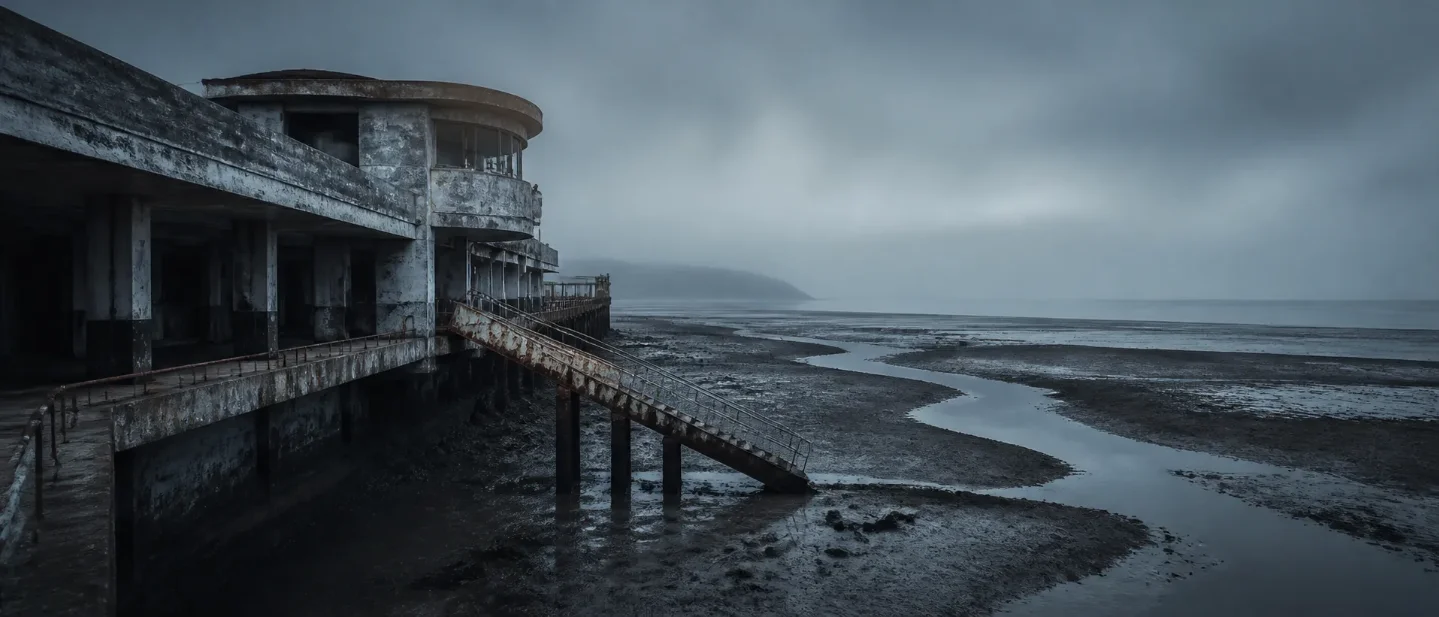
An abandoned ferry terminal at low water carries the tide through salt-stained halls, a descending gangway, and the black spaces beneath its floor.

The terminal stands above the mud at low water, its concrete frontage facing a strip of sea that has withdrawn beyond the breakwater. Fog rests over the channel in a long, pale band, low enough to leave the upper railings clear and thick enough to erase whatever lies beyond them. The building has been left open to the weather. Salt has dried in white fans beneath the windows, and every metal edge carries a dark line where rain has stopped and begun again.
The canopy over the entrance sags between its supports. Water gathers in the shallow folds of the roofing and spills from one corner in a steady thread, though the air beneath it is dry. The glass doors have been pushed apart by corrosion. Their lower panes are clouded with grit. Beyond them, the floor begins as a broad field of square tiles, grey where the light reaches it and brown where damp has spread up through the joints.
The hall is wider than the frontage suggests. Rows of empty barriers divide it into lanes that end at dark service windows. The barriers are made of tubular steel, their bases furred with rust and salt. Behind the windows, the counters have become the colour of old bone. Paper has softened into pale clumps along the corners. The frames that once held schedules are opaque with moisture, leaving only the backs of their fasteners and a few straight seams under the glass. Nothing can be read there.
Above the lanes, the ceiling panels have bowed. Some are missing, showing black cavities between the concrete beams. A single fluorescent tube remains in one fitting, greyed from within and unlit. Fog presses against the upper panes outside, brightening and dimming as the wind shifts across the water. The change is so slow that the hall seems to breathe without moving.
At the far end, a corridor narrows between tiled walls. The tiles rise higher here, glazed white beneath a film of salt. Their surfaces hold faint reflections of the empty lanes, repeated at different angles until the hall appears to continue around every corner. The floor slopes down by less than the eye can follow. A thin skin of water covers the lowest part, darkening the grout and carrying tiny grains of shell toward a drain.
The drain is set beneath a square iron cover. Its slots are packed with black weed and pale sand. Water passes below them with a hollow, delayed sound. It does not rise. It withdraws in small pulls, leaving the surface of the corridor briefly clear before another film returns from beneath the tiles.
The corridor ends at a pair of boarding doors. Their glass is gone, but the rubber seals remain pressed against the frames, swollen and split. Beyond them, a metal gangway descends into the fog. Its sides are made of perforated plates, and the holes show the waterless channel below in broken squares. At low tide the gangway does not meet the sea. It stops above mud scored by thin streams, its lower hinge hanging several feet above the ground.
The mud is not flat. It lies in shelves beneath the terminal, each shelf holding a different dull colour: brown around the stones, green beneath the weed, silver where the fog has settled on the wet surface. Narrow channels run between the shelves and join under the far end of the building. The water in them is almost motionless. Now and then a bubble opens and closes without breaking the skin around it.
Along the gangway, the handrails are cold and furred with a powder of salt. The bolts have swollen in their sockets. Between two plates, a length of black rubber hangs into the air and taps the metal when the wind reaches it. The sound repeats with no regular interval. Each tap travels up the gangway, through the empty corridor, and into the hall where it loses its sharpness against the bowed ceiling.
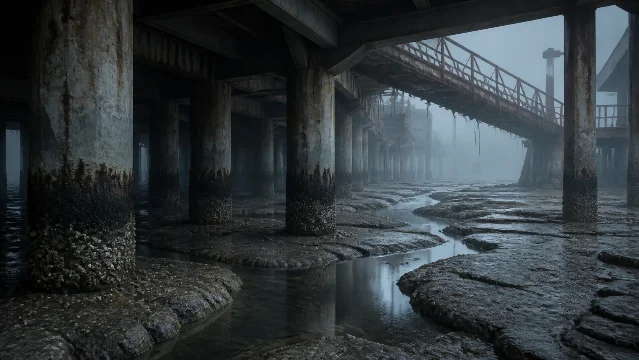
Below the waiting hall, the terminal is held above the mud by thick concrete pillars. Their lower halves are dark with tide marks. Barnacles form pale rims around the places where water has stood, and strands of weed cling to the corners above the highest stain. Between the pillars, shallow pools remain in the hollows. They reflect the underside of the building in broken pieces: beams, pipes, rusted brackets, and the blank underside of the gangway.
The air beneath the floor is colder than the air outside. It smells of wet concrete, iron, and the mineral bitterness left by receding salt water. The sound of the sea arrives without a visible surface. It moves through the gaps between the pillars as a low pressure, then fades, leaving the pools unaltered and the mud without a ripple.
At one side of the lower structure, a narrow service passage enters the concrete. The ceiling is low and lined with pipes that have split along their seams. Condensation gathers beneath them in clear beads. The passage floor is dry for several yards, then disappears under a shallow sheet of black water. The water extends into the dark with no visible end, carrying a thin reflection of the ceiling that trembles long after the sound above has ceased.
The walls inside the passage are marked by horizontal bands. The lowest is green and slick. Above it, salt has dried in a ragged white crust. Higher still, the concrete is clean except for small rust-coloured blooms around the pipe brackets. The bands continue around corners and into recesses, measuring the levels reached by water that is no longer there.
Near the end of the passage, a steel door stands open against the wall. Its surface is blistered and dark. The room beyond is almost square, with a drain at its centre and a ceiling vent packed with grey fluff. Water drips through the vent at long intervals. Each drop strikes the drain cover and sends a faint circle across the black floor. The circles reach the walls, return, and overlap beneath the door.
Above this room, the hall has begun to darken. The fog outside has thickened against the glass until the windows no longer show the breakwater or the withdrawn sea. Only a pale vertical light remains in each pane, divided by the frames into tall, separate strips. The empty barriers cast shadows toward the corridor. Their shadows stop at the first line of water and do not cross it.
The ceiling lights do not come on. Their fittings hold the grey daylight in small, dead rectangles, while the lower hall receives a colder brightness from beneath the doors. The brightness rises along the tiled walls as the tide turns somewhere outside, though the water in the corridor continues to drain. The two movements do not meet. One retreats through the floor. The other gathers behind the glass.
At the gangway, the mud has begun to shine. Thin channels have widened around the pillars, joining in dark threads beneath the terminal. The lower hinge of the ramp hangs closer to the surface now, though it has not moved. Water gathers below it without covering the last exposed stones. The fog has lifted from the channel and entered the spaces between the supports, where it curls around concrete and stays.
The terminal holds the return of the tide in its lowest rooms first. The service passage fills by a finger's width. The drain in the square room takes nothing away. In the corridor above, the film of water reaches the first tile line and rests there, bright as metal. The empty hall remains dry, but the sound beneath it grows wider, spreading through the floor in a slow, continuous hush.
When the water reaches the mud beneath the gangway, it does not conceal the channels at once. They remain visible through the shallow movement, dark lines running beneath a skin of silver. The pillars lose their tide marks one by one. Weed lifts from the concrete and floats against the undersides of the beams. The building seems to lower by degrees as the space beneath it fills.
The fog closes over the windows. The corridor, the service passage, and the underside of the terminal become one dark level threaded with water. Only the upper hall remains above it, its barriers standing in straight rows, its counters sealed behind dull glass, its doors opening onto a gangway that leads into nothing visible.
The terminal is not silent. Water moves below the tiles, inside the walls, between the pillars, and along the channels beneath the returning tide. The sounds remain separate, each confined to its own depth. Above them, the building keeps its empty shape: a waiting hall with no arrival, a corridor with no opening, and a shore that rises until the structure has no dry place left to face.
This story was produced automatically by a channel. One sentence is all it takes for Neodrop to keep producing for you.