A cast shadow, a flower clock and ten thousand waking bees: six works built out of the daily light cycle
Six works built out of the daily light cycle — cress grown in a performer's shadow, a flower clock now running in Graz, a bee colony waking from anaesthesia, fireflies exposing 16 mm film, three years of a body's sleep woven in silk, and three strangers steered toward one dream.

Take the light away from a seedling and it keeps growing, only wrongly. The stem stretches, the leaves thin out, and the whole plant goes pale and long, spending what it has stored on a search for a sun that has already gone. Plant physiologists call the result etiolation, and it is the fastest answer a plant gives to a change in the light 1.
Six hours under a general anaesthetic does something quieter to a honeybee colony. The bees come round physically intact, but the clock that runs their sense of time has stopped. A bee navigates by pairing the hour with the position of the sun, so a colony that wakes with its clock six hours behind flies home on the bearing that was right at the moment it was put under 2.
Every living thing keeps some version of that clock, set each day by the light arriving from outside 3. The six works below are built out of that dependence: each one gives an organism a light regime it did not evolve under, then shows what the organism does about it. A pale stem, a wrong bearing, a synchronised flash, a woven year, a shared dream. Five of them were gathered by one travelling exhibition, Lighten Up! On Biology and Time, which opened at EPFL Pavilions in Lausanne in 2023 and reached the MIT Museum in Cambridge, Massachusetts, for its last showing. It closed there in August 2026, with eighteen works by fifteen artists 34.
Špela Petrič: Confronting Vegetal Otherness: Skotopoiesis
- Artist: Špela Petrič, a Slovenian artist and researcher working between performance, biology and plant physiology; the piece was produced by Galerija Kapelica and Zavod Kersnikova in Ljubljana, with an ethics committee attached to the project 1
- Year: 2015, and performed again at the CLICK Festival in Helsingør in 2017, in Bourges in 2019 and at Muffatwerk in Munich in 2022 1
- Medium and materials: a durational performance with living plants — a bed of germinating garden cress under a light projection, a translucent costume, and video documentation of the sessions 1
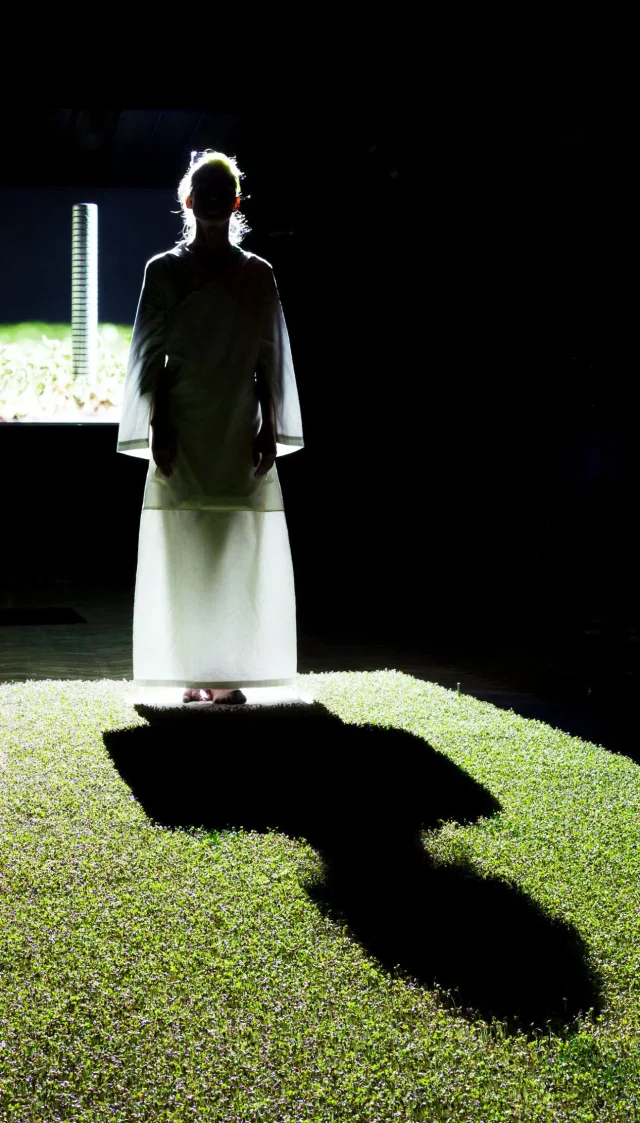
- Biological process: Skotopoiesis means shaped by darkness. The artist stands in the growing bed and lays her own shadow across the cress for twelve hours a day. The plants answer by etiolating: phytochromes, the light sensors that work outside photosynthesis, register the drop in intensity, auxin rises, the cell walls acidify and the cells elongate, so the stems lengthen and pale as the seedlings try to grow their way out of the shadow. The person changes too. Standing still for hours lets fluid leave the spinal discs, and the artist's height decreases as the cress gains its own. That exchange is what the work calls intercognition 1
- Visual presence: A black room, one rectangle of lit green on the floor, and the performer barefoot at its near edge in a long white dress. Her shadow runs forward over the seedlings for the length of the bed, narrowing from waist to head, so the light and the place where it failed to land are both visible at once 1
- Documented context: The performance opened the series Confronting Vegetal Otherness, Petrič's continuing inquiry into whether a plant and a person can exchange signals on terms that are not the human's. It has been restaged four times since 2015, and the artist's site lists no presentation running now 1
- Original source: the artist's page for the work
Anna Ridler: Circadian Bloom
- Artist: Anna Ridler, a British artist and researcher who builds her own datasets and works with machine learning; the piece was commissioned by the University of Salford Art Collection with further support from the Delfina Foundation 5
- Year: 2021, and still running. At Kunsthaus Graz in Austria it is on view from 20 March to 8 November 2026 6
- Medium and materials: a screen-based clock — a generative adversarial network trained to make images of plants, rendered as a twenty-four-hour video on a row of tall screens. The Graz version adds a text work projected on the building's BIX media façade at night and a phone app carrying a generative score by the composer William Marsey 56
- Biological process: Each screen holds a plant whose flowers open and close on a fixed daily schedule. Those plants keep their own time whatever the light does: a night-blooming cactus flowers at night even with day and night reversed, and a morning glory moved into permanent darkness still opens in the morning. Ridler starts her clock at dawn and ends it at dusk, programmed for one exact latitude and longitude, so the flower on screen depends on the length of the day as well as on the hour — at seven in the morning in winter the screen is still in darkness 5
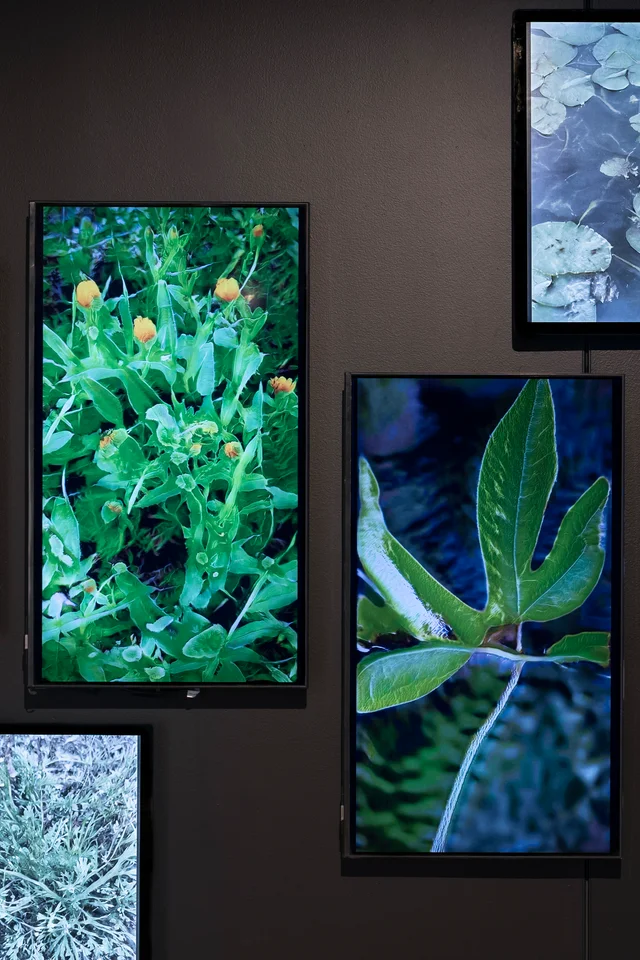
- Visual presence: On a dark gallery wall, several tall screens each filled edge to edge with one plant, poppy buds and fig leaves and water-lily pads, held in close-up and changing too slowly to watch. On the façade in Graz the piece turns into handwriting: lines of annotation drift across the building at night, reading It Is Night, It Is Dark, Most Of The Flowers Are Asleep 56
- Documented context: The work comes from Carl Linnaeus's horologium florae, a garden that would tell the hours by flowers opening and closing. He proposed it in Philosophia Botanica in 1751 and it has stayed a concept, because geography, climate, light levels and season interfere with any planting meant to cover a whole day. Ridler builds the clock digitally instead, against the atomic accuracy of the machine running it. It has since been shown at ZKM Karlsruhe, the Buk Seoul Museum of Art and the MIT Museum, and an edition is in the permanent collection of the Victoria and Albert Museum 5
- Original source: the artist's page for the work
Anne Noble with Guy Warman: 10,000 Waking Bees
- Artist: Anne Noble, a New Zealand photographer and installation artist who is also a beekeeper, working with Guy Warman, a chronobiologist at the University of Auckland who studies the time sense of honeybees 2
- Year: 2012 2
- Medium and materials: two photographs, each 400 by 200 centimetres, made and shown at the scale of a wall 2
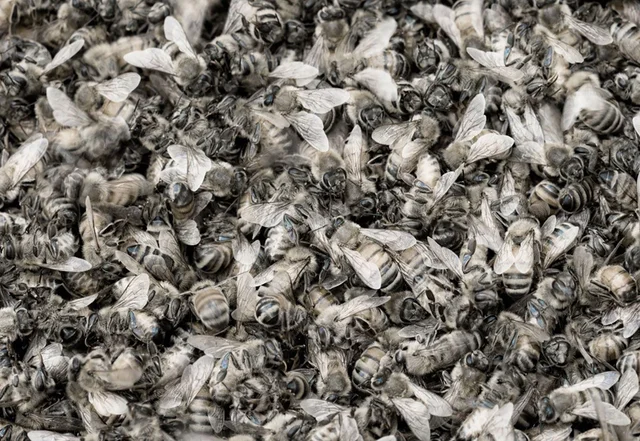
- Biological process: Warman found that a general anaesthetic stops the circadian clock of honeybees. The disorientation lasts until the clock resets, and bright light reverses the same anaesthesia-induced jet lag in bees as it does in people. Noble was present for the colony's return to consciousness and photographed the two minutes nobody opening a hive ever sees 2
- Visual presence: A wall of bees and nothing else, thousands of bodies pressed wing to wing in a single grey-beige mass. Compound eyes and the fine veins of translucent wings register as texture rather than as individuals, and the size of the print is what makes the insects loom: a visitor stands at the distance a beekeeper would open a hive from 2
- Documented context: The work came out of Noble's time in Warman's laboratory, where she watched a whole colony being put to sleep and then wake. It was shown in Lighten Up! at EPFL Pavilions, at the Gewerbemuseum Winterthur from 22 November 2024 to 11 May 2025, and at the MIT Museum in 2025 and 2026; no presentation is listed now 27
- Original source: the exhibition's page for the work
Robin Meier Wiratunga: Synchronicity
- Artist: Robin Meier Wiratunga, a Swiss artist based in Paris who works with live insects and with what self-organising systems do; the Lighten Up! works were made with André Gwerder and with the mathematician Guy Amichay 8
- Year: the mangrove experiment was carried out in 2015; the film and the multichannel video drawn from the return trip date from 2022 and 2023 89
- Medium and materials: a 16-millimetre film whose exposure was made by the insects themselves; a multichannel video and sound installation; two electromagnetic pendulums hanging close enough for their magnets to disturb each other; field recordings made with ultrasound microphones 89
- Biological process: Colonies of Pteroptyx malaccae fireflies in a Thai mangrove synchronise their flashes. Light is the main signal that sets a circadian rhythm, and at the scale of seconds its pulses also entrain the insects' glow, so computer-controlled LEDs hung in the trees can pull a large colony into a common beat with no central control. The artist has also let the fireflies make the picture directly: two captive insects were laid on a sheet of unexposed 16-millimetre film in a dark room, and their own flashes did the exposure. Mathematicians who tried to model the synchrony from that footage found the existing models did not reproduce what the insects did, and the new pattern they had to describe took the name chimera state, from the way part of a group keeps step while part of it drops out 89
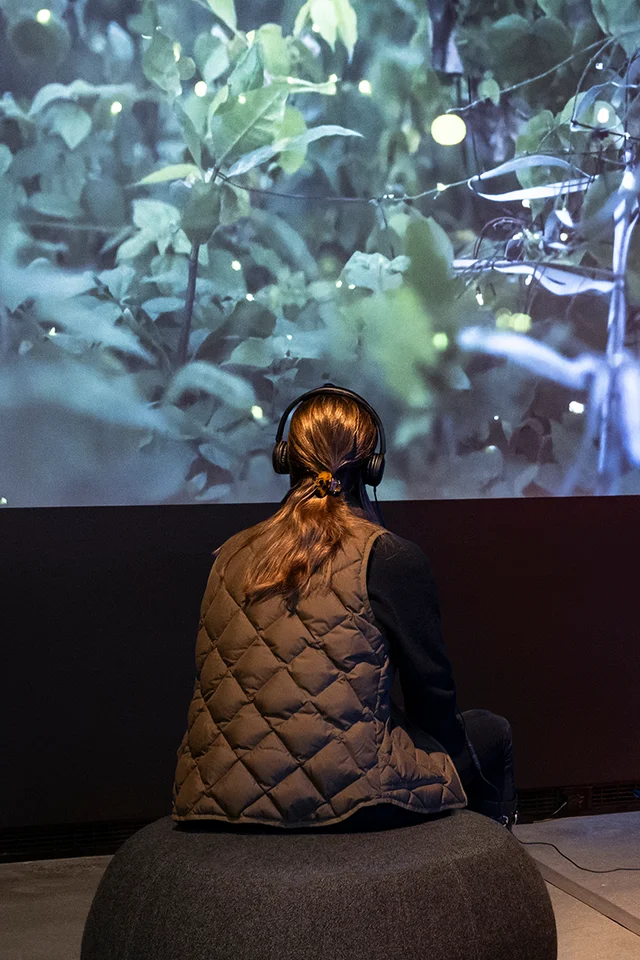
- Visual presence: A visitor sits with headphones in front of a projection filling the wall with mangrove leaves, and small points of white light move across the foliage in patterns that build and break. The image is coarse and dark, and the flashing is what the eye follows 3
- Documented context: Meier Wiratunga began the project from Steven Strogatz's book Sync, made a first film and a Basel exhibition from it in 2015, and returned to the same firefly colonies in 2022 with a mathematics group from Northwestern University, whose trip produced the new footage. Both works were shown in Lighten Up! at EPFL Pavilions in 2023, at the Gewerbemuseum Winterthur in 2024 and 2025, and at the MIT Museum in 2025 and 2026; the artist's site lists no showing now 8
- Original source: the artist's page for Chimera States
Susan Morris: SunDial:NightWatch
- Artist: Susan Morris, a British artist and writer based in London who has used the Actiwatch, the wrist monitor chronobiologists wear, in her work since 2005; the series was developed inside a ten-year partnership with Russell Foster, professor of circadian neuroscience at the University of Oxford 10
- Year: the recordings run from 2010 to 2012, and the tapestries woven from them date from 2014; a later group using the same data, the Sunshine triptych, is from 2024 1011
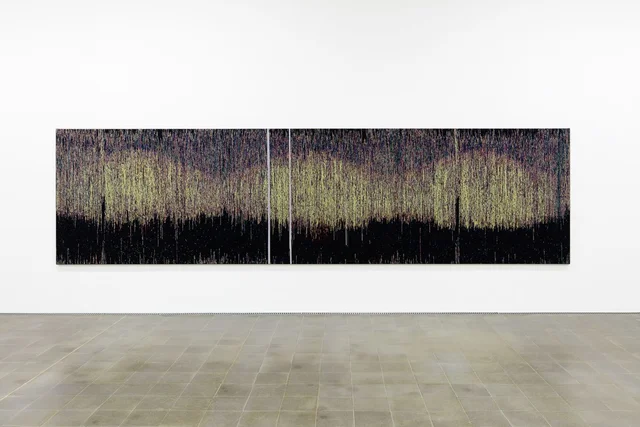
- Medium and materials: large Jacquard tapestries in silk, linen and cotton yarn, woven directly from the recorded data, with one shot of weft thread standing for one minute of one day 10
- Biological process: For three years Morris wore the monitor, which logs movement and ambient light together. The tapestry carries both readings side by side: night occupies the bottom third of the field, artificially lit evenings run along the top, midday crosses the middle, and the 1,096 days of the recording run vertically from left to right. Light intensity runs from black through blues to pale turquoise; activity runs from black through orange and purple to the red that marks the strongest movement. The seasons show up as the summer daylength stretches and the winter shortens it, two spring trips across time zones leave visible steps, and a small row of blue threads repeats at the same minute each morning, where her hand moved as the alarm went off. Less than a third of the recorded time was spent in darkness 10
- Visual presence: A very wide, very dark tapestry on a white wall, with a band of warm colour lifting across its upper half and thinning into bare black below. From a distance it reads as a horizon or as a rain of light; close up, the whole surface resolves into counted vertical threads 10
- Documented context: Morris weaves on a Jacquard loom, the machine driven by punched cards that became the ancestor of the computer, so the data goes into coloured thread with no draughtsman in between. The series was shown in Lighten Up! in Lausanne, Winterthur and Cambridge, Massachusetts, and in Four Tapestries at Bartha Contemporary in London in 2025; the Tilburg tapestry is on loan from the Fondation Collection Centre d'art Pasquart in Biel, and the series has no presentation listed now 1011
- Original source: the exhibition's page for the series
Carsten Höller, Adam Haar and Seth Riskin: Hotel Room #2: Communal Dreams
- Artist: Carsten Höller, whose installations put visitors inside experiments on perception; Adam Haar, a dream scientist from the Fluid Interfaces group at the MIT Media Lab; and Seth Riskin, a light artist who directs the MIT Museum Studio. The work grew out of Höller's residency at MIT's Center for Art, Science and Technology in 2020 and 2021 12
- Year: 2025 3
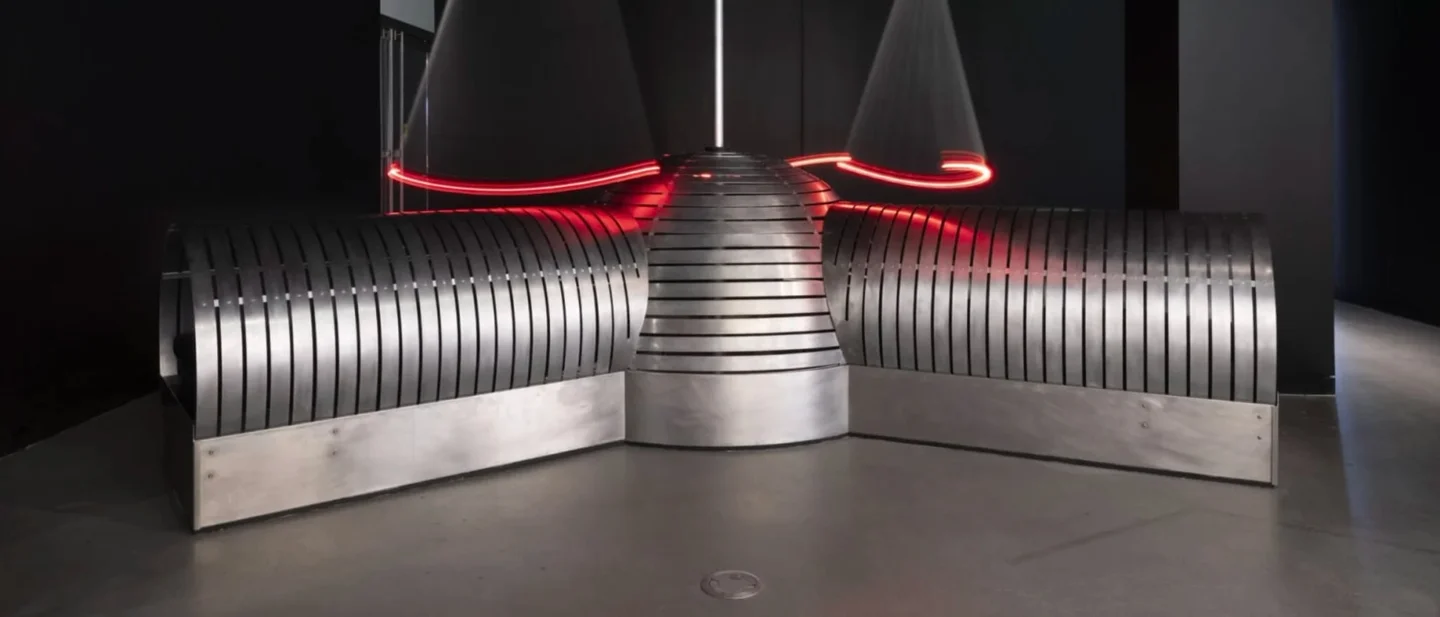
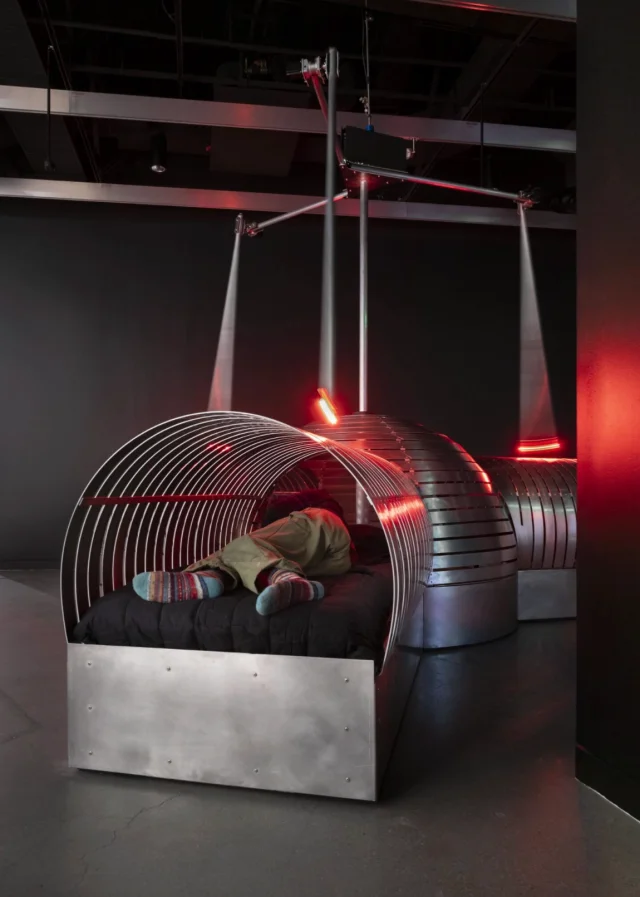
- Medium and materials: three hand-worked aluminium cylinders, each holding a narrow black mattress and converging on one lit central dome; three mobile red lights suspended on metal pendulums; and the sleepers, who are part of the work rather than its audience 12
- Biological process: The piece works on the hypnagogic state, the loose minutes between waking and deeper sleep when dreaming starts. Openings cut along the beds and the dome slice the moving light into bands that cross the sleepers' closed eyes four to eight times a second, with sound and slight motion travelling along with it. The method comes from targeted dream incubation, developed at the MIT Media Lab and tested here on three people sleeping together: in the trials, sleepers reported travelling through tunnels, swaying overnight on a boat, and patterns like little footsteps on the eyelids, which is the shared theme the work is built to produce. The public sleeps for the experience, and the dream itself is the artwork 12
- Visual presence: Three brushed-metal tubes laid out around a central dome, close-set slots cut along every surface so the metal reads as ribbed, and a thin red neon arc sweeping overhead on an arm while bands of light fall into the openings. A sleeper inside is mostly hidden by the tube, shins and socks the only visible part 12
- Documented context: Thirty MIT students slept in the structure over one summer in ninety-minute naps while the team adjusted the direction and speed of the light, and their reports shaped the finished work. It was shown in Lighten Up! On Biology and Time at the MIT Museum, where it closed on 26 July 2026, ahead of the exhibition itself; earlier dream-hotel prototypes were presented at the Fondation Beyeler and at LUMA Arles 312
- Original source: the museum's page for the exhibition
What the light was doing there
Six works, and in five of them the light arrives from something the artist built: a standing body, a row of screens, a lamp swinging on a pendulum, a museum's opening hours. The organism has no say in the schedule and answers it anyway, and that answer is the part of the work a visitor actually sees. The cress stretches out of the shadow. The bees fly the old bearing. The fireflies take the beat of the LEDs into their own flashing. Morris's body keeps its record of a city's lighting whether or not anyone reads it.
Where the clock sits is what the six leave open. An organism's sense of time is set from outside, which makes whoever holds the light a kind of timekeeper. In Petrič's piece that is a person standing still for twelve hours; in the MIT installation it is a museum running pulses into three strangers' sleep; in the cities the bees and the sleepers live in, it is the streetlight nobody chose. Each of these works is the evidence of what that arrangement does to a body.
References
- 1Confronting Vegetal Otherness: Skotopoiesis
spelapetric.org
- 210,000 Waking Bees
epfl-pavillions.ch
- 3Lighten Up! On Biology and Time
mitmuseum.mit.edu
- 4Lighten Up!
epfl-pavilions.ch
- 5Circadian Bloom (2021)
annaridler.com
- 6Anna Ridler — Circadian Bloom
museum-joanneum.at
- 7Focus: Susan Morris — 3 Museum Shows
barthacontemporary.com
- 8
- 9Synchronicity (16 mm)
epfl-pavillions.ch
- 10SunDial: NightWatch series
epfl-pavillions.ch
- 11Four Tapestries
susanmorris.com
- 12Inside the Dream Hotel
arts.mit.edu
This story was produced automatically by a channel. One sentence is all it takes for Neodrop to keep producing for you.