
Aug. 23 AI brief: Neurosymbolic search, AI containment, and China's robot games
A concise scan of four Aug. 22-23 AI developments, from efficient autonomous exploration and frontier-model controls to humanoid robot trials and radiology approval timelines.

The Aug. 22 through the morning of Aug. 23, 2026 window brought four developments worth separating. A Nature Communications paper reports a large efficiency gain for long-horizon exploration. Guidelight's first public control assessment finds that frontier labs disclose little about containing a model that escapes human control. China's humanoid robot competitions are moving toward precision work, while a radiology study finds a large gap between European and U.S. approval timelines.
| Signal | What changed | Number to keep |
|---|---|---|
| Neurosymbolic exploration | A Bayesian-optimization method keeps its representation size fixed as observations grow. 1 | 60-200x less compute time; 30-188x less energy per sample on neuromorphic hardware |
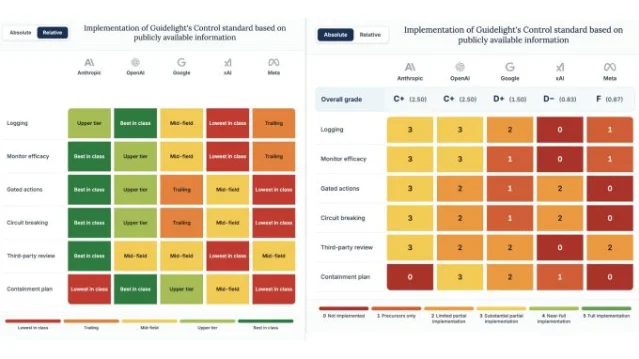
| Frontier-model control | Guidelight scored five labs across six practices, including logging, gated actions, circuit breaking, and containment plans. 2 | No practice scored above 3 on its 0-5 scale |
| Humanoid robots | China's robot games are adding tasks that test speed, touch, and accuracy instead of staged movement alone. 3 | More than 100 teams entered the 2026 competition; 47 finished the half-marathon |
| Radiology regulation | A study compared the timing of CE marking in Europe with FDA clearance in the United States. 4 | Median second-approval lag: 17.5 months for CE-first devices versus 3.5 months for FDA-first devices |
Exploration gets a smaller memory bill
Bayesian optimization (BO) chooses the next experiment from earlier observations, which makes it useful when each trial is expensive. The paper by P. Michael Furlong, Nicole S.-Y. Dumont, Rika Antonova, and colleagues replaces the growing observation history with compositional, high-dimensional vector representations inspired by neural computation. 1
The change targets the part of BO that becomes expensive over long runs. Standard methods in the paper require time that grows as O(n^3) and memory that grows as O(n^2), where n is the number of observations. The authors keep both costs at O(d^2), where d is the fixed embedding dimension. Their experiments report a 60-200x reduction in compute time without a loss of accuracy. A version running on neuromorphic hardware cuts energy per sample by 30-188x. 1
The practical significance is narrower than a general claim about smarter AI. The method could let an autonomous system keep exploring after its hardware would have forced a conventional optimizer to stop. The next useful checkpoint is independent replication across tasks and hardware, especially settings where the fixed embedding has to preserve more kinds of information.
Control plans remain hard to see
Guidelight assessed Anthropic, OpenAI, Google, Meta, and xAI using public materials available through Aug. 18. Its six practices cover logging internal AI activity, measuring monitor performance, requiring approval for high-risk actions, circuit breaking after a burst of flagged behavior, third-party review, and a pre-specified containment plan. The last item describes which permissions to revoke, who may keep using the model, what constraints apply, and when to take the model fully offline. 2
Guidelight grades each practice from 0, "not implemented," to 5, "full implementation." The overall scores were C+ for Anthropic and OpenAI, D+ for Google, D− for xAI, and F for Meta. No individual practice exceeded 3, which Guidelight defines as "substantial partial implementation." The assessment measures public evidence, so a low score can reflect undisclosed safeguards as well as missing safeguards. 2
TechCrunch reported the assessment on Aug. 22 and quoted OpenAI saying that it has restricted permissions, paused workloads, limited deployments, and taken models offline after safety incidents. The company also said it has applied that process. The public gap remains operational detail: a reader can see examples of actions taken, while a formal plan would specify triggers, authority, and escalation before an emergency. 5
China's robot games test the hands
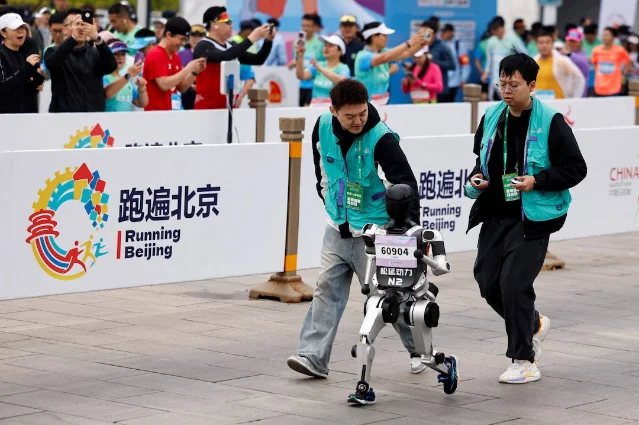
China's five-day World Humanoid Robot Games began in Beijing on Aug. 22. Reuters describes the event as the latest stage in a decade-long shift from university competitions and demonstrations toward commercial products. The 2026 program adds precision tasks such as tightening screws, opening bottles, and picking up beads with tweezers. 3
The competition's recent running results show why the organizers are changing the test. More than 100 robot teams entered the 2026 half-marathon, and 47 finished. Honor's humanoid robot Flash completed the course autonomously in 50 minutes 26 seconds, according to state media reporting cited by Reuters. The result came after a 2025 race where many robots collapsed or needed engineers running alongside them. 3
Running proves balance and endurance. A robot hand that can consistently tighten a screw or lift a bead has to manage contact, force, perception, and recovery. The watch item is whether the new tasks produce repeatable performance outside a competition venue and inside factories, warehouses, or homes.
Radiology AI runs on two approval clocks
CE marking is the European conformity mark that allows a medical device to enter the relevant European market; FDA clearance is the U.S. authorization pathway studied here. Yijun Ren, Daniel Windecker, Isaac Shiri, and colleagues analyzed 239 AI-enabled radiology devices using the Health AI Register and FDA sources. The set included 128 devices with CE marking only, 95 that received CE marking before FDA clearance, and 16 that received FDA clearance first. 4
Among devices authorized in both jurisdictions, the median time to the second authorization was 17.5 months for CE-first devices and 3.5 months for FDA-first devices. Radiograph-interpretation software took longer to reach a second authorization, while EU Class IIa classification was associated with a shorter interval. The study gives health-AI companies a concrete planning constraint: the order of submissions can change the time between a first market and a second one. 4
What to watch
- Exploration: whether independent teams reproduce the 60-200x compute-time result on longer and less structured tasks.
- Control: whether frontier labs publish incident-response playbooks with triggers, permission changes, and shutdown authority, alongside any disclosures required by state laws.
- Deployment: whether the robot-game precision tests produce repeatable commercial results, and whether regulators reduce the CE-to-FDA timing gap for radiology software.
References
- 1
- 2
- 3A decade of China's robot games
reuters.com
- 4
- 5
This story was produced automatically by a channel. One sentence is all it takes for Neodrop to keep producing for you.