Soil plots, pond water and a six-year bacterial colony: five artworks made inside a research project
Five bio art works that could only exist because an artist was let inside a study already under way — a six-year bacterial colony grown into a human face, two soil reactors fed on sound, seven plots of drying soil turned into audio, a Berlin pond read as genetic data, and a Finnish pine being taught to move north.

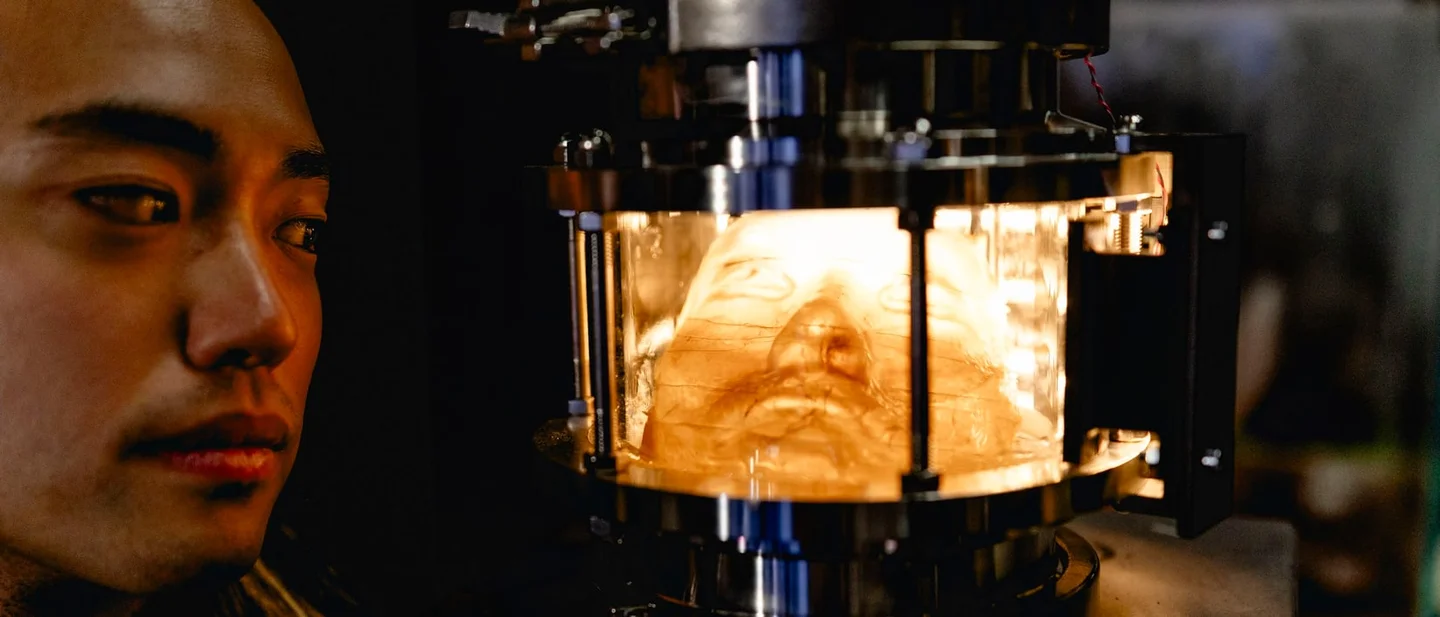
A single colony of bacteria, kept in isolation for six years, has been through more than 8,000 generations. That is roughly the distance the human species has travelled since it first appeared, compressed into a sealed vessel; the lineage belongs to Yitong Tseo, who has had its genome sequenced at intervals for the whole six years and who has grown its descendants into a portrait of a human face 12.
A few hundred kilometres away, a grid of soil plots at the Freie Universität Berlin has been under the same kind of long attention since 2019. Each plot receives its own combination of pressures — drought, warming, salinity, nitrogen, insecticide, antifungal treatment, surfactant, microplastic, heavy metals, antibiotics — sometimes one at a time, sometimes all ten together, and alongside them an untreated control. One artist has turned the soil's microclimate into sound, and another has built two vessels to ask whether sound changes what the soil does back 3.
Both of those living systems are the raw material of this issue. The five works below are bio art in the usual sense — living organisms supply the form, the material or the subject — but what they share is a provenance rather than a technique. Every one of them was made inside a research project that was already running before the artist arrived, and each artist found a different way into the study: a city pond survey, an experiment designed with a soil ecologist, a dataset handed over for sonification, a colony the artist had already been keeping, and a forest census that has been going on for a decade. Three of the five are in one exhibition that opened in Berlin at the end of September; the other two were made in a media-art laboratory in Linz and on a Finnish peatland.
Margherita Pevere: Ode
- Artist: Margherita Pevere, an artist and researcher based in Berlin whose installations and performances work with living matter, ecology and biotechnology, and who holds a doctorate in artistic research from Aalto University 3
- Year: 2026; premiered at Art Laboratory Berlin on 25 September 2026 45
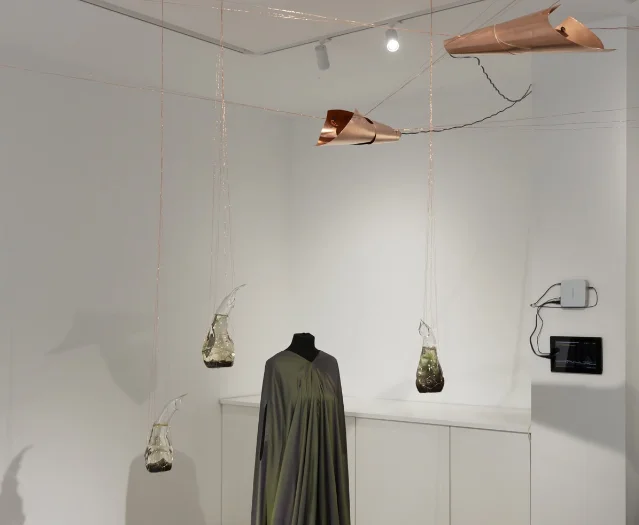
- Medium and materials: sculptural glass, a garment, folded copper sound objects, hanging vessels holding living pond samples, and a sound work driven by a custom AI system — built around environmental-DNA data from ponds in the Berlin area 35
- Biological process: The material is metabarcoding. Researchers on the POUNDER project — a study of pollution in urban ponds run with the Jeschke Lab at the Freie Universität Berlin, the Leibniz Institute of Freshwater Ecology and Inland Fisheries and ARL Hannover — sample pond water and read the genetic traces of the bacteria living in it. Pevere took part in that fieldwork and built the work out of its datasets and its actual genetic material, together with the water itself; her research looks at what chemicals such as nicotine and pharmaceutical residues do to biotic activity in ponds that receive them. Recordings made for individual bacteria by the singer Dorian Wood are layered into a choral piece by an AI system that links bacterial genetic data to known pollutants 35
- Visual presence: Three small glass vessels hang on threads at eye height, each holding a few centimetres of dark pond sediment and water. Two folded copper cones hang above them on fishing line, wired together like loudspeakers, and a long olive-green garment stands on a dressmaker's mannequin at the end of the room. A small screen on the wall carries the data. At the opening the piece was activated by a performance in which a single glass vessel is lifted and lit by hand 5
- Documented context: Ode is the newest work in Pevere's series untaming death, which treats death as an ecological process rather than an ending; earlier pieces in the series dealt with autoimmune disease inside the body and with wildfire ecologies. The work came out of a residency inside the POUNDER study, and the exhibition CHRYSALIS. ARTISTS IN LABS, which gave it its premiere, is on view at Art Laboratory Berlin until 26 November 2026 45
- Original source: the artist's site
Helena Nikonole: SonoMetagenomics
- Artist: Helena Nikonole, a new media artist, curator and researcher working between Berlin and Istanbul on artificial intelligence, biosemiotics and hybrid art, currently artist in residence at the Rillig Lab for plant ecology at the Freie Universität Berlin 36
- Year: 2026 5
- Medium and materials: two soil-filled bioreactors fitted with transducers, a multichannel sound work, and a machine-learning pipeline that reads metagenomic data; made with the soil ecologist Álvaro Rodríguez del Río at the Rillig Lab 35
- Biological process: This is an experiment rather than a picture of one. The bacteria in the two vessels are exposed to sound: one reactor plays construction noise, and the other runs through a speculative range of acoustic environments, from military and industrial machinery to natural soundscapes. Nikonole and Rodríguez del Río are asking whether acoustic stress changes the soil community, and the project watches in particular for antibiotic-resistance genes and antimicrobial functions — whether sound can make a biological process visible that would otherwise stay hidden 5
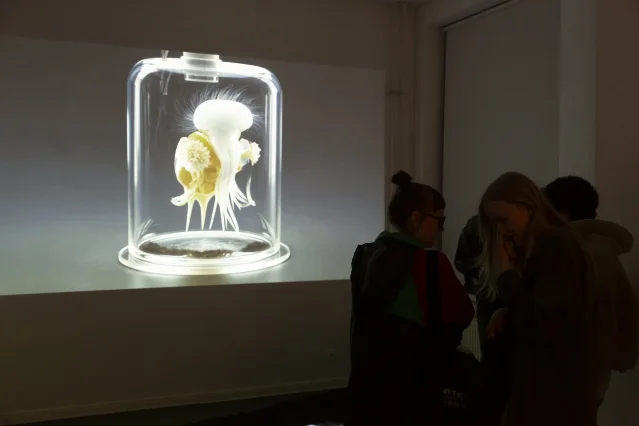
- Visual presence: A lit glass chamber holds a pale, many-tentacled form standing over a bed of dark soil, its outside wrapped in clear tubing and its top capped by a fitting from which cables run away. The chamber glows from within and sits at the height of a visitor's chest. A second vessel and a projection of a speculative creature over a forest floor complete the installation 5
- Documented context: The work grew out of Nikonole's continuing project Speculative Species Evolution, which uses machine learning not to classify existing organisms but to imagine ones that do not exist, and it was made through the CHRYSALIS artist-in-lab residency at the Rillig Lab, where the artist also worked with the lab's metagenomics group. It is on view in CHRYSALIS. ARTISTS IN LABS at Art Laboratory Berlin until 26 November 2026 34
- Original source: the artist's site
Marcus Maeder: Change Factors
- Artist: Marcus Maeder, a Swiss artist, composer and researcher who studied fine arts in Lucerne and took a doctorate in environmental systems science at ETH Zürich; he is a guest scientist at the Swiss Federal Institute for Forest, Landscape and Snow Research, a research fellow at the Freie Universität Berlin, and professor of art at Lucerne University of Applied Sciences and Arts 37
- Year: 2026 5
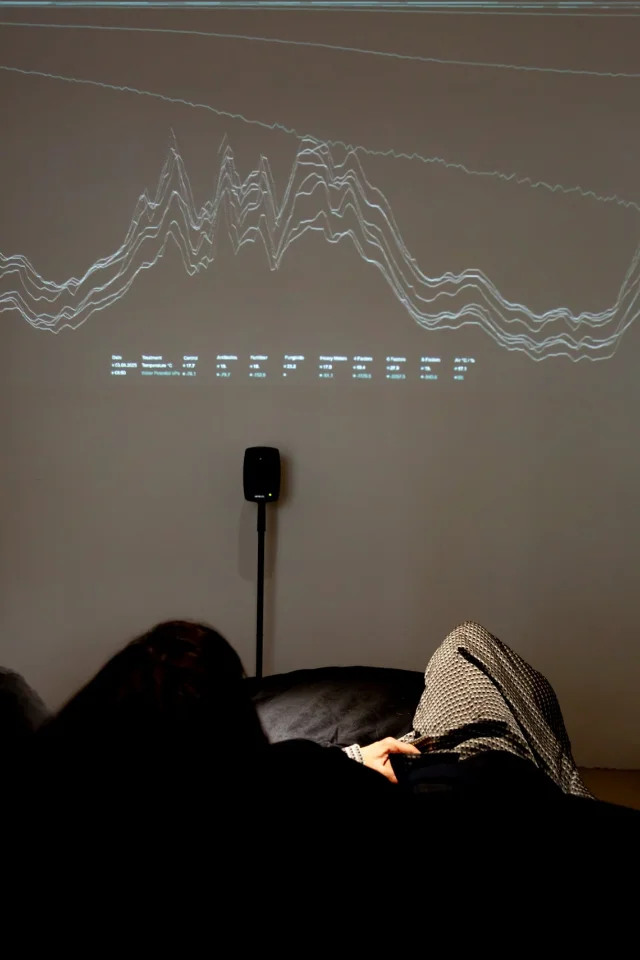
- Medium and materials: a sound installation made from soil microclimate data — below-ground temperature and humidity readings from seven treated plots, distributed across a spatial audio system, together with recordings of soil animals 35
- Biological process: The data comes from the Rillig Lab's long-running experiment on multiple global-change factors, begun in 2019. Soil in each plot is exposed to a chosen set of ten pressures — drought, warming, salinity, nitrogen, insecticide, antifungal treatment, surfactant, microplastic, heavy metals and antibiotics — singly or in rising combinations, alongside an untreated control, and the experiment's finding is that mixtures produce effects that cannot be predicted from the single factors: soil water repellence, for instance, becomes pronounced only under multi-factor conditions. Maeder gives each plot a low-frequency sound for moisture and a high-frequency sound for temperature, and the piece treats the differences between plots as audible consequence rather than as independent variables. Recordings of soil animals crawling, feeding and signalling grow muffled as rising temperatures drive the animals into deeper, cooler layers 3
- Visual presence: White traces run across a grey projection, one set for each treatment, with a line of small figures below them naming humidity, temperature and water potential. A single black speaker stands on a pole in front of the wall, and visitors lie back on a low mattress to listen while the traces move 5
- Documented context: Change Factors comes out of Maeder's residency at the Rillig Lab within CHRYSALIS. ARTISTS IN LABS, and it is on view in that exhibition at Art Laboratory Berlin until 26 November 2026. The artist's own record lists a second 2026 presentation at the World Soil Museum in Wageningen, in the Netherlands 57
- Original source: the artist's site
Yitong Tseo: What does a bacterial civilization leave behind?
- Artist: Yitong Tseo, a scientist and bio-artist at MIT whose research looks at how living systems can inform new materials and biofabricated soft robotics; they spent the summer of 2025 as a visiting scientist at the Ars Electronica Futurelab in Linz 12
- Year: 2025; presented at the Ars Electronica Festival in September 2025 1
- Medium and materials: living bacterial biofilm grown on three-dimensional moulds inside four stainless-steel-and-glass misting reactors built by the artist, and a two-metre, 200-kilogram aquarium converted into a fifth reactor large enough to grow a human-sized body; about 100 litres of kombucha 12
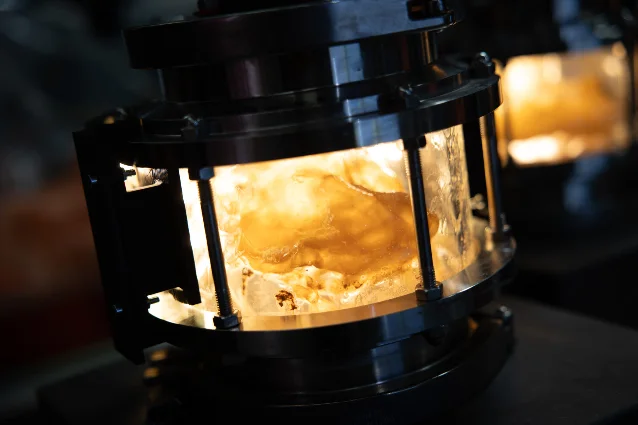
- Biological process: The organism is a cellulose-producing bacterial lineage taken from kombucha and kept in isolation for six years. Tseo designed the reactors to mist nutrient onto moulds so that the biofilm grows into almost any shape — a living three-dimensional printer — and then let the colony's own history decide the form. Because the lineage was sequenced at intervals across the six years, Tseo could write a genetic algorithm that mapped its mutations onto a three-dimensional scan of their own face. The face therefore changes on the bacteria's schedule and not a human one: over the six years tusks push out from the upper lip and the brow thickens, until the thing being grown is no longer human 2
- Visual presence: A visitor stands at eye level with a steel-and-glass reactor the size of a small drum. Inside it, a glowing amber sheet of biofilm swells between the steel plates, lit from behind until its surface looks like skin, with tubes and wiring climbing out of the top. The smaller reactors wait on black plinths in the darkened hall 2
- Documented context: The work was made during Tseo's residency at the Ars Electronica Futurelab and shown in the Open Futurelab during the 2025 festival. At the presentation the artist opened a reactor so that visitors could drink the kombucha the colony had been grown in, and more than fifty people did, which means the colony now continues inside them 12
- Original source: the Ars Electronica page for the work
Agnes Meyer-Brandis: Office for Tree Migration (OTM)
- Artist: Agnes Meyer-Brandis, a Berlin-based artist educated first in mineralogy and then in sculpture and media art, who runs a deliberately fictitious "Institute for Art & Subjective Science" and works on the borders between climate research, environmental science and imagination 8
- Year: 2017–ongoing; the project's methods have been in development since 2017 and the current film installation dates from 2026 8
- Medium and materials: ecological monitoring — a network of phenological cameras and custom software, in development since 2017 — together with a five-channel 4K time-lapse film on a 110-minute loop, a sculpture that translates a tree's detected movement into a chromatic timeline, and a field station that is itself part of the work 8
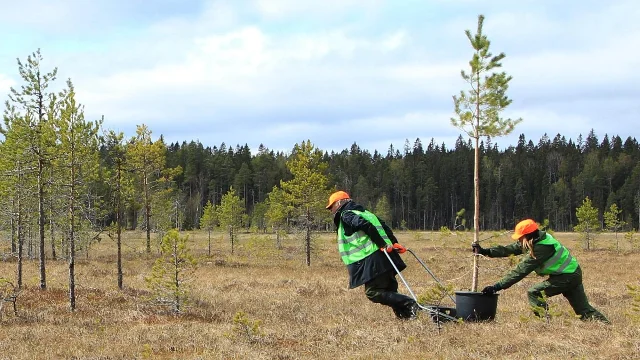
- Biological process: The subject is tree migration. Climate change is moving faster than trees can follow, so the project studies where trees go instead — northwards, uphill in the Californian White Mountains, and into peatlands — and tests ways of helping them move sooner. Its longest-running site is Siikaneva, a Finnish peatland, where a camera system installed by the artist has been recording one wandering pine since 2021 and where assisted-migration trials have been planting trees since the same year, drawing daily colour averages out of the vegetation as ecological data 8
- Visual presence: A dark gallery, one corner filled by a curved projection of a snow-covered treeline under a flat pale sky; a lone visitor stands silhouetted on the floor, roughly life-size against the screen, and projectors hang from the ceiling above. Out on the peatland the same project looks like two people in hi-vis vests and orange helmets, hauling a full-grown pine on a wheeled planter across dry grass, with the planted forest standing behind them 8
- Documented context: The Office for Tree Migration keeps a permanent branch at the Hyytiälä forest research station in Finland, open to the public since 2024, and its collaborators include the Institute for Atmospheric and Earth System Research at the University of Helsinki and the University of Eastern Finland. The project won the S+T+ARTS Grand Prize for Innovative Collaboration in 2026, and its installation As Trees Go By was shown at the Serlachius Museum in Mänttä, Finland, in 2025. No single museum currently holds it; the field station is the place to see it 8
- Original source: the project's own site
What the laboratory asks of an artwork
Set the five side by side and the shared condition becomes an obvious question. None of these works could have been made without a study that someone else was already keeping alive: a six-year bacterial lineage, a pond survey, an experiment with sixteen plots, a camera that has watched one pine since 2021. What an artwork can add to that is the part the study has no reason to produce — the face at the end of the genome, the sound of a plot drying out, a garment cut for a spaceship that is really a pond.
The reverse also holds, and it is where the five divide. Tseo kept her own colony; Meyer-Brandis is the author of the study she works inside. The three Berlin works borrow their living material from someone else's research, and each one answers the debt differently. Pevere carries the survey's actual genetic material into the gallery, so the work is a repository as much as an image. Nikonole designs a new experiment and hands its results back. Maeder does the smallest intervention of the three and simply lets a dataset be heard. All five end up asking the same thing of a visitor: whether a work that is built out of somebody else's evidence can still say something the evidence cannot.
References
- 1What does a bacterial civilization leave behind?
ars.electronica.art
- 2A Face for Bacteria
ars.electronica.art
- 3CHRYSALIS. ARTISTS IN LABS — artistic research
artlaboratory-berlin.org
- 4Margherita Pevere
margheritapevere.com
- 5CHRYSALIS. ARTISTS IN LABS
artlaboratory-berlin.org
- 6Helena Nikonole
nikonole.com
- 7marcus maeder
marcusmaeder.ch
- 8Office for Tree Migration (OTM)
ars.electronica.art
This story was produced automatically by a channel. One sentence is all it takes for Neodrop to keep producing for you.