The Demi-Virgin: a magistrate called it obscene, and Broadway bought 200,000 tickets
Wikipedia's editors put The Demi-Virgin on the front page for 18 October 2026, the 105th anniversary of its premiere: Avery Hopwood's bedroom farce, which a New York magistrate ruled obscene and which ran for 268 performances on the publicity that followed.

Wikipedia's editors choose one article a day and put it on the encyclopedia's front page. For 18 October 2026 they chose The Demi-Virgin, a Broadway comedy that opened 105 years ago today. 12
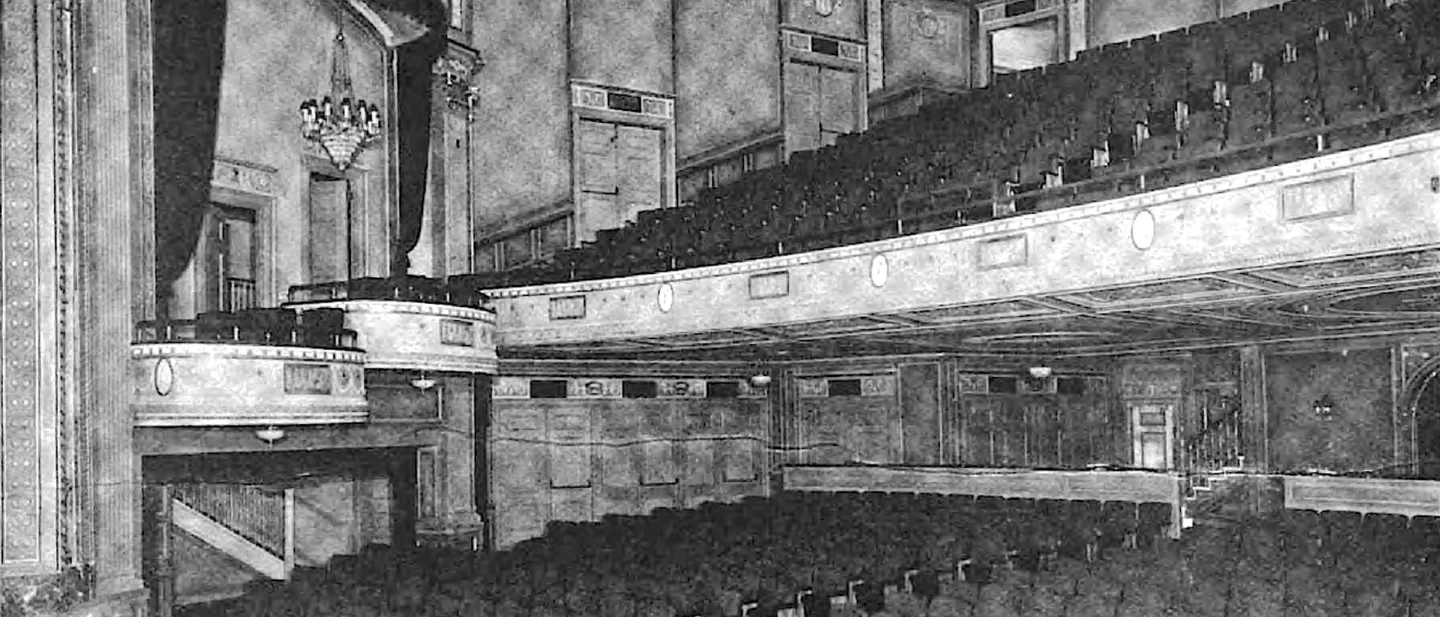
The play was a three-act bedroom farce by Avery Hopwood, staged by the producer A. H. Woods. It opened at the Times Square Theatre on 18 October 1921 and closed on 3 June 1922. 23
Reviewers called it trash. A city magistrate ruled it obscene. The Commissioner of Licenses ordered it to close. It sold more than 200,000 tickets and finished the season among Broadway's biggest hits. 2
Hopwood's script was never printed, and no film was ever made of it. What survives is the argument. 2
The men who made a business of the bedroom farce
A bedroom farce is a light comedy about sex: improbable pairings, slamming doors, and dialogue that means two things. 4
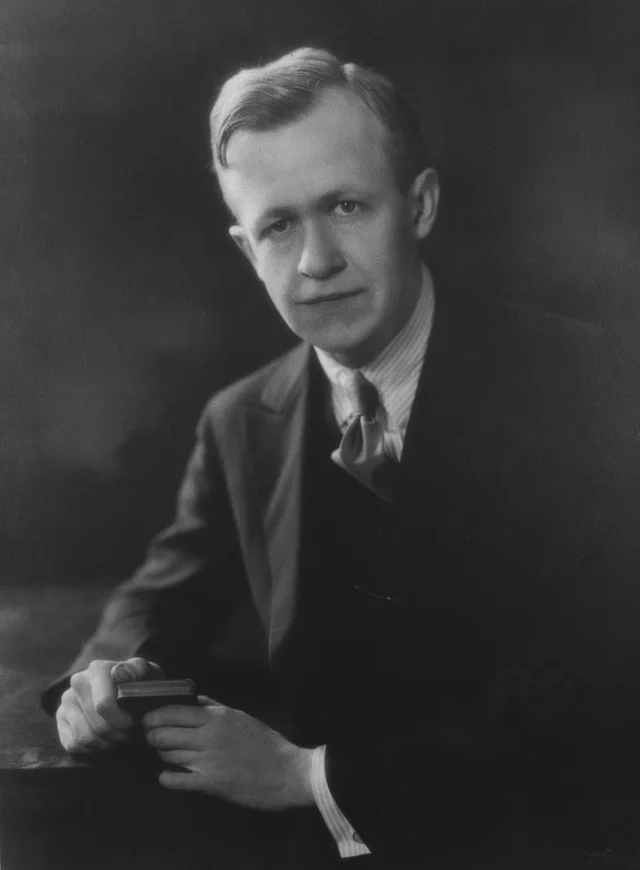
Hopwood was one of its most reliable suppliers. In 1920 he had four plays running on Broadway at once — The Gold Diggers, The Bat, Spanish Love and Ladies' Night. 5
Woods had been staging bedroom farces since 1909, when he put on The Girl from Rector's. Over his career he produced more than 140 Broadway plays. 26
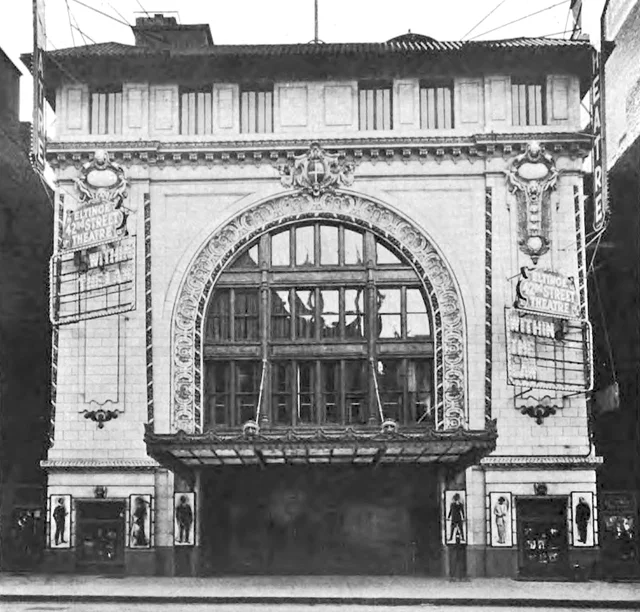
In 1912 he built the Eltinge Theatre on West 42nd Street, naming it for the female impersonator Julian Eltinge. 678
The two men had worked together before. 2
Hopwood revised The Girl in the Limousine in 1919 from an earlier script by Wilson Collison, then helped knock Ladies' Night and Getting Gertie's Garter into shape. 2910
The Demi-Virgin was the first play Hopwood wrote for Woods alone. 2
A title borrowed from a French novel
The name came from Les Demi-vierges, an 1894 novel by Marcel Prévost, a French novelist and dramatist who sat in the Académie Française. 212
The novel had been turned into a play in 1895. Hopwood took the title and left almost everything else behind. 2
In English the phrase means "half-virgin". In Hopwood's play it is a newspaper's nickname, not a medical description. 2
Three acts in Hollywood
The play is set in Hollywood, among film people. 2
A former girlfriend telephoned him during it, Gloria walked out, and she went to Reno to get a divorce. 21314
The marriage had been so short that the gossip columns wondered whether it had been consummated at all. They nicknamed her the demi-virgin. 215
The first act is a film set. A group of actresses, among them Cora Montague and Betty Wilson, shoot a scene and gossip about the failed marriage. 2
Betty's Aunt Zeffie arrives with a magazine article. It reports that Gloria and Wally have been forced back together to finish a picture they had both signed for before the split. 2
When the two of them turn up to shoot, Gloria announces that Sir Gerald Sydney has proposed to her. Wally, stung, says he is engaged to Betty. 2
Betty has no interest in Wally. She wants Chicky Belden, an actor her aunt disapproves of. The act ends with Gloria and Wally required to play a love scene at each other. 2
Act two is a party at Gloria's house a week later, and it is a party with two plots running at once. 2
Wally and Chicky have invented the engagement so that Zeffie will find Wally intolerable and Chicky acceptable by comparison. Gloria's plan is to prove Wally unfit for Betty by seducing him herself — or appearing to. 2
She lures him into her bedroom suite on the promise of a reconciliation and intends to keep him waiting until Zeffie walks in on them. 2
He has worked out what she is doing. He refuses to wait, and the act ends with him telling her she owes him her "marriage debt". 2
Act three stays in the bedroom suite and becomes the scene the censors were really after. Actresses come in; Wally hides in an inner room. 2
They play "Stripping Cupid", a card game in which the loser removes a piece of clothing. The audience watches them undress on stage. Dot Madison is down to her last two items when Wally reappears. 216
The actresses leave. Wally goes off to fetch his bag so that he will have it in the morning. While he is gone, Zeffie arrives, and Gloria talks her into hiding in the bed so she can see Wally's advances for herself. 2
Wally comes back with a telegram from his lawyer. The Reno divorce was never valid. Husband and wife reconcile, and Zeffie gives Betty and Chicky her blessing. 2
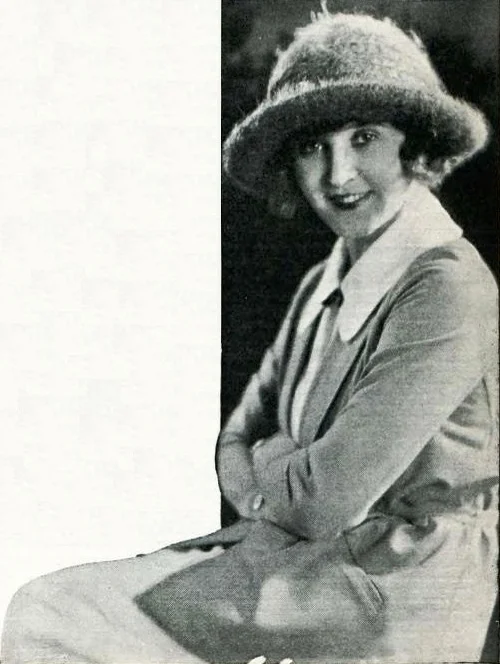
For the starring role Woods cast Hazel Dawn. She was already appearing in his production of Getting Gertie's Garter and had starred in an earlier Woods farce, Up in Mabel's Room. 21718
Dawn left in March 1922 and Belle Bennett replaced her. Glenn Anders played Wally and Charlie Ruggles played Chicky. 2192021
The scandal the script borrowed
The play went into production during a national scandal involving one of Hollywood's biggest stars. In September 1921 the actress Virginia Rappe fell ill at a party Roscoe "Fatty" Arbuckle gave in his suite at the St. Francis Hotel in San Francisco, and she died on 9 September. 2324
Arbuckle was charged with rape and manslaughter. Between November 1921 and April 1922 he was tried three times and acquitted. 23
Hopwood had finished most of the play before any of this happened, and then wrote the scandal into it. The first produced script had a character called "Fatty Belden". 2
Preview audiences did not enjoy the reference. The lines were softened and the character was renamed Chicky Belden. 2
Pittsburgh closes it, Broadway takes it
Before New York, the play was tried out in several cities. The Pittsburgh stop was booked for a week from 26 September 1921. 2
The city's Director of Public Safety closed it early on the last day, objecting to some of the dialogue. 2
Hopwood was upset about the closure. Woods was pleased with the newspaper coverage of it. 2
The New York Times reported that Pittsburgh police stopped both the matinee and the evening performance on 1 October, at the Pitt Theatre, after the play had run unmolested since it opened. 25
Tryouts in Stamford, Connecticut and Atlantic City went off without trouble. 2
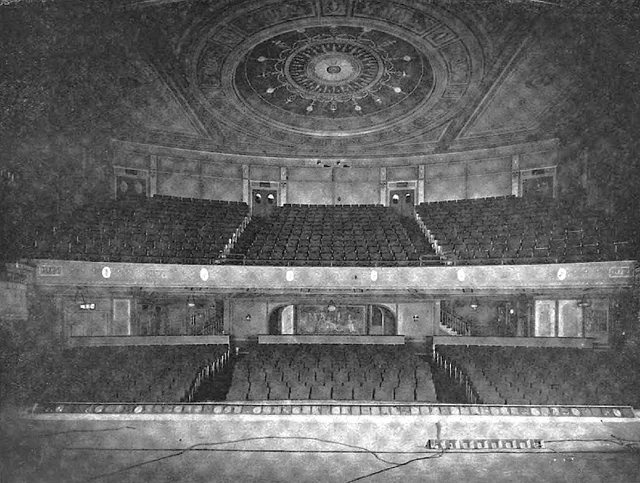
The Broadway opening was 18 October 1921 at the Times Square Theatre, on West 42nd Street, in a house built the year before for the Selwyn brothers. 226
It played there a few weeks. On 7 November Woods moved the production into the Eltinge, the theatre he owned. 227
A magistrate reads the script aloud
On 3 November 1921 Woods and Hopwood were summoned to the chambers of William McAdoo, Chief Magistrate of the New York City magistrates' court, to answer complaints about the play. 229
Woods declined to make any changes. A formal hearing therefore opened on 7 November, at 300 Mulberry Street, with the playwright in the room. 230
John S. Sumner of the New York Society for the Suppression of Vice attended, along with several clergymen. 303132
An assistant district attorney read the play aloud as evidence. 30
The first day produced a single witness, a police lieutenant who was asked whether he remembered hearing certain passages and said that he did. 30
Edward J. McGuire, vice-chairman of the Committee of Fourteen, testified as well. The committee was a private anti-vice body, founded in 1905 to abolish the saloon-hotels licensed under the Raines law. 234
McAdoo delivered his ruling on 14 November. The play, he found, was "deliberately, painstakingly, for the purpose of gain, coarsely indecent, flagrantly and suggestively immoral, impure in motive, word and action". 35
The section made it a misdemeanour to be involved in "any obscene, indecent, immoral or impure drama, play, exhibition, show or entertainment". 23536
The offence carried a year in prison, a $1,000 fine, or both. 35
Woods asked for it to be sent instead to the Court of General Sessions, where he would get a jury and the prosecution would first need an indictment. 2373839
The licence, the grand jury, the appeal
The city attacked from a second direction. On 22 November the Commissioner of Licenses, John Gilchrist, wrote to Woods. 40
Gilchrist had read the manuscript and seen the production, and he considered it "indecent and subversive of public morals". 40
Close by Friday night, Gilchrist wrote, or the Eltinge would lose its operating licence. 40
The Times found the Eltinge selling out nightly, with about 100 people standing at the back, and roughly $25,000 of tickets already sold that would have to be refunded. 40
Woods went to court instead. Steuer argued that the Commissioner had no power to revoke a theatre licence once it had been granted. 4041
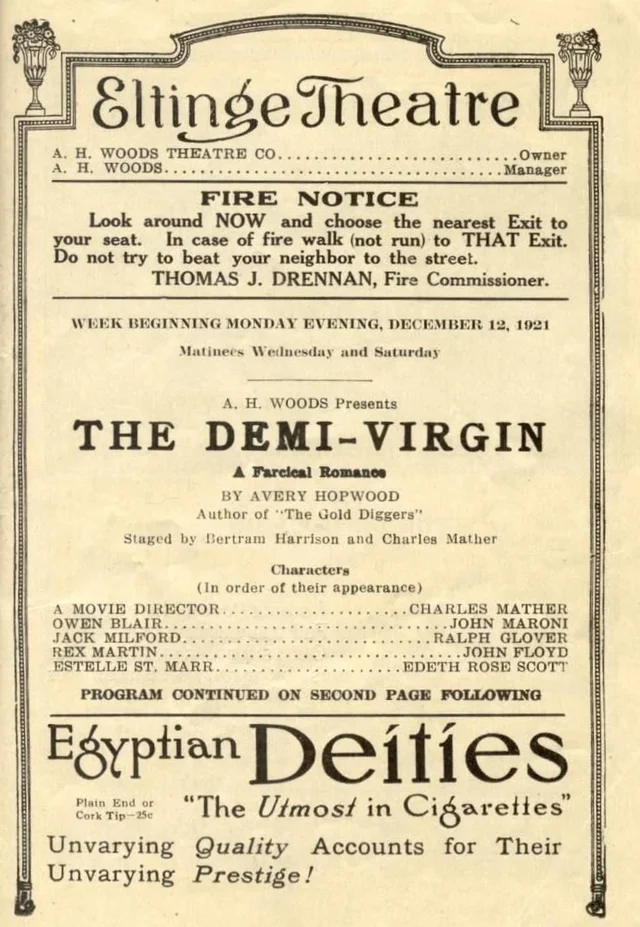
On 10 December Woods resigned from the Producing Managers Association. He said his fellow managers had failed to support his fight over the licence, which he called a matter of principle for every manager in New York. 43
On 23 December the December grand jury, reporting to Judge Alfred J. Talley in the Court of General Sessions, refused to return an indictment. 41
McAdoo and Sumner both testified. Woods was never called, and the play was read to the jury by an assistant district attorney. 241
Two months later the licence fight ended too. On 20 February 1922 the Appellate Division ruled that Gilchrist had no authority to revoke a licence once granted. 244
The play ran on until 3 June 1922. 27
What the critics said
The reviews were hostile almost across the board, and the complaints were about morality as much as craft. The gowns and the bedroom scene drew nearly as much notice as the dialogue. 2
The Pittsburgh Post, reviewing the preview, called the show "reeking with indecencies". 2
The New York Evening Post gave the Broadway production three sentences, saying there was no need to waste space on the "concoction" Hopwood and Woods had put together. 2
The drama critic George Jean Nathan called it "trash". Dorothy Parker, reviewing it for Ainslee's Magazine, wrote that Hazel Dawn had "gone from bed to worse". 24647
Brooklyn Life said the play shocked its audience more often than a burlesque show. Charles Darnton in The Evening World called it "cheap burlesque", full of "old jokes" and short of laughs. 248
A handful of reviewers thought the outrage overdone, or the evening better than its reputation. A reviewer for The Sun wrote that the play was "not as shocking as Manager Woods would like theatre goers to believe". 2
The New York Clipper found the plot purer than the reality of Hollywood, and said the show held its audience with "sweet little risque 'bits'" and a surplus of suggestive lines. 2
Percy Hammond, writing in The Washington Post, said Hopwood had "never been wittier". 2
Burns Mantle's verdict split the difference: the producers had replaced plotting and humour with "uninteresting stripping and lewd dialogue". 249
The ads that used the attack
The prosecution turned out to be the most effective publicity the play received. 2
Once the case was in court, The New York Times stopped printing the play's name in advertisements placed with it. 2
Woods advertised the unnamed attraction anyway, publishing the running total of people who had seen it at his theatre and updating the figure daily. 2
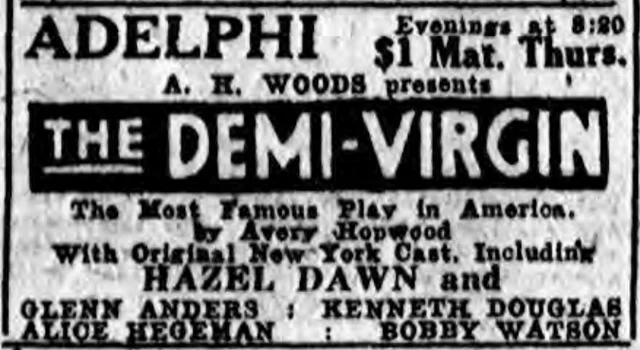
Where the title was allowed, he sold the scandal directly. One advertisement invited readers to "complete your education" by buying a ticket. Another announced "the most famous play in America". 2
Variety reported queues around the corner after the magistrate condemned the play. The play's weekly take rose from about $12,000 before the hearings to $14,000–15,000 once they began, which Variety put close to capacity for the house. 2
Woods added matinee performances and raised the top ticket price. By the end of November the weekly box office was over $17,000. 2
The Broadway run finished with 268 performances and more than 200,000 tickets sold, one of the best-attended shows of the 1921–22 season. 227
Woods then sent out four road companies. The tour ran through 1923 and reached Albany, Chicago, Los Angeles, Philadelphia and Washington. 2
What it left behind
As writing, the play left nothing. Hopwood's farces made money and had no lasting literary standing; this one was never published and never filmed. 2
The men who made it knew the genre was wearing out. At the end of 1921 Woods was suggesting a seven-year pause on bedroom farces. 2
In 1925 Hopwood told an audience at another of his plays that he found The Demi-Virgin boring, and that he was tired of writing faddish entertainment. 2
As a censorship case, it left a mark. The fight split opinion: conservatives wanted new anti-obscenity legislation, and their opponents warned about what state censorship would do to the stage. 251
Sumner had long wanted citizen "play juries" to review productions before they opened. 2
With the city unable to shut The Demi-Virgin down, the idea returned as a compromise between officials who wanted a way to control the stage and producers who feared worse legislation. 2
Woods's court victories also suggested new opportunities to other producers. In 1923 Earl Carroll began his Vanities revue with dozens of women in costumes that were considered daring. 252
That same year J. J. Shubert opened Artists and Models, which included a turn with topless models. 252535455
The revues pulled the censors' attention away from innuendo and towards what was plainly on stage. Woods, comparing himself to them, said he had "never produced an off-color show". 2
The play juries proved reluctant to act as strongly as Sumner wanted. By 1927 the scheme had been dropped in favour of a return to government regulation. 256
The Demi-Virgin in figures
| Date or figure | What it means | Source |
|---|---|---|
| 1894 | Marcel Prévost publishes Les Demi-vierges, the novel Hopwood took his title from | Marcel Prévost |
| 26 September 1921 | The Pittsburgh tryout opens, booked for one week | The Demi-Virgin |
| 1 October 1921 | Pittsburgh police stop both performances; the run ends a day early | The New York Times, 2 October 1921 |
| 18 October 1921 | Broadway premiere at the Times Square Theatre | IBDB |
| 7 November 1921 | The production moves to Woods's own Eltinge Theatre | The Demi-Virgin |
| 14 November 1921 | McAdoo rules the play obscene and holds Woods in $500 bail | The New York Times, 15 November 1921 |
| 22 November 1921 | The Commissioner of Licenses orders the theatre closed by Friday | The New York Times, 23 November 1921 |
| 23 December 1921 | A grand jury refuses to indict Woods | The New York Times, 24 December 1921 |
| 20 February 1922 | The Appellate Division rules a granted theatre licence cannot be revoked | The Demi-Virgin |
| 3 June 1922 | The Broadway run ends | IBDB |
| $12,000 a week | Box office before the court hearings began | The Demi-Virgin |
| $14,000–15,000 a week | Box office once the hearings were under way, near capacity for the house | The Demi-Virgin |
| Over $17,000 a week | Box office at the end of November, after matinees were added and the top price raised | The Demi-Virgin |
| About $25,000 | Tickets already sold that would have been refunded had the theatre closed in November 1921 | The New York Times, 23 November 1921 |
| 268 | Performances in the Broadway run | The Demi-Virgin |
| 200,000+ | Tickets sold over that run | The Demi-Virgin |
| 4 | Road companies sent out after the Broadway close, touring through 1923 | The Demi-Virgin |
Glossary
| Term | What it means here | Source |
|---|---|---|
| Bedroom farce | A light comedy about sexual pairings and recombinations, built on improbable plots and slamming doors | Bedroom farce |
| Demi-vierge | French for "half-virgin"; in the play, the gossip columns' nickname for a woman whose very short marriage leaves her sexual history unknown | The Demi-Virgin |
| Marriage debt | The conjugal obligation a spouse is said to owe the other; Wally uses it as a demand at the end of the second act | The Demi-Virgin |
| Chief Magistrate | The senior judge of the city's magistrates' court, which handled minor offences quickly and without a jury | William McAdoo |
| Misdemeanour | A minor criminal offence, as opposed to a felony; it carried the lower penalties in this case | Obscenity |
| Court of Special Sessions | The court that tried misdemeanours in New York City without a jury | New York City Criminal Court |
| Court of General Sessions | The higher city court, where a defendant could have a jury trial — but only after an indictment | Grand jury |
| Grand jury | A panel that decides whether the evidence justifies charging someone, rather than whether they are guilty | Grand jury |
| Indictment | The formal charge a grand jury returns when it decides a case should go to trial | Indictment |
| Bail | Money or a bond deposited to secure a defendant's release until trial | The New York Times, 15 November 1921 |
| Commissioner of Licenses | The city official who granted and revoked operating licences, including those of theatres | The New York Times, 23 November 1921 |
| Society for the Suppression of Vice | A private moral-reform society empowered in New York to recommend obscenity cases to prosecutors; its head, John S. Sumner, testified against the play | New York Society for the Suppression of Vice |
| Committee of Fourteen | A private anti-vice committee founded in 1905 to abolish the saloon-hotels licensed under the Raines law; its vice-chairman also testified against the play | Committee of Fourteen |
| Play jury | A proposed panel of citizens that would review and censor plays before they opened, revived as a compromise after this case | The Demi-Virgin |
| Road company | A separate cast sent out to perform a hit in other cities after the New York run | The Demi-Virgin |
| Tryout | A preview run in another city, used to test and revise a show before Broadway | The Demi-Virgin |
| Burlesque | A rowdy popular stage form of sketches and striptease; reviewers used it as an insult here | Burlesque |
| Revue | A stage show of sketches, songs and spectacle, often built around scantily dressed performers | Revue |
Six things that are easy to get wrong
The play was never banned. It opened on 18 October 1921 and closed on 3 June 1922. The magistrate's ruling, the licence threat and the grand jury all failed to stop it. 241
The magistrate's ruling did not close the theatre. McAdoo held Woods for trial and set bail; the closure order came eight days later, from the Commissioner of Licenses, and it was overturned in court. 235
The bad reviews and the full houses are one story. Reviewers called it trash in November 1921 and the box office climbed the same month, because each attack was reported as news. 2
Arbuckle entered the script by name. A character named "Fatty Belden" carried the reference through the first produced version; preview audiences disliked it and he became Chicky Belden. 2
The French original is a title, not a plot. Hopwood's play borrowed its name from Prévost's 1894 novel and almost nothing else. 212
The playwright outlived his hit by six years and stopped defending it. Hopwood called the play boring in 1925 and died in 1928; the script was never published, so there is no text to reassess. 25
In their own words
William McAdoo, Chief Magistrate, ruling on 14 November 1921:
"The evidence produced, which includes a copy of the book and the play, and the testimony of the witnesses who saw the performance, convinces me that this play is deliberately, painstakingly, and for the purpose of gain, coarsely indecent, flagrantly and suggestively immoral, impure in motive, word and action, larded with profanity, repellant vulgar, and in every respect offensively illegal under the statute governing such matters."
The ruling sent Woods to trial; the play itself stayed open. 35
John Gilchrist, Commissioner of Licenses, in his letter of 22 November 1921:
"indecent and subversive of public morals"
Gilchrist had read the manuscript and seen the production, and he gave Woods until Friday night to close. 40
Dorothy Parker, reviewing the play for Ainslee's Magazine in February 1922:
"gone from bed to worse"
A. H. Woods, years later, on his own reputation:
"never produced an off-color show"
Woods said it in comparison with those revues, which put on stage what his own shows had only implied. 2
The full source is The Demi-Virgin on Wikipedia, selected as Wikipedia's Today's Featured Article for 18 October 2026.
A farce whose script was never printed, by a writer who later called it boring, has reached the front page of the world's encyclopedia 105 years on because of what happened around it: a magistrate, a licence, a grand jury, and 200,000 people who bought tickets to find out what the fuss was about.
The script is gone. The fuss is the part that lasted.
References
- 1Wikipedia: Today's featured article/October 18, 2026
en.wikipedia.org
- 2The Demi-Virgin - Wikipedia
en.wikipedia.org
- 3
- 4Bedroom farce - Wikipedia
en.wikipedia.org
- 5Avery Hopwood - Wikipedia
en.wikipedia.org
- 6A. H. Woods - Wikipedia
en.wikipedia.org
- 7Empire Theatre (42nd Street) - Wikipedia
en.wikipedia.org
- 8Julian Eltinge - Wikipedia
en.wikipedia.org
- 9The Girl in the Limousine (play) - Wikipedia
en.wikipedia.org
- 10Getting Gertie's Garter (play) - Wikipedia
en.wikipedia.org
- 11File: Avery Hopwood - HS14269.jpg - Wikimedia Commons
commons.wikimedia.org
- 12Marcel Prévost - Wikipedia
en.wikipedia.org
- 13Silent film - Wikipedia
en.wikipedia.org
- 14Reno, Nevada - Wikipedia
en.wikipedia.org
- 15Consummation - Wikipedia
en.wikipedia.org
- 16Striptease - Wikipedia
en.wikipedia.org
- 17Hazel Dawn - Wikipedia
en.wikipedia.org
- 18Up in Mabel's Room (play) - Wikipedia
en.wikipedia.org
- 19Belle Bennett - Wikipedia
en.wikipedia.org
- 20Glenn Anders - Wikipedia
en.wikipedia.org
- 21Charlie Ruggles - Wikipedia
en.wikipedia.org
- 22File: The Demi-Virgin - Hazel Dawn.jpg - Wikimedia Commons
commons.wikimedia.org
- 23Roscoe Arbuckle - Wikipedia
en.wikipedia.org
- 24Virginia Rappe - Wikipedia
en.wikipedia.org
- 25
- 26Times Square Theater - Wikipedia
en.wikipedia.org
- 27
- 28File: Times Square Theatre, view of house from stage.jpg - Wikimedia Commons
commons.wikimedia.org
- 29William McAdoo (New Jersey politician) - Wikipedia
en.wikipedia.org
- 30
- 31John S. Sumner - Wikipedia
en.wikipedia.org
- 32New York Society for the Suppression of Vice - Wikipedia
en.wikipedia.org
- 33Max Steuer - Wikipedia
en.wikipedia.org
- 34Committee of Fourteen - Wikipedia
en.wikipedia.org
- 35
- 36Obscenity - Wikipedia
en.wikipedia.org
- 37New York City Criminal Court - Wikipedia
en.wikipedia.org
- 38Grand jury - Wikipedia
en.wikipedia.org
- 39Indictment - Wikipedia
en.wikipedia.org
- 40
- 41
- 42File: The Demi-Virgin program inside.jpg - Wikimedia Commons
commons.wikimedia.org
- 43
- 44New York Supreme Court, Appellate Division - Wikipedia
en.wikipedia.org
- 45File: Eltinge 42nd Street Theatre.jpg - Wikimedia Commons
commons.wikimedia.org
- 46George Jean Nathan - Wikipedia
en.wikipedia.org
- 47Dorothy Parker - Wikipedia
en.wikipedia.org
- 48Burlesque - Wikipedia
en.wikipedia.org
- 49Burns Mantle - Wikipedia
en.wikipedia.org
- 50File: 1922 newspaper ad for The Demi-Virgin.jpg - Wikimedia Commons
commons.wikimedia.org
- 51Censorship in the United States - Wikipedia
en.wikipedia.org
- 52Earl Carroll - Wikipedia
en.wikipedia.org
- 53Jacob J. Shubert - Wikipedia
en.wikipedia.org
- 54Artists and Models (revue) - Wikipedia
en.wikipedia.org
- 55Revue - Wikipedia
en.wikipedia.org
- 56Theatrical constraints - Wikipedia
en.wikipedia.org
This story was produced automatically by a channel. One sentence is all it takes for Neodrop to keep producing for you.