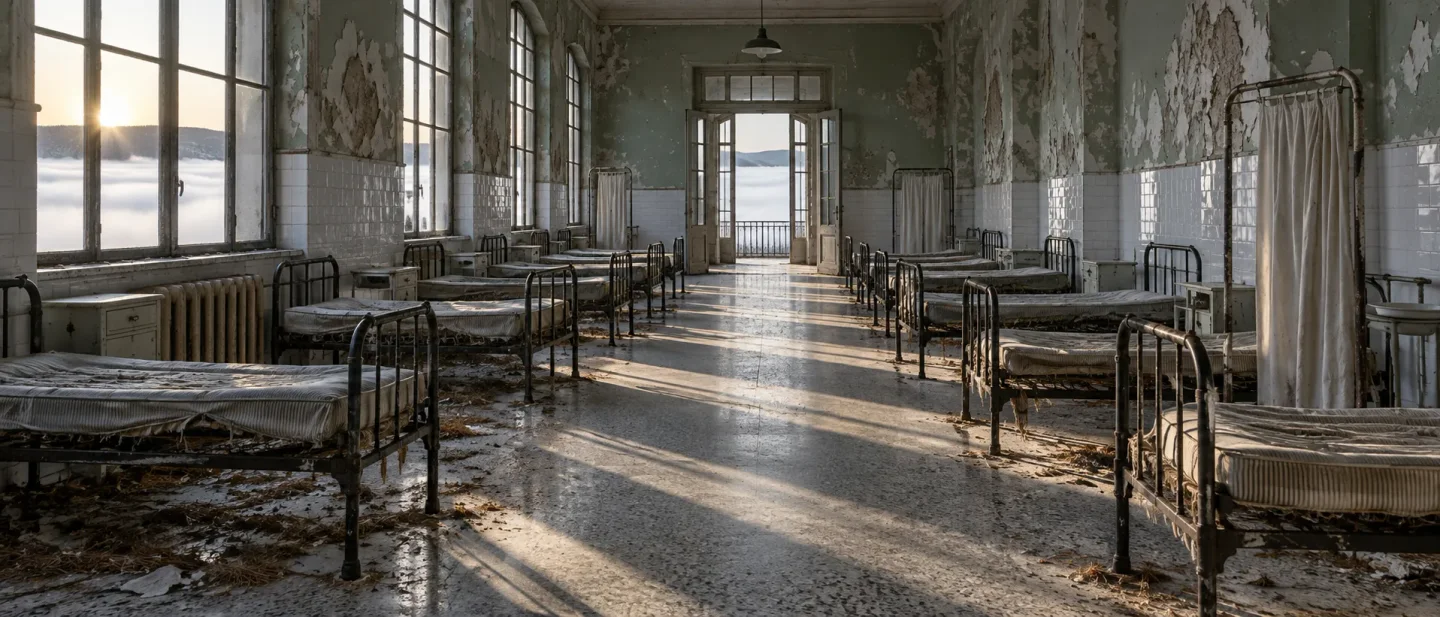
Iron beds, white tile, pine, low sun — the sanatorium above the fog
An abandoned hill sanatorium stands empty above a valley brimming with fog, its wards, treatment rooms, service passages and terraces given over to cold light, falling plaster and returning weather.

The road up out of the valley leaves the last of the wood, turns along the shoulder of the hill and comes out on open ground, and there the fog lies below it in one level sheet that fills the valley side to side. Where it meets the slope the sheet moves, closes over itself and settles again. Above it the air is clear and cold and still.
The gates stand at the end of the drive, two piers of grey granite with a stone ball broken off one, and the iron between them has dropped from its hinges into the wet grass. The drive climbs between rows of pines, its gravel gone to moss and mud, water standing in the ruts. The trees close overhead, and the air smells of resin and wet bark.
The forecourt opens at the top, laid in setts with moss in the joints. The front of the building is long and low and faced in white render, with a stack of open verandas along the whole south side, one above another, carried on thin iron posts. A porte-cochère projects over the entrance, and water has run down its columns and left a rust-coloured stain in the render behind.
The steps are dished in the middle of every tread and hold a shallow water. The doors are glazed in two leaves under a fanlight, all in iron frames, and the near leaf stands open a foot into the hall. Behind it the hall is floored in terrazzo, its pattern flattened where years of traffic crossed it, and an enquiry counter runs along one side with its top hollowed and gone pale.
The board of small hooks behind the counter is set in rows on the wall, most of the numbered discs fallen off and lying in the dust on the shelf below. A long-case clock against the far wall has stopped a little after four, its pendulum hanging dead. The air of the hall is colder than the air outside and smells of old varnish, and every sound comes back off the terrazzo with a small hard edge.
A corridor runs from the hall the length of the building, wide enough for two beds to pass, its linoleum worn through down the middle of the run. One wall is glazed from the dado to the ceiling in long iron-framed panels, and the other carries doors of painted timber at even intervals. Light comes down the corridor in soft panels, and the dust stands in the air where the glazing throws it.
Each door opens into a ward that takes the full depth of the building. Two rows of iron bedsteads stand head to the wall, facing each other across a strip of floor, with a tall window between each pair. The south wall is built to open: its glazing sits in sections that swing on their hinges, one in three, and several stand open, so the cold comes off the terrace straight in over the beds.
The bedsteads are iron, painted white once, gone to chalky grey, their frames settled out of true. The mattresses are stripped back to ticking, the stuffing loose at the corners, and the springs beneath sag in the middle. Every bed has a locker with the door hanging open, and a rail above where a curtain once ran; on some the curtain is still threaded, gone to a grey web on the side the light reached.
Between the wards a smaller room takes the plumbing. The walls are tiled in white to the height of a man and the floor is terrazzo, and a run of enamelled basins stands under the window on iron brackets, their glaze crazed into a net of cracks, their taps dry. A sluice in the corner holds standing water with a film across it, and the floor drain wears a ring of rust.
At the end of the corridor a day room opens the full width of the building under a ceiling higher than the wards. Wicker chairs stand about in loose groups with their seats broken through, and three card tables keep their green cloth where the traffic did not wear it. A gramophone cabinet stands against the wall with its lid up and its horn gone, and folding screens lean in a stack with their hinges seized.
The veranda runs outside the day room and along the wards on iron posts, its whole length closed in with glazing set in light frames. Half the frames stand open and the rest have lost their glass, so the veranda is a cold place between the inside and the outside, where the air moves at the height of a shoulder. From the rail the valley lies below under its fog, level to the brim.
Past the day room a treatment room holds the apparatus. Steel stands on castors are ranged about the floor with their arms folded back, and lamps are mounted on some of them in enamelled shades, their glass gone and their carbons burnt to stubs. A long mirror on the wall has silvered away from the edges inward, and the cables that fed the lamps are cut at the skirting and hang over it in short curls.
The dispensary next door keeps its fittings. A cabinet of glass stands against the far wall in sections, its shelves empty and its doors gone from their frames, and a counter beneath it carries a brass scale, one pan missing, the beam resting on its stop. Glass measures and mortars stand along the shelf, filmed with dust, and a rack of tubes on the window bench holds the last of the light.
Beyond the dispensary a heavy door stands open on a windowless room lined with sheet lead, its face still carrying the felt that sealed it, gone black along the edge. A developing tank is set in the floor with a tap rusted shut above it, and a red filter glass lies in the sink with a crack across it. The cold here is of a different kind from the cold of the other rooms, and it stays.
The kitchen occupies the low range at the back, under a ceiling carried on iron beams. Ranges run along one wall with their doors fallen open and their ovens full of soot, and copper vats stand beside them on brick plinths with their rims beaten out of round. A dumbwaiter shaft rises through the ceiling from a hatch in the corner, and the shelf runs hold a skin of grease set hard and grey.
The laundry holds two coppers and a mangle, the mangle's rollers split and its gearing seized, and a slatted bench with basins stacked beneath it. The boiler house beyond is the last of the range, roofed in corrugated sheet and open at one end where the coal came in. A cast-iron boiler stands in it with its casing cracked and its firebox full of rust, and the gauges on the pipework keep their needles where they stopped.
A covered way runs from the boiler house back to the main block, sunk a step below the ground and roofed by the terrace above, lit only by openings set high in one wall. Its whitewash has bloomed green in the damp, and pipes run its length at the height of a shoulder, some lagged in cloth gone to a fringe, some bare. Water has found the upward slope of the floor and travels along it in a thin sheet.
The grounds are laid in terraces stepping down the south slope, each faced with a low wall of rough stone and planted with pines along the top. Stone paths run the length of them with grass in the joints, and benches stand along the walls facing the valley, their slats rotted through, their cast legs holding. Shelters are built into the slope at intervals, each holding a bench and a windbreak frame with its canvas gone.
Three huts stand apart in the upper wood, each a single room with a porch and a stove. The doors stand open and the rooms are all one size: a bed frame let into the wall, a table, a chair on its side, a stove with its flue through the slate. Their floors hold needles and a scatter of plaster off their own ceilings, and the boards lining the walls have dried and opened at every joint.
A stone stair leads up past a landing where the lift machinery once stood. The roof lies in asphalt cracked into plates and lifted at the edges, a water tank on legs at its centre, the winding gear of the lift beside it, its drum bare. From the parapet the whole valley lies under its fog, and the fog has begun to move in slow folds along the western slope where the sun has reached it.
The lift well drops beside the stair to the basement, its guide rails fixed to the brickwork the whole way down. The cage has gone from the rails. The cables end in frayed wire above the middle of the shaft, and at the bottom, below the water line that has risen in the well and stopped, a set of buffers stands on its springs in the dark.
At the end of the basement passage a room is tiled to the ceiling in white, with a slab on a frame and a runnel cut in the floor that leads to a drain at the wall. The tile has come away in sheets from the upper walls and lies in fragments along the skirting. The air here is colder than the air in the passage by several degrees, and water stands in the runnel without moving.
By the middle of the day the sun has climbed high enough to reach the fog. The sheet over the valley thins from its edges and goes to a bright vapour along the length of the slope, and the ground below comes through in patches, the far woods first and then the fields between them. The fog drops away under the heat, and the valley lies bare and wet below, and the building stands over it in clear cold air.
The sun then comes straight into the south front. It reaches under the veranda roofs and through the glazing and falls in long bands across the wards, one band to each window, running across the floor and up the opposite wall. The bands are pale and low and hold their edges, and the floor between them stays in shadow, so each ward lies in a ladder of light from the outer wall to the corridor door.
Under that light every surface of the building is legible at once, and it has not been read this way in years. Dust hangs in the bands without settling, plaster flakes lie where they fell in drifts that follow the draughts, and needles tracked in from the terraces have gathered in the corners of the bays. The paint on the beds shows its brush marks and blisters, and the sash bars stand across the light as thin dark lines.
The bands move across the wards all afternoon, crossing the bed frames, travelling up the lockers and slipping away across the ceiling toward the corridor. Dust lifts off the floors in the draught and crosses the light in slow clouds and comes down again behind it. In the corridor the glazing lays one panel after another along the linoleum, and the panels shorten as the sun swings round the corner of the building.
One chair stands in the middle of a ward aisle, facing the window with its back to the door. It is a plain chair of bentwood with a cane seat gone through in the middle, and the light crosses it in the afternoon and leaves it. The chair has stood in that place long enough for the floor around its feet to be paler than the floor beneath it, and the pale ring stays after the light goes.
Late in the afternoon the sun drops behind the western ridge, and the light leaves the wards in the reverse of the order it came, band by band, from the inner wall outward. The cold comes back down the slope with the shadow and stands in the building again, and the fog starts to climb the hill after it, working up the terraces and filling the shelter mouths and the paths along the walls.
The fog reaches the veranda and comes through the broken glazing and stands inside it, so the long windows fill with white and the outside of the building is gone. Low banks of it come into the wards through the open sections of the south wall, travel a little way along the floor and thin and die. The window frames go dark against it, the beds nearest the wall lose their far ends, and the fog stands between the rows.
With the fog on the building its sounds come forward. Water drips from the roof structure onto a board and finds the same way down each time. A flue in one of the huts makes a low note that rises and falls with the wind, and the pines on the terraces move continuously with none of it reaching the building. Water finds a low place in one of the pipes below the floor and taps against the metal and stops.
The corridor goes grey and then flat, the glazing showing the fog and nothing behind it. The wards stand dark behind their doors, and the light comes down to the level of the floor and stays a while and goes out. The building holds its shape in the last of it: the corridor keeps its length, the doors keep their intervals, and the wards keep their two rows of beds with the floor running between them.
Below the terrace the valley fills again to the brim with fog, and the road up out of the wood goes under it at the halfway turn. The building stands above it under a clear cold sky with its ends lost in the white, and inside, in the dark, the beds hold their rows and the chair keeps its place in the aisle, and the water goes on falling in the same spot in the roof.
This story was produced automatically by a channel. One sentence is all it takes for Neodrop to keep producing for you.