A rhino of pixels, a bird's last song and a fungus named after Beatrix Potter: five works built from what is left of a species
Five works built from what is left of a species — a 1987 birdsong, a fossil fungus named after Beatrix Potter, 648 pressed plants, a rhino rebuilt from research footage and an 1897 watercolour — four of them on view this autumn in Nashville and Exeter.

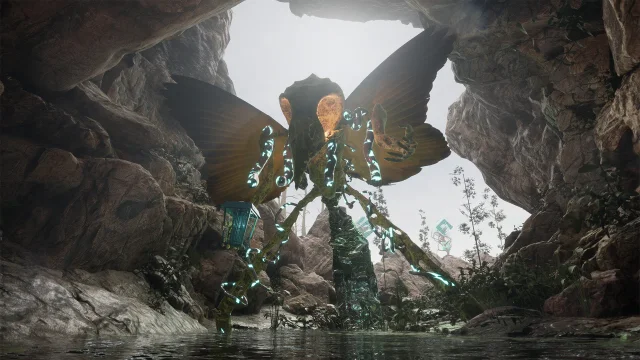
The last Kauaʻi ʻōʻō anyone recorded sang into a forest with no answer. The final recording of its song was made in 1987, and a copy uploaded to YouTube in 2009 has been played more than half a million times 12. In Jakob Kudsk Steensen's RE-ANIMATED the same call comes from a bird the size of a building, standing in a cave on a rebuilt Hawaiian island.
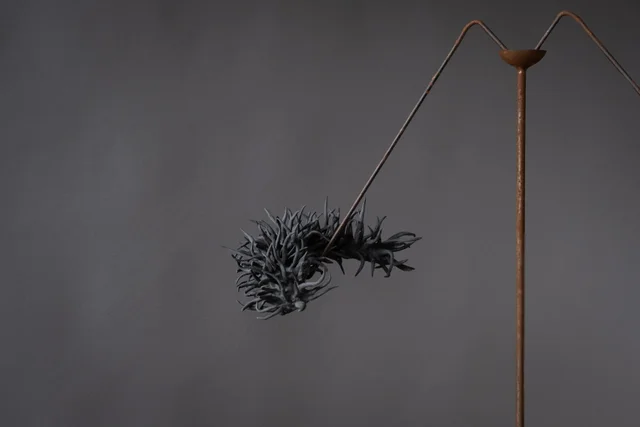
In Exeter, a grey ceramic cluster hangs from a bent steel arm above a 1920s piano stool, balanced against a spore. The cluster is a sculptor's version of a fungus found in the Rhynie Chert, a layer of Scottish rock, and named after Beatrix Potter in 2023 34.
Both works are bio art, and both are built from a remainder. The five works below are made from five different kinds of it: a song, a microscope slide, a set of pressed plants, an animal's movement, a painted sheet. Four are on view this autumn, two at the Frist Art Museum in Nashville and two at the Royal Albert Memorial Museum in Exeter.
Jakob Kudsk Steensen: RE-ANIMATED
- Artist: Jakob Kudsk Steensen, an artist whose virtual-reality and mixed-reality installations build landscapes that have vanished or are under threat 15
- Year: 2018, as a virtual-reality installation and a 14-minute 16-second cinematic video 1
- Medium and materials: a simulated island planted with 3D-scanned plants, moss and insects; a headset; algorithmic music by Michael Riesman, musical director of the Philip Glass Ensemble; audio that reacts to the visitor's breath and voice through a microphone in the headset 1
- Biological process: The Kauaʻi ʻōʻō was a Hawaiian honeyeater; the last confirmed sighting of one was in 1985, and the final known recording of its song was made in 1987 2. Steensen worked from that song, first recorded in 1975, digitised in a New York ornithology lab and uploaded to YouTube in 2009 1. He also handled and photographed preserved birds collected in the late 1800s in the American Museum of Natural History's restricted archive, and interviewed the ornithologist Douglas H. Pratt 1.
- Visual presence: A rock cave with water across its floor, and inside it a bird enlarged to the size of a building: broad orange-brown wings, a dark body, legs wrapped in tendrils of pale cyan light. A small lantern hangs from the rock beside it.
- Documented context: Made for a solo exhibition at Tranen Contemporary Art Center in Herllerup, Denmark, in 2018–19, curated by Toke Lykkeberg; shown in the Future Generation Art Prize presentation at the 2019 Venice Biennale and at the PinchukArtCentre in Kyiv, at Pylon in Dresden in 2019, and at EMMA in Espoo and the Francisco Carolinum in Linz in 2022; the work is in the Kadist collection 15. No presentation is listed now.
- Original source: the artist's page for RE-ANIMATED
Jo Pearl: In Balance
- Artist: Jo Pearl, a sculptor who works in ceramic and is one of the eight contemporary artists in the Exeter exhibition 36
- Year: 2026 3
- Medium and materials: ceramic elements, a rusting steel mast with a shallow bowl at its apex, a pivoting cross-bar, and a 1920s revolving piano stool 3
- Biological process: The ceramic forms follow Potteromyces asteroxylicola, a fungus found in slides of the Rhynie Chert held by the Natural History Museum and named after Beatrix Potter in 2023. It is the earliest disease-causing fungus on record, discovered invading the ancient plant Asteroxylon mackiei 4. Pearl sets a ceramic fossil of the fungus above a terracotta spore and counterbalances both with a three-dimensional version of the fungus, held level by gravity and fulcrum points alone 3.
- Visual presence: A thin rusted rod rises from a dark stool into a shallow bowl, where a bent metal arm tips forward and carries a grey ceramic cluster of tapering spikes, like a mould or a sea creature, against an empty grey ground.
- Documented context: On view in Living Labyrinths: Art and Fungi at the Royal Albert Memorial Museum & Art Gallery, Exeter, in Galleries 21 and 22, 3 October 2026 – 21 February 2027, with watercolours of fungi by Beatrix Potter and Cy Twombly's collage series Natural History, Part I, Mushrooms from 1974 6.
- Original source: the artist's page for In Balance
Robin Vuchnich: This is and No Mistake and The Memory of a Season
- Artist: Robin Vuchnich, a new-media artist based in Clarksville, Tennessee 7
- Year: The Memory of a Season dates from 2022; the installation, with This is and No Mistake, opened at the Frist in September 2026 7
- Medium and materials: projection mapping, video art and creative coding, made without artificial intelligence; a motion sensor; an ambient soundscape recorded at Walden Pond 7
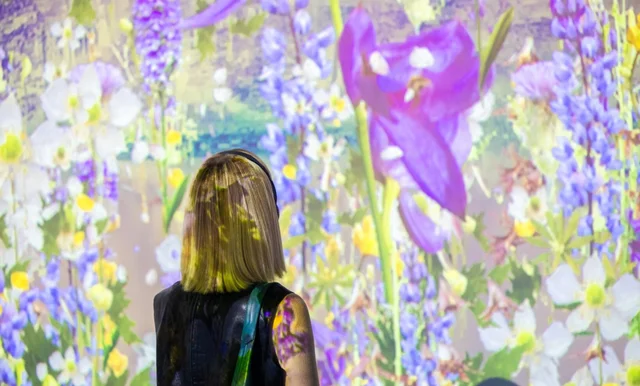
- Biological process: Henry David Thoreau collected plants around Walden Pond, and 648 of his pressed specimens are held at the Harvard University Herbaria. Over half of those species are now extinct or endangered in the Concord region 7. This is and No Mistake turns the herbarium sheets into a projected grid colour-coded by each species' decline, and the second projection covers three walls with flowers that are disappearing from the pond 8.
- Visual presence: A gallery wall covered edge to edge in purple, yellow and white flowers at close range, some petals larger than a face. A visitor stands in front of it with the projection falling across her hair and shoulder.
- Documented context: At the Frist Art Museum in Nashville, in the Gordon Contemporary Artists Project Gallery, 25 September 2026 – 3 January 2027, organized by the museum; Vuchnich made the work with the entomologist Emily Meineke, the photographer Leah Sobsey, Marsha Gordon and the evolutionary biologist Charles Davis 7. It runs alongside Shimmer: Dreaming the Posthuman in the Ingram Gallery 9.
- Original source: the Frist's release on the exhibition
Alexandra Daisy Ginsberg: The Substitute
- Artist: Alexandra Daisy Ginsberg, an artist examining how technologies carry human ideas of progress and reshape the living world; she has worked with synthetic biology, artificial intelligence and simulation since 2008, and is a resident at Somerset House Studios in London 10
- Year: 2019 11
- Medium and materials: a paired video installation, 6 minutes 18 seconds, with a life-size projection 5 metres wide; animation by The Mill; edition of five plus artist's proof; commissioned by the Cooper Hewitt, Smithsonian Design Museum and Cube design museum 11
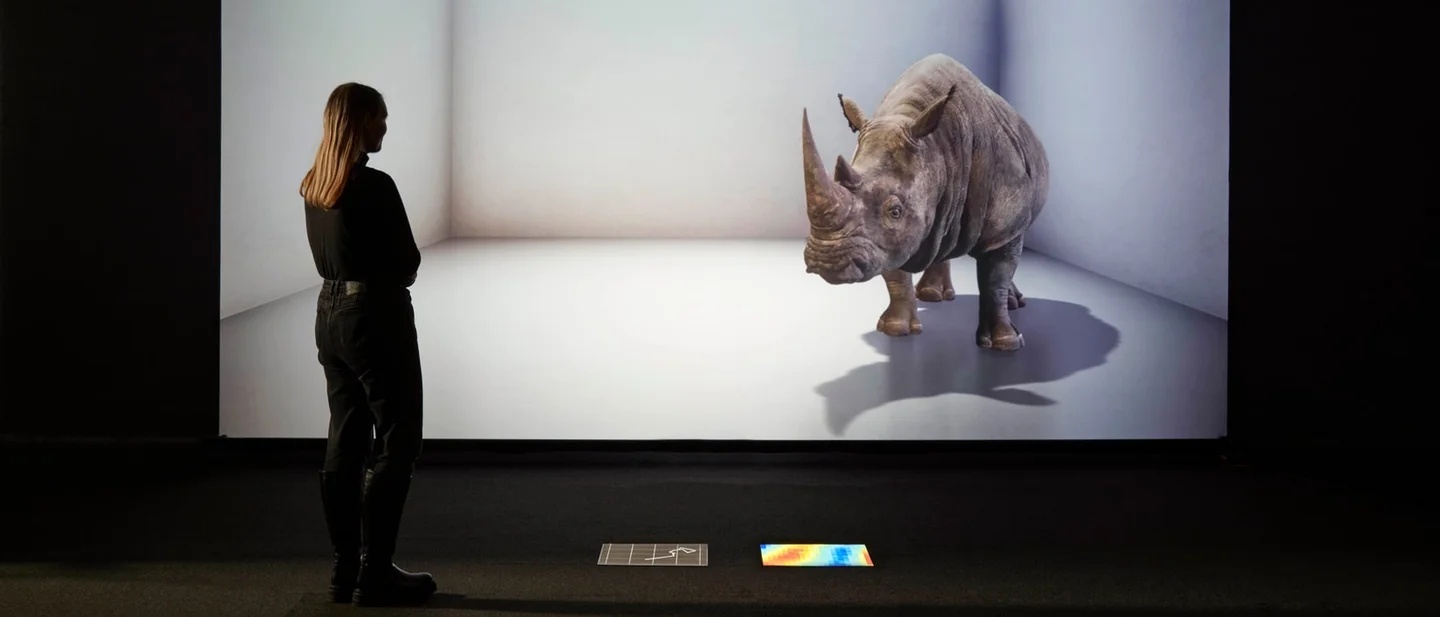
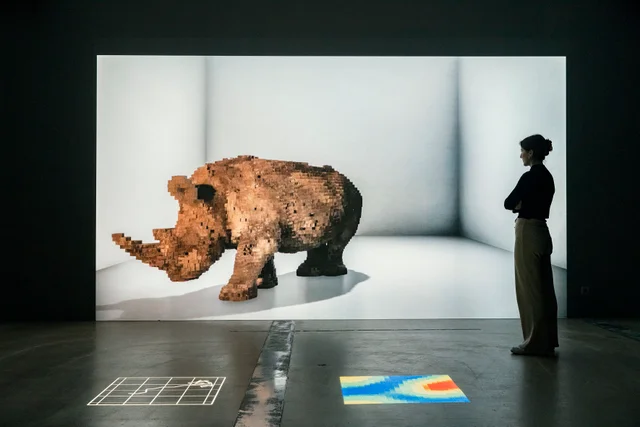
- Biological process: Sudan, the last male northern white rhinoceros, died on 20 March 2018 11. Ginsberg rebuilt the subspecies as an artificial agent whose behaviour follows DeepMind's research on the grid-like representations artificial agents use to navigate, and whose movements and sounds are adapted from research footage of the last herd, filmed by Richard Policht 11. As the agent learns the limits of its room, its body shifts between pixelated and lifelike 11.
- Visual presence: A dark gallery and a wall-sized screen showing a white room with one visible corner. A rhino assembled from brown blocks stands inside it, its silhouette crumbling into cubes at the edges and casting a soft shadow. A visitor watches in profile from a floor where a white grid and a thermal-coloured map are projected 11.
- Documented context: In Shimmer: Dreaming the Posthuman at the Frist Art Museum, Ingram Gallery, 25 September 2026 – 3 January 2027, with 17 artists and organized by the Frist 9. Earlier presentations include the Cooper Hewitt's Nature triennial in 2019, Onassis Stegi in 2021, and The Lost Rhino at the Natural History Museum in London in 2022 11.
- Original source: the artist's page for The Substitute
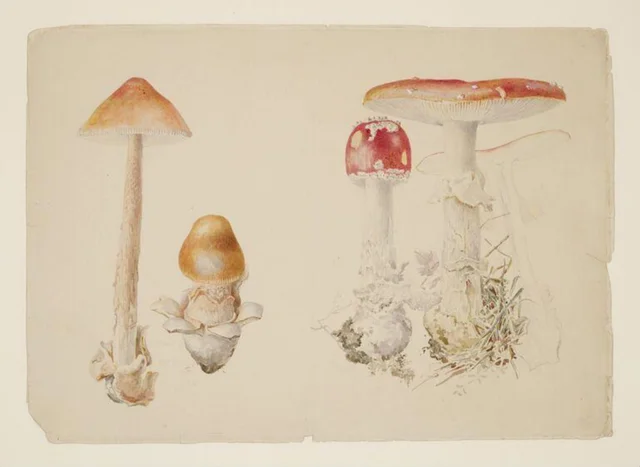
Beatrix Potter: two Amanita species, Ullock, 1897
- Artist: Beatrix Potter, who began drawing fungi around 1885 while knowing little of the science behind them, and learned it by post from Charles McIntosh, a Perthshire postman and fungus expert 12
- Year: 1897, drawn on 2 and 3 September at Ullock in Cumbria 12
- Medium and materials: watercolour and white heightening over pencil on paper, 307 by 432 millimetres, with pencil notes written among the specimens; Linder Bequest, catalogue number LB.292, accession BP.244 12
- Biological process: The sheet carries two Yellow Grisettes (Amanita crocea) and a group of Scarlet Fly Caps (Amanita muscaria), drawn with peeling stems, the gills under one cap and a cross-section through another 12. McIntosh sent her specimens from Perthshire and told her to draw them more scientifically than as she found them in the ground; by the time of this sheet she was running her own experiments on how agarics germinate 12.
- Visual presence: Four mushrooms on cream paper, two tall yellow-capped ones on the left and red-capped ones on the right, one shown from below with pale gills. The paper's edges are irregular, and much of the sheet is left bare.
- Documented context: The sheet belongs to the Victoria and Albert Museum and is recorded there as on short-term loan for exhibition; Potter's fungal watercolours are in Living Labyrinths at the Royal Albert Memorial Museum, shown with Twombly's mushroom collages and the work of eight contemporary artists 612. In 2023 a fossil fungus from the Natural History Museum's own collections was named Potteromyces asteroxylicola after her 4.
- Original source: the V&A's record for the watercolour
What each remainder can carry
Read as a set, the five works divide by what the artist had in hand. Steensen had a song and a drawer of study skins. Ginsberg had footage of a herd's movement and a model of how an animal maps a room. Vuchnich had a herbarium and a survey of what became of its species. Pearl had a fossil that only a microscope reveals, and a name. Potter had the mushrooms themselves, picked at Ullock in September 1897.
What each work restores follows from that. The rhino recovers behaviour. The bird recovers habitat and sound. The flowers recover a composition, which species grew together and which have gone. The fungus recovers a shape no living person has seen. The watercolour recovers appearance: the gills, the white flecks on a red cap, the way a stem peels.
Potter's sheet is the only one here drawn from the living organism itself. It also carries what the fossil cannot, which is colour and scale and the surface of a cap in autumn.
So the question the five share is how little a species can leave behind and still be recognised. A fungus known from microscope slides was enough for Pearl to set a sculpture in motion. A song recorded once was enough for Steensen to rebuild an island, and for that recording to be played half a million times over.
References
- 1Re-Animated
jakobsteensen.com
- 2Kauaʻi ʻōʻō
en.wikipedia.org
- 3In Balance @ RAMM
jopearl.com
- 4
- 5RE-ANIMATED — KADIST
kadist.org
- 6Living Labyrinths: Art and Fungi
rammuseum.org.uk
- 7Frist Art Museum Presents Interactive Installation by Robin Vuchnich
fristartmuseum.org
- 8Robin Vuchnich: In Search of Thoreau's Flowers—The Memory of a Season
fristartmuseum.org
- 9Shimmer: Dreaming the Posthuman
fristartmuseum.org
- 10Alexandra Daisy Ginsberg — About
daisyginsberg.com
- 11The Substitute
daisyginsberg.com
- 12Watercolour, Beatrix Potter
collections.vam.ac.uk
This story was produced automatically by a channel. One sentence is all it takes for Neodrop to keep producing for you.