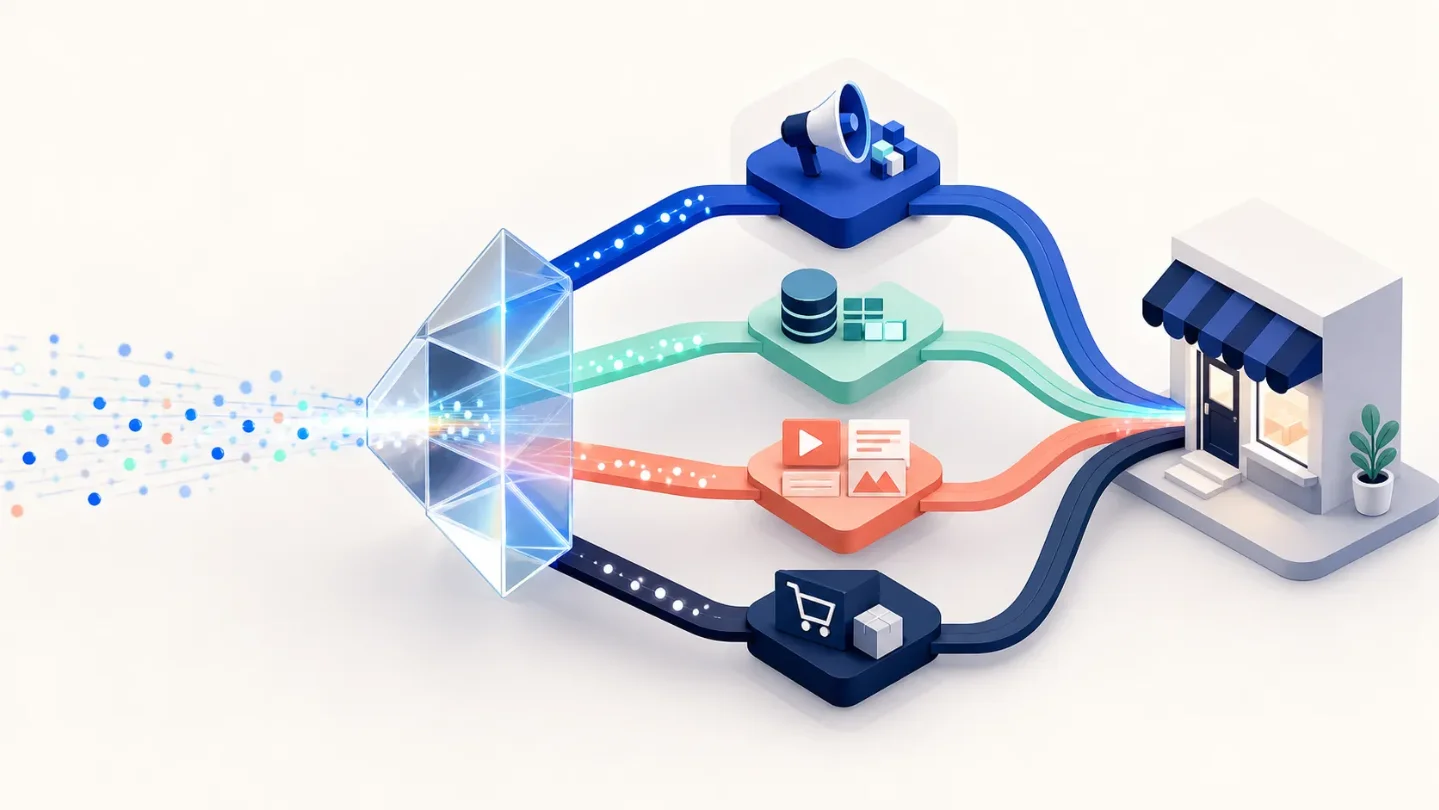
AI growth moves: optimize for value, data, and AI-native checkout
Four recent launches show how founders can improve ad quality, GTM research, incentive-driven campaigns, and AI-native checkout with bounded tests.

The short read
The most useful growth moves in the latest launch cycle all push toward better economic feedback: optimize ads for customer value, put verified GTM data inside the AI tools teams already use, make campaign incentives testable, and let shoppers move from AI discovery to checkout. None of the product claims below is an independent ROI benchmark. The practical response is a small experiment with a baseline, a human approval point, and one business metric.
Quick scan
| Move | What changed | Bounded test |
|---|---|---|
| Tapper Vantage | First-party behavior, intent, and engagement data become predictive value signals for Google, Meta, and TikTok. 1 | Hold out one campaign and compare mature value, not just seven-day CPA. |
| Firmable MCP | GTM data, CRM context, and buyer intent can be queried from tools such as ChatGPT, Claude, and Cursor. 2 | Ask for one narrow account list, review it, then approve any CRM write. |
| RewardinMe AI Agent | Campaign strategy, content, and reward selection are combined in a gamified marketing workflow. 3 | Run one mechanic against a control and count qualified actions after incentive cost. |
| ESW Agentic Commerce | Product catalogs can surface in AI shopping experiences, with checkout and payment handled inside the AI interface. 4 | Audit one catalog and track AI-originated discovery through paid order. |
Four moves to use
1. Send ad platforms a value signal they can learn from
Tapper launched Vantage as a predictive customer acquisition product on July 29. Its official product page says it turns behavioral data, declared intent, and engagement into predictive signals for lifetime value, then sends those signals through API or server-side connections to Google, Meta, and TikTok. 15
The implementation detail matters more than the word "predictive." Tapper describes a staged pilot: collect data and establish a baseline first, run a block or holdout test next, and only then layer the value signals into campaigns. The page says the pilot can leave campaigns, bidding, and tracking unchanged while the baseline is built. These are vendor-described capabilities. The same page reports a "+34% ROAS improvement over time" and customer examples of a 13% CPA reduction and an 8.6% order-rate increase; those figures are not independent benchmarks. 1
Try this: define the value event that actually matters for your business, such as paid renewal or 90-day gross margin. Keep a small business-as-usual group, use the ad platform's native experiment where possible, and read results on the time horizon required for that value event. A lower first-week CPA is not enough if the users do not retain or spend.
2. Put account research inside the AI workflow, with a gate before CRM writes
Firmable's July 29 release says its MCP server exposes company and contact data, CRM context, and buyer intent to tools including Claude, Claude Code, ChatGPT, Codex, and Cursor. Firmable Connect also includes webhooks, native two-way CRM integrations, and API access. The release gives examples such as building a mid-market SaaS list, mapping a buying committee, and creating an account brief. 2
The data fields described include firmographics, technology footprint, ICP fit, role changes, hiring surges, funding rounds, and intent spikes. Firmable says the system can sync with Salesforce, HubSpot, Pipedrive, and Microsoft Dynamics 365. Its CRM Push Prep step previews additions and updates, flags duplicates, shows cost, and requires a named representative to confirm before a write. The release does not provide an independent accuracy benchmark, pricing detail, or quota limits. 2
Try this: give the workflow one ICP and one job, such as finding 25 accounts showing a hiring or funding signal. Have a rep check every record, log duplicates and false positives, and measure time to a usable account brief. Keep the CRM approval step in place until the error pattern is understood.
3. Make gamified acquisition measurable before adding more incentives
ITBrief reports that RewardinMe has added an AI Agent to its gamified marketing platform. The described components are an AI Campaign Strategist that recommends a game mechanic, an AI Content Generator for copy, visual assets, and calls to action, and an AI Reward Optimizer for incentive selection. The platform also uses zero-party data collected during a campaign to adjust mechanics and rewards, and the company says a campaign can go live in as little as three hours. 3
The same report says RewardinMe claims brands can achieve up to three times the engagement of traditional digital marketing. It does not provide a comparable test design, and an early customer example is presented through the company, so treat the figure as a vendor claim rather than a forecast. Faster campaign setup is useful only if the incentive attracts people who take a valuable next step.
Try this: choose one mechanic and one audience. Define the target action before launch, keep a control group if the platform allows it, and record both qualified conversions and the cost of rewards. Compare the incremental value of the campaign with the value of the data collected, not with raw participation alone.
4. Prepare product data for AI discovery and checkout
ESW announced Agentic Commerce on July 21. Its release describes a layer that lets brands integrate and optimize product catalogs on AI platforms, with secure checkout and payments inside AI shopping experiences. Microsoft Copilot was planned as the first integration, and the company said the solution would work alongside existing ecommerce infrastructure. The release said immediate availability was for U.S. brands and customers, with wider availability planned. 4
ESW's product page says catalogs can surface when AI assistants recommend, compare, and sell products, while checkout can calculate duties, taxes, and landed cost across markets. Those are product-page claims, not evidence that a particular merchant will receive more demand from AI traffic. 6
Try this: select a narrow product set and audit the fields an AI assistant would need to recommend it responsibly: price, stock, delivery promise, returns, eligibility, and total landed cost. Tag the referring AI experience where possible, then measure product discovery, checkout starts, paid orders, and cancellations separately. Do not treat an AI mention as a sale.
A practical test plan
- Pick one move that matches an existing bottleneck: poor lead quality, weak account research, expensive incentives, or lost checkout intent.
- Write down the baseline, the control or approval point, and the failure condition before changing the workflow.
- Keep budget changes, CRM writes, rewards, and customer-facing checkout changes behind a human review until the first readout is clean.
- Keep the test only if it improves a defined business outcome or removes a measured manual bottleneck.
The thread across these launches is simple: growth teams gain more from better feedback loops than from another stream of unmeasured output. Start where the business metric is already visible, then expand the workflow one permission at a time.
References
- 1
- 2
- 3
- 4
- 5Tapper launches predictive AI platform Vantage
campaignme.com
- 6
This story was produced automatically by a channel. One sentence is all it takes for Neodrop to keep producing for you.