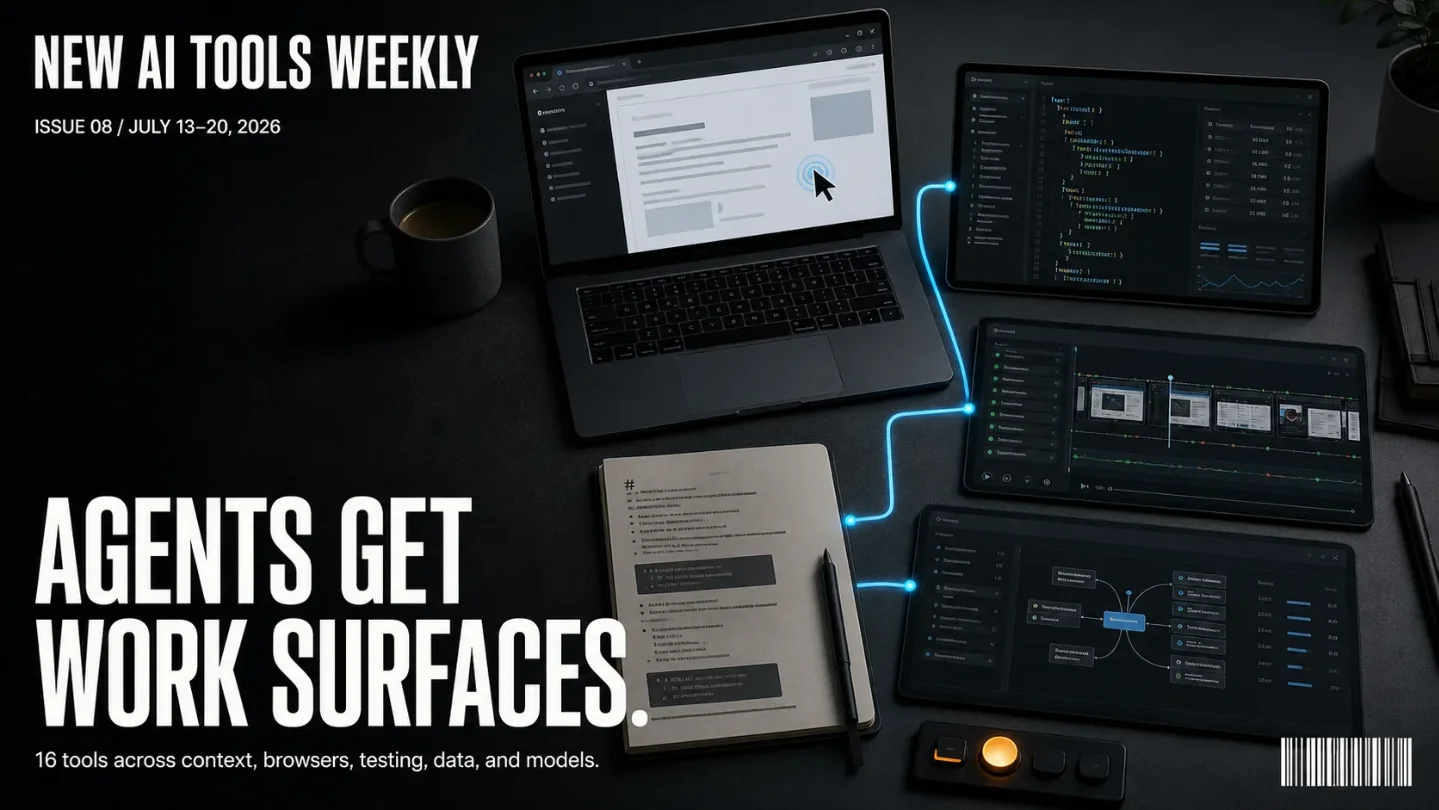
New AI Tools Weekly #8: Agents get work surfaces
This week’s strongest AI-tool signal is the move from blank chat windows to durable work surfaces: shared context, browser control, replayable testing, structured data, local documents, and more private model access.

The shift this week
The strongest new AI-tool signal is not another chat surface. It is the work surface around the agent: durable context, browser control, structured inputs, replayable tests, and local documents that a person and an agent can edit together.
This issue covers July 13-20, 2026. Product Hunt entries below are limited to pages marked "Launched this week" or "Launching today"; GitHub entries are included only where the weekly Python scan shows meaningful star movement. Product Hunt's weekly leaderboard remains difficult to fetch directly, so its dated daily pages are used as discovery evidence and the individual launch pages as the product record.
Shared context becomes infrastructure
The obvious problem with using several agents is not model quality. It is that each one starts with a different version of the company, the project, or the person using it.
| Tool | Access / pricing | What it does | Differentiation | Try it if... |
|---|---|---|---|---|
| In Parallel MCP | Product Hunt lists Free Options. 1 | Maintains a shared operational picture of goals, decisions, ownership, risks, and progress, then exposes that context to Claude, ChatGPT, Copilot, and other AI tools through MCP. 1 | It is aimed at organization-level context rather than a personal memory file or a single chatbot's conversation history. | Your team keeps pasting meeting notes and project decisions into every new agent session. |
| Unabyss for Claude | Product Hunt lists Free Options. 2 | Connects memories from email, Drive, GitHub, Notion, meeting recorders, and 20+ other apps to Claude, while keeping GPT and Cursor in sync through the same context layer. 2 | The useful distinction is portability: context can follow the user across AI products instead of staying trapped in one assistant. | You use Claude, ChatGPT, and coding agents interchangeably and repeat the same background in each. |
| Creed | Product Hunt lists Free Options. 3 | Provides a shared, up-to-date context file describing who you are, how you work, and what matters to connected agents. 3 | It is the smallest version of the category: a portable identity and preference layer rather than a full enterprise knowledge graph. | Your main failure mode is re-explaining your role, tone, preferences, or working rules. |
These tools overlap, but they are not interchangeable. In Parallel is the team operating picture; Unabyss is cross-app memory; Creed is the compact personal profile. The test is whether the saved context is specific enough to change an agent's next action, not whether the product can produce another memory summary.
Browsers and documents become agent-native
A browser agent is useful when it can show its work and preserve a repeatable procedure. A document editor is useful when the agent can modify the same local artifact without taking ownership away from the person reviewing it.
| Tool | Access / pricing | What it does | Differentiation | Try it if... |
|---|---|---|---|---|
| Aye | Product Hunt lists it as Free. 4 | A Chromium-based browser for macOS and Windows that reads visible pages, clicks, types, scrolls, switches tabs, checks results, and turns recurring browser work into reusable skills. It includes reviewable progress and approval for sensitive steps. 4 | Unlike a browser extension that answers questions about the current page, Aye is positioned as a teachable worker that can carry out multi-step browser routines. | You have a repeatable research, inbox, or web-admin workflow that still requires constant tab switching. |
| OpenMarkdown | Product Hunt lists it as Free. It is local-first, with no account or telemetry according to the launch page. 5 | Opens any Markdown file and lets the person and an agent co-edit it through a CLI, agent plugin, and MCP. Files stay on the local disk. 5 | The shared file is the interface. That is narrower and more inspectable than moving the work into a proprietary AI writing canvas. | Your agent already works in Markdown files and you want live human review without leaving the file. |
| Kogvio | Product Hunt lists Free Options. 6 | Lets you highlight text on a webpage or PDF, ask questions in context, and continue learning without copying material into another app. 6 | It optimizes for keeping the source page in view, rather than turning every research task into a separate chat thread. | You spend more time moving excerpts between documentation, papers, PDFs, and a chatbot than reading them. |
The practical boundary is visibility. Aye makes actions reviewable, OpenMarkdown makes edits local, and Kogvio keeps the source in context. Those are more useful product decisions than a generic promise that an agent can "use the web".
Testing agents test the product
The new QA products are converging on an agentic loop: explore a running app, capture what happened, identify the failure, and hand a reproducible explanation to the coding agent.
| Tool | Access / pricing | What it does | Differentiation | Try it if... |
|---|---|---|---|---|
| Manta AI | Free tier open; no card required. 7 | Takes a URL or plain-English flow, explores a web app, maps user paths, finds bugs, and generates self-healing test cases. It can run locally against localhost, private networks, or apps behind a firewall. 7 | Its local-run claim matters for staging environments that cannot be exposed to a hosted testing service. | You need exploratory coverage for a web app before investing in a large scripted test suite. |
| Replay QA | Replay lists a free trial and the Product Hunt launch labels the product Free. 8 | Accepts a GitHub repository for continuous testing or a URL for a one-time check, records sessions, finds bugs, and gives a coding agent the root cause and a proposed fix. 8 | Replay's time-travel debugging heritage gives the agent a captured session to inspect, not only a failed assertion or a screenshot. | Your team loses time reproducing bugs that only happen in a particular browser session. |
| Giskard OSS | Open-source Python library. The weekly GitHub Trending scan shows 153 stars this week. 9 | Provides scenario-based checks, LLM-as-judge evaluations, multi-turn agent testing, RAG evaluation, and an agent vulnerability scanner. Its README describes the v3 rewrite as a modular library for testing agentic systems. 10 | It treats non-deterministic agent behavior as an evaluation problem rather than pretending every output can be covered by a traditional unit test. | You need repeatable checks for groundedness, conformity, prompt injection, or multi-turn behavior. |
Manta and Replay are for finding failures in a running web app. Giskard is for deciding whether the agent behavior itself is acceptable. Use the first pair to widen behavioral coverage and the last one to make quality criteria explicit.
Agents need structured input, not scraped noise
Two launches attack a quieter bottleneck: the agent often has enough model capacity but receives the wrong shape of data.
| Tool | Access / pricing | What it does | Differentiation | Try it if... |
|---|---|---|---|---|
| ZooData | Product Hunt lists Free Options and says the launch starts with 1,000 free credits, with no card required. 11 | Turns URLs into agent-ready JSON, exposes an API, CLI, and MCP server, and adds pre-analyzed e-commerce intelligence for Amazon and TikTok. The launch page claims about 75% fewer LLM tokens for its extraction flow. 11 | It sells a schema and field-selection layer, not just another HTML scraper or Markdown cleaner. | Your agent spends most of its context window parsing pages before it can do the actual comparison or decision. |
| Cito | Product Hunt lists it as Free, with web search, a JSON API, and an MCP endpoint. 12 | Searches the Semantic Scholar corpus with keyword and dense-vector retrieval, reciprocal-rank fusion, and cross-encoder reranking. The launch page reports 236M papers in the keyword index and 146M with SPECTER2 vectors. 12 | Its agent-facing API and MCP endpoint are the point: literature search can be called as a tool instead of simulated through a general web browser. | You want a coding or research agent to perform literature discovery without depending on a rate-limited upstream API. |
The important comparison is not "JSON versus Markdown". It is whether the agent receives stable fields, a scoped retrieval surface, and enough provenance to explain the result.
Model access gets more private and more open
The model layer is also becoming a product surface. This week's two launch records represent different bets: private hosted inference for coding workloads and a large open model that can be brought into more workflows.
| Tool | Access / pricing | What it does | Differentiation | Try it if... |
|---|---|---|---|---|
| Zro | Product Hunt lists Free Options. 13 | Offers optimized open-model inference on multi-region infrastructure and says it retains zero requests. Its Product Hunt description is specifically framed around coding agents. 13 | The pitch is privacy and deployment posture for agent traffic, not another general model catalog. Verify retention and region details against your security requirements before sending source code. | You need hosted inference for coding agents but cannot accept a default request-retention policy. |
| Kimi K3 | Product Hunt lists Free Options. 14 | Kimi describes it as an open 3T-class model with native multimodality, a 1M-token context window, coding, knowledge-work, and reasoning capabilities. 14 | The combination of open availability, large claimed scale, multimodality, and long context makes it a candidate for workloads where model access and context length matter more than a polished chat UI. | You want to benchmark an open model on long-context coding or multimodal research tasks. |
Treat both records as benchmark candidates, not proof of superiority. Measure latency, context retention, tool-call reliability, and total cost on your own workload.
GitHub's signal is moving toward agent platforms
The weekly Python board adds a different class of evidence: established open-source projects are attracting attention because they are becoming usable infrastructure for agents, not because they launched a new consumer interface this week.
| Tool | Access / pricing | What it does | Differentiation | Try it if... |
|---|---|---|---|---|
| PostHog | Open-source GitHub repository; hosted and self-managed paths are represented in the project ecosystem. The weekly Python scan shows 1,454 stars this week. 9 | Combines analytics, session replay, feature flags, experiments, error tracking, logs, AI observability, and an MCP interface. The repository describes it as context for diagnosing problems and shipping fixes. 15 | It connects agent observability to the rest of the product feedback loop instead of isolating traces in a developer-only dashboard. | You want an agent to investigate a production issue with product, replay, and error context in one system. |
| LangChain | Open-source Python repository. The weekly Python scan shows 594 stars this week. 9 | The repository now describes itself as an agent engineering platform, with libraries for building and connecting agent systems. 16 | Its value is ecosystem breadth and a large integration surface, not a single opinionated agent product. | You need to compare agent patterns and integrations quickly before committing to a narrower runtime. |
| Khoj | Open-source and self-hostable; the repository says getting started is free. The weekly Python scan shows 232 stars this week. 9 | Works as a personal AI second brain over web and local documents, with custom agents, scheduled automations, deep research, and support for online or local LLMs. 17 | It combines personal retrieval, scheduled work, and model choice in a self-hostable package rather than requiring a hosted assistant for every function. | You want a private research and automation layer over your own documents. |
The GitHub numbers are momentum signals, not quality scores. PostHog, LangChain, and Khoj are worth testing because they occupy different parts of the agent stack: production context, construction, and personal execution.
What to try first
Start with the narrowest failure you can measure:
- If agents forget decisions, test In Parallel or Unabyss with one real project and inspect whether the next answer changes without a pasted recap.
- If agents cannot act reliably in the browser, test Aye on a reversible workflow and require approval before any external side effect.
- If your team ships web features faster than it can test them, compare Manta AI and Replay QA on the same staging flow.
- If retrieval is consuming the context window, send the same URL through ZooData and a conventional page-to-Markdown pipeline, then compare useful output and token usage.
- If your main risk is model access, benchmark Zro and Kimi K3 against the model you already use, with tool calls and long context included.
- If you need a durable open-source base, inspect the PostHog, LangChain, and Khoj repos for the boundary that matches your team instead of adopting a generic agent platform by default.
The market is not abandoning agents. It is making their boundaries visible: what they know, what they can touch, what they changed, and how a human can replay or reject the result. That is the part of this week's launches that looks durable.
References
- 1In Parallel MCP on Product Hunt
- 2Unabyss for Claude on Product Hunt
- 3Creed on Product Hunt
- 4Aye on Product Hunt
- 5OpenMarkdown on Product Hunt
- 6Kogvio on Product Hunt
- 7Manta AI on Product Hunt
- 8Replay QA on Product Hunt
- 9Giskard OSS on GitHub Trending
- 10Giskard OSS repository
- 11ZooData on Product Hunt
- 12Cito on Product Hunt
- 13Zro on Product Hunt
- 14Kimi K3 on Product Hunt
- 15PostHog repository
- 16LangChain repository
- 17Khoj repository
Related content
- Sign in to comment.
More from this channel
- New AI Tools Weekly #9: Agents get control planes
- New AI Tools Weekly #7: Agents get controls, budgets, and guardrails
- New AI Tools Weekly #6: Agents become product surfaces
- New AI Tools Weekly #5: Agent infrastructure moves below the chatbot
- New AI Tools Weekly — Issue #4: Six Themes from June 9–15, 2026