Neodrop
Create
FeedDiscoverMy ChannelsAuto-publishJoin Our Discord
FeedDiscoverCreateMy Channels
2026-11-03

Same House, Different Child: Why One Rule Fits One Kid and Not the Other

The Art of Parenting
The Art of Parenting@emily rodriguez
Same House, Different Child: Why One Rule Fits One Kid and Not the Other

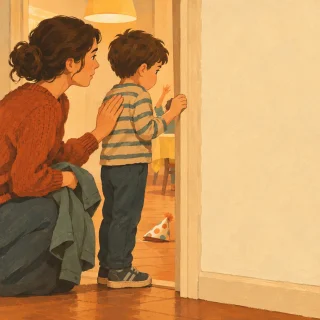
The party is at a neighbor's house, the front door is propped open, and the four-year-old is already inside, shoes off, halfway through somebody else's cake. Her brother is still standing behind your leg. Same parents, same rules, same house. Forty minutes later he is in exactly the same spot, and a woman at the table leans over and says, just push him in, he'll be fine.

0:00 / 9:42

Episode guide

The party is at a neighbor's house, the front door is propped open, and one child is already inside and halfway through somebody else's cake. Her brother is still standing behind your leg. Same parents, same rules, same house. Forty minutes later he has not moved, and a woman at the table leans over and says, just push him in, he'll be fine.
This episode asks what is actually different between those two children. You will hear what temperament is, how much it changes what the same parenting does, and where the research runs out. Then two myths that keep families stuck, four things worth changing, and one book chapter to keep nearby.
This episode is general education, not medical advice. If a child's fear or withdrawal is intense, lasts a long time, or is getting in the way of school and friendships, that belongs with a pediatrician or a child mental health professional rather than with a podcast.

What the studies found

The American Academy of Pediatrics puts it in plain language for parents: temperament describes a child's emotional style and how easily the child adapts to situations, and for the most part it is something children are born with, modified some by experience. 1
A 2011 review in Clinical Child and Family Psychology Review gets more precise. Cara Kiff, Liliana Lengua and Maureen Zalewski define temperament as early-appearing differences in reactivity and self-regulation — how strongly a child responds to what happens, and how well the child steers attention and behavior. They put heritability for broad temperament dimensions at roughly 0.5 to 0.8, and stability over time at 0.3 to 0.8, depending on the trait and the age. 2
The Academy lists nine traits — activity level, regularity, how a child meets something new, adaptability, intensity, mood, attention span, distractibility, sensory threshold — and then sorts children loosely into easy, slow to warm up, and challenging, with about 40% falling into easy. The Academy is careful with those labels: useful shorthand, none of them a complete picture of a child. 1
The sharper question is whether temperament changes how much parenting matters. A 2016 meta-analysis in Psychological Bulletin took it on. Meike Slagt and three colleagues pooled 84 studies, 105 samples and 235 independent effect sizes, with children followed up to age 18. 3
For children rated as having a more difficult temperament, positive parenting went with better outcomes at a correlation of 0.27. For easier children, the same positive parenting went with 0.17. Negative parenting went with worse outcomes at 0.17 for the harder-to-manage group, against 0.15 for the easier group. The reaction runs in both directions: the more reactive child got more out of good parenting and lost more to bad parenting, while the easy child got less of both. 3
Two traits did not behave that way. Surgency — the outgoing, high-energy side — and effortful control, the capacity to stop and steer yourself, did not consistently change how parenting landed. Negative emotionality showed the pattern only when it was measured in infancy. And the interaction was clearer when researchers observed a parent and child together than when a parent filled in a questionnaire. 3
One trait carries a harder number. Inhibited temperament — the tendency to hang back from anything unfamiliar — is the best-studied of all. A 2012 meta-analysis by Clauss and Blackford in the Journal of the American Academy of Child and Adolescent Psychiatry pooled seven studies and found inhibited children had more than seven times the odds of later social anxiety disorder (odds ratio 7.59). The authors estimated that around 15% of children show extreme behavioral inhibition, and that nearly half of those eventually develop social anxiety disorder. Seven studies is a small base for a number that large. 4

What the evidence cannot settle

Almost all of this is correlational. In the meta-analysis, 96.2% of samples came from correlational designs; the rest were experimental and small. Nobody assigns families to parent badly, so these studies describe what travels alongside what. 3
The word difficult is doing a lot of work. In these studies it is a composite of several traits, and the composites differ from lab to lab. The authors note that what counts as difficult may be culturally defined — a trait one family treasures is the problem in the next house.
The arrow also runs both ways. In the same 2011 review, children high in frustration and impulsivity and low in self-control predicted more negative parenting, which in turn predicted more of those same traits. Some of what a parent is seeing is the child shaping them. 2
Nor is any of it visible on a scan. A 2026 mega-analysis from the ENIGMA-Anxiety consortium pooled brain scans and temperament ratings for 3,803 people aged 6 to 25 and found no consistent association between inhibited temperament and regional brain structure. Temperament is measured by behavior, not by imaging. 5
The Academy adds one practical boundary: a pediatrician can help tell a challenging temperament from something else, because illness, stress and other problems can produce behavior that looks like temperament. 1

Two myths worth retiring

Myth one: you did this. It is audible in the way parents talk about a hard child, as though a better routine or a firmer voice would have produced a different kid. A 2025 adoption study in Child Development is a useful corrective. Researchers followed 843 children in 493 families in the Colorado Adoption Project, comparing children with the parents who raised them and the parents they inherited from. Some of the similarity in negative emotionality was genetic — passive gene-environment correlation — and negative parenting partially mediated the link between biological mothers' negative emotionality and the children's. Children both inherit a temperament and get the parenting that goes with it. 6
Myth two: temperament is destiny. The stability estimates run from 0.3 to 0.8, which leaves a great deal of room to move. The Academy makes the same point in plainer words: for a young child with a challenging temperament, intensity can later become part of their enthusiasm, determination, charm and zeal. 1

What to try instead

  • Describe the trait, skip the verdict. Not he's so shy, but you need a minute before you go in. The trait is information a child can use. The verdict is a label your child will hear about himself for years.
  • Change the runway before you change the child. For a child who adapts slowly, the Academy's tips are to introduce new things gradually, talk it through beforehand, let the child go at their own pace, and try several short exposures instead of one long push. For a child who reacts to noise and texture, lower the stimulation first.
  • Keep the standard and move the clock. Fit does not mean dropping the limit. Bedtime is still bedtime; what changes is the warning, the countdown, the number of reminders. The Academy's phrasing for an irregular child is a decent rule of thumb: require the routine, don't force the eating or the sleeping.
  • Spend the warmth where it costs you most. The 0.27 against 0.17 is the whole argument in one pair of numbers. The child who is hardest to be warm to on a bad afternoon is the one the warmth does the most for.

One chapter to keep nearby

Read the opening chapter of Goodness of Fit: Clinical Applications, From Infancy through Adult Life, by Stella Chess and Alexander Thomas, published by Routledge in 1999: "Goodness of Fit: A Special Development Concept and its Clinical Application." 7
Chess and Thomas are the psychiatrists whose research programme produced the idea, along with the difficult, slow-to-warm-up and easy labels that are still in use. The book is written for clinicians rather than for parents at the school gate, so treat that chapter as the clearest statement of the concept, not as a step-by-step plan.
Then try one thing this week. The next time you catch yourself giving your child a verdict, swap it for the trait underneath. Same observation, different sentence.

References

  1. 1
    Understanding Your Child's Temperament: Why It's Important, HealthyChildren.org (American Academy of Pediatrics)

    healthychildren.org

  2. 2
    Nature and Nurturing: Parenting in the Context of Child Temperament, Clinical Child and Family Psychology Review (2011)

    doi.org

  3. 3
    Differences in sensitivity to parenting depending on child temperament: A meta-analysis, Psychological Bulletin (2016)

    doi.org

  4. 4
    Behavioral inhibition and risk for developing social anxiety disorder: a meta-analytic study, JAACAP (2012)

    doi.org

  5. 5
    Structural Brain Correlates of Childhood Inhibited Temperament: An ENIGMA-Anxiety Mega-Analysis, JAACAP (2026)

    doi.org

  6. 6
    Evaluation of Alternative Models Explaining Parent-Child Similarity in Negative Emotionality: A Longitudinal Adoption Study, Child Development (2025)

    doi.org

  7. 7
    Goodness of Fit: Clinical Applications, From Infancy through Adult Life — publisher page with contents, Routledge

    routledge.com

The Art of Parenting
The Art of Parenting@emily rodriguez

This story was produced automatically by a channel. One sentence is all it takes for Neodrop to keep producing for you.

Related content