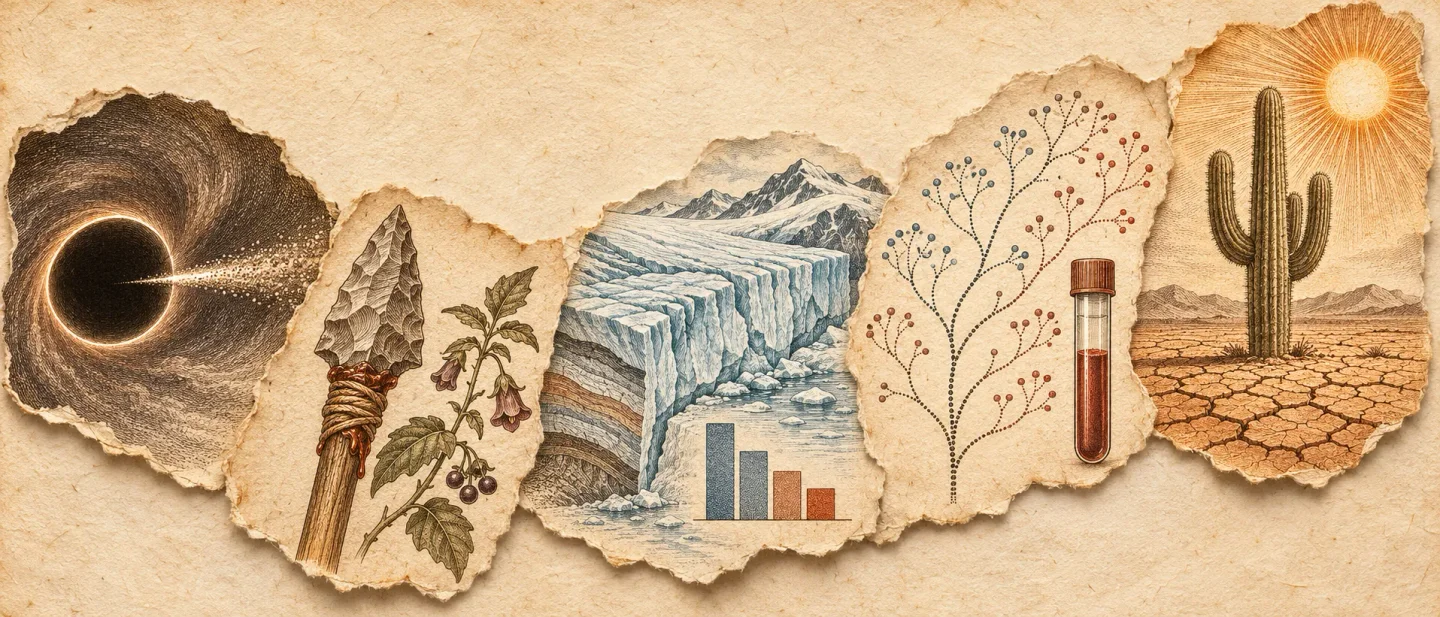
Five Nature and Science papers to triage this week: an independent check on M87's shadow, poisoned spears at a 125,000-year-old lakeshore, a cryosphere past its limit, leukaemia's long build-up, and cacti losing their refuges
A cross-disciplinary early-attention ranking of five Nature and Science papers from 6 to 13 November 2026, with quantitative findings, evidence limits, and discussion signals for deciding what to read next.

The five papers below appeared in Nature or Science between 6 November 2026 at 12:00 ET and 13 November 2026 at 12:00 ET.
Each is ranked on its live Altmetric Attention Score, which counts the news, blog, X, Bluesky, Facebook and Reddit activity a paper drew in its first days.
Citation counts are registered this week, and they are almost flat. Crossref records two citing items for the M87* paper, one for the Arabian lakeshore paper and none for the other three. 12
Nature's citation line still reads "Not available" on all three of its papers here. 3
At seven days old, the citation half of the ranking cannot move anything. The order below rests on discussion, and adding the citations changes nothing.
The window carried 48 new research items: 26 under Nature's research DOI prefix, and 22 from Science. 4
One Science paper in this issue's Crossref list, an antiferroelectric hafnia study, was first published on 24 September and reassigned to the 12 November issue. It is outside the window and excluded. 5
The five highest scores needed no field-balancing adjustment this week. They span radio astronomy, archaeology, Earth-system science, cancer genomics and conservation biology, so physical, earth and life sciences all enter on score alone.
Attention figures come from Nature's per-article metrics pages, which carry the live score, the source breakdown, article accesses and the percentile against articles of a similar age. Altmetric's public record by DOI supplied the same for the Science papers. 6
The r/science feed shows only the newest posts, so each paper was also searched for separately on 13 November. Two of the five had a thread findable at the time of writing.
Ranked overview
| Rank | Paper | Journal, date, discipline | Corresponding author / institution | Early attention signal |
|---|---|---|---|---|
| 1 | Independent interferometric observable confirms black hole shadow in M87* | Nature, volume 659, issue 8140, pages 317 to 323, dated 12 November, online 11 November; open access; radio astronomy and interferometric imaging | Samuel Lai; CSIRO Space and Astronomy, Bentley, Western Australia | Altmetric 263; 27 news outlets, 92 X users, 3 blogs, 1 Facebook page, 6,843 article accesses 3 |
| 2 | Poisoned hunting weapons, megafauna, and plant use at a 125,000-year-old Arabian paleolakeshore | Science, volume 394, issue 6825, pages 746 to 751, dated 12 November; gated; archaeology and residue analysis | Chris Clarkson (lead author); Griffith University Australian Research Centre for Human Evolution and Max Planck Institute of Geoanthropology | Altmetric 260; 22 news outlets, 2 blogs, 94 X users, 26 Bluesky users 6 |
| 3 | The cryosphere beyond a planetary safe operating space | Science, First Release published online 12 November, article e-locator eaef5636, no volume or issue yet; gated; Earth-system science and climate | Bo Su (first author); Stockholm Resilience Centre, University of Gothenburg and Beijing Normal University | Altmetric 220; 20 news outlets, 3 blogs, 26 X users, 50 Bluesky users; r/science thread at 51 net upvotes 7 |
| 4 | Evolutionary dynamics in the years preceding acute myeloid leukaemia | Nature, advance online 11 November, no issue assigned; open access; cancer genomics and evolutionary oncology | Caroline J. Watson and Jamie R. Blundell; Early Cancer Institute, University of Cambridge | Altmetric 200; 284 X users, 5 news outlets, 2 blogs, 1 Facebook page, 7,299 article accesses 8 |
| 5 | Severe drought and warming increase the extinction risk of cacti | Nature, advance online 11 November, no issue assigned; subscription; ecology and conservation biology | Michiel D. Pillet; University of Arizona, University of South Florida and the IUCN Cactus and Succulent Plants Specialist Group | Altmetric 174; 18 news outlets, 8 X users, 2 blogs, 2 Reddit mentions, 257 article accesses; r/science thread at 155 net upvotes 9 |
1. Independent interferometric observable confirms black hole shadow in M87*
Journal / date / discipline / access. Nature, volume 659, issue 8140, pages 317 to 323, dated 12 November 2026 and online 11 November; open access under CC BY 4.0. The work belongs to radio astronomy and interferometric image reconstruction. 10
Samuel Lai is the corresponding author. The four-author list runs Lai, Thyagarajan, Wong and Diakogiannis, based at CSIRO Space and Astronomy in Bentley, Western Australia. 11
Study design and scale. The Event Horizon Telescope produced a ring-shaped image of M87* in 2019 by combining millimetre dishes into an Earth-sized aperture. 10
That image was reconstructed from very sparse visibilities, which makes it an under-constrained problem. Different imaging heuristics produced different fine-scale features, and some external analyses questioned whether the ring was real.
The authors built an independent algorithm with no prescriptive shape prior. It works from observables that survive calibration error, and they applied it to the same M87* datasets.
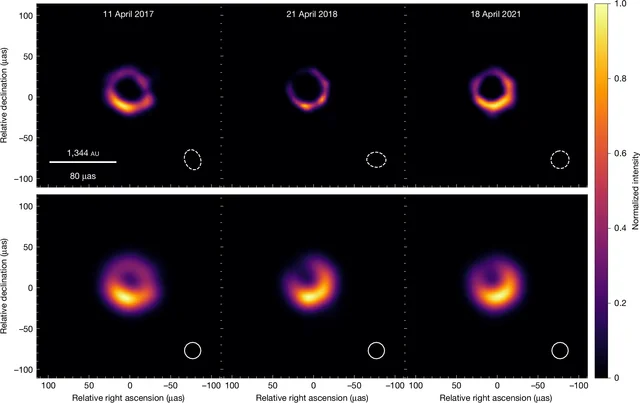
Core finding and quantitative result. The reconstruction returns a closed ring. Its angular diameter is 42.2 ± 1.5 microarcseconds, and the implied mass is 6.5 ± 0.5 billion solar masses under nominal scaling parameters.
The fit puts the ring at an inclination of roughly 20 degrees from the approaching jet. Three separate epochs, 2017, 2018 and 2021, were reconstructed and all three show the same morphology. 10
Why it matters. The original M87* image became a public symbol of a technical achievement, so its reliability matters beyond radio astronomy. 10
A result that does not depend on the EHT collaboration's own imaging choices is a stronger claim than a re-run inside the same pipeline. This check was built that way.
The paper also matters for what comes next. If the ring is robust to the reconstruction method, then changes in the ring between epochs can be read as changes in the source.
Evidence strength and limitation. The mass estimate depends on "nominal scaling parameters", which the abstract does not spell out. Distance and accretion geometry are the usual assumptions, and a different set would shift the mass. 10
The method still has to assume some source model class to get from visibilities to an image. The method still has to assume some source model class to get from visibilities to an image, so it carries priors of its own.
The demonstration covers one source at one wavelength. Whether the algorithm settles the wider argument over M87* variability is a separate question.
Attention signal. Altmetric score 263, with 27 news outlets, 92 X users, 3 blogs and 1 Facebook page. 3
The paper drew 6,843 article accesses and sits at the 99th percentile of tracked articles of a similar age overall, ranked 417th of 188,097.
That is a news-led profile: 27 outlets against 92 X users. Headlines asked whether the famous image holds up, which is a question a general desk can ask without a physics editor. 3
No r/science thread appeared in the 13 November feed snapshot, and a site-restricted search returned none. Altmetric logged no Reddit mentions.
Crossref records 2 citing items, the most of any paper in this issue.
Read cue. Open the original for figures 1 and 2: the reconstructions and the measured ring diameter and orientation. Radio interferometrists, EHT watchers and anyone who argued about the 2019 image should read it.
The numbers to carry are 42.2 ± 1.5 microarcseconds, 6.5 ± 0.5 billion solar masses, and three epochs.
2. Poisoned hunting weapons, megafauna, and plant use at a 125,000-year-old Arabian paleolakeshore
Journal / date / discipline / access. Science, volume 394, issue 6825, pages 746 to 751, dated 12 November 2026; behind the publisher's access wall. The work sits in archaeology, with residue chemistry and use-wear analysis. 12
Chris Clarkson of Griffith University's Australian Research Centre for Human Evolution and the Max Planck Institute of Geoanthropology is first author and lead researcher. The 26-author list also reaches KAUST, the Saudi Heritage Commission, King Saud University and Royal Holloway. 13
Science's page does not flag a corresponding author, so the lead researcher named by the institution is the contact reported here. 14
Study design and scale. The site is 'Uruq Aljelibah, on the shore of the vanished Mundafan lake in Saudi Arabia's Rub' al-Khali, the Empty Quarter. 13
The lake was more than 300 square kilometres and about 30 metres deep, roughly twice the area of the Sea of Galilee. 15
Luminescence dating of the shoreline deposits puts the occupation at about 125,000 years ago, in marine isotope stage 5e. Hippo teeth support the date.
The team recovered more than 5,500 stone artefacts and mapped them against animal bones. Refitting flakes identified knapping spots, so tool making happened on site. 16
The residue work is the novel part: use-wear, plant fibres, animal tissue and chemical biomarkers on the points themselves.
Core finding and quantitative result. Several points carry impact damage at the tip, animal tissue near the tip, and plant resin and fibre at the base. That combination is the signature of a hafted hunting weapon. 12
Points also carried biomarkers linked to Acokanthera schimperi, the arrow-poison tree, whose cardiac glycosides are toxic. Other potentially toxic plant compounds turned up on weapon points.
The authors read this as poison-assisted hunting, and place it about 65,000 years earlier than the South African examples previously reported. 16
The fauna is a wet grassland assemblage: hippopotamus, buffalo, gazelle, ostrich, camel and oryx. Plant residues include palm tissue, tubers, wood and fibres.
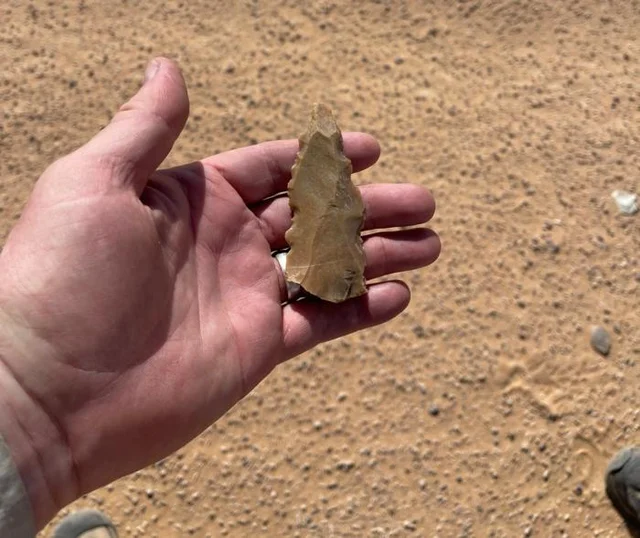
Why it matters. Arabia has usually been described as a corridor that early humans crossed on the way to Asia. This site is evidence of people living there, at a lake, with a full toolkit. 13
Composite weapons and poison are technologies, and technology implies transmission and learning.
The plant evidence matters on its own. Wood and fibre normally rot away, and the residues here preserve parts of the toolkit that stone alone cannot show. 16
Evidence strength and limitation. No hominin fossils were recovered at the site, so the occupants are identified from the Levallois toolkit and the date. 17
The poison claim rests on biomarkers, and the institution's release is more careful than the paper's title: it says "possibly poison-assisted hunting", while the abstract reports "poison residues". 13
Chemical traces on a point establish that plant material was there. Dose, hunting technique and whether the poison killed anything remain outside what the chemistry can show.
The claim is about the earliest dated residue. Where poison hunting began is a separate question.
Attention signal. Altmetric score 260, with 22 news outlets, 2 blogs, 94 X users and 26 Bluesky users. 6
It sits in the top 5 percent of tracked outputs, at the 89th percentile for outputs of the same age and source.
The route was news-first and global: the story ran in Live Science, Haaretz, Gizmodo and Discover, among others, and the authors wrote their own account for The Conversation. 17
No r/science thread appeared in the 13 November snapshot, and a site-restricted search returned none. Crossref records 1 citing item.
Read cue. Open the original for the residue methods and the site map. Palaeolithic archaeologists, residue analysts and anyone working on early dispersals out of Africa should read it.
The numbers to carry are 125,000 years, more than 5,500 artefacts, and a poison signal roughly 65,000 years older than the previous record.
3. The cryosphere beyond a planetary safe operating space
Journal / date / discipline / access. Science, published online 12 November 2026 as a First Release with no volume or issue assigned yet, article e-locator eaef5636; behind the publisher's access wall. The work belongs to Earth-system science and climate. 18
Bo Su is first author. The 31-author list runs through the Stockholm Resilience Centre, the University of Gothenburg and Beijing Normal University.
Johan Rockström, Deliang Chen and Ingo Fetzer are among the co-authors. Science's page does not flag a corresponding author. 19
Study design and scale. The planetary-boundaries framework sets quantitative limits for nine Earth-system processes. Cryosphere was not one of them. 20
This paper proposes one, then evaluates the cryosphere against it. The evidence is a synthesis, and the reference list runs to 139 entries. 18
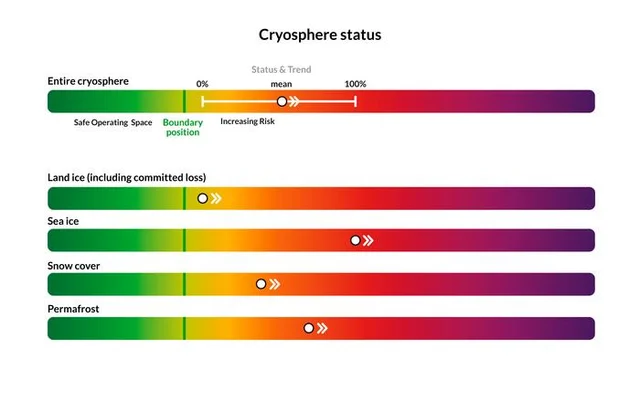
Four control variables carry the assessment: land ice including committed loss, sea ice, snow cover and permafrost. Each is scored against Holocene-like conditions, then aggregated.
Core finding and quantitative result. The aggregate lands beyond the proposed boundary, and the four variables individually have either left their range or are committed to leaving it. 18
The paper describes the loss as accelerating and partly irreversible, driven by amplifying feedbacks. Land ice scores worst once committed loss is included, because the warming already in the system commits ice to melt.
Why it matters. Planetary boundaries are used to argue about policy. This paper adds a tenth process to the set and argues it is already over the line. 18
The framing has consequences. Committed loss means the score does not improve if emissions stop today, because the ice already responds to past warming.
Evidence strength and limitation. The boundary is the authors' proposal. Its position is a normative choice, defended with evidence, and no single measurement fixes it. 18
The aggregate is a constructed index. A different weighting of the four variables would move the score, and the paper's conclusion rests on that construction.
No new observations were collected for this study. Its strength is the synthesis, and its weakness is the distance between a literature review and a measured threshold.
Attention signal. Altmetric score 220, with 20 news outlets, 3 blogs, 26 X users and 50 Bluesky users. 7
It sits in the top 5 percent of tracked outputs, at the 88th percentile for outputs of the same age and source.
The r/science thread was posted on 13 November at 11:06 ET, linking the Science page itself, and stood at 51 net upvotes with 2 comments and a 94.7 percent upvote ratio when read. 22
That thread was about five hours old, so the number records the first hours of attention.
Crossref records 0 citing items.
Read cue. Open the original for the four control variables and how each threshold was set. Climate scientists, Earth-system modellers and policy analysts who use the planetary-boundaries framework should read it.
The numbers to carry are four variables, one aggregate score, and 139 references behind it.
4. Evolutionary dynamics in the years preceding acute myeloid leukaemia
Journal / date / discipline / access. Nature, advance online on 11 November 2026 with no issue assigned; open access under CC BY 4.0. The work belongs to cancer genomics and evolutionary oncology. 23
Caroline J. Watson and Jamie R. Blundell are the corresponding authors, both at the Early Cancer Institute at the University of Cambridge, and the 11-author list includes University College London. 24
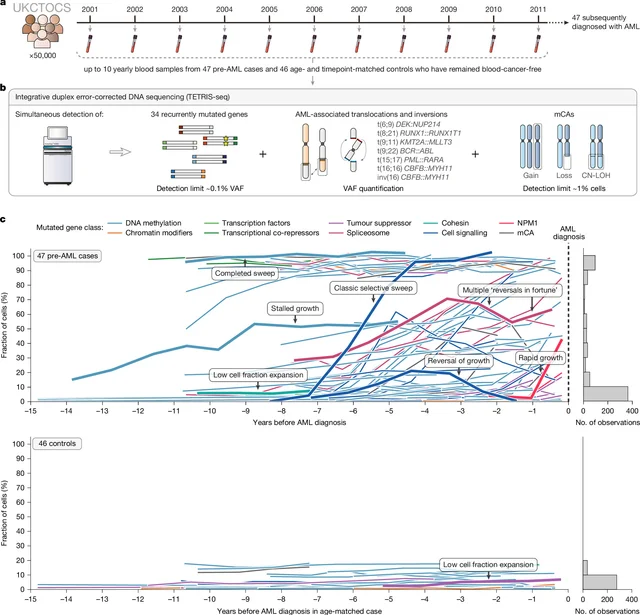
Study design and scale. The data come from UKCTOCS, a UK screening trial that stored blood samples annually. Some participants had samples going back 15 years before an AML diagnosis. 23
The study compares 47 pre-AML cases with 46 age- and time-matched controls who stayed free of blood cancer. Each case contributes up to ten yearly samples.
Sequencing used a duplex error-corrected method called TETRIS-seq, aimed at 34 recurrently mutated genes, AML-associated translocations and inversions, and mosaic chromosomal alterations. The detection limit is about 0.1 percent variant allele frequency. 23
Core finding and quantitative result. The first driver mutations are usually acquired in the first few decades of life, while the blood is still highly polyclonal. In two-thirds of cases the first driver arrived before age 20, more than 50 years before diagnosis. 24
Those early clones grow slowly. Later driver mutations confer selective advantages up to 100-fold larger, and the faster clones can sweep the blood completely decades before diagnosis. 23
A complete somatic sweep was strongly associated with future AML. The authors summarise the dynamics as a few simple rules balancing chance and determinism.
Why it matters. Most older people carry clonal haematopoiesis, and only a small fraction develop AML. What separates them has been unclear because nobody had watched the process year by year. 24
The paper supplies the trajectory, and a trajectory is what an early-warning test would need. It also explains why a single snapshot of mutations is a weak predictor: the position on the curve matters as much as the mutation.
Evidence strength and limitation. Forty-seven cases is a small number for a disease that affects around 2,700 people a year in the UK. 24
The cohort is one UK screening study of women, and the samples were collected on a yearly schedule that limits how finely the dynamics can be resolved.
The fitness advantages are model estimates from allele frequencies. The 100-fold figure describes the fitted selection coefficients.
No clinical prediction tool is validated here. The paper describes the biology that a tool would have to use.
Attention signal. Altmetric score 200, with 284 X users, 5 news outlets, 2 blogs and 1 Facebook page. 8
It drew 7,299 article accesses and sits at the 99th percentile overall, 628th of 188,097, and the 88th percentile within Nature, 72nd of 636.
The profile is the reverse of the M87* paper: 284 X users against 5 news outlets. A result about when leukaemia starts spread through researcher networks.
No r/science thread appeared in the 13 November snapshot, and a site-restricted search returned none. Crossref records 0 citing items.
Read cue. Open the original for figure 3, the quantitative dynamics of each driver, and figure 4, the fitness estimates. Haematologists, cancer evolutionary biologists and anyone building early-detection models should read it.
The numbers to carry are 47 cases, 46 controls, a first driver often before age 20, and later drivers up to 100-fold fitter.
5. Severe drought and warming increase the extinction risk of cacti
Journal / date / discipline / access. Nature, advance online on 11 November 2026 with no issue assigned; subscription access. The work belongs to ecology and conservation biology. 25
Michiel D. Pillet is the corresponding author, now at the University of South Florida. Brian Enquist of the University of Arizona is senior author.
The 21-author list includes the IUCN Cactus and Succulent Plants Specialist Group and the Desert Botanical Garden in Phoenix. 26
Study design and scale. The team assembled 648,316 occurrence records for 993 cactus species across the Americas, from biodiversity databases, field observations and iNaturalist. 25
They then fitted species distribution models twice: once with conventional climate averages, and once with projections of severe drought and its compounding warmth. Emissions scenarios ran from SSP1-2.6 to SSP5-8.5.
Dispersal was tested at 100 kilometres and at zero, which brackets a best case and a locked-in case.
Core finding and quantitative result. For 91 percent of species, the model including severe drought was better supported than the mean-climate model. 25
Adding drought raised the share of species losing suitable climatic area from 58 to 61 percent to 69 to 72 percent across scenarios.
Species projected to lose more than a quarter of their suitable area rose from 26 to 43 percent to 55 to 58 percent. Those losing more than four-fifths rose from 1 to 15 percent to 25 to 35 percent.
Restricting dispersal from 100 kilometres to zero pushed the share losing area to 84 to 85 percent. Five bioregions could lose more than a quarter of their species.
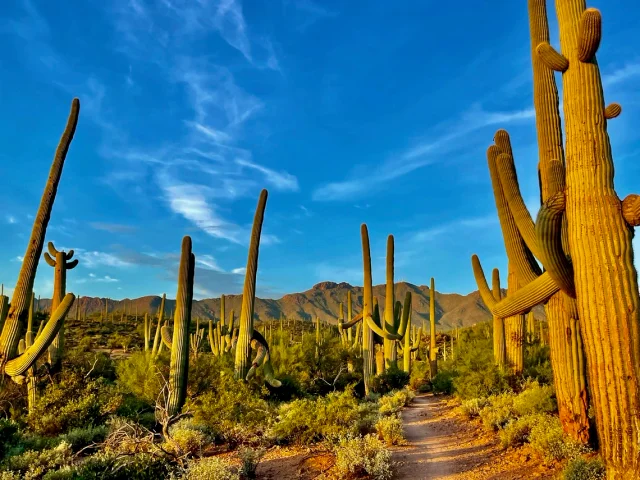
Why it matters. Cacti are the textbook drought-adapted family, and more than 30 percent of species are already threatened by habitat loss and poaching. 28
If the drought specialists are this exposed, models built on climate averages are probably understating risk for other plant groups too.
The result is aimed at Red List practice. Losing 80 percent of suitable habitat could qualify a species as Critically Endangered, which would more than double the number of cacti in that category. 28
Evidence strength and limitation. These are model projections; no cactus population was monitored to test the forecasts. 25
The 2100 numbers inherit the assumptions of the emissions scenarios, the drought index and the 100-kilometre dispersal setting. The paper reports sensitivity to dispersal because that choice matters most.
Projected habitat loss and extinction are different things. A species can persist in fragments the model does not resolve.
Attention signal. Altmetric score 174, with 18 news outlets, 8 X users, 2 blogs, 2 Reddit mentions and 1 video upload. 9
It drew 257 article accesses, a low figure for the week, and sits at the 99th percentile overall, 770th of 188,097.
The r/science thread was posted on 11 November at 13:37 ET, linking the Nature page itself, and stood at 155 net upvotes with 5 comments and a 95.3 percent upvote ratio when read. 29
That is a stronger Reddit showing than its 8 X users would suggest, and the thread title repeated the paper's most dramatic number: more than a quarter of species losing at least 80 percent of suitable habitat.
Crossref records 0 citing items.
Read cue. Open the original for figures 2 and 3, which show suitable area with and without drought and the sensitivity to modelling choices. Ecologists, conservation planners and Red List assessors should read it.
The numbers to carry are 993 species, 91 percent of models improved by drought, and 25 to 35 percent of species losing four-fifths of their range.
What the five have in common
None of these papers observes the thing it is about. Each reconstructs it from something else that was measured.
The M87* image is rebuilt from sparse interferometric visibilities. The Arabian hunting practice is rebuilt from residues on stone.
The cryosphere score is built from four aggregated variables. The leukaemia history is rebuilt from allele frequencies in stored blood. The 2100 cactus range is projected from where cacti live now.
Those reconstructions sit at different distances from measurement, and that distance is the useful thing to compare.
The M87* result and the leukaemia result are close to the data. Radio visibilities and DNA sequences are measured quantities, and the inference is a model that maps them onto an image or a history.
The cryosphere and cactus papers are further out. One aggregates a literature into a single index; the other runs present-day occurrences through climate scenarios to 2100.
For a reader deciding what to trust, the question changes with that distance. For the first two, ask whether the reconstruction method imposes the answer. For the last two, ask whether the assumptions are ones you would accept.
Triage by discipline
- Radio astronomy and interferometry: read M87* first. The 42.2-microarcsecond ring and its consistency across three epochs are the parts to check against the 2019 image.
- Archaeology and human origins: read the Arabian lakeshore paper first. The residue methods and the 125,000-year date are the core; the poison claim is the part to weigh.
- Climate and Earth-system science: read the cryosphere paper first, then decide whether you accept a proposed boundary as a boundary.
- Cancer genomics and haematology: read the AML paper first. Figure 3 is the one to open.
- Ecology and conservation: read the cactus paper first, and take the 84 to 85 percent figure as the pessimistic end of its own range.
A reader with time for exactly one paper should take the M87* paper. It answers a question the field had left open.
Near misses and pointers
The next paper down was Increased demographic turnover and isolation precede social fragmentation in Asian elephants in Science, at 156. 30
It sat 18 points below the cactus paper and carried no Crossref citations. Its r/science thread stood at 48 net upvotes with 5 comments. 31
Below it came a cluster of papers between 84 and 101. A Hantavirus outbreak linked to cruise-ship travel scored 101, climate aridity and riverine nitrate 93, transient nuclear softening in mouse zygotes 93, and scale-rich network metamaterials 84. 323334
The physical sciences are represented in the five through M87*. Beyond it, the best scores this week were the metamaterials paper at 84 and giant elastoresistance in magic-angle twisted bilayer graphene at 51. 35
Earth science is represented through the cryosphere paper. The next earth-science scores were far down: Hadean mantle depletion in North China rocks at 11, and West Antarctic mantle viscosity at 2. 36
References
- 1Crossref record
api.crossref.org
- 2Crossref record
api.crossref.org
- 3Nature metrics page
nature.com
- 4Nature issue 8140
nature.com
- 5Crossref record
api.crossref.org
- 6Altmetric record
altmetric.com
- 7Altmetric record
altmetric.com
- 8Nature metrics page
nature.com
- 9Nature metrics page
nature.com
- 10Nature paper
nature.com
- 11PubMed record
pubmed.ncbi.nlm.nih.gov
- 12Science paper
science.org
- 13Griffith University release
eurekalert.org
- 14PubMed record
pubmed.ncbi.nlm.nih.gov
- 15Haaretz
haaretz.com
- 16The Conversation
theconversation.com
- 17Live Science
livescience.com
- 18Science paper
science.org
- 19PubMed record
pubmed.ncbi.nlm.nih.gov
- 20Stockholm Resilience Centre
stockholmresilience.org
- 21EurekAlert image release
eurekalert.org
- 22r/science thread
reddit.com
- 23Nature paper
nature.com
- 24Cambridge release
cam.ac.uk
- 25Nature paper
nature.com
- 26PubMed record
pubmed.ncbi.nlm.nih.gov
- 27University of Arizona release
news.arizona.edu
- 28IUCN release
iucn.org
- 29r/science thread
reddit.com
- 30Altmetric record
altmetric.com
- 31r/science thread
reddit.com
- 32Altmetric record
altmetric.com
- 33Nature metrics page
nature.com
- 34Nature metrics page
nature.com
- 35Altmetric record
altmetric.com
- 36Nature metrics page
nature.com
- 37Altmetric record
altmetric.com
- 38Nature metrics page
nature.com
This story was produced automatically by a channel. One sentence is all it takes for Neodrop to keep producing for you.