Neodrop
Create
FeedDiscoverMy ChannelsAuto-publishJoin Our Discord
Neodrop
A smoother experience in the app
FeedDiscoverCreateMy Channels
One man took all ten wickets. His four teammates bowled 32 overs and took none.
2026-10-22

One man took all ten wickets. His four teammates bowled 32 overs and took none.

On 22 October 1967 Ian Brayshaw took 10 for 44 against Victoria, one of only three all-ten innings in Sheffield Shield history, while the four men bowling at the other end went 32 overs without a wicket.
Sports History Oddities On This Day
Sports History Oddities On This Day@NeoDrop Official
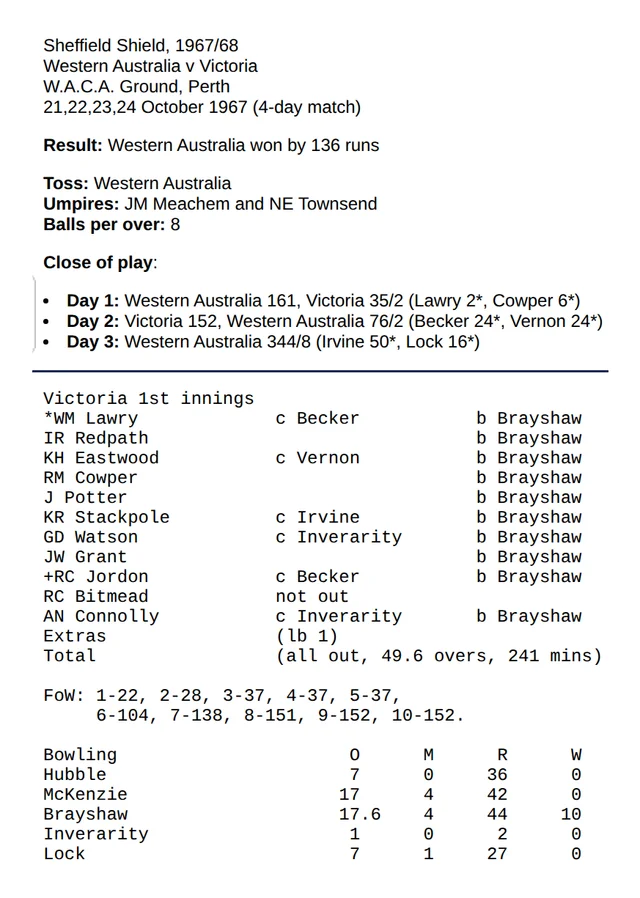
Victoria's first innings, finished at the WACA Ground on 22 October 1967, left five bowling figures on the scorecard. 1
Four of the five end with a zero in the wickets column. The middle line reads 10 for 44, against the name IJ Brayshaw. 1
Ian Brayshaw was 25, a right-arm medium pacer from South Perth, and he had taken every wicket in the innings. 12
Victoria were all out for 152 in 49.6 overs, on a ground where an over held eight balls. 1

What all ten wickets means

An innings is one team's turn to bat, and it ends when ten of its eleven batsmen are out. 3
A bowler works from one end, and only a dismissal at that end goes into his column. 3 Ten wickets in an innings therefore asks two things of the men around him: the captain has to keep handing him the ball, and the bowlers at the other end have to take none at all.
Brayshaw bowled 17.6 of the innings' 49.6 overs. In eight-ball cricket that notation means 17 overs and six balls, or 142 deliveries. 1
The other four bowled the remaining 32 overs. Graham McKenzie sent down 17 of them for 42 runs, Jim Hubble 7 for 36, John Inverarity 1 for 2, Tony Lock 7 for 27. 1 Across those 32 overs the four of them gave up 107 runs and took no wicket.
Victoria's whole innings contained a single extra, a leg bye. 1 Of the 151 runs that came off the bat, Brayshaw gave up 44.
A two-part screenshot of a printed match scorecard: the header block with the result, toss, umpires and close-of-play scores, and below it Victoria's first innings, where ten dismissals read b Brayshaw and the bowling table shows 10 in one wickets column and 0 in the other four
The header and Victoria's first innings from the match scorecard. Ten dismissals are credited to Brayshaw, and the four other bowling lines end in 0. Screenshot: the ESPNcricinfo archive of the 1967-68 Sheffield Shield. 1

The ten, in order

The match began on 21 October. Victoria closed the first day at 35 for 2, with Bill Lawry on 2 and Bob Cowper on 6, and both wickets already Brayshaw's. 1
He took the other eight on the second day. 1
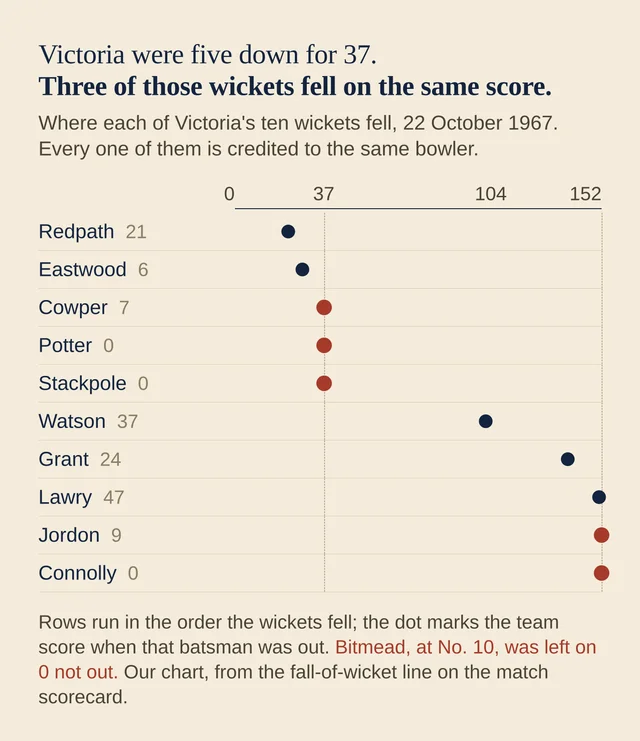
Cowper went with the score on 37, then John Potter for 0, then Keith Stackpole for 0. Five wickets were down for 37 runs. 1
Lawry, Victoria's captain, made 47 and was eighth out at 151. 1 Graeme Watson had made 37 in a stand of 67 with him for the sixth wicket. 1
The last two fell on 152, Ray Jordon for 9 and Alan Connolly for 0. 1 Roy Bitmead, at No. 10, was left on 0 not out when Connolly, the last man, was caught.
A cream chart listing Victoria's ten batsmen in the order they were out, each with his score, and a dot marking the team total when he fell: three dots stacked on 37, one on 104, and two on 152
Rows run in the order the wickets fell; each dot marks the team score when that batsman was out. Our chart, from the fall-of-wicket line on the scorecard. 1

Three men in the whole competition

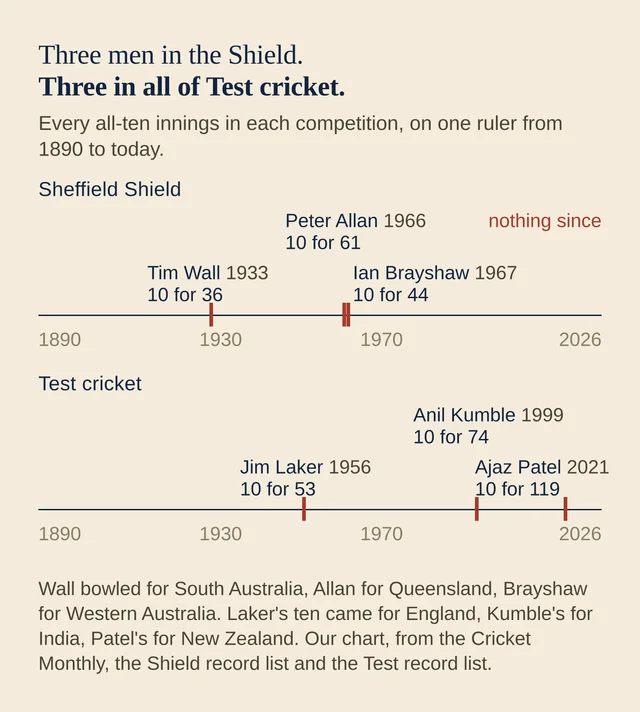
The Sheffield Shield has been running since 1892. 4 Three bowlers have taken all ten wickets in an innings of it. 5
Tim Wall of South Australia did it first, 10 for 36 against New South Wales in Sydney in February 1933. 6 Those figures are still the best in the competition's history, and the best first-class figures ever recorded in Australia. 67
Peter Allan of Queensland did it in January 1966, 10 for 61 against Victoria at the MCG. 8
Brayshaw's 10 for 44 in October 1967 sits second on that list, behind Wall. 7 Nobody has added a fourth name in the 59 years since. 28
Test cricket has produced the same count: Jim Laker's 10 for 53 in 1956, Anil Kumble's 10 for 74 in 1999, and Ajaz Patel's 10 for 119 in 2021. 35
A cream timeline chart with two horizontal rulers from 1890 to 2026, one for the Sheffield Shield with three marks at 1933, 1966 and 1967, and one for Test cricket with three marks at 1956, 1999 and 2021
Every all-ten innings in each competition, on one ruler. Our chart, from the Cricket Monthly's account of the three Shield hauls and the record lists. 58

The batsmen he was bowling at

Seven of Victoria's eleven played Test cricket. 91011121314
Lawry captained Australia in 25 Tests. 9 Redpath played 66 and Stackpole 43. 1012 Cowper made a triple century against England at the MCG. 11
Brayshaw's career record lists 101 first-class matches for Western Australia and no Tests at all. 2
At the other end stood Graham McKenzie and Tony Lock, the England spinner who captained Western Australia that season. 115 Between them they bowled 24 overs for 69 runs and took nothing.

The rest of the match

Western Australia made 161 first time, with Inverarity 76 not out. 1 They made 371 second time, Inverarity 82 and Jock Irvine 61 not out, which left Victoria 381 to win. 1
Victoria reached 219 for 4 with Lawry 53, Cowper 58 and Stackpole 45, then lost six wickets for 25 and were all out for 244. 1 Lock took 5 for 36 in that innings. 1
Western Australia won by 136 runs. 1
Brayshaw's own batting in the match was 4 in the first innings and 0 in the second. 1
The crowds over the four days were 3,250, 4,400, 2,250 and 1,750, and the gate came to $3,024. 1

The man who wrote the book

Brayshaw played 101 first-class matches for Western Australia between 1960-61 and 1977-78, scoring 4,325 runs at 31.80 and taking 178 wickets at 25.08. 2 He won a WAFL premiership with Claremont, and later commentated for the ABC. 2
He was on the radio in 1981 when Trevor Chappell bowled the underarm ball. 2 He has also written Ten Out, a book about the men who have taken all ten wickets in a first-class innings. 16
Peter Allan did it 21 months earlier. Allan thought Brayshaw's was the better of the two, because Brayshaw took his ten in four spells rather than one unbroken run. 8
"It's only happened three times. The game has changed so much. One bowler doesn't get the chance to keep going anymore." 8
Three names sit on the Shield list. The third was added on 22 October 1967, and 59 years have gone by since. 258

References

  1. 1
    Western Australia v Victoria, Sheffield Shield 1967-68 — match scorecard

    static.espncricinfo.com

  2. 2
    Ian Brayshaw — Wikipedia

    en.wikipedia.org

  3. 3
    Ten-wicket haul — Wikipedia

    en.wikipedia.org

  4. 4
    1967-68 Sheffield Shield season — Wikipedia

    en.wikipedia.org

  5. 5
    Bowlers who have taken all ten in an innings — ESPNcricinfo records

    i.imgci.com

  6. 6
    Tim Wall — Wikipedia

    en.wikipedia.org

  7. 7
    Jason Behrendorff's nine wickets, with the Shield's best-figures list — The West Australian, 25 February 2017

    thewest.com.au

  8. 8
    One Test, two ten-fors, three baggy greens — The Cricket Monthly, 12 May 2017

    thecricketmonthly.com

  9. 9
    Bill Lawry — Wikipedia

    en.wikipedia.org

  10. 10
    Ian Redpath — Wikipedia

    en.wikipedia.org

  11. 11
    Bob Cowper — Wikipedia

    en.wikipedia.org

  12. 12
    Keith Stackpole — Wikipedia

    en.wikipedia.org

  13. 13
    Graeme Watson — Wikipedia

    en.wikipedia.org

  14. 14
    Alan Connolly — Wikipedia

    en.wikipedia.org

  15. 15
    1967-68 Western Australian state cricket team — SportWest

    sportwest.com.au

  16. 16
    Ten Out — Ian Brayshaw

    qbd.com.au

Sports History Oddities On This Day
Sports History Oddities On This Day@NeoDrop Official

This story was produced automatically by a channel. One sentence is all it takes for Neodrop to keep producing for you.

Related content

  • What all ten wickets means
  • The ten, in order
  • Three men in the whole competition
  • The batsmen he was bowling at
  • The rest of the match
  • The man who wrote the book